🌍Extraordinary Mission Across the Christian
World
Mor Jacob, the universal bishop, embarked on one of the most remarkable missionary journeys in
Church history. For thirty-five years, he traveled continuously, visiting Orthodox communities,
encouraging the faithful, ordaining clergy, and consecrating bishops. His journeys took him across
vast territories, often traveling in disguise to avoid arrest and execution by Byzantine authorities
who sought to capture him.
His mission encompassed an astonishing geographical scope, demonstrating both his physical endurance
and his unwavering commitment to preserving the Orthodox Church. He visited and ministered to
communities throughout the Christian world, bringing hope to persecuted believers and ensuring the
continuation of apostolic succession.
Syria
Egypt
Armenia
Cappadocia
Cilicia
Isauria
Pamphylia
Lycaonia
Lycia
Phrygia
Caria
Asia Minor
Cyprus (Island)
Rhodes (Island)
Chios (Island)
Mitylene (Island)
Mesopotamia
Persia
Throughout these extensive travels, Mor Ya'qub visited churches, instructed believers, and
encouraged the Orthodox faithful to remain steadfast in the face of persecution. He celebrated the
Divine Liturgy, administered the sacraments, and taught the true faith. His presence brought renewed
hope to communities that had been without episcopal oversight for years, sometimes decades.
Despite his constant travels and the dangers he faced, Mor Ya'qub never forgot his monastic roots.
He returned quite a few times to his monastery, maintaining his connection to the ascetic life even
while engaged in this extraordinary episcopal ministry. This balance between contemplation and
action, between monastic withdrawal and pastoral engagement, characterized his entire ministry.
🛡️Champion of Orthodox Faith
One of the most famous Church Fathers for his godliness and piety, Mor Ya'qub Burdono stands as the
greatest apostolic fighter in support of the true faith, having attained the summit of religious and
austere asceticism. In one of the darkest periods of Church history, when the very survival of
Orthodox Christianity hung in the balance, God raised up this brave monk to preserve the jewel of
the Apostolic faith.
Following the Council of Chalcedon in 451 AD, a council whose resolutions the Syriac Orthodox Church
rejected as a deviation from the doctrine received from the righteous Apostles and holy Fathers,
persecution fell upon those who maintained the ancient faith. The Byzantine state, having adopted
the Chalcedonian formula, began a systematic campaign to eradicate non-Chalcedonian Christianity.
Bishops were killed, others were exiled, many died from the severity of persecution, and still
others were driven from their sees.
By the middle of the sixth century, the situation had become critical. Only three bishops remained
in the entire Syriac Orthodox Church. The hierarchical structure that ensures apostolic succession
and sacramental validity was on the verge of complete extinction. The Byzantine authorities believed
that if they could eliminate the remaining bishops, the Orthodox Church would cease to exist, and
all would be forced to accept Chalcedonian doctrines.
In this crucial moment, when human hope seemed lost, God sent to the Church a brave man who would
become one of the greatest leaders in Syriac Orthodox history—Mor Ya'qub Burdono, known in Greek as
Jacob Baradaeus. He protected the Syriac Orthodox Church against the concerted attempts of its
enemies to eradicate it, and encouraged its followers to preserve the precious Orthodox faith that
they had received from the righteous Apostles and Fathers.
The name "Burdono" (meaning "clothed in rags" or "ragged") came from his rough garments which became
like saddle-cloth through his constant travels and ascetic lifestyle. This humble monk, dressed in
rags, would become the savior of the Orthodox Church.
📖Early Life and Monastic Formation
Mor Ya'qub was born at Tall Mawzalt (ܬܶܠ ܡܰܘܙܰܠܬ݂, now Verensehir in modern Turkey), the son of a
priest named Theophilus bar Manu. Growing up in a priestly household, he was raised in an atmosphere
of devotion and learning. While still young, he felt the call to monastic life and entered the
Monastery of Fsilta (ܦܣܺܝܠܬܳܐ) in the neighborhood of his homeland.
At this monastery, the young Ya'qub proved to be an exceptional student. He mastered both the Syriac
and Greek languages—a rare accomplishment that would prove crucial for his future ministry. He
penetrated deeply into religious books and theological science, developing a comprehensive
understanding of patristic theology and the controversies of his age. His study was balanced with
rigorous asceticism, and he became known for his piety and for working miracles even before his
episcopal consecration.
Ya'qub emerged from his monastic formation as a great scholar, a successful preacher, and a capable
theologian. His rough lifestyle and worn garments became his trademark—a visible sign of his
complete dedication to Christ and renunciation of worldly comfort. The monks and faithful began
calling him "Burdono" because his clothing had become so worn and patched that it resembled
saddle-cloth.
👑Journey to Constantinople
In 528 AD, Ya'qub journeyed to Constantinople, the capital of the Byzantine Empire. This journey
would prove to be providential. He was received with great honor by Empress Theodora, a remarkable
woman who was the daughter of a Syrian priest from Mabug (Manbej) and the wife of Emperor Justinian
I.
Empress Theodora, though married to the Chalcedonian Emperor, secretly served the non-Chalcedonian
bishops who were in distress. These were the Syrian and Coptic bishops who were being persecuted,
imprisoned, and executed for their refusal to accept the Chalcedonian formula. Understanding the
theological issues at stake and sympathizing with the Orthodox cause, Theodora used her considerable
influence at court to protect these persecuted hierarchs.
The situation of the Orthodox Church had become desperate. Al-Harith ibn Jabalah al-Ghassani, the
Arab Christian king of the Ghassanid dynasty who was allied with Byzantium and loyal to the Orthodox
faith, appealed to both the Patriarch and the Empress. His people needed bishops to ordain clergy
and administer the sacraments, but the systematic persecution had left the Church with almost no
hierarchy.
✝️Episcopal Consecration
Through the combined efforts of King al-Harith ibn Jabalah and Empress Theodora, a plan was devised
to ensure the survival of the Orthodox Church. In 543 or 544 AD, Ya'qub was ordained as a universal
bishop—a bishop without a fixed see, authorized to travel throughout the Christian world to ordain
clergy and consecrate bishops wherever Orthodox communities existed.
The consecration was performed by Mor Theodosius, the exiled Patriarch of Alexandria, who was at
that time in Constantinople. Three imprisoned bishops participated with Patriarch Theodosius in
laying hands on Ya'qub, ensuring the validity of his consecration through multiple witnesses. This
consecration, performed in secret under the protection of Empress Theodora, would prove to be one of
the most consequential events in Church history.
Authorized by the Patriarch, Mor Ya'qub set out on his extraordinary mission. For thirty-five years,
he would travel indefatigably, often in disguise to evade Byzantine authorities, to visit and
minister to Orthodox communities scattered across the Christian world.
📊Monumental Achievement
The numerical scope of Mor Ya'qub's ministry is staggering. Over the course of thirty-five years of
continuous travel and ministry, he single-handedly rebuilt the hierarchical structure of the Syriac
Orthodox Church. His ordinations ensured that Orthodox communities throughout the Christian world
had valid clergy to celebrate the sacraments and shepherd the faithful.
27
Bishops Consecrated
1000s
Priests Ordained
1000s
Deacons Ordained
35
Years of Ministry
These numbers represent not merely statistics but the salvation of the Orthodox Church. Each bishop
consecrated by Mor Ya'qub could in turn ordain priests and deacons, and eventually consecrate other
bishops. Through this one man's tireless labor, the apostolic succession that had been on the verge
of extinction was restored and secured for future generations.
The twenty-seven bishops he consecrated became the new foundation of the Syriac Orthodox hierarchy.
They took up sees throughout the Christian East, continuing the work of shepherding Orthodox
communities and maintaining the true faith. The thousands of priests and deacons he ordained ensured
that every Orthodox community, no matter how small or isolated, could have access to the holy
mysteries and pastoral care.
Without Mor Ya'qub's extraordinary ministry, the Syriac Orthodox Church—and indeed all
non-Chalcedonian Orthodox Christianity—might have ceased to exist. He stands as one of the most
important figures in Church history, a true apostle who preserved the apostolic faith for all
subsequent generations.
✍️Liturgical and Literary Contributions
Despite his constant travels and the practical demands of his episcopal ministry, Mor Ya'qub found
time to contribute to the liturgical and theological literature of the Church. His literary legacy,
though not as extensive as some other Church Fathers, reveals his theological depth and pastoral
concern.
St. Jacob composed a Divine Liturgy (Qurbono) consisting of fifteen pages, beginning with the
invocation "O Lord, the most holy Father of peace." This liturgy continues to be used in some Syriac
Orthodox communities, allowing the faithful to worship using the words composed by this great saint.
The liturgy reflects his profound understanding of sacramental theology and his deep spirituality.
He also wrote several letters that have been preserved, four of which were published in the
collection of Syriac Documents. Three of these letters were addressed to John of Ephesus and other
Church leaders, dealing with theological and pastoral matters. He also composed a general letter to
all the bishops and priests under his oversight, which is mentioned in his lengthy biography. These
letters reveal his pastoral heart, his theological precision, and his concern for maintaining unity
in the faith.
☩Final Days and Death
For thirty-five years, Mor Ya'qub fought the good fight for the Church of God, supporting it in its
time of greatest adversity. He traveled constantly, often in danger, always in hardship, driven by
an unwavering commitment to preserving the Orthodox faith. His rough garments, which gave him his
name, were a constant reminder of his ascetic dedication and his solidarity with the poor and
persecuted.
Finally, worn out by decades of continuous travel, ascetic practices, and the weight of his
extraordinary ministry, Mor Ya'qub fell ill. He died on July 29 or 30, 578 AD, at the Monastery of
Romanus (some sources say the Monastery of Cassian). Even in death, he remained faithful to his
monastic calling, departing this life in the same humble circumstances in which he had lived.
The Church immediately recognized his sanctity, and his memory was commemorated with great
reverence. He was buried with honor, though he had lived in rags. The man who had saved the Orthodox
Church from extinction, who had traveled more extensively than perhaps any other bishop in history,
who had ordained thousands and consecrated bishops across the Christian world, passed into eternal
rest, his mission accomplished.
A Life of Heroic Service
"He continued this work for thirty-five years, indefatigably fighting the good fight for the Church
of God, which he supported in the time of adversity until he died. The Church commemorates his
memory with profound gratitude, for through him, God preserved the Orthodox faith for all
generations."
🌟Legacy and Importance
The importance of Mor Ya'qub Burdono to the Syriac Orthodox Church cannot be overstated. He is, in a
very real sense, the second founder of the Church—not in establishing its doctrines or creating its
structure, but in preserving it when it faced extinction. Without his ministry, the apostolic
succession would have been broken, the hierarchy would have disappeared, and Orthodox Christianity
in its ancient Syriac form would have ceased to exist.
The name "Jacobite," by which Syriac Orthodox Christians came to be known in some regions, derives
from his name—not because he founded a new church or introduced new doctrines, but because he saved
the existing Church from destruction. This name, though sometimes used pejoratively by opponents, is
actually a badge of honor, connecting the faithful to this great saint who gave everything to
preserve the Orthodox faith.
His life exemplifies several essential Christian virtues that continue to inspire the faithful
today. His courage in the face of persecution, his endurance through decades of hardship, his
humility despite his crucial importance, his scholarly learning combined with ascetic simplicity,
and his unwavering commitment to the apostolic faith all mark him as a true saint and Church Father.
Today, when Syriac Orthodox Christians throughout the world gather for worship, when bishops
celebrate the Divine Liturgy, when priests administer the sacraments, when the faithful receive
communion—all of this is possible because of the ministry of Mor Ya'qub Burdono. Every bishop in the
Syriac Orthodox Church today can trace his apostolic succession through the bishops consecrated by
this great saint.
Mor Ya'qub Burdono stands as a testament to the truth that God raises up the right person at the
right time to accomplish His purposes. When the Church faced its darkest hour, God sent a humble
monk in ragged clothes who would become the savior of Orthodox Christianity.
🙏Veneration and Commemoration
The Syriac Orthodox Church commemorates Mor Ya'qub Burdono with great reverence, recognizing him as
one of the greatest heroes of the faith. His feast day is celebrated throughout the Syriac Orthodox
world, with special liturgies and hymns honoring his memory and asking for his intercession.
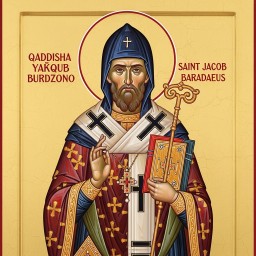
In churches bearing his name, icons depict him as a bishop in worn garments, often shown traveling
or ordaining clergy, capturing the essence of his extraordinary ministry. These icons serve as
visual reminders of his sacrifice and dedication, inspiring contemporary believers to similar
faithfulness.
Prayers to Mor Ya'qub ask for his intercession in times of persecution, for strength to maintain
Orthodox faith in the face of opposition, and for the grace to serve the Church with similar
dedication and humility. His example continues to inspire missionaries, bishops, and all who work
for the preservation and spread of the Orthodox faith.
Prayer for Intercession
"O Holy Father Ya'qub Burdono, great champion of the Orthodox faith, who traveled ceaselessly to
preserve the Church in its darkest hour, intercede for us before the throne of grace. Grant us your
courage in the face of opposition, your endurance in service, and your unwavering commitment to the
apostolic faith. May your prayers strengthen the Church today as your ministry strengthened it in
ages past. Through Christ our Lord. Amen."