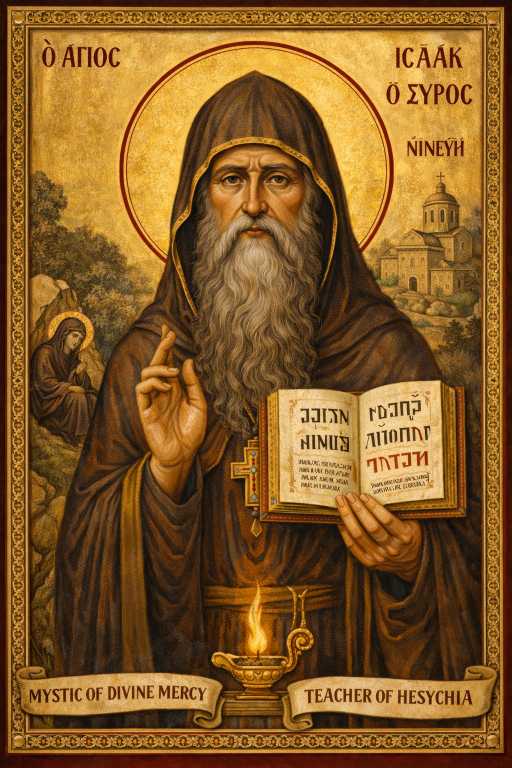
📖Introduction: A Treasure of Syriac
Spirituality
St. Isaac stands as a towering figure in the landscape of Christian mysticism, yet he remains deeply
rooted in the soil of Syriac Christianity, watered by the streams of Mesopotamian monasticism, and
bearing fruit that continues to feed the Church universal. His teachings, originally composed in
Syriac—our sacred language, the language of our liturgy and our fathers—were translated into Greek,
Arabic, Slavonic, and eventually into modern languages, carrying the wisdom of the Syriac spiritual
tradition to the four corners of the earth. Today, his writings are venerated not only in the Syriac
Orthodox Church but also in the Greek Orthodox, Russian Orthodox, Coptic Orthodox, and even among
Roman Catholic and Protestant contemplatives who recognize in his words the authentic voice of
Christian mystical experience.
What makes St. Isaac's legacy particularly precious for us in the Syriac Orthodox Church is that he
represents the flowering of our distinctive spiritual tradition at a crucial moment in history.
Writing in the seventh century, at a time when the Church of the East (to which he belonged) was
expanding its missionary reach along the Silk Road into Central Asia, Persia, and eventually to
China and India, St. Isaac articulated a vision of Christian life centered on divine mercy, radical
love, and contemplative union with God. His teachings synthesized centuries of Syriac ascetical and
mystical wisdom, drawing on the Syrian fathers who preceded him—St. Ephrem the Syrian, St. Isaac of
Antioch, Philoxenus of Mabbug, and the monastic traditions of Mesopotamia and Persia.
Though St. Isaac belonged to what history has called the Church of the East (sometimes, regrettably,
termed "Nestorian," though this designation is theologically problematic and historically
misleading), his spiritual teachings transcend the Christological controversies that divided the
churches in the fifth and sixth centuries. The Syriac Orthodox Church, while maintaining its
theological distinctives rooted in the Cyrillian formula of "one nature of God the Word Incarnate,"
has always recognized St. Isaac as a holy father and spiritual guide. His writings contain no
explicit Christological formulations that would contradict our faith; rather, they focus on the
experiential dimensions of Christian life—prayer, asceticism, humility, love, and divine
mercy—truths that belong to the common patrimony of all who confess Jesus Christ as Lord and Savior.
In this fuller biography, I shall endeavor to present St. Isaac's life, ministry, teachings, and
enduring significance from the perspective of one who stands within the Syriac Orthodox tradition,
seeking to honor this holy father while remaining faithful to our Church's theological identity and
spiritual heritage. May the prayers of St. Isaac accompany us as we explore his witness, and may his
teachings continue to illuminate our path toward that divine light which he so ardently pursued and
so eloquently described.
On Ecclesiastical Identity: St. Isaac belonged to the Church of the East, which
separated from the imperial church after the Council of Ephesus (431 AD) and developed within the
Persian Empire. While theological differences existed, the spiritual wisdom of St. Isaac has been
received by all Orthodox traditions as authentic Christian mysticism. The Syriac Orthodox Church
venerates him as a holy father whose teachings on prayer, mercy, and the interior life represent the
common heritage of Syriac Christianity.
🌅Early Life and Formation in Qatar
St. Isaac was born around the year 613 AD in the region of Beth Qatraye (ܒܶܝܬ݂ ܩܰܛܪܳܝܶܐ in Syriac),
corresponding roughly to modern-day eastern Arabia, including Qatar, Bahrain, and the eastern
coastal regions of the Arabian Peninsula. This region, which might surprise those unfamiliar with
early Christian history in Arabia, was home to a significant Christian population in the seventh
century, with numerous monasteries, churches, and a vibrant ecclesiastical life under the
jurisdiction of the Church of the East.
Beth Qatraye was part of the Persian cultural and political sphere, having strong connections with
the Persian heartland of the Church of the East in Mesopotamia (modern Iraq and parts of Iran and
Syria). The region maintained an Arab Christian identity while participating in the broader Syriac
Christian civilization that stretched from the Mediterranean to Central Asia. Monasteries dotted the
landscape, serving as centers of prayer, learning, manuscript production, and missionary
preparation. It was in this context—simultaneously Arab and Syriac, desert and maritime, ascetic and
intellectual—that St. Isaac received his formation.
Little is known with certainty about Isaac's family background or childhood. The ancient
biographical notices that have come down to us are frustratingly brief, focusing more on his
spiritual achievements than on biographical details. However, we can infer certain things from the
evidence we do have. Isaac clearly received an excellent education in the Christian tradition. His
writings demonstrate profound knowledge of Scripture (which he quotes extensively and interprets
with depth), familiarity with earlier Syriac fathers, understanding of the ascetical and monastic
traditions, and mastery of Syriac as a literary language. Such education would have been available
primarily in monastic schools, suggesting that Isaac may have entered monastic life at a young age,
perhaps as a child oblate or as a youth seeking formation in the religious life.
The monastic tradition of Beth Qatraye, while connected to the broader streams of Mesopotamian and
Persian monasticism, had its own distinctive character shaped by the desert environment and Arab
cultural context. Monasteries in this region emphasized silence (hesychia in Greek, shleya in
Syriac), solitude, manual labor, continuous prayer, and the reading of Scripture and the fathers.
The desert itself—vast, harsh, yet strangely beautiful—served as a teacher, stripping away all that
is superfluous and bringing the monk face to face with God, with himself, and with the fundamental
realities of existence. This desert formation profoundly shaped Isaac's spiritual vision and his
later teachings on solitude, silence, and the interior life.
As a young man, Isaac clearly demonstrated both intellectual gifts and spiritual earnestness. He was
not content with superficial religiosity but sought the depths of Christian experience. He read
voraciously, prayed intensely, practiced asceticism, and sought the guidance of spiritual elders who
could direct him in the monastic life. The monastery became his school, the desert his university,
Scripture his textbook, and prayer his laboratory where he tested and verified the teachings of the
fathers through personal experience.
⛪Brief Episcopal Ministry in Nineveh
Despite his evident call to solitary contemplative life, St. Isaac was eventually called—whether by
divine providence, ecclesiastical authority, or both—to serve as bishop of Nineveh (ancient Ninua,
near modern Mosul in Iraq). This appointment occurred sometime in the mid-to-late seventh century,
probably in the 660s or 670s, when Isaac would have been in his fifties or sixties and already
recognized as a man of great spiritual wisdom and holiness.
Nineveh held profound biblical and historical significance. It was the great city to which the
prophet Jonah had been sent, the capital of the ancient Assyrian Empire, and a symbol in Scripture
of both human wickedness and divine mercy (for God had spared Nineveh when its inhabitants repented
at Jonah's preaching). By the seventh century, Nineveh was part of the heartland of the Church of
the East, with a substantial Christian population and an established ecclesiastical structure. To be
appointed bishop of such a see was a great honor and responsibility.
However, St. Isaac's episcopal ministry was remarkably brief—tradition says he served only five
months before resigning his office and returning to the solitary life. This brevity has been
interpreted in various ways by historians and spiritual writers. Some suggest that Isaac found the
administrative, pastoral, and social demands of episcopal office incompatible with his contemplative
calling and his physical constitution (ancient sources mention that he had weak eyesight, which
would later lead to blindness, making the reading of documents and administrative work difficult).
Others propose that he encountered conflicts with clergy, laity, or civil authorities that he was
temperamentally unsuited to navigate, preferring the silence of the cell to the noise of
ecclesiastical politics.
The most spiritually significant interpretation, however, is that Isaac discerned that his true
vocation was not to govern a diocese but to pursue the contemplative life in solitude and to write
for the benefit of souls seeking deeper union with God. Not everyone is called to active ministry;
some are called to the hidden life of prayer, and their influence on the Church is exercised not
through administrative action but through spiritual teaching and intercessory prayer. St. Isaac
recognized this about himself and had the humility and courage to resign a prestigious position in
order to be faithful to his true calling.
His resignation from the episcopacy, far from being a failure or scandal, was actually a profound
act of self-knowledge and obedience to God's will. In a Church culture that often equates success
with visible achievement and prestigious positions, Isaac's choice reminds us that the highest
Christian vocation is not power or prominence but union with God. Those called to contemplative
solitude serve the Church as surely as bishops and pastors do, though their service is hidden and
their influence often recognized only long after their death.
🏜️Return to Solitude: Rabban Shabur Monastery
After resigning the episcopacy, St. Isaac withdrew to the Monastery of Rabban Shabur (ܕܰܝܪܳܐ ܕܪܰܒܰܢ
ܫܰܒܽܘܪ), located in the region of Beth Huzaye (ancient Khuzestan, in southwestern Iran near the
Persian Gulf). This monastery was renowned as a center of asceticism and learning, a place where
monks devoted themselves to prayer, contemplation, study of Scripture, and the practice of the
spiritual disciplines that lead to purity of heart and union with God.
The decision to retire to Rabban Shabur rather than returning to his native Beth Qatraye was
significant. Rabban Shabur was one of the great monasteries of the Church of the East, with a
distinguished history and a reputation for producing holy monks and spiritual writers. It was far
enough from Nineveh to provide genuine separation from his former episcopal responsibilities, yet
within the orbit of Mesopotamian Christianity where he could maintain connections with the broader
Church. The monastery's extensive library would have provided access to the manuscripts he needed
for his writing, and its community of experienced monks would have provided companionship, support,
and spiritual direction suitable for someone of Isaac's contemplative depth.
At Rabban Shabur, Isaac embraced the full rigor of eremitical monasticism. While remaining
canonically part of the monastic community (cenobitic monasticism), he lived as a solitary (eremitic
monasticism) in a cell or hermitage associated with the monastery, coming to the community only for
certain liturgical offices and receiving support from the monastery while maintaining substantial
independence and solitude. This semi-eremitical pattern—connection to community combined with
solitary contemplation—was common in Syriac monasticism and represented a middle way between the
extremes of total isolation (which could lead to spiritual delusion or physical danger) and constant
community life (which could hinder deep contemplation).
In his cell at Rabban Shabur, Isaac's days were structured around the traditional monastic horarium:
the praying of the canonical hours (the liturgy of the hours), extended periods of silent prayer and
meditation, reading of Scripture and the fathers, manual work (to the extent his failing eyesight
allowed), and writing. The Mesopotamian desert, harsh yet beautiful, provided the perfect
environment for the contemplative life—few distractions, stark beauty that lifted the mind to God,
silence broken only by wind and bird song, and a climate that encouraged interior rather than
exterior activity.
It was during these decades of solitude at Rabban Shabur that St. Isaac composed his spiritual
writings—discourses, homilies, letters, and treatises on prayer, asceticism, humility, love, mercy,
and the stages of the spiritual life. Writing was itself a spiritual discipline for Isaac, a way of
processing his contemplative experiences, synthesizing the teachings he had received from Scripture
and the fathers, and leaving a legacy for future generations of monks and all Christians seeking
deeper communion with God. He wrote not as a theoretical theologian speculating about divine
mysteries from a distance, but as one who had tasted and seen that the Lord is good, whose teachings
were verified in the laboratory of prayer and ascetic practice.
According to tradition, St. Isaac eventually went completely blind—whether from age, from excessive
tears shed in prayer (a phenomenon attested in monastic literature, where compunction and spiritual
tears could damage the eyes), from the strain of reading and writing by poor light, or from some
disease. This blindness, while physically limiting, may have deepened his interior vision and
intensified his contemplative life. Deprived of external sight, he was freed to see more clearly
with the eyes of the heart, to perceive spiritual realities more vividly, to penetrate more deeply
into the mysteries of divine love and mercy that are hidden from those distracted by visible things.
The Spirituality of the Desert: For Syriac monks like St. Isaac, the desert was not
merely a geographical location but a spiritual reality. The desert fathers spoke of "going into the
desert"—leaving behind the settled, comfortable, familiar world to encounter God in solitude,
silence, and struggle. The desert strips away illusions, confronts us with our weakness and sin,
tests our faith and endurance, and ultimately becomes the place of encounter with divine mercy and
love. St. Isaac's teachings bear the marks of this desert formation, emphasizing themes of inner
silence, solitude, vigilance, and the transformation that occurs when the soul stands naked before
God.
📚The Writings: Spiritual Discourses and Their
Transmission
St. Isaac's literary legacy consists primarily of spiritual discourses (memre in Syriac, μέμρα in
Greek transcription)—homilies, treatises, and instructions on the spiritual life originally composed
in Syriac and later translated into other languages. The corpus of Isaac's writings as we now have
it is complex, having been transmitted through multiple manuscript traditions, translated several
times, and sometimes conflated with works by other authors also named Isaac.
The traditional collection known to the Christian East consists of what is called the "First
Collection" of Isaac's writings—82 discourses (or chapters) on various aspects of the spiritual
life, plus some additional material. This collection was translated from Syriac into Greek (probably
in the 8th or 9th century) under the title Ascetical Homilies, and from Greek into various other
languages including Slavonic (which is how Isaac became known and beloved in the Russian Orthodox
tradition). The Greek translation attributed Isaac to Nineveh, calling him "Isaac the Syrian," which
is how he has been known in the Greek-speaking world.
In the late 20th century (1983), a momentous discovery was made: a manuscript containing a "Second
Collection" of Isaac's writings was identified in manuscript collections in Oxford and other
libraries. This Second Collection contains 41 additional discourses, including the remarkable "Four
Centuries on Knowledge" (actually five centuries, or 500 chapters, of spiritual teaching organized
topically). This discovery effectively doubled the known corpus of Isaac's authentic writings and
has led to a renaissance in Isaac studies, with scholars and spiritual writers mining these newly
available texts for their profound wisdom.
More recently, additional works have been attributed to Isaac with varying degrees of certainty,
including a "Third Collection" of writings and various letters and prayers. The task of establishing
a complete and critical edition of Isaac's works in their original Syriac continues to occupy
scholars, and new manuscript discoveries may yet enrich our knowledge of this holy father's
teachings.
What are the major themes and characteristics of St. Isaac's spiritual writings? Let us explore the
contours of his spiritual theology, remembering that for Isaac, theology is never abstract
speculation but always ordered toward transformation, toward the healing of the soul and its union
with God.
💧Divine Mercy: The Heart of Isaac's Theology
If one had to identify the central, unifying theme of St. Isaac's spiritual theology, it would be
divine mercy (raḥmanutha in Syriac, ἔλεος in Greek, misericordia in Latin). For Isaac, God is
fundamentally and essentially merciful. Mercy is not merely one divine attribute among others, not
simply a disposition God sometimes displays, but the very essence of God's relationship with His
creation. All of God's actions toward humanity—creation, incarnation, redemption, providence,
judgment—flow from and express divine mercy.
This emphasis on divine mercy shapes Isaac's entire worldview. Where some Christian theologians have
emphasized divine justice, law, and retribution, Isaac consistently interprets Scripture and
experience through the lens of mercy. Even divine "wrath" and "judgment," for Isaac, are expressions
of mercy—pedagogical means by which God disciplines His children for their healing, not retributive
punishment of the vindictive sort. God's "punishments" are medicinal, not penal; they aim at
restoration, not destruction; they seek to heal, not to harm.
One of Isaac's most famous and controversial passages expresses this theology of universal divine
mercy: "I also maintain that those who are punished in Gehenna are scourged by the scourge of love.
For what is so bitter and vehement as the torment of love?... It is totally false and wrong to think
that the sinners in Gehenna are deprived of God's love. Love is given to all. But love's power acts
in two ways: it torments sinners, while it delights those who have lived in accord with it." Here,
even the fires of hell are interpreted as expressions of divine love—burning not to destroy but to
purify, tormenting the sinner not because God hates them but because the very presence of divine
love is unbearable to those who have oriented their lives away from love.
Isaac goes even further in some passages, suggesting (though not definitively asserting) the
possibility of universal salvation (apokatastasis), the restoration of all things including fallen
angels and condemned sinners. These passages have made Isaac's writings controversial in some
quarters, as the doctrine of apokatastasis was condemned in certain formulations at the Fifth
Ecumenical Council (553 AD). However, Isaac's speculations on universal restoration flow naturally
from his profound conviction of God's boundless mercy, and they are offered not as dogmatic
assertions but as expressions of hope rooted in God's character as revealed in Christ.
From the perspective of the Syriac Orthodox Church, Isaac's emphasis on divine mercy resonates
deeply with our liturgical and theological tradition. Our liturgy is saturated with appeals to
divine mercy (raḥme 'alayn—"have mercy on us"—is our most frequent prayer), our Christology
emphasizes God's condescension and self-emptying love, and our soteriology focuses on theosis
(divinization) rather than purely juridical models of salvation. We may be cautious about universal
salvation as dogma, but we embrace unreservedly Isaac's insistence that God's mercy is boundless,
that His love never fails, and that His desire is for all to be saved and come to the knowledge of
truth.
❤️The Merciful Heart: Transformation Through
Love
Central to Isaac's spiritual teaching is the concept of the "merciful heart" (lebba d-raḥmanutha in
Syriac)—a heart that has been so transformed by contemplating divine mercy that it extends mercy to
all creatures, even to enemies, even to demons, even to irrational beasts. This is not mere
sentimentality or natural compassion but a supernatural gift, a participation in God's own merciful
nature, the fruit of deep prayer and ascetic struggle.
Isaac describes the merciful heart in one of his most beautiful and frequently quoted passages:
"What is a merciful heart? It is a heart on fire for the whole of creation, for humanity, for the
birds, for the animals, for demons, and for all that exists. By the recollection of them the eyes of
a merciful person pour forth tears in abundance. By the strong and vehement mercy that grips such a
person's heart, and by such great compassion, the heart is humbled and one cannot bear to hear or to
see any injury or slight sorrow in any in creation. For this reason, such a person offers up tearful
prayer continually even for irrational beasts, for the enemies of truth, and for those who harm him
or her, that they be protected and receive mercy. And in all this such a person prays even for the
species of reptiles, moved by the infinite pity that rises up in the hearts of those who are
becoming like God."
This extraordinary vision of cosmic compassion—extending mercy even to demons and reptiles—flows
from Isaac's theology of creation and fall. All creation was made good by God and is beloved by Him.
The fall damaged and distorted creation but did not destroy God's love for it. The merciful heart
participates in God's own compassionate love for all that He has made, groaning with creation as it
awaits redemption (Romans 8:22-23), interceding for all beings, desiring the restoration of all
things.
How does one acquire such a heart? Not through natural effort or moral willpower alone, but through
the transformation that occurs in deep prayer, through contemplation of God's mercy toward oneself
as a sinner, through ascetic struggle that purifies the passions, and through the indwelling of the
Holy Spirit who pours God's love into our hearts (Romans 5:5). The merciful heart is the fruit of
sanctification, evidence that one is progressing toward theosis, toward becoming "like God" in love
and mercy.
For the Syriac Orthodox faithful, this teaching on the merciful heart provides both encouragement
and challenge. We are encouraged because God desires to give us such a heart—this is His will for
us, and He provides the means (sacraments, prayer, Scripture, ascetic discipline, spiritual
direction) by which we may be transformed. We are challenged because acquiring such a heart requires
dying to selfishness, overcoming our natural tendency to judge and condemn others, and learning to
see all people and all creation through God's eyes of love.
🧘Hesychia: The Practice of Inner Silence
A second major emphasis in St. Isaac's spiritual teaching is hesychia (ܫܶܠܝܳܐ, shleya in
Syriac)—inner
silence, stillness, quietude of soul. Hesychia is not merely external silence or absence of noise,
though these may help cultivate it; rather, it is an interior state of peace, recollection, and
attentiveness to God that can be maintained even in the midst of outward activity (though it is most
easily cultivated in physical solitude and silence).
Isaac writes extensively about the necessity of solitude for those seeking deep prayer and union
with God. He distinguishes between different forms of monastic life—cenobitic (community-based) and
eremitic (solitary)—and while he respects both, his own experience and teaching emphasize the
eremitic path as the higher calling for those capable of it. Solitude provides the optimal
environment for hesychia because it minimizes external distractions, reduces the stimulation of the
passions, and creates space for sustained attention to God.
However, Isaac is careful to warn that solitude without proper preparation can be dangerous. One
must first learn obedience, humility, and the basic disciplines of the spiritual life in community
before undertaking the solitary life. Premature withdrawal to solitude can lead to spiritual
delusion (Greek: πλάνη, plané; Syriac: ܛܥܰܝܽܘܬ݂ܳܐ, t'ayutha), demonic temptation, psychological
instability, or simple laziness disguised as contemplation. The solitary life is not an escape from
responsibility or difficulty but an intensification of spiritual struggle, undertaken only by those
who have been tested and found ready.
Within the state of hesychia—whether in literal solitude or in the "cell" of interior silence
maintained even in community—Isaac teaches various practices of prayer. He speaks of the "prayer of
the mind" (ṣlawtha d-mad'a), which corresponds to what later hesychast tradition would call "noetic
prayer" or "prayer of the heart"—a simple, attention-focused prayer, often using a short formula
repeated continuously (similar to what the Russian tradition calls the Jesus Prayer: "Lord Jesus
Christ, Son of God, have mercy on me, a sinner"). This form of prayer gradually descends from the
intellect to the heart, becoming not merely something one does but something one is—a state of
continuous communion with God.
Isaac also speaks frequently of "wonder" or "awe" (tehra in Syriac, θαῦμα in Greek)—a state of
consciousness in which the soul, having been purified and illumined, stands in amazement before the
mysteries of God. This wonder is not intellectual curiosity but experiential encounter, not
questioning but adoration, not analysis but participation. In the state of wonder, rational thought
ceases (not because reason is bad, but because it has reached its limit and given way to something
higher), and the soul rests in wordless contemplation of divine beauty and love.
🔥Asceticism and the Transformation of Passions
St. Isaac, while emphasizing divine mercy and love, does not neglect the necessity of ascetic
struggle. Like all the desert fathers and mothers before him, he understands that the fallen human
condition involves disordered passions (kheshe in Syriac, πάθη in Greek)—desires, emotions, and
impulses that have been distorted by sin and now pull us away from God rather than drawing us toward
Him. The spiritual life requires a gradual transformation of the passions through ascetic practice,
bringing them back into proper order and ultimately transforming them into virtues.
Isaac's teaching on passions is nuanced. He does not advocate the Stoic ideal of apatheia understood
as the complete elimination of all feeling and desire; rather, he seeks the transformation of
passion into holy desire, of worldly attachments into love for God, of self-seeking into
self-giving. The goal is not to become passionless automatons but to become persons whose entire
being—intellect, will, emotions, desires—is oriented toward God and neighbor in love.
The traditional ascetic practices that Isaac recommends include fasting (not as an end in itself but
as a means of gaining control over bodily appetites and learning to hunger for God more than for
food), vigils (extended time in prayer, especially at night when distractions are fewest), manual
labor (which occupies the body while freeing the mind to pray and which provides the necessities of
life), custody of the senses (guarding eyes, ears, tongue from inputs that stimulate disordered
passions), and almsgiving/compassion toward the poor (which breaks the power of avarice and
cultivates the merciful heart).
Particularly important in Isaac's ascetical teaching is the cultivation of tears—not merely
emotional weeping but the gift of compunction, deep sorrow for sin combined with joy at God's mercy.
Isaac speaks of "baptism by tears"—a second baptism, spiritual and ongoing, in which the soul is
cleansed again and again through repentance, mourning over sin, and receiving divine forgiveness.
These tears are both bitter (sorrow over sin) and sweet (joy at mercy), and they gradually transform
the heart, making it tender, humble, and compassionate.
However, Isaac insists that ascetic practices are means, not ends. One can practice rigorous
fasting, vigils, and other disciplines yet remain proud, judgmental, and far from God. The purpose
of asceticism is to create conditions favorable for the reception of grace, to remove obstacles to
divine love, to prepare the soul's ground for the seed of contemplation. Without love and humility,
asceticism becomes merely self-torture or spiritual ambition; with love and humility, even simple
practices become powerful means of transformation.
🪜The Stages of the Spiritual Life
Following the tradition of earlier Christian spiritual writers, St. Isaac describes the spiritual
life as a journey with distinct stages or levels. While different fathers organize these stages
differently, and while the progression is not always linear (one can advance and regress, or
experience different stages simultaneously in different aspects of one's being), the schema provides
a helpful map for understanding spiritual growth.
Isaac speaks of three primary levels: the bodily/natural (pagranaya), the psychic/soul (nafshanaya),
and the spiritual (ruhanaya). The bodily stage corresponds to beginners in the spiritual life who
are primarily occupied with controlling bodily passions, practicing basic virtues, learning to pray,
and establishing a disciplined Christian life. Most Christians remain at this level throughout their
lives, which is not a criticism—this level includes genuine holiness and is sufficient for
salvation.
The psychic stage corresponds to those who have made progress in virtue and are beginning to
experience deeper dimensions of prayer. At this level, the intellect (the rational soul) begins to
be illumined by divine light, contemplation begins to replace discursive meditation, and the person
experiences alternating periods of consolation and desolation as God works to purify the soul of
more subtle forms of self-seeking. This is the level of the majority of serious monks and
contemplatives.
The spiritual stage is the level of the perfected—those rare souls who have been so transformed by
grace that they have achieved substantial freedom from the passions (though not absolute
impossibility of sin while in the body), whose prayer has become continuous and effortless, who
experience frequent and sustained contemplation of divine mysteries, and who manifest charismatic
gifts (prophecy, healing, discernment of spirits). Isaac is careful to say that very few reach this
level in its fullness, and those who do reach it only after many years of faithful struggle and only
by pure divine gift, not by their own effort.
Important to Isaac's teaching is that these stages do not represent a rejection of the body or the
lower faculties but their progressive integration and transformation. The body is not evil (this is
the Manichean heresy, which Christianity rejects); it is good but wounded by sin. The spiritual life
does not escape the body but transfigures it, making it a temple of the Holy Spirit, a instrument of
divine love, a participant in the resurrection life that Christ has won for us.
📿Humility: The Foundation of All Virtues
Throughout his writings, St. Isaac returns again and again to the virtue of humility (makkikhuta in
Syriac, ταπείνωσις in Greek), which he considers the foundation of the entire spiritual edifice.
Without humility, no other virtue can truly develop; with humility, all virtues follow naturally.
Pride (the opposite of humility) is the root of all sin, the original fall of Lucifer, the
continuing temptation of all who seek holiness. Therefore, cultivating humility must be the
monk's—indeed, every Christian's—constant concern.
But what is humility? Isaac defines it not as thinking poorly of oneself (which can be a form of
inverted pride or self-obsession) but as thinking rightly about oneself in relation to God and
others. The humble person recognizes their absolute dependence on God for existence and for every
good thing, acknowledges their sinfulness without excuse or comparison to others, receives both
praise and blame with equanimity (neither being puffed up by honor nor devastated by dishonor), and
treats all other people with reverence as bearers of God's image, regardless of their state or
status.
Isaac identifies various practices that cultivate humility: accepting correction and reproof without
defensiveness; choosing the lowest place and simplest tasks; confessing one's sins and faults
regularly to a spiritual father; avoiding situations where one might be praised or honored;
identifying with and serving the poor and despised; remembering one's death and the judgment that
awaits all; and above all, contemplating the humility of Christ, who "being in the form of God, did
not consider it robbery to be equal with God, but made Himself of no reputation, taking the form of
a bondservant, and coming in the likeness of men... He humbled Himself and became obedient to the
point of death, even the death of the cross" (Philippians 2:6-8).
Isaac also warns against false humility—the type of self-abasement that is actually subtle pride,
seeking notice for one's "humility," or the excessive self-deprecation that becomes a form of
manipulation, or the refusal to accept one's gifts and calling under the guise of humility. True
humility is simple, unself-conscious, and life-giving; false humility is complex, self-aware, and
ultimately life-denying.
For contemporary Syriac Orthodox Christians, Isaac's teaching on humility challenges the pride that
pervades modern culture—pride in our achievements, our knowledge, our status, our identity group,
even our spiritual attainments. We live in an age that celebrates self-assertion, self-promotion,
and self-confidence, making humility seem like weakness or lack of self-esteem. Isaac reminds us
that true strength lies in humility, that genuine self-knowledge comes through acknowledging our
dependence on God, and that the way up (to holiness, to union with God) is paradoxically the way
down (to humility, self-emptying, service).
🕯️Knowledge and Contemplation: Theology as
Experience
St. Isaac makes an important distinction between different types of knowledge. There is "bodily
knowledge" or "worldly knowledge" (ida' pagranaya)—the accumulation of facts, mastery of sciences,
learning of philosophies—which has its place but is limited to the natural order. There is "natural
contemplation" (theoria physike)—insight into the spiritual meanings hidden in creation,
understanding of divine providence in history, discernment of God's purposes in Scripture—which is
higher than merely factual knowledge but still operates through the intellect. And there is
"spiritual knowledge" or "mystical contemplation" (ida' ruhanaya, theoria mystike)—direct,
experiential awareness of divine realities, communion with God beyond words and concepts, what Isaac
also calls "knowledge by experience" as opposed to "knowledge by hearing."
This highest form of knowledge is not acquired through study, though study may prepare for it; not
achieved by effort, though effort may dispose one to receive it; not possessed as information,
though it may transform one's understanding. Rather, it is a gift of grace, given to those who have
been purified in heart, who have progressed in prayer, and whom God chooses to illumine. It is
simultaneously knowledge and union, contemplation and participation, seeing and being transformed by
what is seen.
Isaac is clear that this experiential knowledge of God is the true goal of the Christian life, the
"one thing needful" (Luke 10:42) for which all else—moral effort, ascetic practice, theological
study—serves as preparation. Yet he is equally clear that one cannot force or manufacture this
experience. It comes in God's time, according to God's wisdom, to those who wait in humility and
perseverance. Efforts to manipulate consciousness through techniques, to engineer mystical
experiences through exotic practices, or to claim spiritual attainments one has not genuinely
received all represent forms of spiritual delusion that must be avoided.
This teaching has important implications for how the Syriac Orthodox Church understands theology.
Following the entire tradition of the Christian East (both Oriental and Eastern Orthodox), we
understand that theology is not primarily an academic discipline or intellectual system but a form
of prayer, a participation in divine life, knowledge that transforms the knower. The great
theologians of the Church have been the saints—not merely because they were intellectually clever,
but because their theology flowed from their prayer, from their experiential knowledge of God. Isaac
exemplifies this understanding: his writings are not systematic theology in the Western academic
sense but spiritual theology arising from contemplative experience and ordered toward
transformation.
🌍Universal Influence: How Isaac's Writings
Spread
One of the most remarkable aspects of St. Isaac's legacy is how his writings, originally composed in
Syriac within the Church of the East, spread across virtually all Christian traditions and continue
to nourish spiritual seekers today, more than thirteen centuries after his death. This universal
influence testifies both to the depth of Isaac's spiritual vision and to the fundamentally
trans-confessional nature of genuine mystical theology.
The first stage of dissemination occurred within the Syriac-speaking world. Isaac's writings were
copied in monasteries throughout Mesopotamia, Persia, and Central Asia. Monks read them, quoted
them, and incorporated his teachings into their own spiritual practice and instruction. His
reputation as a spiritual guide grew, and his name became synonymous with wisdom about the interior
life.
The second stage—crucial for Isaac's wider influence—was the translation of his First Collection
into Greek, probably in the 8th or 9th century. This translation made Isaac's wisdom available to
the Byzantine world, where it was received with enthusiasm. Greek monks and spiritual writers
recognized in Isaac a kindred spirit, a voice articulating truths they knew from their own tradition
(the sayings of the desert fathers, the teachings of Evagrius, the Macarian homilies) but expressed
with unique beauty and depth. The fact that Isaac came from the Church of the East did not prevent
Orthodox Greeks from venerating him as a holy father and spiritual guide.
From Greek, Isaac's writings were translated into Slavonic, becoming immensely influential in
Russian Orthodox spirituality. Saints like Paisius Velichkovsky (18th century) and the elders of
Optina Monastery (19th century) drew heavily on Isaac's teachings. Dostoevsky, that profound
explorer of human nature and divine mercy, was influenced by Isaac's vision of cosmic compassion
(some scholars see Isaac's influence in the character of Father Zosima in The Brothers Karamazov).
To this day, Isaac is widely read and quoted in Russian Orthodoxy, considered one of the essential
spiritual fathers whose teachings guide the prayer and practice of monks and laity alike.
In the modern period, Isaac's writings have been translated into Western languages—first Latin, then
modern European languages. This has made him accessible to Roman Catholic contemplatives, who have
found in his writings a spiritual depth and mystical beauty that resonates with their own
tradition's mystics (John of the Cross, Teresa of Avila, the Rhineland mystics). Even some
Protestant readers, particularly those interested in contemplative spirituality and mystical
theology, have discovered Isaac and been nourished by his teachings, despite the theological and
ecclesiological differences between their traditions and Isaac's.
The discovery of the Second Collection in the late 20th century renewed interest in Isaac and
sparked a new wave of scholarly and spiritual engagement with his writings. New critical editions,
translations, and studies continue to appear, making Isaac more accessible than ever before and
revealing dimensions of his thought that were previously unknown or underappreciated.
⛪St. Isaac in Syriac Orthodox Tradition and
Liturgy
Within the Syriac Orthodox Church specifically, St. Isaac of Nineveh occupies a place of special
honor as one of the greatest spiritual masters of the Syriac tradition. While he belonged
ecclesiastically to the Church of the East rather than to the Syriac Orthodox Church (which traces
its identity to the patriarchate of Antioch and the Cyrillian Christology), his spiritual teachings
are considered part of the common patrimony of Syriac Christianity, transcending the ecclesiastical
divisions that have, tragically, separated Syriac Christians into different churches.
The Syriac Orthodox Church has always maintained a broad and generous approach to the spiritual
classics of the Syriac tradition. We read and venerate not only the fathers who were definitively
"Syriac Orthodox" in the sense of belonging to the Antiochene patriarchate and accepting the
Cyrillian Christology, but also those who belonged to other Syriac-speaking churches—provided their
spiritual teachings are sound and their lives holy. Thus we read St. Ephrem the Syrian (who died
before the Christological controversies), Philoxenus of Mabbug and Jacob of Serug (who were
explicitly miaphysite/non-Chalcedonian), and also Isaac of Nineveh and other East Syrian fathers
whose Christological formulations might differ from ours but whose spiritual wisdom is undeniable.
St. Isaac is commemorated in the Syriac Orthodox liturgical calendar on January 28. On this day, his
memory is celebrated with appropriate readings, hymns, and prayers. While he may not receive the
same level of liturgical elaboration as some of the great Antiochene fathers or martyrs, his feast
provides an opportunity for the faithful to remember his witness, give thanks for his teachings, and
seek his intercession.
More importantly than formal liturgical commemoration, Isaac's teachings have deeply influenced
Syriac Orthodox spirituality, monastic practice, and theological reflection. His writings are read
in our monasteries, quoted by our spiritual fathers, and recommended to those seeking deeper prayer
and understanding of the spiritual life. His emphasis on divine mercy resonates with the
mercy-centered theology of the Syriac liturgy. His teachings on hesychia and contemplative prayer
guide our monks and nuns in their pursuit of union with God. His vision of the merciful heart
challenges all the faithful to see others—even enemies—through eyes of compassion.
From a theological perspective, the Syriac Orthodox Church's reception of Isaac's writings
demonstrates an important principle: the unity of the Church exists at multiple levels. While we
maintain that ecclesial unity requires unity in faith (particularly in Christology, which is why we
could not accept the Chalcedonian formulation), spiritual unity can transcend these boundaries. The
saints belong not merely to their own ecclesial communities but to the Church universal. When we
read Isaac's writings, we are not borrowing from a foreign tradition but claiming our own Syriac
heritage, recognizing that the Holy Spirit who inspired Isaac's contemplation is the same Spirit who
animates our liturgy, sanctifies our sacraments, and guides our Church.
🎓Isaac's Relevance for Contemporary
Spirituality
Why should contemporary Syriac Orthodox Christians—indeed, all Christians—read St. Isaac of Nineveh
in the twenty-first century? What relevance do the writings of a seventh-century hermit monk, living
in the deserts of Mesopotamia, have for people navigating the complexities of modern life? Several
answers suggest themselves.
First, Isaac's emphasis on interior transformation speaks powerfully to an age characterized by
superficiality, constant distraction, and fragmentation of attention. We live in a culture of
surfaces—social media profiles, carefully curated images, constant performance of identity. Isaac
calls us inward, to the hidden depths where God dwells, to the silence where we can hear the "still
small voice," to the authentic self that exists before God rather than the false selves we project
to others. In an age of noise, Isaac teaches us the value of silence; in an age of constant
stimulation, he teaches us contemplation; in an age of distraction, he teaches us recollection and
mindfulness of God.
Second, Isaac's theology of divine mercy provides an antidote to the harshness, judgmentalism, and
polarization that characterize much of contemporary discourse, including religious discourse. We
live in an age of "cancel culture," of rigid ideological boundaries, of demonization of those who
differ from us. Isaac reminds us that God's mercy extends to all, that we are called to see others
through eyes of compassion rather than judgment, that the merciful heart weeps even for demons. This
does not mean relativism or indifference to truth and justice, but it does mean that our pursuit of
truth and justice must be motivated by love, not by hatred or vengeance.
Third, Isaac's ascetical teachings—properly understood and appropriately adapted—provide resources
for cultivating the virtues and disciplines necessary for human flourishing. Modern culture
encourages instant gratification, consumerism, and the satisfaction of every desire. Isaac teaches
us that genuine freedom comes through discipline, that happiness comes through purification of
desires rather than through their unlimited indulgence, that the ascetic struggle to order our
passions and orient our lives toward God is the path to authentic fulfillment. This is not
life-denying repression but life-affirming formation—learning to desire rightly, to love truly, to
be fully human as God intended.
Fourth, Isaac's contemplative vision provides a corrective to the activism and
achievement-orientation that dominate even religious life. We are constantly doing, producing,
achieving, measuring results. Even our prayer can become another task to accomplish, another box to
check. Isaac reminds us that being precedes doing, that contemplation is not a luxury but a
necessity, that the deepest transformation occurs not through our frantic activity but through
receptive waiting upon God. For those experiencing burnout, exhaustion, or the sense that they must
constantly prove their worth through productivity, Isaac's teachings on resting in God, on the
primacy of grace, on the sufficiency of simply being before God in loving attention, come as healing
balm.
Finally, Isaac's writings exemplify theology as lived experience rather than abstract speculation.
In an age when theology has often become either dry academic discourse disconnected from faith and
practice, or sentimental emotionalism disconnected from intellectual rigor, Isaac shows us a third
way: theology that arises from prayer, that is verified in experience, that transforms the
theologian even as it articulates divine truth. For the Syriac Orthodox Church, recovering this
understanding of theology as spiritual knowledge gained through purification and contemplation is
essential for authentic renewal and witness in the modern world.
💡Key Teachings for Daily Christian Life
While St. Isaac wrote primarily for monks living in solitude, his teachings contain profound wisdom
applicable to all Christians, regardless of their state of life. Here are some of his key insights
that can guide our daily walk with Christ:
On Prayer: Isaac teaches that prayer is not about quantity of words but quality of
attention. Better to pray briefly with full attention than to recite many prayers mechanically. He
encourages the use of short, repeated prayers that can become continuous—the Syriac equivalent of
the Jesus Prayer. He emphasizes the need for regular times of prayer but also for cultivating
continuous awareness of God's presence throughout the day. Prayer is not just petition but
communion, not just asking for things but resting in God's love.
On Reading Scripture: Isaac teaches that Scripture should be read not primarily for
information but for transformation. We should read slowly, meditatively, allowing the words to sink
into the heart. When a particular verse or passage strikes us, we should stay with it, pondering it,
praying it, until it yields its spiritual fruit. The goal is not to finish a reading plan but to
encounter the living God who speaks through His written Word.
On Relationships: Isaac's teaching on the merciful heart has immediate application
to how we treat others. We should never write anyone off as beyond hope. We should pray for our
enemies, not just once but continuously, until our hearts soften toward them. We should be quick to
forgive offenses, remembering how much we have been forgiven. We should avoid gossip and judgment,
recognizing that we know only the surface of others' lives and that God alone knows hearts. We
should be gentle with those who struggle, remembering our own weaknesses.
On Material Possessions: Isaac teaches moderation rather than absolute poverty for
laypeople, but he insists that attachment to possessions is a major obstacle to spiritual progress.
We should regularly examine our relationship with money and things, practicing generosity toward
those in need, simplifying our lives where possible, and cultivating contentment with what is
necessary rather than constantly desiring more. The goal is interior detachment—holding possessions
lightly, as temporary stewards rather than absolute owners.
On Suffering: Isaac teaches that suffering, when received rightly, is a path of
purification and growth. We should not seek suffering (this would be masochistic and unhealthy), but
when it comes—as it inevitably does—we should not waste it through bitterness, complaint, or
despair. Instead, we should offer it to God, unite it with Christ's sufferings, allow it to burn
away our dross and reveal what is essential. Suffering can make us more compassionate, more humble,
more dependent on God—if we receive it with faith rather than resistance.
On Daily Disciplines: Isaac recommends modest fasting (adapted to one's health and
circumstances), brief examination of conscience each evening (reviewing the day and repenting of
failures), regular confession, attendance at the Divine Liturgy and other services when possible,
and daily reading of Scripture and the fathers. These disciplines should be undertaken not
legalistically but as means of grace, not to earn God's favor but to dispose ourselves to receive
the love He freely offers.
✝️Conclusion: The Syrian Sage of Divine Love
St. Isaac of Nineveh stands in the memory and devotion of the Syriac Orthodox Church—indeed, of
Christians worldwide—as one of the greatest spiritual masters the Church has produced. From his
brief episcopal ministry in Nineveh, through his long decades of solitary contemplation at Rabban
Shabur, to his literary legacy that continues to nourish souls across all boundaries, Isaac's life
and teachings witness to the transforming power of divine mercy and the heights of contemplative
union to which God calls those who seek Him with all their heart.
His central message—that God is boundlessly merciful, that this mercy seeks to transform us into
merciful beings who love all creation, that the path to this transformation leads through humility,
silence, ascetic struggle, and contemplative prayer—speaks as powerfully today as it did in the
seventh century. In an age of hatred, violence, superficiality, and distraction, Isaac calls us to
mercy, peace, depth, and recollection. In an age that glorifies the self and its autonomy, Isaac
calls us to humility and dependence on God. In an age that seeks instant gratification, Isaac
teaches patient perseverance in the spiritual struggle. In an age that reduces religion to moralism
or emotionalism, Isaac shows us mystical theology—faith seeking experiential knowledge of God.
For us in the Syriac Orthodox Church, St. Isaac represents the flowering of our Syriac spiritual
tradition, demonstrating the heights to which Syriac Christianity can reach when rooted in
Scripture, nourished by the sacraments and liturgy, guided by the desert fathers, and opened to the
illumination of the Holy Spirit. Though he belonged ecclesiastically to a different branch of the
Syriac family tree, his spiritual fruit belongs to all of us, part of our common heritage as
children of the Syriac tradition.
As we conclude this fuller biography, let us pray in the words and spirit of St. Isaac himself: "O
Merciful Lord, who desires the salvation of all and whose compassion extends to all Your creatures,
look upon Your servant with eyes of mercy. Grant me a merciful heart that burns with love for all
creation. Grant me the gift of tears, continuous prayer, and deep humility. Grant me to taste, even
in this life, something of the sweetness of Your love and the joy of Your presence. Deliver me from
pride, judgment, and hardness of heart. Make me an instrument of Your peace and mercy in a world
that desperately needs both. Through the prayers of St. Isaac and all Your saints, through the
merits of Your only-begotten Son who became human for our salvation, through the power of Your Holy
Spirit who dwells in Your Church—hear my prayer and have mercy. Amen."
May the blessing of St. Isaac of Nineveh, mystic of divine mercy, teacher of hesychia, father of
the desert, and guide to countless souls seeking God, rest upon all who read this account. May
his teachings illuminate our minds, his example strengthen our resolve, and his intercession
bear us safely to that Kingdom of love which he beheld in contemplation and now enjoys in
fullness. Glory to the Father, and to the Son, and to the Holy Spirit, now and forever, and unto
ages of ages. Amen.