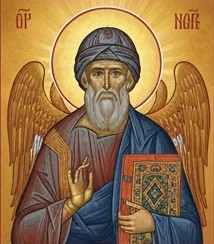
💰From Tax Collector to Apostle
Saint Matthew, also known as Levi son of Alphaeus, occupies a unique place among the Twelve Apostles
as one who was dramatically transformed from a despised tax collector into a herald of the Gospel.
Born in Galilee, he worked as a publican—a tax collector for the Roman occupation—at the customs
post in Capernaum. In first-century Jewish society, tax collectors were considered the worst of
sinners, traitors who collaborated with pagan oppressors and enriched themselves by extorting their
own people.
Yet it was to this very man, seated at his tax booth counting his ill-gotten gains, that our Lord
Jesus Christ directed His life-changing call. The Gospel records the moment with striking
simplicity: Jesus saw Matthew sitting at the tax office and said to him, "Follow Me." Without
hesitation, without negotiation, Matthew immediately arose, left everything behind—his lucrative
position, his wealth, his former life—and followed Christ. This instant response reveals a soul that
recognized divine authority and hungered for righteousness despite his sinful occupation.
🍷The Great Feast: A Testament of Joy
To celebrate his newfound calling and to introduce his former associates to the Master who had shown
him mercy, Matthew prepared a great feast at his house. He invited Jesus, the disciples, and many
other tax collectors and sinners—those whom polite society shunned and religious leaders condemned.
This banquet became a powerful demonstration of Christ's mission: "I came not to call the righteous,
but sinners to repentance."
When the Pharisees and scribes criticized Jesus for eating with tax collectors and sinners, our Lord
responded with words that would echo through the ages: "Those who are well have no need of a
physician, but those who are sick." Matthew's feast thus became not merely a celebration of one
man's conversion, but a prophetic sign of the Kingdom of God—a Kingdom where the lost are found, the
outcast are welcomed, and sinners are transformed into saints through divine grace and mercy.
"I did not come to call the righteous, but sinners, to repentance." — Matthew 9:13
✍️Author of the First Gospel
Saint Matthew holds the distinction of writing the first Gospel in the canonical order of the New
Testament. According to ancient tradition preserved by the Church Fathers—including Papias,
Irenaeus, Origen, and Eusebius—Matthew composed his Gospel originally in Hebrew (or Aramaic) for the
Jewish Christians of Palestine, approximately eight years after the Ascension of our Lord, around
41-50 AD. This makes it the earliest written account of Christ's life and teachings.
Matthew's Gospel is uniquely structured to present Jesus as the promised Messiah, the fulfillment of
Old Testament prophecy. He begins with the genealogy of Christ, tracing His lineage through Abraham
and David, establishing His royal and covenantal credentials. Throughout his Gospel, Matthew
repeatedly uses the phrase "that it might be fulfilled which was spoken by the prophet," connecting
the life of Christ to the ancient Hebrew Scriptures. His account includes the Sermon on the Mount,
the Lord's Prayer, and numerous parables found nowhere else, making it the most comprehensive
catechetical text in the early Church.
As a former tax collector, Matthew was uniquely qualified for this task—he was literate, skilled in
record-keeping, trained in multiple languages, and accustomed to precise documentation. The Holy
Spirit worked through these natural abilities, transforming a man who once counted coins into one
who would count souls for the Kingdom. His Gospel became the bridge between the Old and New
Covenants, demonstrating how Christ fulfilled the Law and the Prophets while inaugurating a new era
of grace and truth.
🌍Apostolic Mission and Martyrdom
After Pentecost, Saint Matthew remained in Palestine for several years, preaching and teaching among
the Jewish people. According to the Syriac Orthodox tradition and the testimony of early Church
historians, he later traveled far beyond the borders of Judea to evangelize distant lands. His
missionary journeys took him through Syria, Persia (modern-day Iran), Macedonia, and eventually to
Ethiopia (which in ancient times referred to the regions south of Egypt, including parts of modern
Sudan and Ethiopia).
In Ethiopia, Saint Matthew performed numerous miracles in the name of Christ, healing the sick,
casting out demons, and raising the dead. Through these signs and wonders, accompanied by his
powerful preaching of the Gospel, he converted multitudes to the Christian faith, including members
of the royal household. He ordained bishops and priests, established churches, and laid the
foundation for what would become one of the most ancient Christian communities in the world.
The circumstances of his martyrdom vary in different traditions. According to the most widely
accepted account in the Syriac Orthodox Church, Saint Matthew was celebrating the Divine Liturgy
when soldiers sent by the local king burst into the church and martyred him at the altar. Other
traditions state he was stabbed with a spear or sword while preaching. Regardless of the precise
manner, all accounts agree that he received the crown of martyrdom around the year 74 AD, sealing
his testimony to Christ with his own blood. His relics were later translated and are venerated in
various locations, with portions traditionally believed to rest in Salerno, Italy.
📜The Gospel of the Kingdom
Matthew's Gospel is characterized by its systematic presentation of Christ's teaching ministry. The
five great discourses—the Sermon on the Mount, the Mission Discourse, the Parables of the Kingdom,
the Discourse on the Church, and the Eschatological Discourse—form the theological backbone of his
work. Each discourse is carefully structured and concludes with a formula phrase, demonstrating
Matthew's skill as a teacher and organizer of divine truth.
The Gospel emphasizes Christ as King, Teacher, and Judge. Matthew presents Jesus as the new Moses
who ascends the mountain to deliver the New Law, as the promised Son of David who establishes an
eternal Kingdom, and as Emmanuel—God with us—who fulfills every promise made to Israel. His account
of the Passion and Resurrection is marked by attention to detail and theological depth, revealing
how Christ's suffering and victory accomplished the salvation of the world.
In the Syriac Orthodox tradition, the Gospel of Matthew has always held a place of special honor. It
is the Gospel most frequently read in the liturgy, and its themes of mercy, repentance, and divine
calling resonate deeply with our understanding of God's boundless love for sinners. Matthew himself
stands as living proof that no one is beyond redemption, that Christ calls not the righteous but
sinners, and that the greatest saints are often those who were once the greatest sinners.
Prayer for Intercession
O Holy Apostle and Evangelist Matthew, you who left behind wealth and worldly security to follow
Christ, who recorded the words and deeds of our Savior for all generations, who preached the Gospel
to distant lands and sealed your witness with martyrdom—intercede for us before the throne of grace.
Pray that we, like you, may hear the call of Christ and respond with immediate obedience, leaving
behind all that hinders us from following Him. Grant us the grace of true repentance and the joy of
knowing that no sin is too great for God's mercy. Through your prayers, may we be counted among
those who hunger and thirst for righteousness and find our names written in the Book of Life. Amen.