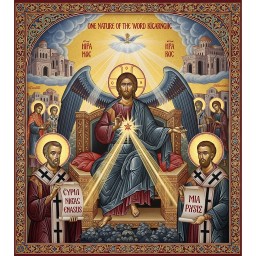
📖The Foundation: Mor Kurillos's Teaching
At the heart of Syriac Orthodox Christology stands the luminous teaching of Mor Kurillos (St. Cyril
of Alexandria), the great champion of orthodox faith and defender of the Theotokos. In response to
the Nestorian heresy that threatened to divide Christ into two separate persons—one divine and one
human—Mor Kurillos articulated the formula that has become the cornerstone of Oriental Orthodox
theology: "Mia Physis tou Theou Logou Sesarkomene," which translates as "One Nature of God the Word
Incarnate." This formula, far from being a novel invention, represents the crystallization of
apostolic and patristic teaching concerning the mystery of the Incarnation.
The term "Mia Physis" requires careful understanding. In the theological vocabulary of Mor Kurillos
and the Alexandrian tradition, the Greek word "physis" (nature) carried a meaning closer to the
modern term "hypostasis" or "concrete reality." It referred not to an abstract nature but to the
living, concrete person of Christ. When Mor Kurillos proclaimed "one nature," he was affirming that
after the Incarnation, there exists one single, unified reality—the God-Man, Jesus Christ. The
eternal Son of God did not assume a separate human person; rather, He united to His divine Person a
complete human nature, creating thereby one incarnate reality that is simultaneously and inseparably
both divine and human.
This understanding preserves what St. Athanasius the Great had taught in the fourth century during
the Arian controversy: God became man so that man might become god by grace. The Incarnation is not
the conjunction of two separate beings but the assumption of humanity into the Person of the divine
Word. As Mor Kurillos wrote in his letters, "We do not say that the nature of the Word was changed
and became flesh, nor that it was transformed into a whole man consisting of soul and body. Rather,
we say that the Word, having united to himself hypostatically flesh enlivened by a rational soul,
became man in an ineffable and incomprehensible manner and was called the Son of Man."
The formula "Mia Physis" is often misunderstood and misrepresented. Critics have falsely accused
Oriental Orthodox Christians of being "Monophysites"—believers in only one nature that somehow
combines or confuses divinity and humanity. This is a grave mischaracterization. We emphatically
reject Eutychianism and affirm that Christ possesses complete divinity and complete humanity, united
without confusion or change in His one Person.
⚖️Perfect God and Perfect Man
The Syriac Orthodox Church confesses with absolute clarity and unwavering conviction that our Lord
Jesus Christ is perfect God and perfect man. This confession is not a compromise or a middle ground
but the fullness of orthodox faith. Christ possesses the complete divine nature—He is consubstantial
with the Father, begotten before all ages, true God from true God, through whom all things were
made. At the same time, He possesses complete human nature—a true human body and a rational human
soul. He was born of the Virgin Mary, grew in wisdom and stature, experienced hunger, thirst,
fatigue, sorrow, and all the innocent passions of human nature. He suffered, died, was buried, rose
from the dead, and ascended into heaven.
What distinguishes our Christology from Nestorian or Chalcedonian formulations is not our confession
of Christ's full divinity and full humanity—on this we agree—but rather our understanding of how
these two natures relate within the single Person of Christ. The Nestorian heresy, condemned at the
Council of Ephesus in 431, taught that Christ consists of two separate persons, divine and human,
joined in a moral or voluntary union. This position made it impossible to call Mary "Theotokos"
(God-bearer), since she would have given birth only to the human person, not to God. Against this
error, Mor Kurillos insisted on the hypostatic union—the union of divinity and humanity in the one
hypostasis (concrete reality) of the Word.
The Council of Chalcedon in 451, while rejecting Nestorianism and affirming many of Mor Kurillos's
teachings, employed a formula that we believe was susceptible to Nestorian interpretation. The
Chalcedonian definition speaks of "one person in two natures," emphasizing the distinction between
the divine and human natures. While this can be understood in an orthodox sense, we maintain that
the Cyrillian formula "one nature of the Word Incarnate" more perfectly safeguards the unity of
Christ and the reality of the Incarnation. The danger in speaking too emphatically of "two natures"
after the union is that it can suggest two separate entities existing side by side, rather than one
unified God-Man.
Our holy fathers, particularly St. Severus of Antioch and St. Philoxenos of Mabbug, developed Mor
Kurillos's teaching with great sophistication. They explained that we recognize the distinction
between divinity and humanity in Christ through "contemplation" (theoria)—that is, by mental
analysis—but we do not separate them in reality. Just as we can distinguish the soul and body of a
human being through contemplation while recognizing that they form one living person, so we can
distinguish the divine and human aspects of Christ while affirming that He is one incarnate reality.
St. Severus wrote, "We confess one nature of God the Word Incarnate, recognizing the difference of
the natures from which the ineffable union took place, the difference not being destroyed by the
union."
ܡܳܪܝ ܟܽܘܪܺܝܠܽܘܣ ܫܰܡܺܝܚܳܐ ܘܫܰܪܺܝܪܳܐ، ܗܰܘ ܕܓܠܳܐ ܒܓܶܠܝܳܐ ܠܝܳܕܬܶܗ ܕܡܳܪܰܢ ܝܶܫܽܘܥ
ܡܫܺܝܚܳܐ، ܘܐܰܘܕܰܥ ܕܡܶܠܬܳܐ ܕܐܰܠܳܗܳܐ ܒܶܣܪܳܐ ܗܘܳܬ݀.
Mor Kurillōs shmayyō w-shrīrō, haw d-gallā b-galyā lydtēh d-Moran Yesu'
Mshiḥo, w-awde' d-Maltho d-Alōho b'sro hawyth.
"The renowned and faithful Mor Kyrillos, who openly proclaimed the mystery of the
Incarnation of our Lord Jesus Christ, teaching with clarity that the Word of God truly became
flesh."
"വചനമായ ദൈവം ശരീരീയായി തീർന്നു എന്ന് നമ്മുടെ കർത്താവ് യേശുമിശിഹായുടെ
മനുഷ്യാവതാരത്തെ ക്കുറിച്ച് സ്പഷ്ടമായി തെളിയിച്ചവനും, സത്യവാനും ഉന്നതഗോപുരവുമായ, പ്രസിദ്ധനായ മോർ
കൂറിലോസ് "
Mor Kurillos (St. Cyril of Alexandria) is honored in the Syriac Orthodox Church as a chief defender
of the true doctrine of the Incarnation. He affirmed that the eternal Word of God became fully human
without ceasing to be divine. His teachings protected the unity of Christ and safeguarded the title
of Mary as Theotokos, 'Mother of God,' a cornerstone of the Church's faith.
✝️Without Confusion, Change, Division, or
Separation
The Syriac Orthodox Church employs four crucial negative qualifications—borrowed partially from
Chalcedonian vocabulary but rooted in Cyrillian theology—to safeguard the mystery of the
Incarnation: without confusion, without change, without division, without separation. These four
terms protect the faith from opposite errors that have threatened the Church throughout history.
"Without Confusion" (Asynchrontos): Against the heresy of Eutyches and the
Monophysites proper, we affirm that the divine and human natures in Christ are not confused,
blended, or mixed into some tertium quid—a third thing that is neither truly divine nor truly human.
The divinity remains fully divine, and the humanity remains fully human. When the Word became flesh,
the divine nature did not change into a human nature, nor did the human nature become divine in
essence. Rather, the Word assumed humanity into personal union with Himself while each nature
retained its essential properties.
"Without Change" (Atreptos): Against any suggestion of divine passibility or
suffering on God's part, we affirm that the divine nature is immutable. The Word did not change into
flesh; rather, the Word assumed flesh. God cannot be diminished, altered, or affected. What changed
in the Incarnation was not God's nature but the human nature's relationship to God. The humanity
became deified, elevated, sanctified, and joined to Divinity, but God remained immutable and
perfect.
"Without Division" (Ameristos): Against any Nestorian separation that would treat
Christ as two distinct entities, we affirm that the Incarnation resulted in one undivided Reality.
The divine and human are not split or parceled out to different subjects. Christ is not a man into
whom divinity entered, nor is He divinity to which humanity was attached. Rather, in the one Person
of the Word, divinity and humanity are indivisibly united. The divine actions and human actions
belong to one subject: the God-Man.
"Without Separation" (Adiairetos): Complementing the principle of non-division,
this affirmation emphasizes that we cannot even mentally separate or isolate the natures after the
union in such a way as to treat them as existing independently. While we can contemplate the
distinction between divinity and humanity by mental analysis (as we distinguish soul and body in a
human being), we recognize that this distinction does not imply actual separation. The natures are
permanently and eternally conjoined in the Person of the Word.
👑Mary as Theotokos: Mother of God
One of the most crucial implications of our Christology concerns the title and honor of the Virgin
Mary. The Council of Ephesus (431), convened by Mor Kurillos to combat Nestorian heresy, affirmed
that Mary should be called and honored as Theotokos—the "God-bearer" or "Mother of God." This title
flows necessarily from the hypostatic union. If Christ is truly one Person—the divine Word—then Mary
gave birth to that divine Person. She is not merely the mother of the human nature or the mother of
a human being to whom divinity was attached; she is the mother of God Himself as incarnate.
The honor paid to Mary is not worship (latreia), which belongs to God alone, but hyperdulia
(profound veneration)—the highest honor that can be paid to a creature. She is honored as the
Theotokos, as the living vessel through whom the eternal Word entered the world, as the one whose
obedience reversed the disobedience of Eve, as the ever-pure spotless one who preserved her
virginity before, during, and after the birth of Christ. She is called "Agia Maria"—the Holy One—and
is venerated as the Queen of Heaven and the Advocate for all humanity before the throne of her Son.
Devotion to Mary in the Syriac Orthodox tradition is woven into the very fabric of worship. Every
Sunday is dedicated to her commemoration. The Divine Liturgy includes prayers to her. The Akathist
Hymn—that magnificent poem of praise—celebrates her greatness and her intercession. Yet this
veneration is always grounded in the reality of the Incarnation: Mary is honored precisely because
she is the mother of our Incarnate Lord and the icon of the Church, the spotless bride of Christ.
🙏The Relevance of Miaphysite Christology Today
The Christological affirmations of Mor Kurillos and the Council of Ephesus are not mere doctrinal
abstractions of antiquity but living truths with profound implications for Christian faith and
practice. They address fundamental questions about the nature of salvation, the possibility of
deification, the meaning of grace, and the relationship between God and humanity.
The Miaphysite understanding preserves the radical reality of the Incarnation. God did not merely
touch humanity from a distance or dwell in a human being as in a temporary residence. The eternal
Word Himself became human, assuming flesh and entering into the fullness of human life and
experience. This makes the Incarnation not a partial event but a total transformation of human
nature itself. When the Word became flesh, human nature was elevated, sanctified, and made capable
of union with God.
This Christology also grounds the Orthodox understanding of salvation as theosis—deification or
divinization. If Christ is truly the God-Man, if divinity and humanity are united in Him without
confusion or separation, then the redemption He accomplished is not merely the forgiveness of sins
or the cancellation of guilt, but the actual transformation of human nature into participation in
divine life. As St. Athanasius taught, "God became man so that man might become god." The goal of
Christian life is not merely moral improvement or emotional comfort but actual communion with the
living God, true theosis.
Prayer for the Defense of True Christology
O Lord Jesus Christ, only-begotten Son and Word of God, who in the fullness of time took flesh of
the holy Virgin Mary and became Man while remaining God, truly divine and truly human in one
undivided Person—accept this our praise and worship. We confess with Mor Kurillos and the holy
fathers of the Council of Ephesus that You are one nature of the Word Incarnate, perfect God and
perfect Man, without confusion, change, division, or separation. Grant us grace to hold fast this
apostolic faith against all errors and heresies that would divide or confuse Your nature. Preserve
in Your Church the true understanding of Your Incarnation and the reality of Your redemption. Help
us to grow in Your love, to advance toward theosis—union with Your divine Life—and to proclaim this
Gospel of salvation to all people. Accept also our veneration of Your all-pure Mother, the
Theotokos, and hear the intercessions she offers on behalf of the world. For You are merciful and
love mankind, and to You, together with Your eternal Father and Your all-holy, good, and life-giving
Spirit, we ascribe glory, now and always and forever. Amen.