📖Early Life and Formation
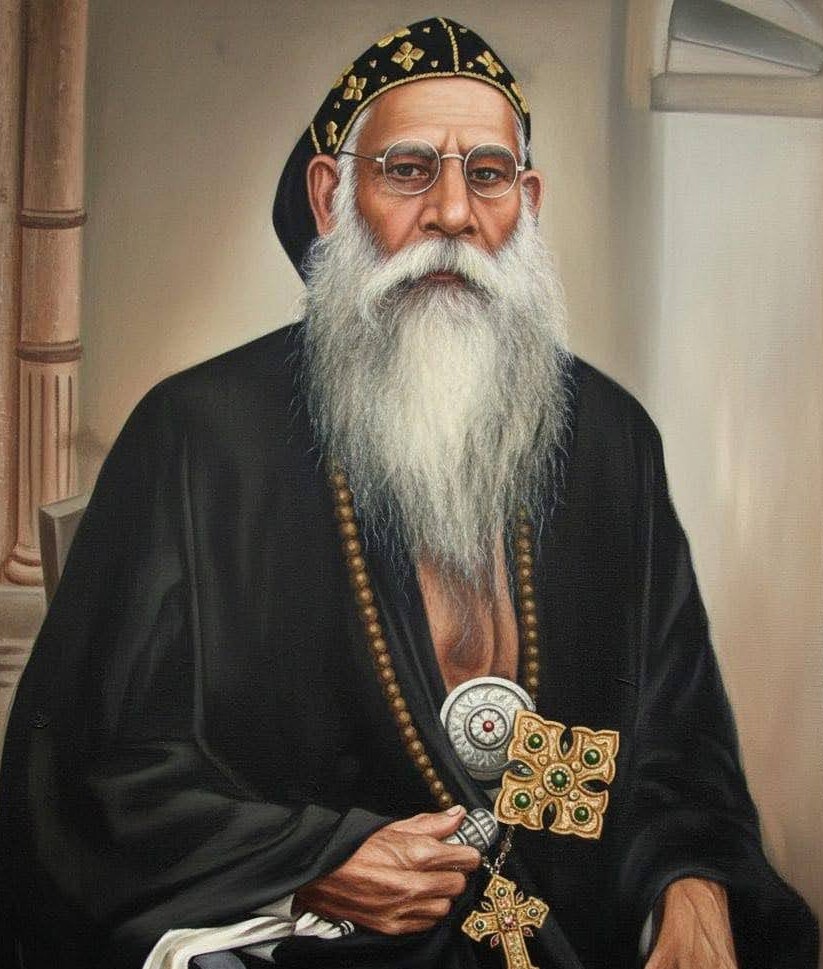
Michael Mor Dionysius, affectionately known as the "Roaring Lion of Malankara," was born on June 15,
1879, as Mikhayel, the eldest son of evangelist John of the esteemed Alummoottil family and Kilileth
Achamma in Kayamkulam, Kerala. From his earliest years, young Mikhayel exhibited an uncommon
devotion to spiritual matters and a keen intellect that would later serve him throughout his
ministry.
After completing his primary education in his native town of Kayamkulam, Mikhayel pursued his
English studies at the M.D. Seminary High School in Kottayam. His academic excellence and spiritual
fervor did not go unnoticed, and at the tender age of 18, his life took a dramatic turn when he was
personally summoned by the visiting Malankara Metropolitan, Pulikkottil Joseph Mor Dionysius. This
divine calling would set the course for a life of extraordinary service to the Church.
✝️Journey Through Holy Orders
Mikhayel's ordination as Korooyo (a reader in the church) took place on January 7, 1898, at the
hands of Mor Joseph Dionysius, marking the beginning of his formal ministry. His spiritual journey
continued when he was ordained Yaufdaikkino (subdeacon) by the revered Mor Geevarghese Gregorius
Chathuruthil in 1901/1902 at the Old Seminary. The young deacon then accompanied Mor Dionysius to
Kottayam, where he immersed himself in intensive theological studies at both the M.D. Seminary and
the Old Seminary.
His spiritual formation reached a significant milestone when he received full deaconship (Shamshono)
in M.E. 1081 (1905-1906) from Pulikkottil Mor Dionysius Joseph at Kayamkulam Kadeesa Church. Under
the guidance of these holy fathers, including the great Saint Gregorios of Parumala who had ordained
him as a full deacon, young Mikhayel's faith deepened and his understanding of ecclesiastical
matters matured.
The culmination of his journey through the diaconate came on August 30, 1908, when he was ordained
to the holy priesthood at Parumala Seminary. This momentous occasion was graced by an assembly of
distinguished hierarchs: Mor Geevarghese Dionysius served as the chief celebrant, alongside
Pulikkottil Mor Dionysius, Mor Osthatheos Sleeba (the delegate of the Holy See of Antioch), and Mor
Coorilos Paulose as co-celebrants. This sacred moment marked the beginning of Father Michael's
priestly ministry that would span nearly five decades.
📚Ministry and Service to the Church
From 1905 to 1910, Father Michael served with distinction at the M.D. Seminary in Kottayam, where he
devoted himself to the education and spiritual formation of future church leaders. During this
period, he rendered invaluable service as an active worker in several crucial spiritual
organizations, including the Sunday School movement, the Suryiani Youth Association, and the
Malankara Missionary Society. His dedication to these organizations demonstrated his vision for
comprehensive church development and the nurturing of future generations in the faith.
Father Michael's ministry extended beyond the walls of the seminary and church. He was deeply
committed to civic life and the betterment of his community, understanding that the Gospel called
for engagement with the world. He undertook significant evangelical work in and around Kayamkulam,
bringing many people into the light of Christianity through his compelling preaching and personal
witness. His voice, noted for its depth and gravity, captivated audiences and drew people to the
faith.
🛡️A Pillar of Faith During the Great Schism
When disputes erupted in the Malankara Church in the early 20th century, threatening to tear apart
the ancient community of faith, Father Michael's true character emerged with stunning clarity. As a
painful schism rent the Malankara Syrian Church apart, he faced the most difficult decision of his
life. Despite his deep personal connections and the tremendous pressure from various quarters,
Father Michael remained a steadfast and unwavering pillar of loyalty to the Holy Patriarchate of
Antioch.
This courageous stance required him to part ways with Vattasseril Mor Dionysius, who had ordained
him to the priesthood, choosing instead to uphold the unity and apostolic authority of the ancient
See of Antioch. It was a decision that cost him dearly in personal terms but demonstrated his
unwavering commitment to what he believed was the authentic apostolic tradition. His resolute
position in a time of widespread confusion and division marked him as a true defender of the faith
and earned him the sobriquet "The Roaring Lion of Malankara."
In the midst of this turmoil, Father Michael left his position at the M.D. Seminary in Kottayam and
returned to his native Kayamkulam. Rather than retreating into isolation, he turned his attention to
public service, serving as a municipal councillor for twelve years and representing Kayamkulam in
the Sree Moolam Praja Sabha, the legislative body of Travancore. Through these positions, he
continued to serve the people while maintaining his steadfast loyalty to the Patriarchate.
During the great schism in the Malankara Syrian Church, Father Michael chose loyalty to the Apostolic
See of Antioch over personal comfort and relationships, a decision that defined his legacy as a
courageous defender of apostolic tradition and earned him the title "The Roaring Lion of Malankara."
⛪Consecration as Metropolitan
In recognition of his unshakeable loyalty, leadership, and steadfast service to the Church during
its most trying period, Father Michael was selected for consecration as a Metropolitan. On September
30, 1926, he, along with Rev. Fr. Ottathaikkal Thomas (selected for the Knanaya community), departed
India to accompany Mor Yulios Elias Qoro, the delegate of the Holy See of Antioch, to Jerusalem for
their consecration. They boarded the Italian ship S.S. Pilsana from Bombay on October 6, 1926,
embarking on a journey that would forever transform their ministry.
After arriving at Port Said on October 20, 1926, they continued their sacred pilgrimage to Jerusalem
by train. His Holiness St. Ignatius Elias III was residing at St. Mark's Monastery in Jerusalem, the
ancient seat of Syriac Orthodox presence in the Holy City. In a solemn ceremony filled with
apostolic majesty, the metropolitan candidates were adorned with vestments and, holding a cross and
a lighted candle, were led inside the ancient church.
On October 20, 1926, Rev. Fr. Michael and Rev. Fr. Thomas were first ordained as Rambans (monks), a
prerequisite for episcopal consecration in the Syriac Orthodox tradition. Then, on October 27, 1926,
these two Rambans, along with Michael Ramban, a native of Mardin and the nephew of Patriarch St.
Peter III, were consecrated as Metropolitans in a historic ceremony. His Holiness Patriarch St.
Ignatius Elias III bestowed upon him the episcopal name Michael Mor Dionysius, linking him to the
great tradition of the Dionysian metropolitans who had shaped Malankara Church history.
The installation ceremony was attended by the Bishop of Jerusalem, Mor Geevarghese Gabriel, the
delegate Mor Yulios Elias, and several other priests. After their consecration, the new bishops
remained in Jerusalem for fifty days, visiting the holy places where Our Lord had walked, prayed,
suffered, and triumphed over death. This extended period of prayer and pilgrimage at the sacred
sites of Christianity deeply enriched their spiritual lives and prepared them for the challenging
ministry that awaited them.
The newly ordained bishops returned to Alwaye (now Aluva) on February 11, 1927, where they visited
Mor Osthatheos Sleeba, the delegate of Antioch, at Vadakara Church. They arrived in Kottayam on
February 12, 1927, where they were received with great joy by the faithful who remained loyal to the
Patriarchate. As a Metropolitan, Mor Dionysius became a formidable pillar of strength for the
church, guiding the faithful with wisdom and courage through one of its most challenging periods.
👑Service to the Patriarch
When His Holiness Patriarch St. Ignatius Elias III arrived in Malankara in March 1931, Mor Dionysius
Michael assumed a role of crucial importance. He served as the Patriarch's personal interpreter and
helper, facilitating communication between the Patriarch and the Malankara faithful. This position
placed him at the very center of church affairs during a critical period and demonstrated the trust
and confidence the Patriarch had in him.
Mor Michael's service to the Patriarch continued with unwavering dedication until the Patriarch's
repose on February 13, 1932. The passing of the Patriarch was a profound loss for the entire church,
but particularly for Mor Michael, who had worked so closely with him. Despite this grief, Mor
Michael continued to strengthen the faithful and maintain the connection with the Holy See of
Antioch.
🙏A Life of Simplicity and Sacrifice
Throughout his episcopal ministry, Mor Dionysius Michael was renowned for leading a life of profound
simplicity and piety that stood in stark contrast to worldly notions of ecclesiastical dignity. He
famously declared his philosophy of episcopal life: "Along with accession as the bishop, I have
taken up four things for myself: ragged clothes, torn mattress, bran pie, and plain water. I have
these and my children would provide them for me. I want to gain nothing by showing impiety to the
throne of the Holy See of Antioch."
This was no mere rhetoric but a lived reality. Mor Michael relished the ordinary man's diet of gruel
and vegetable curry, rejecting the sumptuous meals that often accompanied high ecclesiastical
office. He gave away much of his possessions and personal wealth to the poor and needy, embodying
the gospel message of charity and humility in the most practical and tangible ways. His lifestyle
was a powerful sermon without words, demonstrating that true spiritual authority comes not from
material comfort but from authentic sacrifice and service.
His pastoral care was equally extraordinary. Mor Michael visited parish churches on foot and by
ox-cart, eschewing comfortable modes of transportation to remain close to the common people. He
looked into the affairs of the people personally, made various arrangements for their welfare, and
addressed everyone by name, which endeared him deeply to the parishioners. This personal touch,
combined with his powerful preaching, created an unbreakable bond between the shepherd and his
flock.
✨Episcopal Ministry and Church Leadership
Mor Michael administered the affairs of the Diocese of Kottayam for twelve years, establishing his
headquarters at the historic Thrikothamangalam Mor Sharbeel Monastery. From this ancient center of
Syriac Orthodox spirituality, he guided the diocese through turbulent times with wisdom, firmness,
and compassion. His administrative acumen was matched by his spiritual depth, making him an
effective and beloved leader.
One of his most enduring contributions was the establishment of the Malankara Sunday School
Association, creating a vital institution for the religious education and spiritual formation of
children throughout the church. This visionary act demonstrated his profound understanding that the
future of the church depended on properly catechizing and nurturing the young in the Orthodox faith.
The Sunday School Association continues to be a cornerstone of religious education in the Malankara
Church to this day.
During his episcopate, Mor Michael ordained several priests who would themselves go on to become
significant church leaders. Among those who received priesthood from his hands were the late Mor
Yulios Yacoob (Manjanikkara), Mor Thimotheus Yacoob (Thrikkothamangalm), and Mor Ivanios Philipose
(Velloor). Through these ordinations, his influence extended far beyond his own lifetime, shaping
the leadership of the church for generations to come.
Mor Michael was known for his fearless defense of church order and discipline. He never hesitated to
admonish those who behaved defiantly in the altar or who compromised the sacred traditions of the
church. This courage, combined with his personal holiness, earned him deep respect even from those
who disagreed with him. His voice, described as having remarkable depth and gravity, commanded
attention and conveyed authority whenever he spoke.
💔Trials and Steadfastness
Mor Michael's ministry was not without profound personal sorrows. Mor Dioscorus Thomas, the Knanaya
bishop who had been ordained alongside him in Jerusalem in 1926, later shifted his allegiance to the
Roman Catholic Church. This defection was a source of deep sadness for Mor Michael, who had shared
the sacred journey to Jerusalem and the profound experience of consecration with him. Despite this
personal pain and the challenges it presented to the church, Mor Michael endeavoured to provide
courage to the believers and vigorously protested against the adversaries of the faith. His
steadfastness in the face of such betrayals only strengthened his resolve and deepened his
commitment to the Apostolic See of Antioch.
🕊️Final Days and Holy Repose
On December 15, 1955, Mor Michael delivered what would be his final public address at Panampady
Church, speaking for about one hour in connection with the feast of his beloved teacher, Mor
Coorilos Paulose. His words that day carried the weight of a lifetime of faith, struggle, and
unwavering commitment to the Church. After concluding his sermon and partaking of his meals at the
vestry, he turned to the assembled priests with prophetic words: "Dear children, I will die soon."
The priests fell silent, unable to respond to such a stark pronouncement. Finally, Rev. Fr.
Kuriakose Maliyil found his voice and replied, "We will be near you." Mor Michael's response was
simple yet profound: "That is enough." These words revealed both his acceptance of his approaching
death and his confidence in the continuing care of the church he had served so faithfully.
The very next day, Mor Michael found it difficult to swallow food, and his condition rapidly
worsened. As his health deteriorated, the holy sacrament of anointing with oil was performed,
surrounding him with the prayers and care of the Church he had loved and defended throughout his
life. His condition continued to decline, and in the early morning hours of January 18, 1956, at 3
a.m., the Roaring Lion of Malankara breathed his last, entering into the rest prepared for the
faithful servants of Christ.
Mor Phelexinos Paulose (who would later become His Beatitude Catholicos Baselios Paulose II) led the
prayers in his honour, a fitting tribute from one who would himself become a major figure in the
church. Mor Yulios Elias Qoro, the delegate who had accompanied him to Jerusalem for his
consecration nearly three decades earlier, enrobed him in canonical attire, completing the circle of
his episcopal journey. His mortal remains were kept in the church for the faithful to pay their
final homage to this beloved father in God who had guided them through so many trials.
The following day, after a funeral procession that drew countless faithful who wished to bid
farewell to their spiritual father, the burial service was completed in the afternoon. Mor Michael's
mortal remains were interred at Panampady Church in Kottayam District, Kerala, where they remain to
this day. His tomb has become a place of pilgrimage and prayer for the faithful who continue to
honor his memory and seek his intercession. His holy relics are also preserved at Chennitla Horeb
Church in Kerala, providing another site of veneration for the faithful.
🌟Legacy and Continuing Influence
The name of Mor Michael Mor Dionysius has remained an inspiration to generations of faithful
Orthodox Christians. His unwavering loyalty to the Patriarchate of Antioch during a time of
tremendous pressure and division established a model of steadfast adherence to apostolic tradition
that continues to inspire the church today. His choice to maintain communion with the ancient See of
Antioch, even at great personal cost, demonstrated that true ecclesial unity is worth any sacrifice.
His life of radical simplicity—the ragged clothes, torn mattress, bran pie, and plain water he
proudly claimed as his episcopal lifestyle—stands as a perpetual challenge to worldliness and
materialism in church leadership. In an age when ecclesiastical office sometimes brought worldly
honors and comforts, Mor Michael chose the path of voluntary poverty and identification with the
poor, embodying the kenotic spirituality at the heart of Orthodox Christianity.
The believers of his time were captivated by his powerful speeches, the depth and gravity of his
voice conveying authority and spiritual wisdom. His practice of addressing everyone by name, his
willingness to travel by foot and ox-cart to visit parishes, and his personal attention to the needs
of his flock created a model of pastoral care that emphasized accessibility and genuine relationship
over institutional distance and formality.
His establishment of the Malankara Sunday School Association represents a legacy that continues to
bear fruit today, as generations of children have received their foundational religious education
through this institution. His vision that the church's future depended on properly catechizing the
young has proven prophetic, as the Sunday School movement has become one of the most vital aspects
of church life in Malankara.
The annual feast of Mor Michael, celebrated on January 18, the anniversary of his repose, continues
to draw faithful from across Kerala and beyond. Known as the "Roaring Lion of Malankara," his memory
is invoked whenever courage in the face of adversity is needed, whenever loyalty to apostolic
tradition is tested, and whenever the church faces division or confusion. His life reminds us that
authentic spiritual authority comes not from worldly power or comfort, but from sacrificial service,
unwavering faithfulness, and genuine love for God's people.
"Along with accession as the bishop, I have taken up four things for myself: ragged clothes, torn
mattress, bran pie, and plain water. I have these and my children would provide them for me. I want
to gain nothing by showing impiety to the throne of the Holy See of Antioch." - Metropolitan Michael
Mor Dionysius
Prayer for Intercession
O Blessed Metropolitan Michael Mor Dionysius, the Roaring Lion of Malankara, who stood as an
unshakeable pillar of truth in a time of great division and shepherded your flock with extraordinary
love and simplicity, we humbly seek your holy intercession before the throne of our Lord. Pray for
us, that we may have your courage to remain loyal to the true apostolic faith in times of confusion,
your compassion for the poor and the needy, your wisdom to guide future generations, and your
willingness to sacrifice personal comfort for the sake of Christ's Church. Through your powerful
prayers before the throne of God, may our church be strengthened in unity, may divisions be healed,
and may love triumph over discord. Grant us the grace to follow your example of steadfast
faithfulness to the Apostolic See and humble service to God's people. Amen.