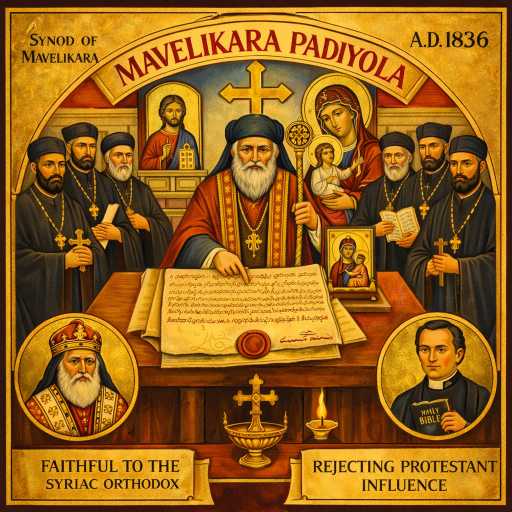
📜 What is the Mavelikara Padiyola?
The Mavelikara Padiyola is a formal ecclesiastical declaration issued in 1836
at
Mavelikara, Kerala, by the leaders of the Malankara Syrian Church under the presidency of
Cheppad Mar Dionysius IV, the Malankara Metropolitan. The term Padiyola in
Malayalam refers to a written bond, covenant, or formal resolution—often used in historical
contexts for legal and ecclesiastical documents of binding significance.
This declaration stands as a watershed moment in Malankara Church history, representing the
formal rejection of Protestant theological reforms and the reaffirmation of the ancient Syriac
Orthodox faith. It was not merely a reactive document but a positive statement of ecclesial
identity, rooted in apostolic continuity, patristic theology, and communion with the
Patriarchate
of Antioch.1
🏛️ Historical Context: The CMS Mission and Its Impact
In the early decades of the nineteenth century, the Malankara Syrian Church found itself in a
complex relationship with British colonial authorities and their religious institutions.
Following
the establishment of British dominance in Kerala, the Church Missionary Society
(CMS),
an Anglican evangelical organization, began active missionary work in the region.
Initially, the relationship between the CMS missionaries and the Malankara Church appeared
cooperative. The Church, which had long maintained ties with the Syriac Orthodox Patriarchate
of Antioch, was experiencing administrative challenges and welcomed certain forms of assistance
in education and printing. The CMS established schools, promoted vernacular literacy, and helped
print liturgical texts. However, beneath this surface cooperation lay fundamental theological
differences that would soon become irreconcilable.2
The CMS missionaries, influenced by evangelical Protestant theology, began to advocate for what
they considered "reforms" within the Malankara Church. These included:
- The removal of prayers for the departed from liturgical services
- The elimination of veneration of saints and their intercession
- Changes to sacramental theology, particularly regarding the Eucharist and priesthood
- The reduction of the role of tradition in favor of sola scriptura
- The introduction of low church liturgical practices
- Criticism of episcopal authority and apostolic succession
These proposed changes struck at the heart of Syriac Orthodox ecclesiology and liturgical life.
For a church that traced its origins to St. Thomas the Apostle and maintained unbroken communion
with the ancient Patriarchate of Antioch, such innovations represented not reform but rupture—a
departure from the faith once delivered to the saints.3
⛪ The Synod of Mavelikara (1836)
As tensions between the traditional faction and the reform-minded party intensified, the need
for a definitive ecclesiastical statement became urgent. In 1836, under the leadership of
Cheppad Mar Dionysius IV (Punnathara Dionysios), the fourth Malankara
Metropolitan, a synod was convened at Mavelikara to address the crisis facing the Church.
Mavelikara, located in the Alappuzha district of Kerala, was chosen as the venue for this
historic gathering. The synod brought together clergy and lay leaders representing the parishes
and faithful who remained committed to the apostolic faith. The assembly deliberated on the
theological deviations being promoted and the necessary response to preserve the integrity of
the Church's teaching and worship.4
Mar Dionysius IV himself was a figure of considerable stature and learning. Consecrated as
Metropolitan with the blessing of the Syriac Orthodox Patriarch of Antioch, he understood his
role as guardian of the faith handed down from the apostles. He recognized that the issues at
stake were not merely administrative or cultural but fundamentally theological—concerning the
very nature of the Church, the sacraments, and salvation itself.
✍️ The Declaration: Content and Theological Affirmations
The Mavelikara Padiyola, issued as the formal resolution of the synod, contained clear and
unambiguous declarations concerning the faith and discipline of the Malankara Church. While
the complete text of the original document has been subject to scholarly discussion, its
essential contents and theological thrust are well-established through historical records
and subsequent ecclesiastical references.
The Padiyola made the following key affirmations:
1. Adherence to Apostolic Faith
The document declared the Malankara Church's unwavering commitment to the faith received from
the apostles and preserved in the teaching of the Fathers. This included acceptance of the
Nicene Creed, the christological definitions of the first three ecumenical councils, and the
miaphysite christology articulated by St. Cyril of Alexandria and upheld by the Oriental
Orthodox tradition.5
2. Rejection of Protestant
Innovations
The Padiyola explicitly rejected the theological novelties being introduced by the CMS
missionaries. It affirmed the validity of prayers for the departed, the intercession of saints,
the sacramental nature of priesthood and episcopacy, the real presence of Christ in the
Eucharist,
and the authority of sacred tradition alongside Holy Scripture. These were not negotiable points
of ecclesiastical practice but essential elements of Orthodox faith.6
3. Preservation of Syriac Liturgy
The declaration committed the Church to maintaining its ancient Syriac liturgical heritage,
particularly the Divine Liturgy of St. James and the various offices of prayer from the
Syriac tradition. These were not mere customs but the living expression of the Church's
theological identity and spiritual life. The liturgy was understood as the repository and
teacher of the faith—lex orandi, lex credendi—and any alteration to its essential
content would constitute a departure from orthodoxy.7
4. Communion with the Patriarchate
of
Antioch
Perhaps most significantly, the Mavelikara Padiyola reaffirmed the canonical relationship
between the Malankara Church and the Syriac Orthodox Patriarchate of Antioch. This was not
a new development but the continuation of an ancient bond. The Malankara Church acknowledged
the Patriarch as its spiritual father and the source of apostolic authority, rejecting any
suggestion of independent governance that would sever this connection.8
🕊️ Theological Significance: A Defense of Orthodoxy
From the perspective of a Syriac Orthodox scholar and believer, the Mavelikara Padiyola
represents far more than a historical document or ecclesiastical resolution. It is a
confession of faith, a martyria (witness) to the truth of the Gospel as received and
preserved in the Orthodox tradition. Its significance can be understood at multiple levels:
Ecclesiological Clarity
The Padiyola articulated a clear understanding of the Church as the Body of Christ, rooted
in apostolic succession and governed by bishops in communion with one another and with the
ancient patriarchal sees. Against Protestant notions of invisible church or congregational
autonomy, it affirmed the visible, hierarchical, and sacramental nature of ecclesial life.
The Church is not a voluntary association of believers but the mystical Body of Christ,
established by the apostles and sustained through the ages by the Holy Spirit working through
the sacraments and the apostolic ministry.9
Sacramental Theology
By rejecting Protestant reinterpretations of the sacraments, the Padiyola upheld the Orthodox
understanding of divine grace operative through material elements sanctified by the Holy Spirit.
The Eucharist is not a mere memorial but the true Body and Blood of Christ. Baptism effects
regeneration, not mere symbolic cleansing. Priesthood is a sacramental order, not simply
functional leadership. These affirmations were grounded in Scripture, tradition, and the
liturgical experience of the Church through the centuries.10
The Communion of Saints
In maintaining prayers for the departed and the invocation of saints, the Padiyola expressed
the Orthodox vision of the Church as embracing both heaven and earth. Death does not sever
the bonds of love and prayer within the Body of Christ. The faithful departed remain members
of the Church, and the Church militant on earth continues in communion with the Church
triumphant in heaven. This theology of cosmic unity and mutual intercession was integral to
the Syriac Orthodox spiritual tradition and could not be abandoned without loss of essential
Christian truth.11
Authority of Tradition
Against the Protestant principle of sola scriptura, the Padiyola implicitly affirmed
the Orthodox understanding of divine revelation as transmitted through both Scripture and
Tradition. The Bible itself emerged from the Church's living tradition and must be interpreted
within that tradition under the guidance of the Holy Spirit. The Fathers, the councils, the
liturgy—all these form an organic whole through which the apostolic faith is preserved and
proclaimed. To separate Scripture from this living context is to invite distortion and
innovation.12
⚖️ Historical Consequences and Ecclesiastical Division
The issuance of the Mavelikara Padiyola did not immediately resolve the crisis facing the
Malankara Church. Instead, it formalized the theological divide between those who accepted
the traditional Orthodox faith and those who had embraced Protestant reforms. This division
would have lasting consequences for the ecclesial landscape of Kerala.
Those who aligned with the CMS missionaries and their theological innovations eventually
formed what became known as the Mar Thoma Syrian Church. This group retained
certain liturgical and cultural elements of Malankara tradition while adopting Protestant
doctrines regarding justification, the sacraments, and ecclesiastical authority. They severed
communion with the Patriarchate of Antioch and developed an independent ecclesial structure
modeled on Anglican lines.13
The traditional faction, which upheld the Mavelikara Padiyola, remained in communion with
the Syriac Orthodox Patriarchate and continued as the canonical continuation of the ancient
Malankara Church. This group understood itself not as creating something new but as
preserving what had always been—the apostolic faith, the liturgical heritage, and the
canonical order received from the time of St. Thomas and maintained through unbroken
succession and communion with Antioch.14
The division was painful and affected families, parishes, and the wider Christian community
in Kerala. Properties were disputed, loyalties tested, and relationships strained. Yet from
the Orthodox perspective, the choice was unavoidable. The integrity of the faith could not
be compromised for the sake of external unity or material advantage. As the apostolic
tradition teaches, "What fellowship hath righteousness with unrighteousness? and what
communion hath light with darkness?" (2 Corinthians 6:14).
📚 The Padiyola in Orthodox Ecclesial Memory
For subsequent generations of Syriac Orthodox faithful in Malankara, the Mavelikara Padiyola
has served as a touchstone of ecclesial identity. It is remembered not as an act of schism
but as an act of fidelity—a refusal to compromise the deposit of faith for pragmatic or
political reasons. The document stands alongside other historic declarations of Orthodox
resistance to heterodoxy, from the councils that rejected Arianism and Nestorianism to the
confessions that maintained the faith during periods of persecution and pressure.
In the liturgical and catechetical life of the Church, reference to the Mavelikara Padiyola
functions as a reminder of the cost of discipleship and the importance of doctrinal integrity.
The faithful are taught that their identity as Orthodox Christians is not a matter of ethnic
heritage or cultural preference but of theological conviction. The Padiyola exemplifies the
principle that the Church must sometimes choose the narrow way of fidelity over the broad
way of accommodation.15
Scholarly study of the Padiyola within Orthodox academic circles has emphasized its continuity
with earlier statements of Malankara ecclesiology. The document did not invent new doctrines
but articulated existing beliefs that had been threatened by external pressure. It drew upon
the canonical tradition, the patristic consensus, and the liturgical heritage to formulate
a response appropriate to the historical moment while remaining rooted in timeless truth.
🔥 Contemporary Relevance: Lessons for the Modern Church
Nearly two centuries after its promulgation, the Mavelikara Padiyola continues to speak to
contemporary challenges facing Orthodox Christians. In an age of ecumenical dialogue,
theological pluralism, and pressure to conform to prevailing cultural norms, the Padiyola
offers important lessons:
The Priority of Truth
The Padiyola demonstrates that genuine Christian unity must be based on truth, not merely
organizational consolidation or social harmony. Dialogue and cooperation with other Christian
traditions are valuable, but they cannot come at the cost of abandoning the apostolic faith.
The Church's first loyalty is to Christ and His revelation, not to human projects of unification
that require doctrinal compromise.
The Courage to Witness
The leaders who issued the Padiyola knew they would face consequences—loss of material support,
social ostracism, and ecclesiastical division. Yet they chose fidelity over convenience. This
example challenges contemporary Orthodox Christians to maintain their witness even when it
proves costly or unpopular. The Church's mission is not to accommodate the world but to
transform it through prophetic testimony to the Gospel.
The Value of Tradition
By defending the liturgical and theological tradition against innovation, the Padiyola affirmed
that tradition is not dead weight from the past but living encounter with the truth that
transcends any particular age. Each generation receives the faith from those before and has
the responsibility to transmit it faithfully to those who come after. This requires both
preservation and creative engagement, maintaining the essence while expressing it in ways
appropriate to each cultural and historical context.16
🌟 Conclusion: A Living Witness
The Mavelikara Padiyola of 1836 stands as a defining moment in the history of the Syriac
Orthodox Church in India. It was both an ending and a beginning—the formal conclusion of an
impossible attempt at theological coexistence with Protestant innovations and the beginning
of a renewed commitment to Orthodox identity rooted in apostolic faith and canonical order.
For Syriac Orthodox believers, the Padiyola is not merely a historical curiosity but a living
witness to the unchanging truth of the Gospel and the Church's responsibility to guard that
truth against all attempts at corruption or dilution. It reminds us that faithfulness sometimes
requires difficult choices, that unity without truth is hollow, and that the apostolic heritage
is worth preserving at great cost.
As we face new challenges in our own time—secularism, relativism, theological confusion—the
example of Mar Dionysius IV and the faithful who stood with him at Mavelikara calls us to
similar courage and clarity. The faith once delivered to the saints must be proclaimed,
defended, and lived in every generation. The Mavelikara Padiyola testifies that such
faithfulness is both possible and necessary, by the grace of God who preserves His Church
through all trials and temptations.
"Therefore, brethren, stand fast, and hold the traditions which ye have been taught, whether
by word, or our epistle. Now our Lord Jesus Christ himself, and God, even our Father, which
hath loved us, and hath given us everlasting consolation and good hope through grace, comfort
your hearts, and stablish you in every good word and work" (2 Thessalonians
2:15-17).17
📝 Footnotes
-
Historical definition and ecclesiastical function of the Mavelikara Padiyola as a formal
declaration of faith issued by the Malankara Syrian Church leadership in response to
Protestant theological innovations.
-
Context of British colonial presence in Kerala and the initial cooperative relationship
between the Church Missionary Society and the Malankara Church in educational and
publishing ventures.
-
Theological content of CMS reforms including rejection of prayers for the departed,
veneration of saints, sacramental theology, and traditional liturgical practices—all
fundamental to Syriac Orthodox ecclesiology.
-
Details of the 1836 Synod at Mavelikara convened under Mar Dionysius IV to address the
doctrinal crisis and formulate the Church's response to Protestant innovations.
-
Affirmation of apostolic faith including Nicene Creed, christological definitions of
early councils, and miaphysite theology as articulated by St. Cyril of Alexandria and
the Oriental Orthodox tradition.
-
Explicit rejection of Protestant doctrines and reaffirmation of prayers for departed,
intercession of saints, sacramental priesthood, real presence in Eucharist, and
authority of sacred tradition.
-
Commitment to preservation of Syriac liturgical heritage, particularly Divine Liturgy
of St. James, as living expression of theological identity and embodiment of Orthodox
faith—lex orandi, lex credendi.
-
Reaffirmation of canonical relationship with Syriac Orthodox Patriarchate of Antioch,
acknowledging Patriarch as spiritual father and source of apostolic authority in
continuation of ancient ecclesial bonds.
-
Orthodox ecclesiology affirming visible, hierarchical, sacramental nature of the Church
as mystical Body of Christ rooted in apostolic succession, against Protestant notions
of invisible church or congregational autonomy.
-
Sacramental theology upholding Orthodox understanding of divine grace operative through
material elements—Eucharist as true Body and Blood, Baptism as regeneration, Priesthood
as sacramental order—grounded in Scripture, tradition, and liturgical experience.
-
Theology of communion of saints expressing Orthodox vision of Church embracing heaven
and earth, with prayers for departed and invocation of saints as manifestation of
cosmic unity in Body of Christ.
-
Orthodox understanding of divine revelation transmitted through Scripture and Tradition
as organic whole, against Protestant sola scriptura, emphasizing role of Fathers,
councils, and liturgy in preserving apostolic faith.
-
Formation of Mar Thoma Syrian Church by reform-minded faction adopting Protestant
doctrines while retaining certain cultural elements, severing communion with
Patriarchate of Antioch.
-
Traditional faction's understanding of continuity as canonical continuation of ancient
Malankara Church, preserving apostolic faith, liturgical heritage, and communion with
Antioch through unbroken succession.
-
Role of Mavelikara Padiyola in Orthodox ecclesial memory as touchstone of identity,
exemplifying fidelity to deposit of faith and principle that Church must choose
narrow way of faithfulness over accommodation.
-
Contemporary relevance emphasizing priority of truth in unity, courage to witness
despite cost, and value of tradition as living encounter with transcendent truth
requiring both preservation and creative engagement.
-
Concluding theological reflection on Padiyola as living witness to unchanging Gospel
truth and Church's responsibility to guard apostolic heritage, calling contemporary
believers to similar faithfulness by grace of God.