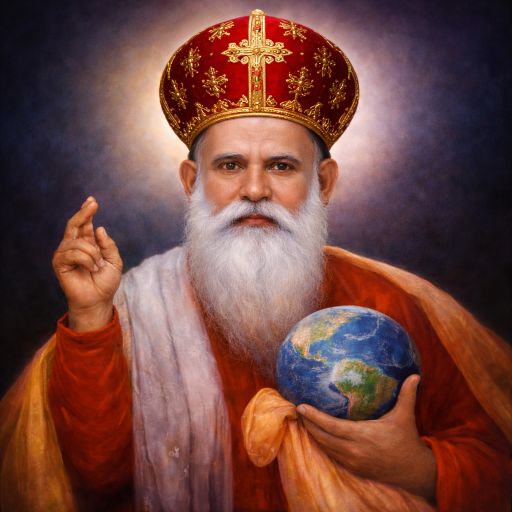
📖Arrival and the Kollam Era
Mor Sabor Iso (Syriac: Mor Sabrisho, meaning "Hope of Jesus") stands as a towering figure
in the medieval history of the Malankara Church. According to the steadfast traditions of the
Nasranis, this Holy Father, accompanied by his spiritual brother Mor Proth (Mor Aphroth), arrived at
the port city of **Kurakkeni Kollam (Quilon)** in **825 CE**.
Their arrival was not merely a missionary journey but a transformative event for the socio-political
landscape of Kerala. Historical consensus and church tradition strongly suggest that their landing
in
Kollam marked the beginning of the **Kollam Era** (Malayalam Era or Kollavarsham), a
calendar system that has defined the chronology of Kerala for over a millennium. They came from the
ancient See of the East, likely from Nineveh, bringing with them the rich liturgical and theological
heritage of the Syriac speaking world to invigorate the St. Thomas Christians.
⚖️The Tharisapalli Cheppedu
The most enduring testament to Mor Sabor Iso's influence is the **Tharisapalli Cheppedu** (Copper
Plates) of **849 CE**. During the reign of the Chera Emperor Sthanu Ravi Varma, the local ruler of
Venad, **Ayyan Adikal**, granted extensive land, rights, and privileges to the church built by Mor
Sabor Iso.
In this historic charter, the Saint is explicitly named as the beneficiary who established the
**Tharisapalli** ("Church of the God-Fearers"). The grant bestowed upon the Christians the **72
Vidperu** (Aristocratic Privileges), including the right to collect customs duties, the use of royal
insignia (such as elephants and silk umbrellas), and exemption from taxes. This elevated the
Nasranis to the status of high-caste nobility, fully integrating the Church into the social fabric
of the Chera Empire while preserving its distinct apostolic faith.
⚓Apostolic Ministry and Miracles
Mor Sabor Iso and Mor Proth traveled extensively throughout Malankara, establishing churches and
performing miracles that cemented the faith of the people. They are credited with founding or
renovating ancient churches at **Kayamkulam**, **Kadamattom**, **Akaparambu**, and
**Udayamperoor**.
Tradition holds that Mor Sabor Iso was the spiritual mentor of the legendary priest **Kadamattathu
Kathanar**, imparting to him spiritual wisdom and the power of prayer. The saint's life was marked
by deep asceticism and a profound connection to the divine, earning him the affectionate title
Sabor Abun ("Our Father Sabor") among the local population. Their ministry was a true
example of "Inculturation," where the Syriac faith flourished within the indigenous culture of
India.
🛡️The Tragedy of Diamper
For centuries, Mor Sabor and Mor Proth were venerated as saints, and their names were recited in the
*Thubden* (Diptychs) of the Malankara Church. However, the arrival of the Portuguese brought a dark
chapter. At the infamous **Synod of Diamper in 1599**, the Portuguese Archbishop Aleixo de Menezes
accused these Holy Fathers of being "Nestorian heretics" simply because they hailed from the Persian
Church and not from Rome.
The Synod decreed that their names be erased from the liturgy, their feasts abolished, and churches
dedicated to them be renamed to "All Saints" or Latin saints like Gervase and Protase. Despite this
attempt at erasing history, the faithful Nasranis never forgot their "Guardian Fathers." In the
hearts of the believers and in the oral traditions of the Jacobite Syrian Church, Mor Sabor Iso
remained a pillar of orthodoxy and sanctity.
"May the prayers of Mor Sabor Iso and Mor Proth be a stronghold for us."
The memory of these Holy Fathers, though suppressed by colonial powers, remained alive in the
silent prayers of the faithful, standing as a testament to the pre-Portuguese purity of the
Malankara Church.
✨Restoration and Legacy
Today, the Syriac Orthodox Church views Mor Sabor Iso through the lens of our shared Syriac
heritage. While historically under the East Syriac jurisdiction, his theology, liturgy, and
asceticism belong to the common treasury of the Syriac tradition. He is honored not merely as a
visitor, but as an **"Apostle to India"** (Shliha d-Hendu) for his era.
The **Tharisapalli Cheppedu**, which he received, remains the most important legal document in the
history of Christianity in India. It serves as undeniable proof that the Church in Kerala was a
wealthy, organized, and royally recognized community centuries before the arrival of European
powers. Mor Sabor Iso's legacy is the "Magna Carta" of the Nasranis—a legacy of dignity, rights, and
unwavering faith.
Prayer for Intercession
O Holy Father Mor Sabor Iso, who traversed oceans to bring the light of the Syriac faith to the
shores of Malankara, look upon us your children. You, who were the Hope of Jesus to our forefathers
and the architect of our liberties, intercede for us before the Throne of Grace.
Protect the Holy Church from all division and heresy, just as you protected the flock of Kollam in
ages past. Grant us the wisdom to cherish our ancient traditions and the courage to witness Christ
in truth. May your prayers be a fortress for us, day and night.
Amen.