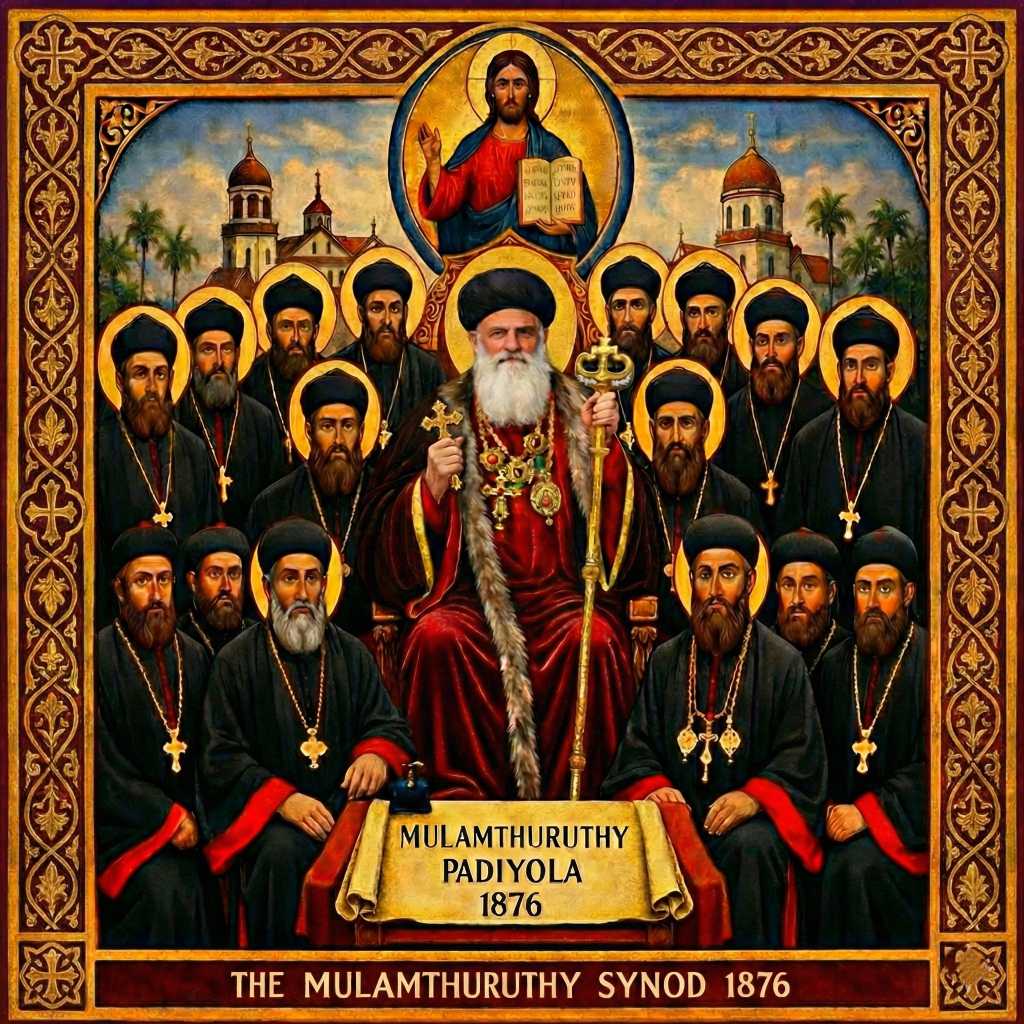
⚖️ Mulamthuruthy Synod
The Mulamthuruthy Synod was a canonical assembly convened in 1876 at Mulamthuruthy,
Kerala, under the presidency of His Holiness Ignatius Peter IV, the Patriarch
of Antioch and Supreme Head of the Syriac Orthodox Church. This was not merely a regional
administrative meeting but a patriarchal synod possessing full canonical authority within the
Syriac Orthodox ecclesial system.
The Synod represents one of the most significant moments in Malankara Church history, marking
the formal regularization of hierarchical structure, the codification of patriarchal jurisdiction
according to ancient canonical norms. The decisions
made at Mulamthuruthy and the subsequent Padiyola (formal declaration document) would
become foundational to the ecclesial identity and canonical self-understanding of the Syriac
Orthodox faithful in India for generations to come.
📜 Historical Context: The Need for Canonical Regularization
By the mid-nineteenth century, the Malankara Syrian Church found itself in a complex and often
precarious situation. Following the theological controversies surrounding the Anglican missionary
influence and the subsequent divisions formalized by the Mavelikara Padiyola of 1836, the need
for clear canonical structure became increasingly urgent.
The traditional Orthodox party, which had rejected Protestant reforms and maintained loyalty to
the Syriac Orthodox Patriarchate of Antioch, faced significant challenges. There were questions
about the precise nature of the relationship between Malankara and Antioch, disputes over
ecclesiastical properties, and the need for bishops to shepherd the growing Orthodox faithful
scattered across Kerala. The Church required not only spiritual leadership but also canonical
clarity and juridical definition.
Previous visits by Syriac prelates had provided temporary assistance, including episcopal
consecrations and liturgical support, but a comprehensive reorganization under direct patriarchal
authority had not been achieved. The arrival of Patriarch Ignatius Peter IV in India in 1875
provided the opportunity for such a definitive canonical act.
👑 Patriarch Ignatius Peter IV: The Canonical Authority
Ignatius Peter IV (Ignatius Butrus IV) served as the 109th Patriarch of Antioch
from 1872 to 1894. His pontificate was marked by pastoral journeys to the various churches under
the Antiochene jurisdiction, including the ancient Christian communities in India, Mesopotamia,
and the Middle East. He understood his role as successor to St. Peter at Antioch to involve
active shepherding of all the faithful in communion with the Apostolic See.
The Patriarch's visit to Malankara in 1875-1876 was of immense canonical significance. In Syriac
Orthodox ecclesiology and canon law, the Patriarch holds supreme authority within the bounds of
conciliarity. He is not merely a symbolic figure but possesses real jurisdictional power to
convene synods, consecrate bishops, resolve disputes, and establish canonical structures. His
presence in India was therefore not that of a foreign dignitary but of the canonical superior
exercising his legitimate authority over a portion of his flock.
When Patriarch Peter IV presided over the Synod at Mulamthuruthy, he did so with the fullness
of patriarchal authority recognized by Syriac Orthodox canon law. This meant that the decisions
of the Synod were not local preferences or regional arrangements but binding canonical acts with
universal force within the Syriac Orthodox communion.
⛪ The Juridical Nature of the Synod
1. Competent Canonical Authority
In Syriac Orthodox canon law, as in all ancient Christian traditions, there exists a hierarchical
order of authority. Local bishops possess jurisdiction within their dioceses, metropolitan bishops
coordinate regional churches, and the Patriarch exercises supreme authority over the entire
patriarchate. This structure derives from apostolic precedent and was codified in the canons of
the ecumenical councils and the particular legislation of the various patriarchal sees.
The principle is articulated in various forms throughout canonical tradition. The Apostolic Canons,
particularly Canon 34, establish that "the bishops of every nation must acknowledge him who is
first among them and account him as their head." This does not imply monarchical absolutism but
recognizes the necessity of hierarchical unity for ecclesial order and apostolic
continuity.
When Patriarch Ignatius Peter IV convoked the Synod at Mulamthuruthy, he did so as the legitimate
successor of the Apostles at Antioch, exercising the authority inherent in his office. The Synod
was therefore not a regional convention subject to confirmation by higher authority—it was
the exercise of the highest ordinary authority within the Syriac Orthodox Church. Its decisions
possessed immediate and binding canonical force.
2. Patriarchal Synod vs. Local Assembly
It is essential to distinguish between different types of synods in canonical tradition. A local
synod of clergy and laity might address pastoral concerns and make recommendations, but its
decisions require episcopal ratification. A diocesan synod, presided over by the local bishop,
has authority within that diocese. A regional synod under a metropolitan has broader scope.
Mulamthuruthy, however, was a patriarchal synod—the Patriarch himself was present
and presiding. This placed it at the highest level of ordinary ecclesiastical authority. The
parallel in other traditions would be a papal consistory in Roman Catholicism or a patriarchal
synod in Eastern Orthodoxy. Such assemblies do not merely advise but enact binding canonical
legislation.
🗺️ Key Canonical Decisions: Affirmation of Patriarchal Jurisdiction
The most foundational decision of the Mulamthuruthy Synod was the formal declaration that the
Malankara Church is spiritually and canonically subject to the Patriarch of Antioch. This was
not a new development but rather the explicit codification of an ancient relationship that had
existed, with varying degrees of regularity, since apostolic times.
1. Recognition of Hierarchical
Communion
The Synod affirmed that episcopal authority in Malankara derives from communion with the Patriarch
of Antioch. This principle is fundamental to Orthodox ecclesiology. A bishop does not possess
authority in isolation or by democratic election but receives his office through episcopal
consecration by other bishops in apostolic succession and exercises that authority in communion
with the wider Church, under the presidency of the patriarchal see.
In practical terms, this meant that bishops serving in Malankara received their canonical mission
from the Patriarch, were accountable to him for their pastoral stewardship, and could not act
independently in matters affecting the universal communion of the Church. The metropolitan of
Malankara, while possessing significant authority over the Indian diocese, functioned as the
Patriarch's representative and delegate, not as an autocephalous prelate.
2. Rejection of De Facto Autocephaly
The Mulamthuruthy declarations definitively rejected any notion that the Malankara Church could
function as an independent, self-governing entity without reference to patriarchal authority.
While practical circumstances—distance, communication difficulties, political conditions—had
sometimes necessitated greater local autonomy in administrative matters, the principle of canonical
subordination to Antioch remained inviolate.
This was not merely a question of administrative convenience but touched the very essence of
ecclesial identity. To claim autocephaly would have been to assert that Malankara constituted
a separate church rather than a diocese within the universal Syriac Orthodox Church. Such a
claim would have severed the canonical bonds that linked the Christians of Kerala to the apostolic
see of Antioch and, through Antioch, to the universal Orthodox communion.
3. Restoration of Canonical Order
The Patriarch's presence and the Synod's decisions served to regularize various irregular
situations that had arisen over the decades. Episcopal consecrations were confirmed or performed
according to proper canonical form. Liturgical practices were reviewed and corrected where
necessary. Disputed ordinations and ecclesiastical acts were adjudicated. Property rights and
parish boundaries were clarified.
This work of regularization was essential for the health and integrity of ecclesial life. Canon
law exists not as arbitrary legislation but as the Church's self-regulation according to divine
law and apostolic tradition. When canonical order breaks down, pastoral care suffers, disputes
multiply, and the witness of the Church is compromised. The Mulamthuruthy Synod addressed these
problems at their root by reestablishing clear lines of authority and accountability.
🤝 The Malankara Association: Conciliar Element in Governance
The Mulamthuruthy Synod also gave formal structure to the Malankara Association,
a representative body composed of clergy and laity that would participate in the governance of
the Church. This innovation requires careful canonical interpretation to understand its proper
role within Orthodox ecclesiology.
The Principle of Conciliarity
(Συνεργία)
Orthodox Christianity has always recognized the importance of conciliarity—the principle that
the Church's decisions should reflect the consensus of the faithful under episcopal leadership,
guided by the Holy Spirit. This is not democracy in the modern political sense but a theological
principle: the truth of the Gospel is preserved not by hierarchical decree alone but through
the symphonia (harmony) of bishops, clergy, and laity together confessing the apostolic
faith.
Throughout Church history, lay participation in ecclesial governance has taken various forms.
Laypeople participated in episcopal elections, were consulted on doctrinal controversies, and
contributed to the administration of ecclesiastical properties. The patristic dictum "what
affects all should be decided by all" (quod omnes tangit ab omnibus approbetur) reflects
this ancient tradition, though always understood within the context of sacramental
hierarchy.
The Malankara Association: Structure
and Function
The Association established at Mulamthuruthy provided a formal mechanism for clergy and lay
representatives to participate in certain aspects of Church governance, particularly those
involving administration, finance, and temporal affairs. It was structured to include delegates
from the various parishes, ensuring broad representation of the Malankara faithful.
However—and this is canonically crucial—the Association's authority was understood to be
administrative rather than sacramental or jurisdictional. It did not supersede
episcopal authority, could not override canonical decisions of bishops, and functioned under the
presidency of the metropolitan. The Association's role was consultative and administrative, not
legislative in matters of faith, worship, or holy orders.
Episcopacy Remains Ontologically
Primary
In Orthodox ecclesiology, the episcopate is not a democratic office conferred by popular vote
but a sacramental order received through apostolic succession. The bishop's authority to celebrate
the Eucharist, ordain clergy, and guard the deposit of faith derives from his consecration and
communion with other bishops, not from delegation by the laity or lower clergy.
The Malankara Association, therefore, could participate in governance but could not claim to
be the source of episcopal authority. The bishops governed the Church by virtue of their office;
the Association assisted in administration by virtue of the bishops' delegation and the people's
canonical right to participate in certain temporal matters. This distinction—between sacramental
authority and administrative participation—is essential to understanding the Mulamthuruthy
settlement correctly.
📄 The Mulamthuruthy Padiyola: A Juridical Text
The decisions of the Synod were formally recorded in the Mulamthuruthy Padiyola,
a written declaration document that would serve multiple canonical and legal functions in
subsequent decades. The term Padiyola (from Malayalam) refers to a formal written
bond or covenant with legal force.
Canonical Function
Within the Syriac Orthodox canonical system, the Padiyola functioned as a constitutio
or formal decree of a patriarchal synod. It was not merely a record of proceedings but a binding
legislative act. The clergy and faithful who subscribed to it acknowledged themselves bound by
its provisions. Those who later disputed its contents or sought to act contrary to its stipulations
were subject to canonical discipline.
The document codified the relationship between Malankara and Antioch, established the diocesan
structure, defined the role of the metropolitan and the Association, and settled various disputed
questions about property, liturgy, and ecclesiastical protocol. It became, in effect, the
constitutional charter of the modern organized Malankara Syriac Orthodox Church.
Legal Function in Civil Courts
The Padiyola would later prove critically important in civil litigation. During the twentieth
century, disputes over church properties and ecclesiastical authority came before Indian courts.
In these cases, the Mulamthuruthy Padiyola served as documentary evidence of the constitutional
arrangements agreed upon by the Malankara community in 1876.
Indian courts, applying principles of trust law and religious freedom, have repeatedly examined
the Padiyola to determine the intended governance structure of the Church and the rights of
various parties to ecclesiastical properties. The document has been cited in numerous judgments,
including landmark Supreme Court cases that shaped the relationship between religious communities
and the Indian state.
Theological Witness
Beyond its juridical and legal functions, the Padiyola serves as a theological witness to the
faith and ecclesial identity of the Malankara Syriac Orthodox community. It testifies to the
community's commitment to apostolic succession, sacramental theology, conciliar governance, and
communion with the ancient Patriarchate of Antioch. It stands as a public confession of Orthodox
faith in an age of confusion and theological controversy.
✝️ Ecclesiological Significance: An Orthodox Perspective
From the perspective of a Syriac Orthodox scholar, theologian, and believer, the Mulamthuruthy
Synod of 1876 represents far more than an administrative reorganization. It was a profound
ecclesiological event with lasting theological significance. Its importance can be understood
at several levels:
1. Apostolic Continuity
The Synod reaffirmed the apostolic continuity of the Malankara Church through its connection
with Antioch. Orthodox Christianity holds that the Church's identity is not self-generated but
received through succession from the apostles. The bishops of the Church today stand in an
unbroken line stretching back to the apostolic era. Antioch, as one of the ancient patriarchal
sees and the city where the disciples were first called Christians (Acts 11:26), holds a special
place in this apostolic memory.
By formally acknowledging patriarchal jurisdiction, Mulamthuruthy testified that the Malankara
Church's apostolic heritage flowed through Antioch. The Indian Christians were not an isolated
community claiming apostolic foundation on their own authority but were part of the universal
Orthodox Church, connected through canonical bonds to one of the most ancient centers of
Christianity.
2. Sacramental and Anti-Protestant
Ecclesiology
The Synod's decisions strengthened sacramental theology and apostolic episcopacy against competing
Protestant ecclesiological models that had influenced some in Malankara. Protestant traditions
generally view church structure as a matter of human organization rather than divine institution,
and they often reduce ministry to functional leadership rather than sacramental office.
The Mulamthuruthy settlement, by contrast, reaffirmed the Orthodox understanding that the Church's
structure is not optional but essential. The episcopate is not a convenient administrative
arrangement but a gift of the Holy Spirit instituted by Christ through the apostles. Bishops
are successors to the apostles not merely in teaching but in sacramental authority. They alone
can ordain priests and deacons, consecrate churches, and chrismation. They are, in the words
of St. Ignatius of Antioch, "as Jesus Christ" to their people.
3. Rejection of Congregationalism
By establishing diocesan structures and affirming hierarchical authority, the Synod rejected
congregationalist models of church governance. Congregationalism, which vests authority in the
local assembly of believers, may appeal to democratic sensibilities but lacks foundation in
apostolic tradition. The early Church was governed by bishops, presbyters, and deacons in a
hierarchical structure under the presidency of the apostles and their successors.
Mulamthuruthy made clear that authority in the Malankara Church was not vested in local parish
assemblies or even in a democratic confederation of parishes but in the apostolic episcopate
acting in hierarchical communion. This protected the Church from fragmentation and preserved
its catholicity—its universal character as one body across space and time.
4. Balance of Authority and
Conciliarity
The establishment of the Malankara Association demonstrated that hierarchical authority does
not negate conciliar participation. Orthodoxy has always avoided both papal absolutism and
democratic egalitarianism, seeking instead a middle path in which bishops govern with the
counsel and consent of clergy and laity, guided by the Holy Spirit working through the whole
body of the faithful.
The Synod's structure reflected this principle. The Patriarch presided with full authority,
but the decisions were made in synod with other bishops and representatives of the faithful.
The Association would provide ongoing participation, but within the framework of episcopal
leadership. This balance is difficult to maintain in practice and has been the source of much
subsequent controversy, but the principle itself is deeply Orthodox and was clearly articulated
at Mulamthuruthy.
⚔️ Later Canonical Controversies and Interpretations
The Mulamthuruthy Synod, despite its clarity and canonical weight, did not end all disputes
in Malankara Church history. Indeed, the twentieth century saw intense conflicts over the
interpretation and application of the Synod's decisions. These controversies reveal both the
enduring importance of Mulamthuruthy and the challenges of maintaining canonical order in
complex historical circumstances.
The Patriarch vs. Catholicos Question
Beginning in the early twentieth century, a movement emerged within Malankara seeking to
establish a Catholicos—an independent prelate who would govern the Indian Church with full
authority, reducing or eliminating patriarchal jurisdiction. This movement eventually succeeded
in having a Catholicos consecrated (Baselios Geevarghese I in 1912 and subsequently Baselios
Geevarghese II in 1964), leading to protracted ecclesiastical and legal battles.
The autocephalist or autonomist party argued that Malankara had always enjoyed substantial
independence, that the Patriarch's authority had been administrative rather than jurisdictional,
and that the Malankara Association possessed supreme governing authority under a Catholicos
rather than under patriarchal oversight.
The patriarchal party, in contrast, argued that Mulamthuruthy had definitively established
the Patriarch of Antioch as the supreme canonical authority over Malankara, that any Catholicos
could function only as a delegate of the Patriarch, and that attempts to sever this relationship
constituted schism from the Syriac Orthodox Church.
Canonical Interpretation from
Antiochene Perspective
From a strict Antiochene canonical reading, Mulamthuruthy constitutes a formal, explicit, and
binding acknowledgment of patriarchal jurisdiction over Malankara. The Synod was presided over
by the Patriarch himself, the decisions were made under his authority, and the Padiyola clearly
stated that Malankara was under the spiritual and canonical authority of Antioch.
Any subsequent attempt to establish an independent Catholicos or to claim autocephaly would
therefore require either: (a) formal canonical release from the Patriarch of Antioch, (b)
recognition as an autocephalous church by the wider Oriental Orthodox communion, or (c) a new
synodal act with patriarchal approval modifying the Mulamthuruthy arrangements. Absent such
formal canonical processes, unilateral declarations of independence would constitute schism
from the canonical order established in 1876.
Court Cases and Civil Law
Interpretation
The ecclesiastical disputes eventually reached the civil courts, with both factions claiming
rightful authority over church properties and seeking legal recognition. Major court cases,
including those decided by the Kerala High Court and the Supreme Court of India, examined the
Mulamthuruthy Padiyola and other historical documents to determine the constitutional structure
of the Church.
Different courts at different times reached varying conclusions, sometimes favoring the
patriarchal interpretation, sometimes favoring various forms of autonomy. These legal judgments,
while binding in civil law, cannot resolve the underlying canonical and theological questions,
which must ultimately be adjudicated within the Church's own canonical structures according to
Orthodox ecclesiology.
📚 The Enduring Legacy of Mulamthuruthy
Despite subsequent controversies and divisions, the Mulamthuruthy Synod of 1876 remains a
watershed moment in Malankara Church history and a defining reference point for understanding
Syriac Orthodox identity in India. Its legacy can be seen in multiple dimensions:
Canonical Foundation
For those who have remained in communion with the Patriarchate of Antioch—the Jacobite Syrian
Christian Church—Mulamthuruthy serves as the canonical foundation of their ecclesial structure.
The diocesan organization, the relationship with the Patriarch, and the role of the metropolitan
all trace back to the decisions made in 1876. The Synod is not merely a historical event but
a living constitutional charter.
Theological Identity
The Synod articulated a clear theological identity for the Malankara Syriac Orthodox faithful:
they are Orthodox Christians in the Antiochene tradition, governed according to ancient canons,
maintaining apostolic succession and sacramental theology, and participating in the universal
Oriental Orthodox communion through their bond with the Patriarchate. This identity has been
preserved and transmitted through liturgy, catechesis, and canonical practice.
Historical Witness
For scholars and historians, Mulamthuruthy provides invaluable documentation of nineteenth-century
Malankara Church life and the process of canonical regularization. It reveals how ancient
apostolic churches navigate the challenges of modernity, colonial influence, and internal
tensions while striving to maintain their traditional identity and structure.
🌟 Conclusion: Canonical Order and Apostolic Faithfulness
The Mulamthuruthy Synod of 1876, presided over by His Holiness Patriarch Ignatius Peter IV,
stands as a monumental act of canonical regularization and ecclesial renewal. It was not a
rupture with the past but a reaffirmation and strengthening of ancient bonds. It was not an
innovation but a restoration of proper canonical order according to apostolic tradition.
From the perspective of Syriac Orthodox theology and canon law, Mulamthuruthy accomplished:
- Formal recognition of patriarchal jurisdiction as the constitutional principle of Malankara
Church governance
- Establishment of territorial dioceses according to ancient canonical norms
- Creation of conciliar structures balancing hierarchical authority with participatory governance
- Codification of these arrangements in the Padiyola, providing canonical and legal continuity
- Strengthening of apostolic identity and sacramental ecclesiology against competing models
For Syriac Orthodox believers today, the Synod remains a touchstone of canonical legitimacy
and apostolic continuity. It testifies to the wisdom of the Church's ancient structures, the
importance of hierarchical communion, and the possibility of maintaining Orthodox identity
in challenging historical circumstances. As the Church faces new challenges in the twenty-first
century, the principles articulated at Mulamthuruthy—fidelity to apostolic tradition, canonical
order, conciliar governance, and communion with the universal Church—remain as relevant and
necessary as ever.
The words of St. Paul to the Corinthians, chosen as the scriptural motto for this page, capture
the spirit of Mulamthuruthy: "Let all things be done decently and in order" (1 Corinthians 14:40).
The Synod was an exercise in establishing proper order—not for the sake of bureaucratic
neatness, but so that the Gospel might be proclaimed, the sacraments celebrated, and the
faithful shepherded according to the pattern handed down by the apostles and preserved in the
Orthodox tradition through the centuries.
Convened by the Holy Father:
St. Ignatius Peter IV, Patriarch of Antioch and All the East, who preserved the church in the true
faith by destroying the royal support of Mathews Athanasius, who was acting to introduce the
reformed teachings into the true faith of the Jacobite Syrian Church and defeating the Metropolitan
Mar Joseph Dionysius, appointed by the Holy Apostolic See of Antioch, with the backing of royal
power.
Metropolitans Present:
- Mor Gregorios Abdulla of Jerusalem.
- Mor Joseph Dionysius of Malankara.
Key Organizer:
Geevarghese Rambachan of Chathuruthy from the Mulamthuruthy parish (Holy Kochu Thirumeni), who was
the private secretary to the Holy Patriarch Bava.
Notice/Bull of the Holy Father:
In the bull dated 1876 (1051) Edavam 22, it was announced that a Synod to discuss and decide on the
general spiritual matters of our church would be convened on the coming Mithunam 15 at the
Mulamthuruthy church established in the name of St. Thomas the Apostle.
Participating Churches:
1. Angamaly Akaparambu, 2. Niranam, 3. Arthat, 4. Pallikkara, 5. Manarcad, 6. Mamalassery, 7.
Piravom, 8. Chiramoola, 9. Makamkunnu, 10. Kunnamkulam Puthenpally, 11. Keezhvaillur, 12. Kundara,
13. T Puthenpally, 14. Onakkoor, 15. Vengoor, 16. Pothanicad, 17. Mulakulam, 18. Thekkan Paravoor,
19. Puttumanoor, 20. Vadakara, 21. Kurinji, 22. Kottoor, 23. Kolenchery, 24. Kanyattunirappu, 25.
Cherai, 26. Pariyaram, 27. Nadamel, 28. Marady, 29. Chathannoor, 30. Rakkad, 31. Pandalam, 32.
Pampakuda, 33. Pazhanji, 34. Kandanad, 35. Manthuruthel, 36. Kochikottayil, 37. Kunnakurudi, 38.
Ramamangalam, 39. Ranni, 40. Thiruvalla Valiyapally, 41. Kuttichi, 42. Nellikkel, 43. Ayiloor, 44.
Kattoor, 45. Mallappally, 46. Kallissery, 47. Pampady, 48. Nalunnakkal, 49. Kaippattoor, 50.
Omallur, 51. Kadamattam, 52. Thumpamon, 53. Koodassanad, 54. Chandanapally, 55. Puthuppally, 56.
Kottayam Valiyapally, 57. Chelakkara, 58. Thuruthicad, 59. Peechanicad, 60. Mazhuvannoor, 61.
Chempu, 62. Neelamperoor, 63. Puthencavu, 64. Kuruppampady, 65. Chennithala, 66. Chengannur, 67.
Kothamangalam, 68. Kumarakom, 69. Kottappady, 70. Kallooppara, 71. Kallunkathara, 72. Mavelikara
Thazhakkara, 73. Palakuzha, 74. Cheppad, 75. Karingachira, 76. Pallipad, 77. Karichal, 78.
Veliyanad, 79. Thuruthippi, 80. Parumala, 81. Vakathanam, 82. Puthussery, 83. Pallom, 84. Kottayam
Cheriyapally, 85. Kothamangalam Cheriyapally, 86. Manarcad, 87. Mavelikara Puthiyakavu, 88.
Mulamthuruthy, 89. Cherai, 90. Kottayam Puthenpally, 91. Karakkal, 92. Thalavadi Kizhakkekkara, 93.
T Kuzhipally, 94. Kattanam, 95. Veeyapuram, 96. Karuvatta, 97. Anumpampal, 98. Thiruvalla
Kattappurathu, 99. Neyyoor, 100. Chalissery, 101. Chengulam, 102. Kayamkulam, 103. Kannankode.
Priests - 130, Laymen - 144 (From the document submitted as EL number on 13-8-92). The
aforementioned churches are bound to honor the pledge made by their fathers.