📖Biblical Foundation and Textual Tradition
The sending forth of the Seventy Disciples stands as one of the most significant missionary
commissioning events in the Gospel narrative, recorded uniquely in the Gospel according to St. Luke
(10:1-24). This sacred account preserves for us our Lord's expansion of the apostolic mission beyond
the Twelve, establishing a wider circle of witnesses who would carry the Gospel to "every city and
place where He Himself was about to go." In the economy of divine revelation, this commissioning
reveals the abundant provision of laborers for God's harvest and the establishment of a hierarchical
yet collaborative ministry that would characterize the Church throughout the ages.
The Gospel of St. Luke recounts that "the Lord appointed seventy others and sent them on ahead of
him, two by two, into every town and place where he himself was about to go" (Luke 10:1). This
appointment was not arbitrary but deliberate, structured, and imbued with profound theological
significance. These were not casual followers but chosen disciples, selected by our Lord Himself for
a specific mission that would prepare the way for His own ministry and ultimately extend the reach
of the Kingdom beyond the confines of the Twelve Apostles.
Within the living tradition of the Syriac Orthodox Church, preserved faithfully from apostolic times
through an unbroken chain of episcopal succession and liturgical memory, the Seventy Disciples hold
a place of special honor and veneration. They are commemorated liturgically, invoked in prayer, and
recognized as the second tier of apostolic authority—after the Twelve, yet before the wider body of
believers. Their witness forms part of the foundation upon which the Church is built, their labors
contributing to the spread of the Gospel in the earliest and most critical phase of Christian
history.
🔢The Textual Question: Seventy or
Seventy-Two?
The ancient manuscripts present a textual variant that has engaged Christian scholars for centuries:
did our Lord send forth seventy disciples (ἑβδομήκοντα) or seventy-two (ἑβδομήκοντα δύο)? This is
not merely an academic curiosity but touches upon questions of textual transmission, liturgical
tradition, and typological interpretation that have profound implications for how we understand this
commissioning.
The Syriac Orthodox tradition, following the Peshitta—our ancient and venerable Syriac
translation of the Holy Scriptures dating to the 2nd century—consistently renders this number
as seventy (ܫܰܒܥܺܝܢ, shab'in). This reading is not arbitrary but reflects the textual
witness of the Syriac-speaking churches from the earliest times, preserved in manuscripts that rival
and in some cases predate the Greek witnesses. The Peshitta, translated when Syriac was the living
language of the faithful in Mesopotamia and Syria, maintains this reading with remarkable
consistency across all known manuscripts.
This reading of "seventy" is also found in significant Greek manuscripts including Codex Sinaiticus
(in its original hand), Codex Vaticanus, and many others. The Church Fathers, both Eastern and
Western, frequently refer to "the Seventy" in their homilies, commentaries, and theological
treatises. St. John Chrysostom, St. Cyril of Alexandria, St. Ephrem the Syrian, and numerous other
patristic witnesses consistently employ this number, suggesting it was the dominant reading in the
early Church.
The alternative reading of "seventy-two" appears in some Greek manuscripts, including Codex
Alexandrinus and Codex Bezae, and is defended by some Church Fathers including St. Jerome in the
Latin Vulgate. Both readings have ancient attestation, and both have been maintained in different
branches of Christian tradition. Modern critical editions of the Greek New Testament generally favor
"seventy-two" on text-critical grounds, though acknowledging the strong support for "seventy."
However, the Syriac Orthodox Church, trusting in the apostolic witness preserved in our
ancient Peshitta and in the consistent testimony of our liturgical tradition, maintains the
reading of "seventy." This is not stubbornness or ignorance of the textual evidence,
but a recognition that the Holy Spirit has guided the Church in preserving the authentic text, and
that the witness of the Syriac-speaking churches—who spoke the very language of our Lord—deserves
particular weight in this matter.
✡️Typological Significance of the Number
Seventy
The number seventy resonates throughout the sacred Scriptures with profound typological and
symbolic meaning, connecting the mission of the Seventy Disciples to the broader narrative of God's
redemptive work in history. Our Lord, as the Divine Wisdom incarnate, did nothing by chance; every
detail of His earthly ministry, including the number of disciples appointed, carries theological
significance.
The Seventy Elders of Moses: The most direct Old Testament parallel is found in
Numbers 11:16-25, where the Lord commanded Moses to gather seventy elders of Israel. Upon these
seventy the Spirit of the Lord descended, enabling them to share Moses' burden of leadership and to
prophesy. This established a pattern of shared ministry under a primary leader—Moses prefiguring
Christ, the seventy elders prefiguring the Seventy Disciples. Just as the seventy elders helped
Moses shepherd Israel, so the Seventy Disciples would help Christ shepherd the New Israel, the
Church.
The Seventy Nations: According to the traditional Jewish interpretation of Genesis
10 (the Table of Nations), there are seventy nations descended from Noah's three sons, representing
the totality of humanity dispersed after Babel. The Septuagint actually lists seventy-two nations
(which may explain the variant reading in Luke), but the Hebrew text counts seventy. By appointing
seventy disciples, our Lord symbolically declared His mission to all nations, not merely to Israel.
The Gospel would be preached to every people and tongue, fulfilling the promise to Abraham that in
his seed all the nations of the earth would be blessed.
The Seventy Members of the Sanhedrin: The great council of Israel consisted of
seventy elders (plus the High Priest making seventy-one), who governed religious and civil affairs.
Christ's appointment of seventy disciples may have been, in part, a prophetic statement about the
establishment of a New Covenant governance structure—not based on genealogical descent or Levitical
priesthood, but on apostolic calling and spiritual endowment.
The Seventy Years of Exile: Israel's captivity in Babylon lasted seventy years
(Jeremiah 25:11-12, Daniel 9:2), a period of judgment but also of preservation and eventual
restoration. The sending of seventy disciples may echo this theme of exile and return, as Christ
came to gather the scattered sheep of Israel and to end the spiritual exile caused by sin, bringing
His people home to the Kingdom of God.
The Seventy Palms of Elim: When the Israelites journeyed through the wilderness,
they came to Elim, "where there were twelve springs of water and seventy palm trees" (Exodus
15:27). The twelve springs corresponded to the twelve tribes (and prefigured the Twelve Apostles),
while the seventy palms provided shade and refreshment for the people. Similarly, the Seventy
Disciples would provide spiritual refreshment and shelter for the people of God as they journeyed
toward the heavenly promised land.
These typological connections demonstrate that our Lord's choice of seventy disciples was far from
arbitrary. It connected His mission to the entire sweep of salvation history, from the patriarchs
through Moses, the prophets, and the exile, pointing toward the universal scope of redemption and
the establishment of the New Covenant people of God.
🎯The Mission and Instructions of the
Seventy
The instructions our Lord gave to the Seventy Disciples reveal the nature of apostolic mission, the
principles of evangelistic work, and the spiritual warfare involved in proclaiming the Kingdom of
God. These directives, recorded with careful detail in Luke 10:2-16, establish patterns that would
guide the Church's missionary endeavors for all subsequent generations.
"The harvest is plentiful, but the laborers are few; therefore pray earnestly to the Lord of
the harvest to send out laborers into his harvest" (Luke 10:2). Our Lord begins not
with strategy but with prayer. The expansion of the Kingdom is ultimately God's work, not ours. The
harvest—souls ready to receive the Gospel—already exists, prepared by the Father. What is needed are
laborers willing to gather it. The Seventy themselves were the answer to this prayer, yet they were
commanded to continue praying for more laborers, teaching us that the work of evangelism is never
complete and always requires more workers.
"Go your way; behold, I am sending you out as lambs in the midst of wolves" (Luke
10:3). This stark warning prepared the disciples for opposition, persecution, and
danger. They would not go as conquerors with worldly power, but as vulnerable witnesses armed only
with the Gospel. The image of lambs among wolves deliberately evokes weakness meeting strength,
innocence confronting predation. Yet this apparent vulnerability is actually the strength of the
Gospel—it conquers not by force but by witness, not by coercion but by transformation.
"Carry no moneybag, no knapsack, no sandals, and greet no one on the road" (Luke
10:4). These instructions emphasized total dependence on God's provision and urgent
focus on the mission. The disciples were to travel light, unburdened by material concerns, trusting
that "the laborer deserves his wages" (Luke 10:7) and that faithful believers would provide for
their needs. The prohibition against lengthy greetings on the road (which in Middle Eastern culture
could consume considerable time) underscored the urgency of their task—they were not on a leisurely
journey but on a divine mission with eternal consequences.
"Whatever house you enter, first say, 'Peace be to this house!' And if a son of peace is
there, your peace will rest upon him. But if not, it will return to you" (Luke 10:5-6).
The greeting of peace (שָׁלוֹם, shalom in Hebrew; ܫܠܳܡܳܐ, shlama in Syriac) was not mere courtesy but
a prophetic pronouncement carrying spiritual power. Where received by "a son of peace"—one chosen by
God to receive the Gospel—this peace would bring blessing, reconciliation, and salvation. Where
rejected, it would return to the messenger undiminished, for God's word never fails of its purpose.
"Remain in the same house, eating and drinking what they provide, for the laborer deserves
his wages. Do not go from house to house" (Luke 10:7). This instruction served multiple
purposes: it prevented the appearance of constantly seeking better accommodations (which would
suggest greed or discontent), it fostered deeper relationships with host families who could become
pillars of the emerging church, and it enabled the disciples to establish a stable base for ministry
in each town rather than constantly moving about.
"Heal the sick in it and say to them, 'The kingdom of God has come near to you'" (Luke
10:9). The proclamation of the Kingdom was to be accompanied by demonstrable signs of
its reality. Healing the sick manifested God's compassion and power, confirmed the authority of the
messengers, and provided a tangible glimpse of the restored creation that the Kingdom would bring.
Word and deed, preaching and healing, proclamation and demonstration—these were inseparable in
apostolic mission.
"But whenever you enter a town and they do not receive you, go into its streets and say,
'Even the dust of your town that clings to our feet we wipe off against you. Nevertheless know
this, that the kingdom of God has come near'" (Luke 10:10-11). The symbolic act of
shaking off the dust was a solemn testimony against those who rejected the Gospel. It declared that
the messengers had fulfilled their responsibility; the guilt of rejection now rested upon those who
refused to hear. Yet even in judgment, the witnesses proclaimed that the Kingdom had drawn near—the
offer had been genuine, the opportunity real, the rejection therefore culpable.
"I tell you, it will be more bearable on that day for Sodom than for that town" (Luke
10:12). Our Lord pronounced severe judgment upon cities that rejected the Seventy,
specifically naming Chorazin, Bethsaida, and Capernaum (Luke 10:13-15). These cities had witnessed
Christ's own mighty works yet remained impenitent. Their greater privilege brought greater
responsibility; their rejection of manifest grace incurred proportionately severe judgment. This
sobering reality reminds us that the Gospel, when proclaimed with power and clarity, brings not only
the offer of salvation but also the necessity of decision and the consequences of rejection.
"The one who hears you hears me, and the one who rejects you rejects me, and the one who
rejects me rejects him who sent me" (Luke 10:16). This remarkable statement conferred
upon the Seventy Disciples an extraordinary authority. They were not merely messengers delivering
information; they were representatives bearing the very authority of Christ Himself, and through
Him, the authority of the Father. To accept or reject them was to accept or reject Christ. This
establishes the principle of apostolic succession and representative authority that has
characterized
the Church throughout history—those sent by Christ, and those whom they in turn send, bear His
authority when they faithfully proclaim His Gospel.
⚡The Joyful Return and Christ's Response
After completing their mission, the Seventy returned to our Lord with joy, exclaiming, "Lord, even
the demons are subject to us in your name!" (Luke 10:17). Their astonishment reveals that they had
experienced spiritual power beyond their expectations. The authority Christ had given them proved
effective not only in healing the sick and proclaiming the Kingdom, but even in confronting and
vanquishing demonic powers.
Our Lord's response to their joy is profoundly instructive, containing both affirmation and
correction, both revelation and warning: "I saw Satan fall like lightning from heaven.
Behold, I have given you authority to tread on serpents and scorpions, and over all the power of
the enemy, and nothing shall hurt you. Nevertheless, do not rejoice in this, that the spirits
are subject to you, but rejoice that your names are written in heaven" (Luke
10:18-20).
This response contains several layers of meaning that the Church Fathers have pondered deeply:
The Fall of Satan: Christ's statement "I saw Satan fall like lightning from heaven"
has been interpreted in multiple ways by the Fathers. Some see it as referring to Satan's original
fall from glory through pride, when he who was once Lucifer (light-bearer) became the adversary.
Others understand it as a prophetic vision of Satan's defeat through Christ's Passion, death, and
Resurrection. Still others interpret it as Christ witnessing Satan's defeat in real-time as the
Seventy exercised authority over demons in His name—each exorcism being a reenactment and
manifestation of Satan's ultimate overthrow. The Syriac tradition generally embraces all three
interpretations as complementary facets of one truth: Satan's power was broken at his initial
rebellion, is being broken through the ministry of Christ and His disciples, and will be fully
manifested as broken at the final judgment.
Authority Over the Enemy: The promise of authority "to tread on serpents and
scorpions, and over all the power of the enemy" echoes Genesis 3:15, where God promised that the
seed of the woman would crush the serpent's head. In Christ and through His disciples, this promise
finds fulfillment. The authority given is comprehensive—"all the power of the enemy"—and
protective—"nothing
shall hurt you." This does not mean immunity from physical suffering or martyrdom (as Church history
would abundantly demonstrate), but rather that no spiritual harm, no ultimate defeat, no final
separation from God's love can befall those who labor in Christ's name and under His protection.
The Greater Joy: Yet Christ redirects their rejoicing from power over demons to a
greater cause for joy—that their names are written in heaven. This is the ultimate blessing, the
surpassing grace, the pearl of great price. To have one's name inscribed in the Lamb's Book of Life,
to be numbered among the elect, to be assured of eternal salvation—this transcends all earthly
accomplishments and all spiritual gifts. Spiritual power can become a source of pride, a temptation
to vainglory, a stumbling block to humility. But the knowledge of one's salvation, received as pure
gift rather than earned achievement, produces genuine humility and lasting joy.
St. Ephrem the Syrian, in his commentary on this passage, notes that Christ teaches His disciples to
prioritize being over doing, identity over activity, grace over gifts. "Many will say to me in that
day, 'Lord, Lord, did we not prophesy in your name, and cast out demons in your name, and do many
mighty works in your name?'" (Matthew 7:22). Yet Christ will declare to some of these, "I never knew
you; depart from me, you workers of lawlessness." Spiritual gifts without relationship, ministry
without communion, power without love—these profit nothing. The Seventy must learn, and we with
them, that our joy rests not in what we can do for God but in what God has done for us in Christ.
🌟Identity of the Seventy: The Church's Living
Memory
While the canonical Gospels do not provide a complete list of the Seventy Disciples by name, the
Church has preserved through apostolic tradition and patristic testimony the identity of many of
these blessed witnesses. The Syriac Orthodox Church, drawing upon ancient sources including the
writings of Hippolytus of Rome (2nd-3rd century), Dorotheus of Tyre (3rd-4th century), and our own
Syriac fathers, maintains a traditional list that has been transmitted through liturgical
commemoration and hagiographical literature.
It is crucial to understand that this list represents the Church's living memory—not inspired
Scripture requiring assent of faith, but reliable tradition deserving respect and attention. Some
names appear across multiple ancient sources with remarkable consistency, suggesting historical
reliability. Others appear in some lists but not others, reflecting the limitations of historical
transmission. The Syriac Orthodox Church does not claim absolute certainty regarding every name but
trusts that the Holy Spirit has preserved through the Church's memory those whom it is beneficial
for us to know and honor.
Among the Seventy, several became prominent figures in the apostolic and sub-apostolic Church,
serving as bishops, evangelists, and martyrs. These include:
St. Barnabas – A Levite from Cyprus, companion of St. Paul, and according to
tradition author of the Epistle of Barnabas. He played a crucial role in integrating Gentile
converts into the Church and established churches throughout Cyprus and Asia Minor.
St. Mark the Evangelist – Author of the Second Gospel, companion of both St. Peter
and St. Paul, and founder of the Church of Alexandria. He is particularly venerated in the Syriac
tradition for his role in bringing the Gospel to Egypt and establishing one of the great apostolic
sees.
St. Luke the Evangelist – The beloved physician, author of the Gospel bearing his
name and the Acts of the Apostles, and faithful companion of St. Paul. His Gospel is our primary
source for the account of the Seventy's mission, perhaps because he was himself among them.
St. Clement of Rome – According to tradition, one of the Seventy and later the
fourth Bishop of Rome (after Linus, Anacletus, and following Peter). His epistle to the Corinthians
(c. 96 AD) is one of the earliest Christian writings outside the New Testament.
St. Apollos – The eloquent Alexandrian Jew, "mighty in the Scriptures," who was
instructed more perfectly by Aquila and Priscilla and became a powerful evangelist in Corinth,
working alongside St. Paul.
St. Stephen the Protomartyr – Though primarily known as one of the Seven Deacons
(Acts 6), some traditions number him among the Seventy, recognizing that his ministry and witness
extended beyond the diaconal service to full apostolic preaching.
St. Philip the Deacon – One of the Seven, who evangelized Samaria and baptized the
Ethiopian eunuch (Acts 8). Like Stephen, some traditions count him among the Seventy, though
distinguishing him from Philip the Apostle.
St. Silas (Silvanus) – Companion of St. Paul, co-author of several epistles, and a
leading prophet and teacher in the Jerusalem church who helped convey the decisions of the
Jerusalem Council to Gentile believers.
St. Timothy – Paul's beloved spiritual son and co-worker, bishop of Ephesus,
recipient of two canonical epistles, and faithful shepherd of the flock entrusted to him.
St. Titus – Paul's companion and representative, bishop of Crete, recipient of a
canonical epistle, and organizer of the Cretan church.
St. James the Brother of the Lord – Leader of the Jerusalem church, author of the
Epistle of James, and according to tradition the first Bishop of Jerusalem, martyred by being thrown
from the temple and stoned.
St. Matthias – Chosen by lot to replace Judas Iscariot among the Twelve (Acts
1:15-26), having been a follower of Jesus from the beginning. His qualification was that he had
accompanied the Lord "beginning from the baptism of John until the day when he was taken up," which
strongly suggests he was among the Seventy.
St. Thaddeus (Addai) – Not to be confused with Jude Thaddeus the Apostle, this
Thaddeus is particularly venerated in the Syriac tradition as one of the Seventy sent by Christ to
King Abgar of Edessa, establishing the Church in Mesopotamia. The correspondence between Jesus and
Abgar, while not canonical, is treasured in Syriac tradition as testimony to the early
evangelization
of our region.
Other names preserved in various ancient lists include: Aristobulus, Carpus, Crispus, Epaphroditus,
Epaphras, Gaius, Jason, Justus, Linus, Olympas, Onesimus, Onesiphorus, Quartus, Rufus, Sosipater,
Sosthenes, Tertius, Tychicus, Urbanus, Zenas the Lawyer, and many others. Each of these, whether
prominently featured in the New Testament or known only through tradition, contributed to the
foundation of the Church and the spread of the Gospel in the crucial first generation of Christian
witness.
🌍Geographic Dispersion and Apostolic
Missions
Following the Resurrection and Ascension of our Lord, and empowered by the descent of the Holy
Spirit at Pentecost, the Seventy Disciples dispersed throughout the known world, fulfilling Christ's
command to be His witnesses "in Jerusalem and in all Judea and Samaria, and to the end of the earth"
(Acts 1:8). The Syriac Orthodox tradition preserves accounts of their missionary journeys,
establishing churches from Mesopotamia to Egypt, from Armenia to Ethiopia, from Greece to Rome, and
beyond.
To the East: Several of the Seventy carried the Gospel eastward into Mesopotamia,
Persia, and beyond. St. Addai (Thaddeus) and St. Mari established the Church of the East in Edessa,
Nisibis, and throughout the Tigris-Euphrates valley. Their ministry laid the foundation for what
would become one of the most vibrant Christian communities in history, producing saints, scholars,
and missionaries who would eventually carry the Gospel as far as India and China.
To Egypt and North Africa: St. Mark the Evangelist established the Church in
Alexandria, which would become one of the great patriarchal sees and a center of theological
learning. The Coptic Church of Egypt and the Ethiopian Church trace their apostolic foundation to
his ministry. Other disciples carried the faith westward along the North African coast.
To Asia Minor and Greece: Many of the Seventy labored in the cities of Asia Minor
and Greece mentioned in the Acts of the Apostles and the Pauline epistles. They established churches
in Ephesus, Corinth, Thessalonica, Philippi, and countless other cities, often serving as bishops
and continuing the work begun by Paul and other apostles.
To Armenia and the Caucasus: The ancient tradition holds that some of the Seventy
preached in Armenia and Georgia, preparing the ground for these nations' eventual conversion to
Christianity in the early 4th century. The Armenian and Georgian churches honor these early
witnesses
as spiritual ancestors.
To Rome and the West: Several disciples made their way to Rome, the capital of the
empire, contributing to the establishment and strengthening of the church there. St. Clement and
others served as early bishops, maintaining continuity with apostolic teaching and practice.
This geographic dispersion fulfilled the typological significance of the number seventy—just as the
seventy nations of Genesis 10 represented all humanity, so the Seventy Disciples carried the Gospel
to all peoples, demonstrating that Christ came to save not one nation but all nations, not one
culture but all cultures, not one language but speakers of every language under heaven.
👑Episcopal Authority and Church
Organization
A significant number of the Seventy Disciples became bishops, establishing and leading local
churches throughout the Christian world. This historical fact demonstrates the essential role the
Seventy played in the apostolic organization of the Church. While the Twelve Apostles held unique
authority as the immediate witnesses of Christ's Resurrection and the recipients of His direct
commission, the Seventy formed the second tier of leadership, serving as the immediate collaborators
with the Twelve and their designated successors in local communities.
The pattern we observe is this: the Twelve provided itinerant apostolic oversight across multiple
regions, while the Seventy often settled in specific cities as resident bishops, providing stable
local leadership. This two-fold structure—universal apostolic authority represented by the Twelve
and their successors, combined with local episcopal authority exercised by the Seventy and their
successors—established the framework for church governance that continues to this day in the
Orthodox and Oriental Orthodox churches.
St. James of Jerusalem, St. Timothy of Ephesus, St. Titus of Crete, St. Mark of Alexandria, St.
Clement of Rome, St. Apollos of Corinth (according to tradition)—these and many others among the
Seventy exercised episcopal ministry, ordaining presbyters and deacons, celebrating the Eucharist,
teaching the faith, defending against heresy, and maintaining communion with other bishops and with
the apostolic college. Their ministry was not self-appointed but received from the Apostles through
the laying on of hands, ensuring continuity with Christ's own appointment and authority.
This apostolic succession, transmitted through the bishops from generation to generation, is not
merely an organizational convenience but a theological necessity in the Syriac Orthodox
understanding. It ensures the preservation of authentic apostolic teaching, the validity of
sacramental ministry, and the unity of the Church across time and space. The bishops are not merely
administrators but are living links in the chain of tradition, bearers of the apostolic witness, and
guarantors of orthodoxy.
🔥Martyrdom and Witness
Many of the Seventy Disciples sealed their witness with their blood, becoming martyrs for Christ.
The word "martyr" (μάρτυς in Greek, ܣܳܗܕܳܐ in Syriac) originally meant simply "witness," but it
acquired the specific connotation of one who witnesses unto death, giving the ultimate testimony to
the truth of the Gospel. The willingness of the Seventy to suffer and die rather than deny Christ or
compromise the faith demonstrates their complete conviction in the reality of the Resurrection and
the truth of their message.
St. Stephen, the Protomartyr, was stoned to death for his fearless testimony before the Sanhedrin,
becoming the first Christian to die for the faith (Acts 7). St. James, the Brother of the Lord, was
thrown from the temple wall and then beaten to death with clubs. St. Mark was dragged through the
streets of Alexandria until he died. St. Timothy was beaten to death by a pagan mob in Ephesus. The
list continues—one after another, these blessed witnesses chose suffering and death over apostasy,
demonstrating a faith more precious than life itself.
Their martyrdoms were not meaningless suffering but powerful testimonies. Tertullian's famous
dictum, "The blood of the martyrs is the seed of the Church," proved true in the experience of the
early Christian communities. Those who witnessed the courage, peace, and even joy of martyrs facing
death were often moved to inquire about this faith that could inspire such devotion. The willingness
to die rather than deny Christ gave credibility to the Gospel in a way that mere words could not.
The Syriac Orthodox Church honors these martyrs among the Seventy with special veneration. Their
feast days are observed with solemnity, their intercessions sought with confidence, their examples
held up for imitation. In times of persecution (which the Syriac church has experienced repeatedly
throughout history), the memory of these ancient martyrs strengthens contemporary believers,
reminding us that suffering for Christ is neither new nor shameful but is rather a participation in
His own passion and a prelude to sharing in His glory.
📚Literary Contributions
Several members of the Seventy made significant literary contributions that have enriched the
Church's theological and spiritual treasury. These writings, whether canonical Scripture or revered
tradition, have shaped Christian thought and practice across the centuries.
St. Luke the Evangelist gave us both the Third Gospel and the Acts of the Apostles,
comprising approximately one-quarter of the New Testament. His careful historical methodology,
attention to detail, and theological insight provide us with invaluable accounts of Jesus' life,
death, and resurrection, as well as the birth and early expansion of the Church.
St. Mark the Evangelist wrote the earliest Gospel, providing a fast-paced narrative
focused on Jesus as the suffering Messiah and Son of God. Though tradition holds that Mark recorded
Peter's preaching, his Gospel bears his own apostolic authority as one of the Seventy.
St. James the Brother of the Lord authored the Epistle of James, a profoundly
practical letter emphasizing that genuine faith inevitably produces good works, that wisdom from
above transforms behavior, and that the community of believers must care for the poor and oppressed.
St. Barnabas is traditionally credited with authoring the Epistle of Barnabas, an
early Christian writing (though not canonical) that allegorically interprets the Old Testament and
addresses the relationship between Christianity and Judaism. While modern scholarship debates this
attribution, the ancient church widely accepted it.
St. Clement of Rome wrote the First Epistle of Clement to the Corinthians (c. 96
AD), one of the earliest Christian writings outside the New Testament canon. This letter addresses
divisions in the Corinthian church and emphasizes the importance of order, humility, and submission
to lawfully appointed leaders.
These and potentially other literary works by members of the Seventy provided doctrinal instruction,
pastoral guidance, historical record, and spiritual encouragement to the early Christian
communities.
They continue to serve these purposes for the Church today, connecting us to the apostolic witness
and shaping our understanding of the faith once delivered to the saints.
🕊️Theological Significance in Syriac Orthodox
Ecclesiology
In Syriac Orthodox ecclesiology—our theology of the Church—the Seventy Disciples occupy a crucial
position. They represent the expansion of apostolic authority beyond the Twelve, the multiplication
of witnesses, and the beginning of the hierarchical structure that would characterize the Church's
organization. Their sending by Christ establishes the principle that apostolic ministry is not
limited to a closed circle but extends through ordination and succession to subsequent generations.
The Seventy demonstrate that the Church's ministry is both charismatic (gifted by the Holy Spirit)
and institutional (structured through ordination and appointment). They received their authority
directly from Christ—"The one who hears you hears me"—yet they also submitted to the oversight of
the Twelve and worked within the organized structure of the emerging Church. This balance between
Spirit and structure, between charisma and order, between immediacy and mediation, has been
characteristic of Orthodox ecclesiology from the beginning.
Furthermore, the Seventy illustrate the collaborative nature of ministry in the Church. They were
sent "two by two" (Luke 10:1), working in partnership rather than in isolation. This pattern of
collaborative ministry, of mutual accountability and support, of shared labor in the Gospel,
continues in the Church's practice of having multiple bishops in a region, presbyters serving
together in a local church, and believers exercising their various gifts in coordination rather than
competition.
The Seventy also embody the missionary nature of the Church. They were not sent to establish
maintenance ministries but to evangelize new territories, to proclaim the Kingdom where it had not
yet been heard, to gather the harvest of souls prepared by the Father. Their example challenges
every generation of believers to move beyond comfortable maintenance of existing communities and to
engage in risky, sacrificial mission to those who have not yet heard the Gospel.
🙏Liturgical Commemoration and Veneration
The Syriac Orthodox Church commemorates the Seventy Disciples collectively on January 4 (according
to the liturgical calendar), celebrating their shared witness and apostolic labors. Additionally,
many individual members of the Seventy have their own feast days throughout the year, honoring their
particular contributions to the Church's mission and their unique examples of holiness.
The liturgical texts for the feast of the Seventy emphasize their role as "laborers in the harvest,"
"foundation stones of the Church," "heralds of the Kingdom," and "partners with the Twelve in
apostolic ministry." The prayers invoke their intercession for the Church's missionary work, for the
strengthening of bishops and teachers, and for the conversion of those who have not yet heard the
Gospel.
In Syriac hymnography, the Seventy are often praised for their humility, their obedience to Christ's
commands, their boldness in preaching, their patience in suffering, and their faithfulness unto
death. They are presented as models for all Christians, particularly for those engaged in ministry,
whether ordained or lay. Their example teaches us that effectiveness in ministry comes not from
human wisdom or strength but from obedience to Christ, dependence on the Holy Spirit, and
willingness to suffer for the Gospel.
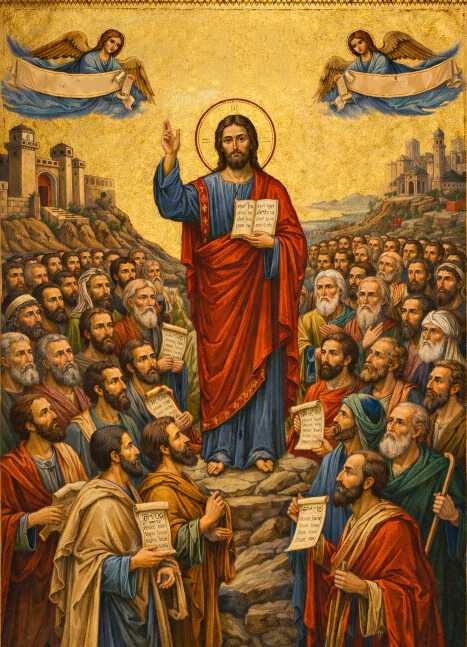
Icons depicting the Seventy typically show them gathered together, often with the Twelve Apostles,
representing the unity and collaboration of apostolic ministry. Some icons depict scenes from their
mission—traveling two by two, preaching in cities, healing the sick, confronting demons. These
images serve as visual catechesis, teaching the faithful about the nature of Christian witness and
the power of the Gospel.
📿Intercession and Contemporary Relevance
The faithful of the Syriac Orthodox Church invoke the intercession of the Seventy Disciples,
particularly seeking their prayers for success in evangelistic endeavors, for wisdom in teaching the
faith, for courage in witnessing to Christ, and for the conversion of unbelievers. As those who
pioneered the missionary expansion of the Church, who faced opposition and persecution with
unwavering faith, and who successfully established Christian communities throughout the known world,
they are believed to be especially powerful intercessors for similar concerns today.
In our contemporary context, the example of the Seventy speaks with particular relevance:
To Missionaries and Evangelists: The Seventy model total dependence on God's
provision, boldness in proclamation despite opposition, and willingness to go wherever Christ sends.
They remind us that effectiveness in mission depends not on abundance of resources or human
strategic planning but on faithful obedience to Christ's commands and reliance on the Holy Spirit's
power.
To Teachers and Preachers: The Seventy demonstrate that teaching the faith requires
both accurate knowledge of truth (they taught "accurately," Acts 18:25) and spiritual power (demons
were subject to them). Academic training without spiritual depth produces dead orthodoxy; spiritual
enthusiasm without doctrinal precision produces dangerous error. Both are necessary.
To All Believers: The Seventy show that every Christian is called to be a witness,
not merely the professionally ordained. While they held special apostolic authority, their mission
was fundamentally the same as that given to all believers—to proclaim the Kingdom, to heal the
broken, to confront evil, and to invite people into relationship with Christ. The Great Commission
is not for clergy alone but for the entire Body of Christ.
To the Persecuted Church: The Seventy's willingness to suffer and die for Christ
encourages contemporary believers facing persecution. Their martyrdoms were not defeats but
victories; their blood became seed for the Church's growth. Those who suffer for Christ today stand
in continuity with these ancient witnesses and can take courage from their example.
⭐Conclusion: Living Legacy of the Seventy
The Seventy Disciples of Jesus Christ stand as enduring witnesses to the truth of the Gospel, the
power of the Holy Spirit, and the missionary nature of the Church. Sent by our Lord Himself to
prepare His way, empowered to heal the sick and cast out demons, commissioned to proclaim the
Kingdom of God, they fulfilled their calling with faithfulness, courage, and often with the shedding
of their own blood.
Their legacy continues in multiple ways: through the churches they established, many of which
persist to this day; through the writings some of them produced, which continue to instruct and
inspire; through the episcopal succession they initiated, which maintains the continuity of
apostolic teaching and sacramental ministry; through their martyric witness, which strengthens
believers facing persecution; and through their example of faithful service, which challenges every
generation to renewed commitment to Christ's mission.
In the Syriac Orthodox Church, we honor the Seventy not merely as historical figures from the
distant past but as living members of the communion of saints, present with us in the liturgy,
interceding for us before the throne of God, and encouraging us by their example. When we celebrate
their feast, we do not merely remember what they did long ago; we renew our own commitment to the
mission they began, we seek their prayers for strength to follow in their footsteps, and we give
thanks to God who called them, empowered them, and brought them through suffering to glory.
May their memory be eternal. May their intercession be powerful. And may we, like them, be faithful
witnesses to Jesus Christ, proclaiming His Kingdom with boldness, serving with humility, suffering
with patience, and persevering unto the end, until we join them in the presence of our Lord whom
they loved and served so faithfully.
O Holy Seventy Disciples of our Lord Jesus Christ, chosen witnesses of the Kingdom, faithful
proclaimers of the Gospel, courageous martyrs for the faith, and glorious intercessors before God's
throne—pray for us that we may be granted wisdom to teach, power to heal, courage to witness, and
grace to persevere. Through your prayers, may the Church continue to grow, may the Gospel reach
those who have not yet heard, may the Kingdom of God advance until that day when every knee shall
bow and every tongue confess that Jesus Christ is Lord, to the glory of God the Father. Amen.
Glory be to the Father, and to the Son, and to the Holy Spirit, now and always and unto the ages of
ages. Amen.