🏛️Foundational Place in Syriac Memory
Mar Addai (known in Greek traditions as Thaddeus) occupies a central and sacred place in the Syriac
Orthodox imagination as the apostolic founder of Edessa (modern Şanlıurfa, Turkey) and the
initiating figure for Syriac-language Christianity in Upper Mesopotamia. In the liturgical
calendars, medieval compilations of saints, and most profoundly in the foundational Anaphora that
bears his name alongside Mar Mari, Addai is remembered not merely as an early preacher but as the
apostle who translated apostolic faith into Aramaic-speaking culture and liturgy. This memory shapes
how the Syriac Church understands its very origin: not as an offshoot or dependency of Greek
Christianity, but as an apostolic stream with its own divinely appointed witnesses and indigenous
rites flowing directly from the apostolic age.
For the Syriac Orthodox Church, Addai represents something far more profound than historical
curiosity. He embodies the claim to apostolic continuity, the assertion that the Gospel was preached
in the Syriac language from the earliest days, and the conviction that Mesopotamian Christianity
possesses its own authentic apostolic heritage parallel to that of Jerusalem, Antioch, and Rome.
When Syriac Christians celebrate the Holy Qurbana using the ancient Anaphora of Addai and Mari, they
are not simply commemorating a distant past—they are affirming their living connection to an
apostolic witness who spoke their language, understood their culture, and established their Church
on foundations as ancient and legitimate as any in Christendom.
✉️The Royal Correspondence: Christ's Promise to
Edessa
The narrative foundation of Addai's mission rests upon one of the most beloved traditions in Syriac
Christianity: the correspondence between King Abgar V Ukkama (Abgar the Black) of Edessa and our
Lord Jesus Christ Himself during His earthly ministry. According to the Doctrine (Teaching) of
Addai—a Syriac text composed in the late fourth or fifth century but preserving much older oral
traditions—King Abgar, suffering from an incurable disease (traditionally identified as leprosy or a
similar affliction), heard reports of Jesus's miraculous healings in Palestine and was moved to
write to Him.
In this letter, preserved in the Doctrine and treasured throughout Syriac tradition, Abgar addressed
Jesus with profound faith and humility, acknowledging Him as either God descended from heaven or the
Son of God. The king pleaded with Jesus to come to Edessa to heal him and offered Him refuge from
the hostility of the Jews. This letter represents more than a historical curiosity—it expresses the
faith of the Gentile world reaching out to Christ, recognizing His divine authority even before the
Resurrection and Ascension, and offering Him a place of honor and safety in the Aramaic-speaking
East.
According to the tradition, Jesus did not come to Edessa Himself—for His mission was first to the
lost sheep of the house of Israel—but He sent a reply through Abgar's messenger Ananias (who,
according to some versions, also painted the first icon of Christ's face on cloth—the Holy
Mandylion). In His letter, Christ blessed Abgar and his city, promising that after His Ascension He
would send one of His disciples to heal the king and bring life to him and all his people. This
promise forms the charter, the apostolic commission, for the Church of Edessa. It establishes that
Christianity came to Mesopotamia not by accident or human initiative alone, but by the express will
and promise of Christ Himself.
"Blessed are you who believed in Me without having seen Me. For it is written of Me that those who
have seen Me will not believe in Me, and those who have not seen Me will believe and live." —
Traditional words of Christ to Abgar
🕊️Addai's Apostolic Mission to Edessa
After the Ascension of our Lord and the descent of the Holy Spirit at Pentecost, the promise made to
Abgar was fulfilled. According to the Doctrine of Addai, the Apostle Thomas (Mar Toma), who had
evangelized regions east of Palestine, selected Addai from among the seventy disciples and sent him
to Edessa as the designated messenger of Christ to fulfill the Lord's promise to King Abgar. Some
traditions identify Addai with Thaddeus, one of the Twelve Apostles (also called Judas son of James
or Lebbaeus), while the Syriac tradition more commonly presents him as one of the Seventy, sent by
Thomas specifically for this mission.
Addai arrived in Edessa bearing the apostolic message of salvation and, according to tradition,
carrying either the Mandylion (the miraculous image of Christ's face) or the spiritual authority to
heal in Christ's name. He lodged with Tobias, son of Tobias, a Jewish resident of Edessa, and word
of his arrival quickly reached King Abgar. The king, remembering Christ's promise and recognizing
that this must be the promised disciple, summoned Addai to the royal palace.
The encounter between Addai and Abgar, as recorded in the Doctrine, is filled with theological and
spiritual significance. When Addai entered the king's presence, a great light appeared on his face—a
visible sign of divine approval and apostolic authority. Abgar, seeing this supernatural
manifestation, immediately fell from his throne in reverence and worship, recognizing the presence
of divine power. Though some of the king's nobles did not see the light and were confused by the
king's prostration, Abgar declared his faith: "In truth you are the disciple of Jesus, Son of God,
who said to me, 'I will send you one of my disciples who will heal you and give you life.'"
Addai then preached to the king the full Gospel: the Incarnation, the ministry of Christ, His
crucifixion for the sins of the world, His burial, His Resurrection on the third day, and His
Ascension to the Father. He explained that he had been sent by the laying on of hands from Thomas,
who had himself been commissioned by Christ. Upon hearing this proclamation of the Gospel and
expressing faith in Christ, King Abgar was immediately healed of his disease—the leprosy departed
from him completely, leaving only a small mark on his forehead as a permanent testimony to the
miracle that had occurred.
💒Establishment of the Church in Edessa
The healing of King Abgar was not merely a personal miracle but the birth moment of the Church in
Edessa and, by extension, of Syriac Christianity throughout Mesopotamia. Following his healing and
conversion, Abgar assembled all the citizens of Edessa in the public square and had Addai preach the
Gospel to them. The Doctrine records that the entire city—nobles, commoners, Jews, and pagans—heard
the message of Christ with profound attention and that many believed and were baptized.
Addai organized the nascent Christian community with great care and apostolic wisdom. He established
regular gatherings for worship, instituted the reading and exposition of the Holy Scriptures
(particularly the Old Testament, which was already revered by the Jewish community and which Addai
interpreted christologically), and ordained local leaders to serve the community. According to
tradition, he ordained Aggai (Ahai) as the first bishop of Edessa, establishing the episcopal
succession that the Syriac Church traces back to apostolic times.
The Doctrine of Addai emphasizes that Addai's ministry in Edessa was characterized by three
interconnected activities: preaching, healing, and teaching. He proclaimed the Gospel with apostolic
authority, he healed the sick and cast out demons in the name of Jesus Christ (demonstrating that
the power of Christ continued to work through His apostles), and he taught the Scriptures, showing
how all the Law and the Prophets testified to Christ. This three-fold ministry—kerygma, charismatic
signs, and didache—established the pattern for all subsequent Syriac Christian ministry.
With King Abgar's support, Addai oversaw the construction of a church building in Edessa—one of the
first purpose-built Christian houses of worship. This was not merely a practical necessity but a
powerful symbol: Christianity was no longer confined to private homes or secret gatherings but had
become a public, recognized, and honored religion in Edessa. The church became a center for daily
prayer, Scripture reading, baptismal preparation, and eucharistic celebration. It was here that the
liturgical life of Syriac Christianity began to take its distinctive form, blending apostolic
tradition with Aramaic language and culture.
📖The Doctrine of Addai: Historical Source and
Theological Text
The primary source for the story of Mar Addai is the Syriac text known as the Doctrine (or Teaching)
of Addai (Malpanutha d-Addai in Syriac). This text, composed in the late fourth or early fifth
century, represents a carefully crafted narrative that combines historical memory, legendary
development, theological reflection, and ecclesial apologetics. Modern scholars approach it with
appropriate critical caution, recognizing it as a product of late antique Syriac piety rather than a
verbatim apostolic-era eyewitness account.
However, dismissing the Doctrine as mere legend would be a serious mistake. The text preserves
authentic traditions about the early evangelization of Edessa, reflects genuine historical memories
about the establishment of Christianity in Upper Mesopotamia, and expresses theological truths about
apostolic continuity that were vital to the Syriac Church's self-understanding. Most importantly,
the Doctrine testifies to historical facts that even critical scholarship acknowledges: Christianity
did reach Edessa very early (possibly by the mid-second century at the latest), it developed a
strong and distinctive Syriac character, and the Church there possessed ancient literary and
liturgical traditions that demonstrate deep indigenous roots.
The Doctrine exists in multiple manuscript versions and was read, copied, and venerated across
Syriac-speaking communities for centuries. It was not simply a historical text but a foundational
narrative that shaped identity, worship, and ecclesial consciousness. When Syriac Christians heard
the Doctrine read, they were not merely learning about the past—they were connecting themselves to
apostolic origins, affirming their place in salvation history, and claiming their legitimate
inheritance as children of the apostolic Church.
⛪The Anaphora of Addai and Mari: Liturgical
Legacy
Perhaps the most tangible and enduring legacy of Mar Addai in Syriac Christian life is the
Eucharistic Anaphora (liturgical prayer) that bears his name alongside that of Mar Mari. The
Anaphora of Addai and Mari is one of the oldest Eucharistic prayers in continuous liturgical use in
Christianity, with scholarly consensus dating its formative elements to the third century or even
earlier. It is primarily preserved and used in the East Syriac (Chaldean and Assyrian) tradition,
though it is known and honored throughout the Syriac Orthodox world as a witness to the ancient
apostolic liturgy of Mesopotamia.
What makes this Anaphora particularly significant—and indeed unique among ancient Eucharistic
prayers—is that in its oldest manuscript forms it lacks an explicit narrative of the Institution of
the Eucharist (the Words of Institution: "This is My Body... This is My Blood"). Instead, the
consecration occurs through the epiclesis (invocation of the Holy Spirit) and through the entire
eucharistic thanksgiving that recalls the saving work of Christ. This demonstrates that the early
Syriac liturgical tradition had its own authentic approach to eucharistic theology and practice,
different from but equally valid as the patterns that developed in Greek and Latin Christianity.
The association of this ancient Anaphora with Addai and Mari is deeply significant for Syriac
identity. It means that every time this prayer is prayed—in Chaldean Catholic churches, Assyrian
Church of the East congregations, and in historical and occasional use in Syriac Orthodox
settings—the names of these apostolic founders are invoked, their memory is honored, and their
witness is perpetuated. Addai is thus not merely a historical figure from the distant past but a
living presence in the ongoing liturgical life of the Syriac Church.
The Anaphora's theology reflects themes central to Addai's mission as remembered in tradition:
thanksgiving for creation and redemption, emphasis on Christ's saving death and resurrection,
invocation of the Holy Spirit to sanctify the gifts and the people, and prayers for the unity and
holiness of the Church. These themes express in liturgical form the apostolic Gospel that Addai
preached and the sacramental life he established in Edessa. For Syriac Orthodox Christians, the
Anaphora of Addai and Mari is proof that their liturgical tradition traces back to apostolic times
and that their way of celebrating the Holy Mysteries is rooted in the practices established by
Christ's own designated messengers.
🌍Addai, Mari, and the Evangelization of
Mesopotamia
While the Doctrine of Addai focuses primarily on Edessa itself, later Syriac traditions expand the
scope of Addai's apostolic activity throughout Upper Mesopotamia and associate him closely with Mar
Mari, who became the evangelist of regions farther east, including areas that would become the
heartland of the Church of the East in Persia. The pairing of "Addai and Mari" in the Anaphora's
title reflects this tradition of shared apostolic mission and complementary labors.
According to these expanded traditions, Addai established not only the church in Edessa but also
appointed and sent out disciples who founded churches in other cities and regions of Mesopotamia.
Mar Mari is presented as one of these disciples—sometimes as a direct companion of Addai, sometimes
as his successor and spiritual heir—who carried the Gospel eastward into the Parthian Empire,
establishing Christian communities along the Tigris and Euphrates rivers and eventually reaching as
far as Seleucia-Ctesiphon, which became the patriarchal see of the Church of the East.
This tradition of Addai and Mari as co-founders of Mesopotamian Christianity served several
important purposes in Syriac ecclesiology. First, it established apostolic credentials for churches
throughout the region, not just in Edessa alone. Second, it created a narrative of unity and
succession linking the various Syriac-speaking Christian communities. Third, it demonstrated that
the evangelization of Mesopotamia was systematic and organized, carried out by apostolic authority
with proper ordination and succession. Whether historically precise in every detail or not, this
tradition expresses the theological truth that Christianity in the Syriac-speaking world has
apostolic foundations and legitimate standing as an ancient apostolic church.
📚Addai in Syriac Literature and Cathedral
Memory
Beyond the Doctrine of Addai itself, Mar Addai appears prominently in Syriac Christian literature
across the centuries. Medieval Syriac historians and hagiographers—from both the West Syriac (Syriac
Orthodox/Jacobite) and East Syriac (Church of the East/Nestorian) traditions—cite the Addai
tradition when explaining the origins of Christianity in their regions. Liturgical calendars
commemorate his feast day with special hymns and readings. The synaxaria (collections of saints'
lives) include accounts of Addai that draw on the Doctrine and elaborate upon it with additional
pious traditions.
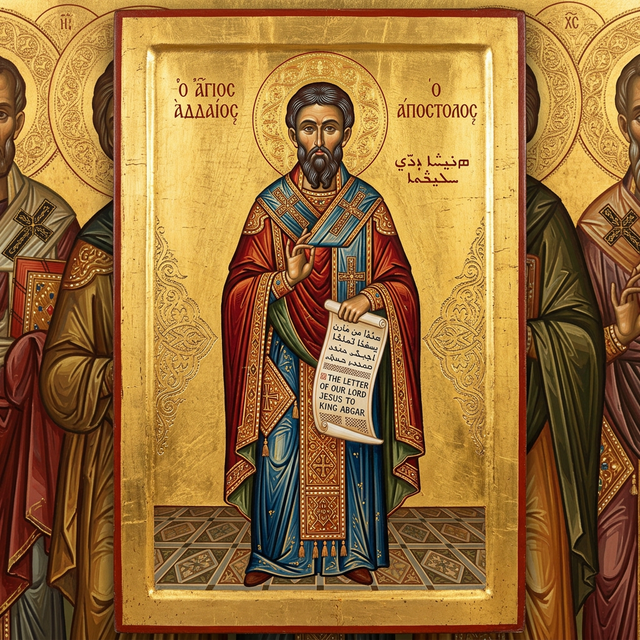
In iconography and manuscript illumination, Addai is depicted as an apostolic figure bearing the
marks of his mission: sometimes holding a scroll representing the Gospel or the letter from Christ
to Abgar, sometimes shown with healing gestures, sometimes portrayed alongside Mari as a twin pillar
of Mesopotamian Christianity. These artistic representations, found in medieval Syriac Gospel
manuscripts, liturgical books, and church decorations, kept Addai's memory visually present in the
worship and devotional life of Syriac Christians.
The Acts of Mar Mari and other related texts from the East Syriac tradition further develop the
Addaiian apostolic narrative, showing how the Gospel spread from Edessa throughout Mesopotamia and
Persia. These texts form part of a larger corpus of apostolic acts that Syriac Christians used to
narrate their sacred origins and to demonstrate their continuity with the apostolic age. While
modern scholarship recognizes these as products of later piety rather than first-century documents,
they nevertheless preserve authentic communal memories and express theological convictions about
apostolic continuity that were central to Syriac Christian identity.
✨Theological Significance: The Gospel in Aramaic
For the Syriac Orthodox Church, the chief theological importance of Mar Addai lies in what he
represents: the inculturation of the Gospel into Aramaic language and Semitic culture from the
earliest apostolic times. Addai embodies the conviction that the Good News of Jesus Christ was never
the exclusive property of Greek-speaking or Latin-speaking Christianity. Rather, the Gospel was
proclaimed in multiple languages and cultural contexts from the beginning, each with its own
legitimate and authentic apostolic witness.
The fact that Addai preached in Syriac (a dialect of Aramaic closely related to the language Jesus
Himself spoke), celebrated the Eucharist in Syriac, and established a liturgical and theological
tradition in Syriac means that this language is not a secondary translation but a primary vehicle of
apostolic faith. When Syriac Orthodox Christians worship in Syriac, read the Peshitta (Syriac
Bible), and pray the ancient Syriac liturgies, they are not using second-hand materials translated
from Greek—they are engaging with an indigenous Christian tradition as ancient and apostolic as any
in existence.
Addai's mission also demonstrates the universal scope of Christ's saving work. The narrative of King
Abgar—a Gentile monarch from the East—corresponding with Jesus and being promised an apostle shows
that the Gospel was always intended for all nations. The rapid and enthusiastic reception of
Christianity in Edessa, as portrayed in the Doctrine, illustrates that the Gentile world was ready
and eager for the message of salvation. Addai thus represents the fulfillment of the prophetic
vision that the light would shine not only in Judea but to the ends of the earth, and that peoples
from the East would come to worship the true God.
Finally, the liturgical and pastoral emphasis in Addai's remembered ministry—baptism, teaching,
Scripture reading, communal worship, ordained ministry, care for the poor—summarizes what the Syriac
Church considers essential to authentic apostolicity. Being apostolic is not merely about having the
right doctrines or valid sacramental orders (though these matter); it is about maintaining the
fullness of apostolic life: faithful preaching, sacramental celebration, biblical formation,
compassionate service, and the building up of local Christian communities in holiness and love.
Prayer for Intercession
O Holy Apostle Mar Addai, divinely sent messenger to the blessed city of Edessa, faithful fulfiller
of Christ's promise to King Abgar, founder of the Church in Mesopotamia, and father of Syriac
liturgical tradition—we seek your powerful intercession before the throne of the Most High. You who
brought the light of the Gospel to our Aramaic-speaking ancestors, who healed the sick in Christ's
name, who established the Holy Mysteries in our language, who ordained the first bishops and priests
of our tradition, and whose name is invoked in every celebration of the Sacred Liturgy—pray for us.
Grant that we may treasure and preserve the apostolic heritage you planted in our land, that we may
remain faithful to the Syriac tradition you inaugurated, and that we may proclaim Christ with the
same apostolic boldness and power with which you preached Him. Through your intercession, may the
Church you founded continue to flourish, may our Syriac language forever glorify God, and may we at
last join you and all the saints in the heavenly Kingdom. Amen.