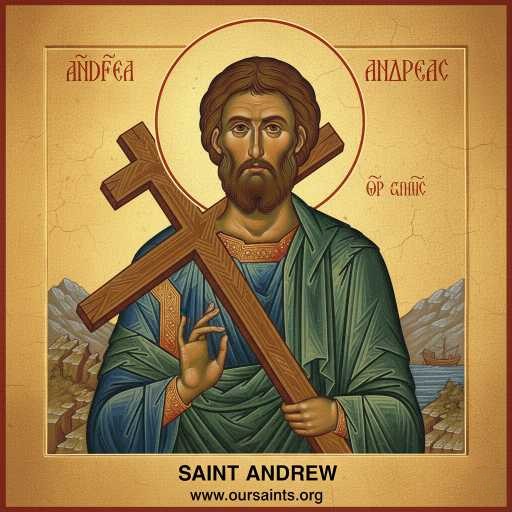
⭐The First to Be Called
St. Andrew holds a unique distinction among all the apostles—he was the very first disciple to
follow Jesus Christ, earning him the honored title "Protoclete" or "First-Called" in the Eastern
Church. Born in Bethsaida, a fishing village on the northern shore of the Sea of Galilee, Andrew
worked alongside his brother Simon (later called Peter) in the family fishing business. His name,
derived from the Greek "Andreas," means "manly" or "brave," qualities that would define his
ministry.
Before meeting Christ, Andrew was a disciple of John the Baptist, seeking spiritual truth and the
coming of the Messiah. On a day that would change the course of history, Andrew stood with John the
Baptist when Jesus walked by. John proclaimed, "Behold, the Lamb of God!" These words pierced
Andrew's heart with divine understanding. Immediately, he and another disciple (traditionally
believed to be John the Evangelist) followed Jesus. When Jesus turned and asked, "What do you seek?"
Andrew replied, "Rabbi, where are you staying?" Jesus invited them, "Come and see." They spent the
rest of that day with Christ, and Andrew's life was forever transformed.
The first thing Andrew did after encountering the Messiah was to find his brother Simon. With joy
and conviction, he declared, "We have found the Messiah!" and brought Peter to Jesus. This act of
evangelism, bringing his own brother to Christ, established Andrew as the first Christian
missionary. Christ looked at Simon and said, "You are Simon the son of John. You shall be called
Cephas" (Peter). Thus, through Andrew's witness, the Rock upon which Christ would build His Church
came to the Lord.
The First Proclamation
"He first found his own brother Simon, and said to him, 'We have found the Messiah' (which is
translated, the Christ). And he brought him to Jesus." — John 1:41-42
🐟The Fisherman Becomes Fisher of Men
When Jesus returned to Galilee and began His public ministry, He found Peter and Andrew casting
their nets into the Sea of Galilee. With divine authority, He called to them, "Follow Me, and I will
make you fishers of men." Without hesitation, the two brothers immediately left their nets and
followed Him. This decisive moment marked the beginning of Andrew's apostolic journey, leaving
behind the security of his profession to follow an itinerant rabbi with a revolutionary message.
Throughout Christ's ministry, Andrew appears at several crucial moments. At the feeding of the five
thousand, when Philip despaired of feeding such a multitude, it was Andrew who found the boy with
five barley loaves and two fish. Though he wondered aloud, "What are these among so many?" his
willingness to bring what little they had to Jesus resulted in one of the greatest miracles recorded
in Scripture. This incident reveals Andrew's character—practical, observant, and willing to present
even seemingly insufficient resources to Christ.
Andrew also served as a bridge between the Jewish and Gentile worlds. When certain Greeks came to
Philip during the final week of Jesus' life, saying "Sir, we wish to see Jesus," Philip brought them
to Andrew, and together they brought them to the Lord. Andrew's Greek name and his openness to
Gentiles foreshadowed his future mission to the Greek-speaking world. He understood that Christ's
message was not limited by ethnic or linguistic boundaries.
On the Mount of Olives, Andrew was among the select group—Peter, James, John, and himself—who
privately asked Jesus about the signs of the end times. This places him among the inner circle of
apostles who received special teaching from the Lord. Though not as prominent in the Gospels as
Peter, James, and John, Andrew's consistent presence at key moments shows his importance in the
apostolic band.
⛪Founder of the Church of Byzantium
The Apostolic See of Constantinople
After the Resurrection and Pentecost, St. Andrew embarked on extensive missionary journeys that
would establish him as the Apostle of the East. According to ancient and consistent tradition,
Andrew traveled to the regions of Bithynia and Pontus on the southern shores of the Black Sea,
preaching the Gospel to both Jews and Gentiles. From there, he journeyed to the city of
Byzantium around 38 AD, where he founded the Christian Church and ordained Stachys, one of the
seventy disciples of the Lord, as its first bishop.
This act of establishing the Church in Byzantium (later renamed Constantinople and known today
as Istanbul) holds immense significance in Christian history. While his brother Peter founded
the Church of Rome, representing the West, Andrew founded the Church of Byzantium, representing
the East. This brotherhood of apostolic sees symbolizes the fundamental unity of the Christian
Church, East and West, both rooted in the ministry of the two brothers from Galilee.
The See of Constantinople traces its apostolic succession directly back to St. Andrew, and he is
venerated as its patron saint. The Ecumenical Patriarchate of Constantinople honors him as its
founder and first bishop, making Andrew the spiritual father of Eastern Orthodox Christianity in
the same way Peter is revered in Rome. This connection between the two brothers and their
respective sees has been recognized by popes and patriarchs throughout history as a bond of
shared apostolic heritage.
Pope Benedict XVI beautifully expressed this relationship, calling Andrew "the Apostle of the
Greek world" and noting that the brotherhood between Peter and Andrew is "symbolically expressed
in the special reciprocal relations of the See of Rome and of Constantinople, which are truly
Sister Churches." This spiritual kinship between Rome and Constantinople, rooted in the blood
brotherhood of their apostolic founders, represents a powerful testimony to the unity Christ
desired for His Church.
🌍Missionary Journeys and Ministry
Church tradition records that St. Andrew's missionary zeal took him far beyond Byzantium. He is said
to have traveled throughout Asia Minor, including the regions of modern-day Turkey, evangelizing
cities and establishing Christian communities. Ancient sources place him in Thrace, Macedonia, and
throughout Greece, where his preaching and miracles converted many to the Christian faith. He is
particularly remembered for his ministry in Achaia, the southern region of Greece.
Some traditions even speak of Andrew traveling as far north as Scythia (the region around the Black
Sea, including parts of modern Ukraine and Russia), making him a patron saint of these nations. The
Russian Orthodox Church particularly venerates him, believing he brought Christianity to the lands
that would become Russia. While historical verification of all these journeys is difficult, they
testify to the widespread impact of Andrew's evangelical work and the reverence in which he was held
across the ancient world.
Unlike his brother Peter, Andrew worked primarily in Greek-speaking regions, bringing the Gospel to
the Hellenistic world. His ministry complemented Peter's work among Jews and Latin speakers,
fulfilling Christ's command to preach to all nations. Through his tireless travels and bold
proclamation, Andrew established churches, ordained bishops, and laid the foundations for
Christianity's spread throughout the Eastern Mediterranean and beyond.
✝️Martyrdom in Patras
St. Andrew's apostolic journey culminated in the city of Patras in Achaia (southern Greece), where
his preaching and miracles brought many to faith in Christ. Among those converted were some of the
most prominent citizens of the city, including Maximilla, the wife of the Roman Proconsul Aegeates,
and Stratoklis, the proconsul's own brother. Andrew healed Maximilla through the power of Christ,
and Stratoklis, witnessing this miracle and hearing Andrew's teaching, embraced Christianity. Andrew
consecrated Stratoklis as the first Bishop of Patras.
These conversions within his own household infuriated Proconsul Aegeates. The pagan priests and
philosophers who advised him urged decisive action against the Christian apostle who was undermining
the worship of the Roman gods. Despite Andrew's eloquent defense of the faith and his offer of
eternal salvation, Aegeates remained hardened in his idolatry. He ordered that Andrew be arrested
and crucified.
Around the year 60 AD, St. Andrew was led to his martyrdom. According to ancient tradition, he was
crucified on an X-shaped cross, which has since been known as St. Andrew's Cross or the "crux
decussata." The proconsul specifically ordered that Andrew be bound with ropes rather than nailed,
intending to prolong his suffering. For two days, Andrew hung on the cross, continuing to preach to
the crowds that gathered. He spoke of Christ's love, the meaning of the cross, and the hope of
resurrection.
When the people of Patras, outraged by this injustice, demanded his release, Andrew refused to come
down. He prayed that he might be allowed to complete his witness and die as his Master had died. As
he hung on the cross, a brilliant light surrounded him, and when the light faded, Andrew had given
up his spirit. The faithful took his body and gave it honorable burial. Thus, the First-Called
Apostle became one of the first apostolic martyrs, sealing his testimony with his blood.
St. Andrew's final words from the cross expressed his joy at being deemed worthy to die on the same
instrument of torture as his Lord: "Hail, O Cross, consecrated by the Body of my Lord and adorned
with His limbs as with rich jewels. I come to you exulting and glad. Receive me with joy into your
arms, that I may be presented to Him who redeemed me through you."
📜Timeline of Andrew's Ministry
-
c. 5 BC - Born in Bethsaida
Andrew born to Jonah and his wife in the fishing village of Bethsaida, Galilee
-
c. 28 AD - Follows John the Baptist
Becomes a disciple of John the Baptist, seeking the Messiah
-
c. 28-29 AD - First to Follow Christ
Hears John declare "Behold the Lamb of God," becomes Jesus' first disciple, brings Peter to Christ
-
c. 29 AD - Called as Apostle
Jesus calls Andrew and Peter from their fishing nets: "Follow Me, and I will make you fishers of
men"
-
29-33 AD - Ministry with Christ
Witnesses the miracles, teachings, death, and resurrection of Jesus
-
33 AD - Pentecost
Receives the Holy Spirit with the other apostles in the Upper Room
-
c. 34-38 AD - Early Ministry
Preaches in Jerusalem and Judea, establishing the early Church
-
c. 38 AD - Founds Byzantium Church
Travels to Byzantium (Constantinople), establishes the Church, ordains St. Stachys as first bishop
-
38-60 AD - Missionary Journeys
Evangelizes Asia Minor, Thrace, Macedonia, Scythia, and Greece
-
c. 60 AD - Martyrdom in Patras
Crucified on an X-shaped cross by order of Proconsul Aegeates in Patras, Greece
👥Andrew the Connector
Throughout his life, St. Andrew demonstrated a unique ministry of connection—bringing people to
Christ and building bridges between communities. He brought Peter to Jesus, initiating his brother's
journey to becoming the Rock of the Church. He found the boy with loaves and fish, connecting human
resources to divine provision. He brought the Greeks to Jesus, bridging the gap between Jewish and
Gentile seekers. He connected Byzantium to the apostolic faith, linking East and West through the
Gospel.
This pattern of connection reveals Andrew's essential character as an evangelist and church builder.
He did not seek the spotlight for himself—his brother Peter would become the more prominent
leader—but Andrew's quiet, faithful work of bringing others to Christ had profound and lasting
effects. Every person he connected to Jesus became part of the ever-expanding web of Christian faith
that would eventually encompass the world.
St. John Chrysostom praised Andrew's humility and wisdom, noting that unlike some who might have
felt overshadowed by a more famous sibling, Andrew rejoiced in Peter's prominence and continued his
own mission with dedication and joy. This freedom from envy and ambition made him an effective
servant of Christ. His life teaches us that in God's kingdom, faithfulness matters more than fame,
and bringing others to Christ is the highest calling.
🏛️Legacy and Veneration
The relics of St. Andrew, originally buried in Patras, had a remarkable journey through history. In
357 AD, they were translated to Constantinople by order of Emperor Constantius II and enshrined in
the Church of the Holy Apostles alongside the relics of St. Luke the Evangelist and St. Timothy.
This transfer honored Andrew's role as founder of the Church of Byzantium and reinforced
Constantinople's apostolic dignity.
During the Fourth Crusade in 1204, when Constantinople was sacked, Cardinal Peter of Capua brought
most of Andrew's relics to Amalfi, Italy, where they remain enshrined in the Cathedral of St.
Andrew. However, significant portions of his relics have been returned to both Patras and
Constantinople in gestures of Christian unity. In 1964, Pope Paul VI returned Andrew's skull to
Patras as a sign of reconciliation between Catholic and Orthodox Christians. In 1974, a further
portion was given to the Ecumenical Patriarchate in Constantinople.
The Syriac Orthodox Church, along with all Eastern Orthodox and Catholic Churches, venerates St.
Andrew as one of the greatest apostles. His feast day on November 30 is celebrated with special
liturgies and hymns commemorating his life, ministry, and martyrdom. Many churches throughout the
world are dedicated to his name, and his X-shaped cross appears in numerous national flags,
including those of Scotland and Russia, nations that claim him as their patron saint.
The spiritual bond between the Sees of Rome and Constantinople, founded by the brothers Peter and
Andrew, remains a powerful symbol of Christian unity. When Catholic and Orthodox leaders meet, they
often invoke the memory of these two brothers who stood together on the shores of Galilee, left
their nets together to follow Christ, and each founded great apostolic churches in different parts
of the world. Their brotherhood in the flesh and in faith speaks to the fundamental unity of the
Church Christ established.
Andrew's Call to Discipleship
"As Jesus walked by the Sea of Galilee, He saw two brothers, Simon called Peter, and Andrew his
brother, casting a net into the sea; for they were fishermen. Then He said to them, 'Follow Me, and
I will make you fishers of men.' They immediately left their nets and followed Him." — Matthew
4:18-20
🙏Lessons from the First-Called
St. Andrew's life offers profound lessons for every Christian. His immediate response to Christ's
call—"Come and see"—teaches us to be open to divine invitation without delay or excessive
calculation. When he encountered the Messiah, he did not hoard this treasure for himself but
immediately shared it with his brother. This evangelical impulse, to share the good news of Christ
with those closest to us, remains the foundation of Christian witness.
Andrew's willingness to work behind the scenes, to connect others to Christ without seeking
recognition, challenges our culture's obsession with prominence and celebrity. He reminds us that in
God's economy, the one who serves faithfully in hidden ways is as valuable as the one who leads
publicly. The First-Called Apostle was content to let his brother become the leader, while he
continued the work of building Christ's Church throughout the East.
His martyrdom on the cross, embracing suffering with joy and continuing to preach until his last
breath, exemplifies the Christian call to bear witness even unto death. Andrew did not view his
crucifixion as a tragedy but as the ultimate privilege—to die as Christ died, to complete his
ministry in imitation of his Master. His final prayer from the cross, welcoming death as a doorway
to resurrection, shows the transforming power of Christian hope.
Finally, Andrew's role in bridging different worlds—Jewish and Greek, East and West, Jerusalem and
Byzantium—speaks to the universal nature of the Gospel. Christ's message transcends all human
divisions of ethnicity, language, and geography. Andrew understood this early on, and his missionary
work established churches across diverse cultures and peoples. His ministry reminds us that the
Church is truly catholic, universal, meant for all humanity without exception.
Prayer to St. Andrew the First-Called
O holy and glorious Apostle Andrew, First-Called of Christ and founder of the Church of the
East, you who heard the Baptist proclaim the Lamb of God and immediately followed the Lord:
obtain for us the same eagerness to seek Christ and the same joy in bringing others to Him. You
who embraced the cross with gladness and preached from it until your last breath: grant us
courage in our witness and perseverance in our faith. O blessed Protoclete, brother of Peter,
patron of Byzantium and Constantinople, bridge between nations and cultures: intercede for us
before the throne of grace, that we may follow Christ as faithfully as you did, proclaim Him as
boldly, and one day share in the glory you now enjoy. Through your prayers and those of all the
saints, may Christ our God have mercy on us and save us. Amen.