📚Name, Identity, and Alexandrian Heritage
Apollos—a name meaning "given by Apollo" or "destroyer" (ܐܰܦܳܠܳܘܣ in Syriac)—stands as one of the
most learned and eloquent evangelists of the apostolic age. Born in the glorious city of Alexandria,
Egypt, the intellectual center of the ancient world, Apollos was formed in the confluence of Jewish
piety and Hellenistic learning that characterized that great metropolis. The sacred Scripture
describes him as "an eloquent man, mighty in the Scriptures" (Acts 18:24), a testimony to both his
rhetorical skill and his profound knowledge of the Holy Writ.
Within the holy tradition of the Syriac Orthodox Church, preserved faithfully from the apostolic
fathers, St. Apollos is reverently numbered among the Seventy Disciples whom our Lord Jesus Christ
sent forth to proclaim the Kingdom of God (Luke 10:1-24). Though the canonical Scriptures first
introduce him after the Resurrection, appearing in the ministry at Ephesus and Corinth, the Church's
living memory recognizes that his formation in the faith began during our Lord's earthly ministry,
nurtured in the Alexandrian Jewish community that maintained close ties with Jerusalem.
Alexandria, the city of his birth, was not merely a seat of worldly wisdom but also home to a
vibrant Jewish community that produced the Septuagint translation of the Hebrew Scriptures. It was
in this environment that Apollos was "instructed in the way of the Lord" and learned to speak with
"fervent spirit" about the things of God. The Alexandrian school of thought, with its allegorical
interpretation of Scripture and philosophical sophistication, deeply influenced his theological
method, though it was tempered and perfected by the apostolic teaching he would later receive.
✝️The Way of the Lord: Initial Knowledge and
Formation
When Apollos arrived in Ephesus, the great Asian metropolis and future See of the Beloved Disciple
John, he came bearing knowledge of the Lord Jesus that was genuine yet incomplete. The Holy
Scripture tells us that he was "instructed in the way of the Lord" and "taught accurately the things
of the Lord" (Acts 18:25), demonstrating that his teaching about Christ was true and orthodox in its
substance. He spoke boldly in the synagogue, fearlessly proclaiming the Messiahship of Jesus before
his fellow Jews.
Yet there remained a gap in his understanding: he knew "only the baptism of John" (Acts 18:25). This
detail, preserved carefully in the apostolic witness, reveals that Apollos had received instruction
about Christ's coming, His ministry, and His teachings, perhaps from disciples who had been present
during our Lord's earthly sojourn, but had not yet received the fullness of apostolic teaching
regarding the sacramental life of the Church, the outpouring of the Holy Spirit at Pentecost, and
the complete revelation of the Resurrection and its theological implications.
This partial knowledge was not condemned but perfected. The baptism of John, administered by the
holy Forerunner, was a baptism of repentance preparing the way for the Lord, but it was not the
baptism into Christ's death and resurrection that incorporates believers into His Body, the Church.
Apollos knew the ethical demands of the Kingdom, the prophetic fulfillment in Jesus, and the call to
repentance, but awaited the deeper mysteries of the faith—the Eucharistic life, the sevenfold gifts
of the Spirit, and the full doctrine of the Trinity.
👥Aquila and Priscilla: The Perfecting of a
Saint
In the providence of God, whose ways are higher than our ways, Apollos encountered in Ephesus two
luminous witnesses to the apostolic faith: Aquila and Priscilla (or Prisca), that noble couple who
had labored alongside the holy Apostle Paul in tentmaking and in the Gospel. These blessed saints,
themselves trained in the fullness of apostolic doctrine, heard Apollos speaking in the synagogue
with great boldness and eloquence. Recognizing both his gifts and his need, they did not publicly
correct or shame him, but "took him aside and explained to him the way of God more accurately" (Acts
18:26).
This private instruction exemplifies the spirit of the ancient Church—correction offered in love,
teaching given in humility, and the recognition that all believers, however gifted, stand in need of
the Church's apostolic tradition. Aquila and Priscilla did not diminish Apollos's gifts but
completed them, watering what had been planted. They taught him about the baptism in the name of the
Father, Son, and Holy Spirit; about the laying on of hands for the reception of the Holy Spirit;
about the mysteries of the Eucharist; and about the full implications of Christ's Resurrection and
Ascension.
Apollos, for his part, demonstrated the mark of a true saint: humility to receive correction and
eagerness to grow in knowledge of the truth. A lesser man, proud in his Alexandrian learning and his
rhetorical gifts, might have resented instruction from tentmakers. But Apollos, whose eloquence was
matched by wisdom, received their teaching with gratitude. This moment of formation would prove
decisive for his ministry, transforming a learned teacher into an apostolic evangelist, a eloquent
speaker into a vessel of the Holy Spirit.
🌾Ministry in Achaia: Watering What Paul
Planted
After his instruction in Ephesus, when Apollos desired to cross over to Achaia (the Roman province
containing Corinth and much of southern Greece), the brethren encouraged him and wrote letters of
commendation to the disciples there. This practice of letters of recommendation, evidenced
throughout the apostolic writings, reflects the unity and communion of the early Church—no
evangelist labored alone, but all worked within the fellowship and authorization of the apostolic
community.
Upon arriving in Achaia, particularly in Corinth, that great commercial city rife with both
opportunity and temptation, Apollos proved himself "a great help to those who by grace had believed"
(Acts 18:27). The sacred text emphasizes that his ministry was not to unbelievers alone but
particularly to the edification of those already in the faith. This is the mark of apostolic
ministry: not merely the proclamation of the Gospel to those who have never heard, but the building
up of the Church, the strengthening of believers, and the deepening of understanding.
The Scripture records that Apollos "vigorously refuted the Jews in public debate, proving from the
Scriptures that Jesus was the Messiah" (Acts 18:28). His Alexandrian training in the interpretation
of Scripture, now perfected by apostolic teaching, made him uniquely suited to demonstrate from the
Law and the Prophets that Jesus of Nazareth was indeed the promised Christ. His public disputations
were not exercises in intellectual pride but apologetic warfare, defending the faith against those
who rejected the Gospel and strengthening believers in their conviction that their faith rested on
the sure foundation of prophetic fulfillment.
In Corinth, Apollos's ministry complemented that of the Apostle Paul. Paul himself testified to
this, writing to the Corinthians: "I planted, Apollos watered, but God gave the growth" (1
Corinthians 3:6). This beautiful image reveals the divine economy of ministry—different workers,
different gifts, one Lord, one Spirit, one work. Paul, with apostolic authority, laid the
foundation; Apollos, with eloquent teaching, built upon it; and God, by His grace, brought forth the
increase. Neither planter nor waterer could boast, for both were servants of the same Master,
instruments in the hand of the same God.
⚖️The Corinthian Factions: Unwitting Source of
Division
Though Apollos himself remained faithful and humble, his very eloquence and effectiveness became,
through no fault of his own, an occasion for division in the Corinthian church. The Apostle Paul
addresses this sad situation in his first letter to the Corinthians, where he speaks of factions
arising: "I follow Paul," or "I follow Apollos," or "I follow Cephas," or "I follow Christ" (1
Corinthians 1:12). Some believers in Corinth, attracted by Apollos's rhetorical skill and
philosophical sophistication, began to compare him favorably with Paul, whose preaching was
deliberately simple and focused on "Christ crucified" (1 Corinthians 2:2).
This factionalism grieved the Apostle Paul deeply, not because he envied Apollos (for Paul
consistently speaks of him with affection and respect), but because it revealed a fundamental
misunderstanding of the nature of Christian ministry. The Gospel is not advanced by human wisdom or
eloquence, but by the power of God. Ministers are not masters to whom disciples pledge allegiance,
but servants through whom people come to believe. Paul writes: "What then is Apollos? What is Paul?
Servants through whom you believed, as the Lord assigned to each" (1 Corinthians 3:5).
The Syriac Orthodox tradition has always understood this passage as a warning against personality
cults and the exaltation of human leaders in the Church. Whether the leader be as apostolic as Paul
or as eloquent as Apollos, the glory belongs to Christ alone. The ministers are merely instruments,
fellow workers in God's field, builders on God's foundation. This teaching remains ever relevant,
calling each generation to look beyond human leaders to the divine Head of the Church.
Significantly, there is no evidence that Apollos himself encouraged this factional loyalty. On the
contrary, when Paul later urged Apollos to return to Corinth, Apollos declined, perhaps because he
wisely discerned that his return might exacerbate the divisions rather than heal them. This shows
his spiritual maturity and his willingness to subordinate his own ministry to the greater good of
the Church. True humility is shown not only in accepting correction, as Apollos did with Aquila and
Priscilla, but also in voluntarily limiting one's ministry when it might cause harm, however
unintentionally.
🤝Relationship with St. Paul: A Model of
Apostolic Unity
Despite the divisions that arose among the Corinthians, the relationship between St. Paul and St.
Apollos remained one of mutual respect, affection, and cooperation. Paul's letters contain numerous
references to Apollos, always in favorable terms. He calls him "brother Apollos" (1 Corinthians
16:12), a title of Christian fellowship and equality. He urges the Corinthians to receive Apollos
well: "Now concerning our brother Apollos, I strongly urged him to visit you with the other
brothers, but it was not at all his will to come now. He will come when he has opportunity" (1
Corinthians 16:12).
This passage reveals several important truths. First, Paul and Apollos were in communication,
discussing ministry plans together. Second, Paul actively encouraged Apollos's ministry, showing no
jealousy or competition. Third, Apollos was free to make his own decisions about where and when to
minister—he was not subordinate to Paul in a hierarchical sense, but was a fellow worker, a brother
in the Gospel. Fourth, Paul respected Apollos's judgment when Apollos decided the timing was not
right for a return to Corinth.
In the Epistle to Titus, Paul mentions Apollos again: "Do your best to speed Zenas the lawyer and
Apollos on their way; see that they lack nothing" (Titus 3:13). This brief reference shows Apollos
continuing in itinerant ministry, traveling to spread the Gospel, and worthy of support from the
churches. The association with Zenas "the lawyer" (νομικός) is interesting, perhaps suggesting that
Apollos, with his Alexandrian education, continued to be involved in answering legal and
theological questions for the churches.
The harmony between Paul and Apollos stands as a rebuke to those who would foster divisions in the
Church or who would pit one teacher against another. These two great servants of God, different in
background, education, and rhetorical style, were united in their devotion to Christ and their
commitment to building up the Church. They modeled for all generations what Christian ministry
should look like: humble service, mutual honor, and subordination of personal preferences to the
good of the Gospel.
⛪Episcopal Ministry: Bishop of Corinth
While the canonical Scriptures do not explicitly record Apollos's appointment as bishop, the
venerable tradition of the Church, preserved in the writings of the Church Fathers and in the
liturgical memory of the Syriac Orthodox Church, identifies him as the first Bishop of Corinth (or
according to some traditions, of Caesarea or Iconium). This tradition is ancient and widespread,
found in sources such as the Constitutions of the Holy Apostles, the chronicles of Hippolytus of
Rome, and various martyrologies.
The appointment of Apollos as bishop would make perfect sense given his long association with
Corinth and his proven effectiveness in teaching and defending the faith. After the initial
divisions mentioned in Paul's first letter had been healed (as evidenced by the more positive tone
of 2 Corinthians), Apollos would have been an ideal choice to provide stable episcopal oversight to
this important church. His combination of Jewish learning, Alexandrian education, and apostolic
instruction equipped him uniquely for the challenges facing the Corinthian church, situated as it
was at the crossroads of multiple cultures and philosophies.
As bishop, St. Apollos would have presided over the Eucharistic assembly, ordained clergy, taught
catechumens, and provided pastoral care to the faithful. He would have been the living link to the
apostolic teaching, the guarantor of orthodoxy, and the center of unity for the local church. In the
Syriac Orthodox understanding, bishops are not merely administrators but are primarily teachers and
guardians of the faith, roles for which Apollos was supremely qualified by both natural gifts and
spiritual formation.
The tradition also suggests that St. Apollos may have written certain epistles or treatises,
particularly works of biblical interpretation in the Alexandrian style. While none of these have
survived (if they ever existed), the possibility is not implausible given his scholarly background
and his reputation as one "mighty in the Scriptures." Some early Christian scholars even speculated
that Apollos might have been the author of the Epistle to the Hebrews, given its sophisticated
rhetoric, Alexandrian style, and deep knowledge of the Old Testament. While this theory is
unprovable and generally rejected by modern scholarship, it testifies to the ancient reputation of
Apollos as a learned exegete and theologian.
🕊️Theological Legacy: Eloquence in Service of
Truth
St. Apollos stands in the history of the Church as a model of how human learning and eloquence can
be sanctified and employed in the service of the Gospel. Alexandria, his native city, would go on to
become one of the great intellectual centers of Christianity, producing theologians like Clement,
Origen, Athanasius, and Cyril. In a sense, Apollos was the forerunner of this Alexandrian
theological tradition—a learned man who brought the tools of philosophy and rhetoric to bear on the
interpretation of Scripture and the defense of the faith.
Yet Apollos also exemplifies an important corrective to merely intellectual Christianity. His
initial knowledge, though accurate, was incomplete until it was perfected by those who bore the
apostolic tradition. This teaches us that scholarship, however brilliant, must always be subject to
the Church's living tradition. The faith is not discovered through human wisdom alone but is
received from the apostles and handed down through the bishops in unbroken succession. Academic
excellence is a gift to be cultivated and used for God's glory, but it must always be in service to,
not in judgment over, the deposit of faith.
Furthermore, St. Apollos demonstrates that eloquence is a gift from God to be used for edification,
not for personal glory. The Corinthian factions that formed around his name were a perversion of his
ministry, not its intention. True eloquence in Christian preaching is not rhetorical flourish for
its own sake, but clarity and beauty in the service of truth. The goal is not to dazzle the audience
with the speaker's brilliance, but to illuminate the Gospel and to draw hearts to Christ.
In the Syriac Orthodox liturgical tradition, St. Apollos is remembered and honored as one who
"watered the plant of faith with streams of eloquence" and who "refuted the enemies of truth with
the sword of the Spirit." His feast day, celebrated on September 10, is an occasion to give thanks
for all those who use their intellectual gifts in service of the Gospel, and to pray for scholars,
teachers, and preachers that they may follow in his footsteps—combining learning with humility,
eloquence with truth, and human wisdom with divine revelation.
📖Scriptural Portrait and Character
The sacred Scriptures, though they give us only brief glimpses of St. Apollos, paint a clear and
consistent portrait of his character. He is described as "eloquent" (λόγιος), a term that in Greek
connotes not merely verbal facility but learning and culture. He was "mighty in the Scriptures"
(δυνατὸς ὢν ἐν ταῖς γραφαῖς), indicating deep knowledge and interpretive skill. He spoke "with
fervent spirit" (ζέων τῷ πνεύματι), showing passion and conviction in his preaching. He was "bold"
(παρρησιάζεσθαι) in the synagogue, unafraid to proclaim unpopular truths.
Yet alongside these impressive qualities, we see equally important virtues of humility and
teachability. He received correction from Aquila and Priscilla without offense. He worked in harmony
with Paul without rivalry. He declined to return to Corinth when he judged it might cause harm. He
is never recorded as defending his own reputation or asserting his own importance. These character
traits are perhaps even more significant than his natural gifts, for they show a man who had been
truly transformed by the Gospel he preached.
St. Apollos also demonstrates the value of different gifts within the Church. He was not an apostle
like Paul, with the authority to found churches and establish doctrine. He was an evangelist and
teacher, building on foundations laid by others. Yet his ministry was no less important for being
different. The Church needs both those who plant and those who water, both those who lay foundations
and those who build upon them, both those with apostolic authority and those with teaching gifts.
The diversity of ministries, when exercised in unity and humility, enriches the Church and advances
the Gospel.
✨Later Traditions and Repose
The later traditions regarding St. Apollos vary among different sources. Some traditions hold that
he died peacefully in Corinth after a long episcopal ministry. Others suggest he may have suffered
martyrdom, though the details are uncertain and not universally attested. The Syriac tradition
generally remembers him as having died in peace, having completed his course and kept the faith.
What is certain is that St. Apollos, whether through martyrdom or through natural death, entered
into the rest prepared for the faithful. His labors in the Gospel were completed, his race was run,
and the crown of righteousness awaited him. The churches he served, the believers he taught, and the
faith he defended remain as his monument—a monument far more enduring than any earthly memorial.
In the communion of saints, we believe that St. Apollos continues to intercede for the Church,
particularly praying for teachers, scholars, and all who use their intellectual gifts in service of
the Gospel. His example inspires us to pursue learning not as an end in itself, but as a means of
serving Christ and His Church. His humility challenges us to remain teachable, however learned we
may become. His eloquence reminds us that all our gifts are from God and must be used for His glory
alone.
🙏Lessons for Today's Church
St. Apollos speaks powerfully to our contemporary situation. In an age that often pits faith against
reason, tradition against scholarship, and devotion against learning, he shows us that these are
false dichotomies. A faithful Christian can and should be learned; a scholar can and should be
devout; eloquence can and should serve truth. The integration of intellectual excellence with humble
faith is not only possible but necessary for the health of the Church.
His example also challenges the cult of personality that afflicts much of contemporary Christianity.
Just as the Corinthians erred in dividing over Paul and Apollos, so today's Christians err when they
follow celebrity preachers or charismatic personalities rather than Christ Himself. Ministers are
servants, not stars; the Gospel is about Jesus, not about those who preach Him. We must honor and
respect our teachers while recognizing that they are mere instruments through whom God works.
Furthermore, St. Apollos reminds us of the importance of lifelong learning in the faith. His
willingness to receive further instruction from Aquila and Priscilla, despite his considerable
existing knowledge, models the humility we all need. No matter how much we know, we can always learn
more. No matter how mature we are in faith, we can always grow deeper. The moment we think we have
mastered the faith is the moment we have begun to lose it. True wisdom consists in knowing how much
we do not know and remaining open to the teaching of the Spirit through the Church.
Finally, St. Apollos teaches us about unity in diversity. The Church is enriched by different gifts,
different backgrounds, different styles of ministry. Some plant, some water, but God gives the
growth. Instead of comparing ministries or competing for followers, we should recognize that we are
all fellow workers in God's field, fellow builders on Christ's foundation. Our unity is in Him, not
in our uniformity.
⭐Veneration in the Syriac Orthodox Church
In the Syriac Orthodox Church, St. Apollos is commemorated with reverence and love. His feast day on
September 10 is observed with special prayers and hymns that celebrate his eloquence, his humility,
and his service to the Gospel. The liturgical texts for his feast emphasize his role as one of the
Seventy Disciples and his partnership with the great Apostle Paul in building up the churches.
In Syriac hymnography, St. Apollos is often invoked as an intercessor for students, teachers,
preachers, and all who engage in theological study. His combination of learning and piety makes him
a natural patron for Christian education. Many Syriac Orthodox seminaries and theological schools
have placed themselves under his patronage, seeking his prayers for wisdom, eloquence, and fidelity
to the apostolic tradition.
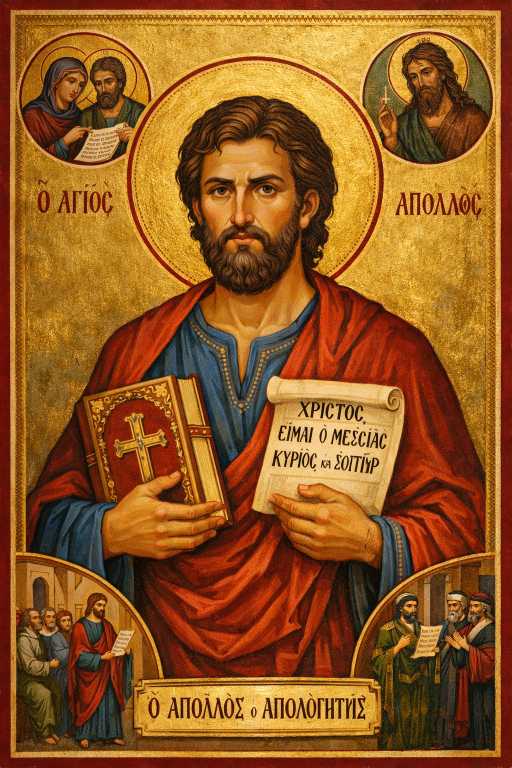
The iconographic tradition depicts St. Apollos as a mature man, often shown with a scroll or book
representing his mastery of the Scriptures, sometimes shown being instructed by Aquila and Priscilla
to symbolize his teachability, and occasionally shown preaching or disputing with opponents to
represent his apologetic ministry. These images serve as visual catechesis, teaching the faithful
about the character and ministry of this great saint.
📿Prayer and Intercession
The faithful of the Syriac Orthodox Church invoke St. Apollos in prayer, particularly when seeking
help in understanding the Scriptures, in teaching the faith to others, or in defending orthodoxy
against error. As one who was himself taught more perfectly in the way of God, he is believed to be
especially compassionate toward those who struggle to understand the mysteries of faith or who seek
deeper knowledge of divine truth.
Traditional prayers to St. Apollos ask for his intercession in obtaining from God the gifts of
wisdom, understanding, and eloquence in service of the Gospel. Students preparing for examinations,
preachers preparing sermons, scholars working on theological questions, and teachers instructing the
young—all may turn to St. Apollos as a heavenly helper and advocate.
O Holy Apostle Apollos, eloquent preacher of truth and mighty defender of the faith, who watered
what the blessed Paul had planted and who learned from humble teachers the fullness of apostolic
doctrine, pray for us that we may grow in wisdom and knowledge of our Lord Jesus Christ. Help us to
use whatever learning we possess not for vain glory but for the building up of the Church. Teach us
to remain humble and teachable all our days, and grant that our words may always serve the truth and
glorify God. Through your prayers, may we come at last to the heavenly wisdom that surpasses all
earthly knowledge. Amen.
💫Conclusion: The Eloquent Servant
St. Apollos of Alexandria stands before us as a model of sanctified intellect, humble service, and
eloquent witness. From the great intellectual center of Alexandria, he brought learning and
rhetorical skill into the service of the Gospel. Through the patient instruction of Aquila and
Priscilla, he received the fullness of apostolic teaching. In Corinth and beyond, he watered what
Paul had planted, building up the churches and defending the faith against all who opposed it.
His life teaches us that all our gifts—whether eloquence, learning, or any other talent—are given by
God and must be used for His glory and the good of His Church. It shows us that true wisdom combines
scholarship with humility, knowledge with devotion, and eloquence with truth. It reminds us that
ministers are servants, not celebrities, and that unity in Christ transcends differences in style or
approach.
As we honor St. Apollos, we give thanks to God for all faithful teachers, preachers, and defenders
of the faith throughout the ages. We ask for his intercession, that we too may be mighty in the
Scriptures, fervent in spirit, and bold in witness. And we commit ourselves to following his
example—combining learning with humility, using our gifts for God's glory, remaining teachable all
our days, and laboring together in unity as fellow workers in the Lord's field.
May the memory of St. Apollos be eternal. May his prayers ascend before the throne of God on behalf
of all who study, teach, and proclaim the holy Gospel. And may we, inspired by his example, dedicate
all our gifts and talents to the service of Christ and His holy Church, until that day when we join
the saints in glory and see face to face the Truth we now glimpse through Scripture and tradition.
Glory be to the Father, and to the Son, and to the Holy Spirit, now and always and unto the ages of
ages. Amen.