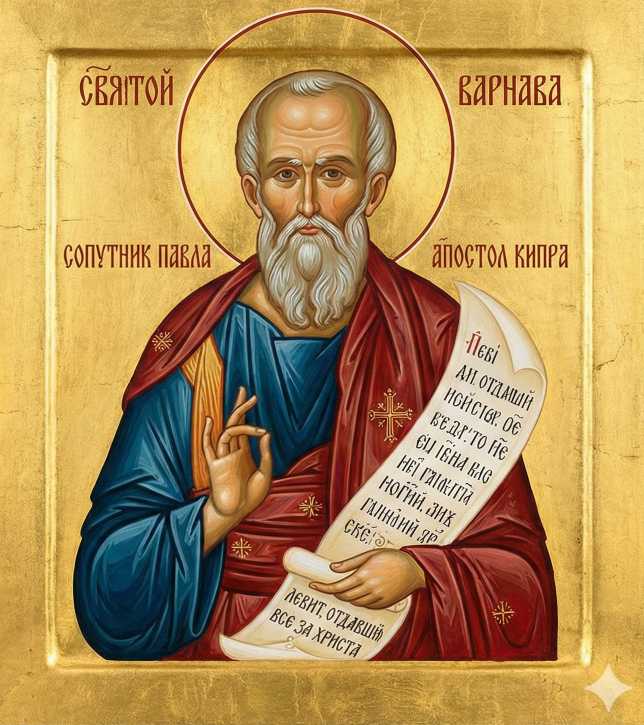
🌟Joseph of Cyprus: A Levite of Generous Heart
Saint Barnabas, whose birth name was Joseph, was born on the island of Cyprus into a Jewish family
of the priestly tribe of Levi. As a Levite, he belonged to the ancient tribe consecrated to the
service of the Temple, the tribe from which priests and those who assisted in worship were drawn.
This sacred heritage gave him a deep knowledge of the Hebrew Scriptures, the Law of Moses, and the
prophetic traditions—knowledge that would later prove invaluable in his apostolic ministry as he
demonstrated how Christ fulfilled every prophecy and promise of the Old Testament.
Joseph was a man of considerable wealth, owning lands and properties in Cyprus. According to
tradition preserved in the Syriac Orthodox Church and attested by early historians such as Clement
of Alexandria and Eusebius, he was among the seventy disciples whom our Lord Jesus Christ sent out
during His earthly ministry to preach the Kingdom of God, heal the sick, and cast out demons. If
this tradition is accurate—and there is no reason to doubt it—then Barnabas heard the teachings of
Christ directly from the Lord's own lips, witnessed His miracles, and was present during the events
of Holy Week, the Crucifixion, and the Resurrection appearances.
What is absolutely certain from the canonical account in the Acts of the Apostles is that Joseph was
an early and fervent believer in the Jerusalem church immediately following Pentecost. The Apostles
gave him a new name—Barnabas—which is interpreted as "Son of Consolation" or "Son of Encouragement"
(Bar-Naba in Aramaic). This name was not given casually; it reflected the essence of his character
and ministry. Barnabas was a man who brought comfort to the sorrowful, encouragement to the
discouraged, and hope to the despairing. In a church facing persecution, poverty, and internal
challenges, such a gift was precious beyond measure.
💎The Great Act of Generosity
One of the first recorded acts of Saint Barnabas in Scripture demonstrates the depth of his
commitment to Christ and his love for the community of believers. The Book of Acts records that in
the Jerusalem church, "all who were possessors of lands or houses sold them, and brought the
proceeds of the things that were sold, and laid them at the apostles' feet; and they distributed to
each as anyone had need." In this context of radical Christian community, Barnabas distinguished
himself by selling a field that he owned and bringing the entire sum to lay at the Apostles' feet.
This was no small gesture. Barnabas voluntarily gave up his financial security, his inheritance, his
earthly treasure, placing it all at the disposal of the Church for the care of the poor and the
support of the ministry. He did this not for recognition—for many others were doing the same—but out
of love for Christ and His people. His act of generosity is placed in Scripture immediately before
the sobering account of Ananias and Sapphira, who pretended to give everything while secretly
holding back a portion. The contrast is stark: Barnabas represents genuine, wholehearted devotion,
while they represent the tragedy of hypocrisy and greed.
This act of radical generosity established Barnabas as a man of integrity and demonstrated that he
had truly "counted all things as loss for the excellence of the knowledge of Christ Jesus." He had
no divided loyalty between God and mammon; he had chosen his treasure and placed it in heaven. This
spiritual freedom from material attachment would characterize his entire ministry, allowing him to
focus completely on the work of the Gospel without the encumbrance of worldly concerns.
"And Joses, who was also named Barnabas by the apostles (which is translated Son of Encouragement), a
Levite of the country of Cyprus, having land, sold it, and brought the money and laid it at the
apostles' feet." — Acts 4:36-37
🛡️Champion and Mentor of Saint Paul
Saint Barnabas's most significant role in salvation history was his relationship with Saint Paul.
When Saul of Tarsus, the infamous persecutor of Christians, came to Jerusalem after his conversion
claiming to be a disciple, the believers were understandably terrified and suspicious. They
remembered how he had ravaged the Church, dragging men and women to prison, consenting to the
martyrdom of Stephen, and breathing threats against the disciples. No one believed his conversion
was genuine; all feared it was a trap to infiltrate the Church and identify more Christians for
arrest.
It was Barnabas alone who had the courage, discernment, and compassion to take Saul's side. He
investigated Saul's story, listened to his testimony of meeting Christ on the Damascus road,
verified the accounts of his preaching in Damascus, and became convinced of the authenticity of his
conversion. Then Barnabas performed an act of tremendous courage and trust: he took Saul and brought
him to the Apostles, particularly to Peter and James. Barnabas vouched for Saul, testified on his
behalf, declared that Saul had seen the Lord, had preached boldly in Damascus, and was truly a
changed man.
Thanks to Barnabas's intervention and endorsement, Saul was accepted by the Jerusalem church.
Barnabas quite literally rescued Paul's ministry before it could even begin. Without Barnabas's
advocacy, Paul might have remained isolated, unable to connect with the Apostolic community, unable
to have his calling confirmed by the Jerusalem church. The entire future of Gentile Christianity
hung on this moment of Barnabas's faithful discernment and courageous endorsement. History records
few acts of spiritual patronage with more far-reaching consequences.
Years later, when the church in Antioch—the first predominantly Gentile congregation—experienced
explosive growth and needed mature leadership, the Jerusalem Apostles sent Barnabas to investigate
and shepherd this new work. Barnabas, seeing the grace of God at work among the Gentiles, rejoiced
and encouraged them all "with purpose of heart to continue with the Lord." But recognizing the
magnitude of the task, Barnabas remembered Saul, who had been living in relative obscurity in Tarsus
since being sent away from Jerusalem due to threats on his life. Barnabas traveled to Tarsus, found
Saul, and brought him to Antioch, where together they taught great numbers for an entire year. This
partnership marked the beginning of one of the most fruitful missionary collaborations in Christian
history.
🌍The First Missionary Journey
While Barnabas and Saul (who would soon be known as Paul) were ministering in Antioch, the Holy
Spirit spoke through the prophets and teachers of the church, saying: "Now separate to Me Barnabas
and Saul for the work to which I have called them." Note that Barnabas is named first—at this point,
he was the senior partner, the recognized leader, the one with apostolic credentials. After fasting
and prayer, the church laid hands on them and sent them forth on what would become known as the
First Missionary Journey (approximately 46-48 AD).
They first sailed to Cyprus, Barnabas's homeland—a strategic choice that allowed Barnabas to
leverage his knowledge of the island and possibly his family connections. In Cyprus, they preached
in the synagogues and eventually came before Sergius Paulus, the Roman proconsul. Here occurred a
dramatic confrontation with a false prophet and sorcerer named Bar-Jesus (Elymas), who tried to turn
the proconsul away from the faith. Paul, filled with the Holy Spirit, struck the sorcerer with
temporary blindness, and Sergius Paulus believed, "being astonished at the teaching of the Lord."
This was the first recorded conversion of a high-ranking Roman official and demonstrated the
Gospel's power to penetrate even the highest levels of society.
From Cyprus, the missionaries sailed to Perga in Pamphylia (southern Asia Minor), where John Mark,
Barnabas's cousin who had accompanied them as an assistant, left them and returned to Jerusalem.
This departure would later become a point of contention. From Perga, they traveled inland to Antioch
of Pisidia, Iconium, Lystra, and Derbe, establishing churches, ordaining elders, and enduring severe
persecution. In Lystra, after Paul healed a crippled man, the pagan crowds attempted to worship
Barnabas and Paul as gods, calling Barnabas "Zeus" (the chief god) and Paul "Hermes" (the messenger
god)—indicating that Barnabas had a commanding, dignified presence that made him appear as the
senior figure.
The same crowd, stirred up by hostile Jews from Antioch and Iconium, later stoned Paul and dragged
him out of the city, leaving him for dead. But Barnabas and the disciples stood around Paul, and
miraculously he rose up and re-entered the city. The next day, they departed for Derbe. After
establishing a church there, they courageously retraced their steps through all the cities where
they had been persecuted, strengthening the disciples, appointing elders, and commending them to the
Lord. This journey established the pattern for all subsequent missionary work: proclaiming Christ,
enduring suffering, establishing churches, appointing leadership, and maintaining connection through
return visits.
⚖️The Council of Jerusalem and Defense of
Gentile Freedom
When Barnabas and Paul returned to Antioch and reported all that God had done through them and how
He had "opened the door of faith to the Gentiles," controversy erupted. Certain men came from Judea
teaching that unless Gentile converts were circumcised according to the custom of Moses, they could
not be saved. This teaching threatened to turn Christianity into merely a sect of Judaism and to
burden Gentile believers with obligations that even many Jews found difficult to keep.
After much dissension and dispute in Antioch, the church decided to send Paul and Barnabas to
Jerusalem to consult with the Apostles and elders about this question. This resulted in the Council
of Jerusalem (approximately 49 AD), the first ecumenical gathering of the Church, which addressed
the relationship between Jewish and Gentile Christians. At this council, Barnabas and Paul testified
about the miraculous signs and wonders God had performed among the Gentiles through their ministry,
demonstrating that God had accepted the Gentiles through faith alone, without requiring circumcision
or full observance of the Mosaic Law.
The council, under the guidance of the Holy Spirit and the leadership of James the brother of the
Lord, decreed that Gentile believers should not be burdened with the yoke of the Law, but should
only abstain from things polluted by idols, from sexual immorality, from things strangled, and from
blood. This decision was monumental: it established that salvation is by grace through faith in
Christ alone, not by works of the Law. It freed Gentile Christianity to develop its own expression
while maintaining unity with Jewish believers. Barnabas played a crucial role in this decision, not
through eloquent speeches (that was Paul's gift), but through his testimony, his example, and his
recognized status as a trusted apostolic figure who bridged both communities.
💔The Sharp Disagreement and Separation
After returning to Antioch with the council's decree, Paul proposed to Barnabas that they revisit
all the churches they had established on their first journey. Barnabas agreed and wanted to take
John Mark with them again. But Paul refused, considering Mark's earlier departure from Perga as a
desertion and judging him unfit for the rigors of missionary work. The disagreement was so intense
that Scripture records "the contention became so sharp that they parted from one another."
This separation is often viewed with sadness, and indeed it represents a moment of human weakness
even in great saints. However, it should not be seen as a failure but rather as an example of how
God works through human limitations. Barnabas, true to his character as "Son of Encouragement,"
believed in giving people second chances. He saw potential in his cousin Mark and was willing to
invest in his restoration and development. Paul, focused on the mission's urgency and the demands of
apostolic work, made a pragmatic decision based on past performance.
The result was that instead of one missionary team, there were now two: Paul took Silas and traveled
through Syria and Cilicia; Barnabas took Mark and sailed to Cyprus. God used this division to
multiply the missionary effort, reaching more regions and establishing more churches than one team
alone could have done. Furthermore, Barnabas's investment in Mark proved prophetic: Mark later
became so valuable that Paul himself wrote, "Get Mark and bring him with you, for he is useful to me
for ministry." Mark went on to write the Gospel according to Mark and became the founder of the
Church in Alexandria. Barnabas's encouragement and mentoring had rescued another crucial figure for
the Kingdom.
🏝️Return to Cyprus and Martyrdom
After separating from Paul, Saint Barnabas, accompanied by Mark, returned to his native Cyprus to
continue the evangelization of the island. According to the ancient tradition preserved in the Acts
of Barnabas (an early Christian text dating from the 5th century but based on earlier traditions)
and confirmed by the Church Fathers, Barnabas conducted an extensive preaching mission throughout
Cyprus, establishing churches, ordaining clergy, and confirming believers in the faith.
The tradition states that Barnabas and Mark preached throughout the island, from Salamis to Paphos,
performing miracles, healing the sick, and converting many to Christianity. However, their success
aroused fierce opposition from the Jewish community, particularly in Salamis, where Barnabas had
family connections and where his preaching had been especially effective in converting both Jews and
Gentiles.
According to the martyrology preserved in the Syriac Orthodox Church and other Eastern traditions,
around the year 61 AD, hostile Jews in Salamis, enraged by Barnabas's success and viewing him as a
traitor to Judaism, seized him while he was preaching in the synagogue. They dragged him outside the
city, subjected him to torture, and ultimately stoned him to death—the same form of martyrdom that
Stephen had endured and that Barnabas had witnessed years before in Jerusalem. Thus, the man who had
once held the garments of those who stoned Stephen (if he was indeed present, as many traditions
suggest) received the same crown of martyrdom.
John Mark, who had hidden during the violence, secretly recovered Barnabas's body under cover of
darkness. Following Barnabas's own instructions (according to the Acts of Barnabas), Mark buried him
in a cave west of Salamis, placing on his chest a copy of the Gospel of Matthew that Barnabas had
transcribed with his own hand. This detail, whether literal or symbolic, emphasizes Barnabas's
devotion to preserving and spreading the Gospel message.
In 478 AD, according to a vision given to Archbishop Anthemius of Cyprus, the tomb of Saint Barnabas
was discovered in exactly the location described in the ancient tradition. The Gospel of Matthew was
found on his chest, miraculously preserved. Emperor Zeno granted the Church of Cyprus independence
(autocephaly) in honor of this discovery, and a magnificent church was built over Barnabas's tomb.
His relics became a source of healing and miraculous interventions, and his veneration spread
throughout the Christian world.
📜The Epistle of Barnabas
An early Christian writing known as the Epistle of Barnabas has been attributed to Saint Barnabas
since ancient times, though modern scholarship debates this attribution. This epistle, written in
Greek probably between 70-132 AD, presents a detailed allegorical interpretation of the Old
Testament, arguing that the covenant, the Temple, and the sacrificial system all find their
fulfillment in Christ. It addresses the relationship between Judaism and Christianity, emphasizing
that Christians are the true inheritors of the Abrahamic covenant through faith in Christ.
Whether or not Barnabas literally wrote this epistle, it represents the type of theological teaching
he would have provided: bridging the Old and New Testaments, explaining how Christ fulfills the Law
and the Prophets, and demonstrating the continuity of God's salvific plan. The epistle's emphasis on
moral living, proper interpretation of Scripture, and the two ways (the way of light and the way of
darkness) resonates with the character of the "Son of Encouragement" who would have taught believers
how to walk worthy of their calling.
✨Legacy and Significance in the Syriac Orthodox
Church
In the Syriac Orthodox tradition, Saint Barnabas is venerated as one of the chief Apostles, equal in
honor to the Twelve. His feast is celebrated with great solemnity, and his life is held up as a
model of Christian virtue. The Church particularly emphasizes several aspects of his character and
ministry that are relevant for all believers:
First, his generosity and detachment from material wealth. Barnabas demonstrated that true
discipleship requires placing all our resources at God's disposal, holding nothing back, trusting
completely in divine providence. Second, his gift of encouragement and his willingness to see
potential in others. He championed Paul when everyone else feared him, and he believed in Mark when
Paul had given up on him. Both decisions proved prophetic and essential for the Church's mission.
Third, his humility and willingness to work in partnership. Though senior to Paul initially,
Barnabas graciously allowed Paul's greater gifts to flourish and eventually to overshadow his own
leadership. He never displayed jealousy or competition but rejoiced when others excelled. Fourth,
his ability to bridge communities. As a Levite who embraced Gentile Christianity, as a Cypriot who
ministered in Jerusalem and Antioch, as a companion of both Peter and Paul, Barnabas embodied the
unity of the Church across ethnic and cultural boundaries.
Finally, his steadfast faithfulness unto death. Like his Master, Barnabas was rejected by his own
people, suffered for the Gospel, and gave his life as a martyr witness to the truth of Christ's
resurrection. His blood, mingled with that of countless other martyrs, became the seed from which
the Church in Cyprus and throughout the Mediterranean world grew and flourished.
Prayer for Intercession
O Holy Apostle Barnabas, Son of Consolation and Encouragement, generous benefactor of the Church,
faithful companion of Saint Paul, champion of the outcast, mentor of the discouraged, bridge between
Jew and Gentile, and glorious martyr of Cyprus—we seek your powerful intercession. You who gave away
all your possessions for love of Christ, who risked your reputation to defend the
persecutor-turned-apostle, who believed in the restoration of those who had failed, who preached the
Gospel with signs and wonders, and who sealed your testimony with your own blood—pray for us. Grant
us generous hearts that hold nothing back from God, discerning spirits that recognize Christ in
unexpected people, encouraging words that build up the discouraged, and steadfast courage to witness
to Christ regardless of cost. Through your prayers, may we grow in holiness and faithfulness, and
may we hear at last the words, "Well done, good and faithful servant." Amen.