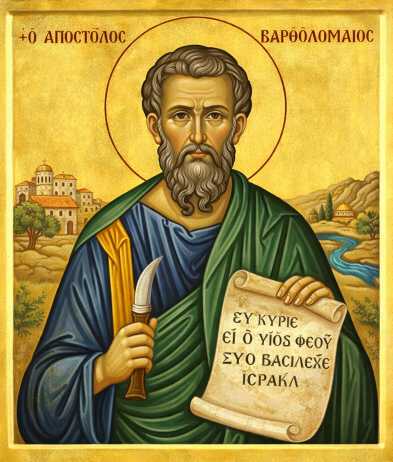
🕊️Name, Identity, and Early Background
Bartholomew—whose name in Aramaic (Bar-Tolmai, ܒܰܪܬܳܘܠܡܰܝ) means "son of Tolmai" or "son of
furrows"—stands among the Twelve Apostles as one whose identity is deeply woven into the sacred
narratives of our Lord's ministry. The ancient and venerable tradition of the Syriac Orthodox
Church, preserved from apostolic times, identifies Bartholomew with Nathanael, the one whom our
Savior beheld under the fig tree and declared to be "truly an Israelite in whom there is no guile."
This identification is not a mere speculation but rests upon solid ground: the Synoptic Gospels
(Matthew, Mark, and Luke) list Bartholomew among the Twelve, always in close association with
Philip, yet never mention Nathanael. Conversely, the Fourth Gospel speaks of Nathanael but never
mentions Bartholomew. The pairing of Philip and Bartholomew in the apostolic lists mirrors the
intimate connection between Philip and Nathanael in John's Gospel, where Philip brings Nathanael to
Christ. The Church Fathers, including Eusebius of Caesarea and St. Jerome, alongside the consistent
witness of the Syriac tradition, affirm this identity.
According to the sacred tradition preserved among our Syriac forefathers, Bartholomew (Nathanael)
was from Cana of Galilee, that blessed town where our Lord performed His first miracle at the
wedding feast, transforming water into wine. Some scholars of our tradition hold that Bartholomew
himself may have been present at that wedding, witnessing the first manifestation of Christ's glory.
He was a man learned in the Law and the Prophets, one who spent his days in meditation upon the
sacred Scriptures—it was under a fig tree, that traditional place of study and prayer for devout
Israelites, that Philip found him.
The depth of Nathanael's spiritual preparation is evident in his immediate recognition of Christ.
Though initially skeptical—"Can anything good come from Nazareth?"—his doubt was honest inquiry
rather than cynical rejection. When our Lord revealed His divine knowledge, declaring, "Before
Philip called you, when you were under the fig tree, I saw you," Nathanael's heart was opened. His
confession was immediate and profound: "Rabbi, You are the Son of God! You are the King of Israel!"
This was among the earliest and most complete confessions of faith in Christ's divinity recorded in
the Gospels.
📖With Christ: The Discipleship of Bartholomew
Though the Gospel narratives do not frequently single out Bartholomew by name after his calling, the
Syriac tradition understands this silence not as absence but as the mark of a faithful disciple who
served without seeking prominence. He was constantly present among the Twelve, witnessing our Lord's
mighty works, hearing His teachings, and growing daily in faith and understanding.
As Nathanael, he was among those to whom the risen Lord appeared at the Sea of Tiberias, as recorded
in the twenty-first chapter of John's Gospel. There, with Peter, Thomas, James, John, and two other
disciples, he witnessed the miraculous catch of fish and partook of the breakfast prepared by the
Risen Christ on the shore. This appearance holds deep significance in our tradition, for it
represents the restoration and commissioning of the apostles after the trauma of the Crucifixion.
The Syriac fathers teach us that Bartholomew, as one who was initially skeptical yet became a
wholehearted believer, represents the journey of every soul from doubt to faith. His transformation
from one who questioned whether good could come from Nazareth to one who confessed Jesus as the Son
of God mirrors the spiritual journey the Church calls each believer to undertake. In this way, Mar
Bartholomew stands as a patron for all who struggle with doubt yet seek truth with sincere hearts.
After the Ascension of our Lord, Bartholomew was present in the Upper Room with the other apostles,
the holy women, and Mary the Mother of God, persevering in prayer and awaiting the promise of the
Father. On the day of Pentecost, he was filled with the Holy Spirit and received power from on high,
equipping him for the great apostolic mission that lay ahead.
🌍Apostolic Mission: To the Ends of the Earth
The apostolic labors of St. Bartholomew are among the most extensive recorded in Christian
tradition. According to the consistent testimony of the Syriac Orthodox Church, preserved in our
liturgical texts and hagiographical accounts, Bartholomew carried the Gospel to distant regions,
fulfilling literally our Lord's command to be His witnesses "to the ends of the earth." The Syriac
tradition, in harmony with the Armenian Apostolic Church and the broader Oriental Orthodox family,
identifies Armenia as the primary field of his apostolic labors.
Journey to the East: Following the distribution of mission fields among the
apostles after Pentecost, Bartholomew set forth eastward. According to the sacred tradition, he
traveled through Mesopotamia, that ancient land of the Arameans where the Syriac language
flourished. In these regions, he encountered diverse populations—Jews of the diaspora, Arameans,
Persians, and various peoples—and proclaimed to all the message of the crucified and risen Christ.
The Syriac-speaking regions proved particularly receptive to his preaching, for he spoke their
language and understood their culture, being himself an Aramean from Galilee who spoke the language
of our Lord Jesus Christ.
Some traditions also place him in Arabia Felix (modern Yemen) and other eastern territories during
his journeys, though these accounts vary in detail. What remains certain and consistent across all
Syriac and Oriental Orthodox sources is his ultimate destination and primary field of labor: the
land of Armenia.
Mission to Armenia—The Crown of His Apostolic Labor: It is Armenia above all that
claims St. Bartholomew as its apostle and patron. The Armenian Apostolic Church, our beloved sister
church in the Oriental Orthodox family, holds Bartholomew in the highest veneration alongside St.
Jude Thaddeus. This is not a late development or pious legend, but a tradition confirmed by early
historical sources including Moses of Chorene (5th century), the father of Armenian historiography,
and consistently maintained throughout the centuries by both the Armenian and Syriac churches.
According to the sacred tradition, Bartholomew arrived in Armenia together with his fellow apostle
St. Jude Thaddeus. These two apostles, sent by the Lord to evangelize this ancient and proud nation,
labored with one heart and one mind to plant the seeds of the Gospel in Armenian soil. Their mission
would bear fruit beyond measure, for Armenia would become the first nation in history to officially
embrace Christianity as its state religion in 301 AD under St. Gregory the Illuminator—a direct
continuation of the apostolic foundation laid by Bartholomew and Thaddeus.
In Armenia, Bartholomew's ministry was marked by extraordinary signs and wonders that authenticated
his apostolic authority. He healed the sick, cast out demons, and raised the dead—all in the name of
Jesus Christ. One of the most celebrated miracles recounted in Armenian tradition tells of how
Bartholomew exorcised a demon that had possessed the daughter of King Polymius of Armenia. The
demon, before being expelled, revealed that it and its fellow demons had been dwelling in the pagan
idols worshiped throughout the kingdom. At Bartholomew's command, in the powerful name of Jesus
Christ, the idols shattered and the demons fled, leading to the conversion of the king, his family,
and many people of Armenia.
Through such mighty works, Bartholomew demonstrated that the gods of the nations were mere
idols—lifeless, powerless, and inhabited by demons—while Jesus Christ is the true and living God,
Lord of all creation. He taught the Armenians the fullness of the apostolic faith: the Holy
Trinity—Father, Son, and Holy Spirit, one God in three persons; the Incarnation of God the Word, who
became man for our salvation; the redemption accomplished through Christ's death on the Cross and
His glorious Resurrection; the promise of eternal life for all who believe; and the moral teachings
of the Gospel that transform human life. He established churches in the cities and villages of
Armenia, ordained presbyters and deacons, and organized the Christian community according to
apostolic order, laying foundations that would endure through the centuries.
The Syriac Orthodox Church, sharing the same Oriental Orthodox communion with the Armenian Church,
has always recognized and honored this apostolic connection. In our liturgical commemorations and
hagiographical traditions, we venerate St. Bartholomew as the apostle to Armenia, acknowledging the
deep bond between our churches that traces back to apostolic times. The blood of Bartholomew, shed
on Armenian soil, and the blood of countless Armenian martyrs through the centuries, mingle in
testimony to the one faith, the one Lord, and the one baptism that unite us in Christ.
👑The Crown of Martyrdom
The glorious apostolic career of St. Bartholomew reached its consummation in martyrdom—that supreme
witness to Christ which our Syriac fathers called the "baptism of blood" and the "crown of victory."
The manner of his death is recorded in multiple ancient sources and has been consistently preserved
in Christian tradition, both East and West.
After his successful ministry in Armenia, the pagan priests, seeing their influence destroyed and
their temples emptied, stirred up opposition against the apostle. They went to King Astyages
(brother of King Polymius) in the city of Albanopolis (modern Baku in Azerbaijan), accusing
Bartholomew of turning the people away from the ancient gods and introducing a foreign religion.
The king summoned Bartholomew and commanded him to sacrifice to the idols. The apostle, filled with
the Holy Spirit, responded with boldness: "I worship the one true God, the Father Almighty, and His
only-begotten Son Jesus Christ, and the Holy Spirit, the Trinity in Unity. Your idols are the work
of human hands and the dwelling places of demons. They can neither see nor hear, neither help nor
harm. I will not bow before them, for my knee bows only to the Living God."
Enraged by this defiance, the king ordered Bartholomew to be tortured. According to the most widely
attested tradition, the apostle was flayed alive—his skin was removed from his body while he yet
lived. This horrific torture was inflicted with the intention of forcing him to renounce Christ, but
the blessed apostle endured with supernatural courage, praying for his persecutors even as they
tormented him.
The Syriac tradition teaches us that during his martyrdom, Bartholomew manifested the same spirit as
his Master, who endured the Cross for the joy set before Him. Even as his flesh was torn from his
body, the apostle's spirit remained fixed on Christ, and his lips continued to confess the faith and
to pray. Some accounts state that he was beheaded after the flaying; others that he was crucified
upside down in imitation of St. Peter. What is certain is that he surrendered his life completely
for Christ, achieving the martyr's crown around the year 68-71 AD.
The martyrdom of St. Bartholomew fulfills the words of our Lord: "Greater love has no one than this,
that someone lay down his life for his friends." The apostle demonstrated in his death the same
radical commitment he had shown from the moment he confessed Jesus as the Son of God under the fig
tree. From that first encounter to his final breath, Bartholomew proved himself to be, as Christ had
declared, "an Israelite indeed, in whom there is no guile."
📜Literary Legacy and the Gospel of Matthew
The Church Fathers preserve an intriguing tradition regarding St. Bartholomew and the written
Gospel. According to Eusebius of Caesarea in his Ecclesiastical History (written in the early fourth
century), when the Christian scholar Pantaenus of Alexandria traveled to distant eastern lands
around 190 AD, he discovered Christian communities there who possessed a Gospel of Matthew written
in Hebrew characters. The local tradition claimed that this Hebrew Gospel had been brought to them
by "Bartholomew, one of the apostles."
This testimony, repeated by St. Jerome and other Church Fathers, is significant for the Syriac
Orthodox tradition, which has always treasured the Aramaic and Hebrew languages as the sacred
languages of Christ and His apostles. Our Lord Jesus spoke in Aramaic (the Galilean dialect closely
related to Syriac), and the earliest Christian communities in the Holy Land and throughout the East
used these Semitic languages in their worship and teaching. That Bartholomew is associated with
carrying a Hebrew or Aramaic Gospel testifies to the apostolic Church's commitment to proclaiming
the Good News in the vernacular languages of the peoples they evangelized.
The identity of the "eastern lands" mentioned by Eusebius has been debated by scholars. In ancient
geographic terminology, "India" could refer to various distant eastern regions—the Arabian
Peninsula, the Horn of Africa, Persia, or the Indian subcontinent. What is certain from the Syriac
and Armenian traditions is that Bartholomew carried the Gospel in its Semitic form to the eastern
mission fields, ultimately establishing it firmly in Armenia, where the apostolic faith took deep
root.
The significance of this tradition lies not primarily in the exact geographic details, but in what
it reveals about apostolic mission: the apostles did not simply preach orally, but carried with them
written accounts of our Lord's life and teachings. They established literate Christian communities
capable of preserving and transmitting the Sacred Scriptures. Bartholomew, whether in Mesopotamia,
Armenia, or other eastern lands, ensured that the churches he founded possessed not only the oral
apostolic tradition but also the written Word of God.
Various apocryphal texts circulated in the ancient church under Bartholomew's name, including the
"Questions of Bartholomew" and the "Gospel of Bartholomew." While the Church has not received these
as canonical Scripture, they testify to the high regard in which the apostle was held in early
Christian communities and the desire to preserve traditions about his teachings and revelations. The
Syriac Orthodox Church, with its careful preservation of ancient texts and traditions, has
maintained awareness of these writings while properly distinguishing them from the inspired
canonical Scriptures.
⛪Veneration and Sacred Relics
The body of the holy apostle, after his martyrdom, was initially buried at Albanopolis in Armenia.
The site became a place of pilgrimage, where the faithful gathered to venerate the apostle's memory
and to seek intercession through his prayers. The relics remained in Armenia for several centuries,
a sacred treasure of the Armenian Church.
In the sixth century, during the reign of Emperor Anastasius I, the holy relics were translated to
the island of Lipari (off Sicily), where they remained for centuries. Later, portions of the relics
were transferred to Benevento in southern Italy and finally to Rome, where they rest today in the
Church of St. Bartholomew on the Tiber Island. However, the Armenian Church and other Eastern
churches also claim to possess relics of the apostle, which were distributed throughout the
Christian world as blessings for the faithful.
Throughout the history of the Syriac Orthodox Church, St. Bartholomew has been venerated with deep
reverence. His feast day is celebrated on June 11 in the Syriac calendar, with special liturgical
services that commemorate his apostolic labors and martyrdom. The faithful invoke his intercession,
particularly in times of persecution and trial, drawing strength from his example of unwavering
faith unto death.
In our sacred liturgy, we remember St. Bartholomew in the commemoration of the apostles, asking that
through their prayers and intercessions, the Lord would strengthen His Church, preserve it from all
heresy and error, and grant it victory over the enemies of truth. The example of Mar Bartholomew—his
immediate response to Christ's call, his transformation from skepticism to faith, his extensive
apostolic labors, and his courageous martyrdom—continues to inspire and instruct the faithful of
every generation.
✝️Theological Significance in Syriac Tradition
For the Syriac Orthodox Church, St. Bartholomew embodies several crucial theological themes that
resonate deeply with our spiritual heritage. First, he represents the fulfillment of the Old
Covenant in the New. As "an Israelite without guile," he personifies the faithful remnant of Israel
who recognized and received the Messiah when He came. His study of Scripture under the fig tree
prepared him to recognize Jesus as the One foretold by Moses and the Prophets.
Second, Bartholomew demonstrates the transformative power of encounter with Christ. His movement
from skepticism ("Can anything good come from Nazareth?") to profound confession ("You are the Son
of God! You are the King of Israel!") models the conversion that the Gospel effects in human hearts.
This transformation was not merely intellectual but existential—it changed the entire trajectory of
his life.
Third, his apostolic mission to distant lands embodies the universal scope of Christ's redemption.
The Gospel is not confined to one people or nation but is proclaimed "to the ends of the earth."
Bartholomew's journeys to Armenia, and beyond demonstrate that in Christ there is neither Jew
nor Greek, neither East nor West, but one new humanity united in faith.
Fourth, his martyrdom reveals the theology of witness (martyria) that is central to Christian faith.
To be a martyr is not simply to die for a cause but to witness to the truth of Christ's resurrection
with one's whole life and death. Bartholomew's willingness to endure flaying rather than deny Christ
testifies to his absolute certainty of the resurrection and eternal life. He knew, as St. Paul
wrote, that "to live is Christ, and to die is gain."
Finally, the Syriac fathers see in Bartholomew's guilelessness a model of Christian simplicity and
integrity. In a world filled with deceit and duplicity, the Christian is called to be a person of
truth, whose yes is yes and whose no is no. This guilelessness is not naivety but rather the
transparency that comes from a pure heart fully committed to Christ.
💡St. Bartholomew's Message for Our Time
The life and witness of St. Bartholomew speak powerfully to the challenges facing Christians in
every age, but particularly in our contemporary context. We live in an era characterized by
skepticism, relativism, and widespread doubt about ultimate truth. Like Nathanael questioning
whether good could come from Nazareth, many today question whether any true answers exist to life's
deepest questions.
Bartholomew's example teaches us that honest questioning need not end in cynicism. His skepticism
was not a closed door but an open one—he was willing to "come and see" when Philip invited him. This
openness to evidence, this willingness to investigate, led him to the greatest discovery possible:
the encounter with the Living God incarnate in Jesus Christ. In our age of doubt, the Church must
encourage the same spirit—not blind acceptance, but earnest seeking; not intellectual cowardice, but
courageous pursuit of truth.
Furthermore, St. Bartholomew's extensive missionary journeys challenge the complacency that can
afflict Christian communities. He did not content himself with the comfortable or the familiar but
ventured into unknown lands, faced unfamiliar cultures, and risked his life to proclaim Christ. The
missionary mandate given by our Lord—"Go into all the world and preach the gospel to every
creature"—remains as urgent today as in the apostolic age. Every Christian is called to be a
witness, whether in distant lands or in the familiar contexts of daily life.
Perhaps most powerfully, Bartholomew's martyrdom speaks to Christians facing persecution and
pressure to compromise their faith. In many parts of the world today, believers face the choice
between confessing Christ and suffering consequences—loss of livelihood, social ostracism,
imprisonment, or even death. St. Bartholomew's unwavering witness, even unto flaying and death,
provides both inspiration and intercession for these modern martyrs. His example demonstrates that
the grace of God is sufficient to enable ordinary human beings to endure extraordinary suffering for
the sake of Christ.
Finally, the identification of Bartholomew with Nathanael reminds us that discipleship begins with a
personal encounter with Jesus. It was not abstract doctrine that transformed Nathanael but the
experience of being known and loved by Christ: "Before Philip called you, when you were under the
fig tree, I saw you." This personal relationship with the Lord—being seen, known, and called by
Him—remains the foundation of authentic Christian life. All our theology, liturgy, and ethics flow
from this primary reality: Christ knows us, calls us, and invites us to follow Him.
📖Scriptural Foundation
The Call of Nathanael (John 1:45-51):
Philip found Nathanael and said to him, "We have found Him of whom Moses in the Law and also the
Prophets wrote, Jesus of Nazareth, the son of Joseph." Nathanael said to him, "Can anything good
come out of Nazareth?" Philip said to him, "Come and see." Jesus saw Nathanael coming toward Him and
said of him, "Behold, an Israelite indeed, in whom there is no deceit!" Nathanael said to Him, "How
do You know me?" Jesus answered him, "Before Philip called you, when you were under the fig tree, I
saw you." Nathanael answered Him, "Rabbi, You are the Son of God! You are the King of Israel!" Jesus
answered him, "Because I said to you, 'I saw you under the fig tree,' do you believe? You will see
greater things than these." And He said to him, "Truly, truly, I say to you, you will see heaven
opened, and the angels of God ascending and descending on the Son of Man."
This passage is the foundation of our understanding of Bartholomew (Nathanael). Notice the
progression: skepticism ("Can anything good come from Nazareth?"), personal encounter ("Come and
see"), divine knowledge ("I saw you under the fig tree"), confession of faith ("You are the Son of
God"), and promise of greater revelation ("You will see heaven opened"). This pattern describes the
journey of every soul that comes to Christ in faith.
Appearance After the Resurrection (John 21:1-2):
After this Jesus revealed Himself again to the disciples by the Sea of Tiberias, and He revealed
Himself in this way. Simon Peter, Thomas (called the Twin), Nathanael of Cana in Galilee, the sons
of Zebedee, and two others of His disciples were together.
This text confirms that Nathanael (Bartholomew) was among the disciples who witnessed the risen
Lord. It also specifies that he was from Cana in Galilee, which the Syriac tradition has
consistently maintained.
Lists of the Twelve Apostles
Bartholomew is named among the Twelve in the following passages:
- Matthew 10:2-4: "Philip and Bartholomew; Thomas and Matthew the tax
collector..."
- Mark 3:16-19: "Philip, Bartholomew, Matthew, Thomas..."
- Luke 6:13-16: "Philip, Bartholomew, Matthew, Thomas..."
- Acts 1:13: "Philip and Thomas, Bartholomew and Matthew..."
Note that in every list, Bartholomew is mentioned in close connection with Philip, which corresponds
to the Gospel of John's account of Philip bringing Nathanael to Jesus.
🌟Conclusion: The Israelite Without Guile
St. Bartholomew the Apostle stands before us as a complete model of Christian discipleship: from
initial encounter with Christ, through years of learning and service, to apostolic mission in
distant lands, culminating in the supreme witness of martyrdom. His life demonstrates that the
Gospel transforms individuals and reaches to the ends of the earth, and that the grace of God
enables ordinary people to accomplish extraordinary things for the Kingdom.
For the Syriac Orthodox Church, Bartholomew is not a distant historical figure but a living presence
in the communion of saints, a faithful intercessor before the throne of God, and an inspiration for
mission and martyrdom. His guileless character, his immediate response to Christ, his extensive
evangelistic labors, and his courageous death all combine to present us with a saint who lived the
Gospel fully and witnessed to it faithfully.
As we honor his memory and seek his intercession, may we be inspired to imitate his example: to seek
Christ with sincerity, to confess Him boldly, to serve Him faithfully in whatever field He assigns
us, and to witness to Him courageously, even unto death if He should call us to that supreme honor.
Through the prayers of St. Bartholomew and all the holy apostles, may our Lord Jesus Christ have
mercy upon us and save us. Amen.
Prayer for Intercession
O Holy Apostle Bartholomew, Nathanael of Cana, you who were called by our Lord from beneath the fig
tree and confessed Him as the Son of God and King of Israel, pray for us before the throne of grace.
You who carried the Gospel to Armenia, and the uttermost parts of the earth, intercede that
we might be faithful witnesses to Christ in our own time and place. You who endured the agony of
flaying yet remained steadfast in faith, strengthen those who suffer persecution for righteousness'
sake. By your prayers, may the Syriac Orthodox Church remain faithful to the apostolic tradition you
helped establish, may it grow in holiness and truth, and may it fulfill its mission to proclaim
Christ until He comes again in glory. Amen.