📖Early Life and Monastic Formation
Saint Mor Baselios Yeldho, whom the faithful of Malankara venerate with profound devotion as
"Kothamangalam Bava" (the Blessed Father of Kothamangalam), was born in the year 1593 AD in the
village of Bakhdida (also known as Karakosh or Kooded) near the ancient city of Mosul in Iraq. This
blessed village holds a sacred place in Christian memory, for it is the very location where the
glorious martyr St. Shmuni (Morth Shmuni) and her seven heroic sons suffered martyrdom for their
faith in Christ during the persecution under Antiochus Epiphanes, as recorded in the Second Book of
Maccabees.
To be born in such a place, sanctified by the blood of martyrs, was itself a providential sign of
the holiness that would characterize his life. Young Yeldho grew up surrounded by the rich spiritual
heritage of Mesopotamian Christianity, in a region where the Syriac Orthodox faith had flourished
since apostolic times. The churches, monasteries, and holy sites of the area provided a living
catechism in stone and prayer, teaching him from his earliest years about the faith of his fathers.
From his youth, Yeldho demonstrated an extraordinary spiritual sensitivity and a deep longing for
closer communion with God. While other young men of his village pursued worldly ambitions or sought
to establish themselves in trades and professions, young Yeldho's heart was drawn irresistibly
toward the monastic life. He heard the call of Christ to "leave all and follow Me," and he responded
with wholehearted generosity.
At a remarkably young age, Yeldho presented himself at the gates of the renowned Monastery of Mor
Behnam (also known as Mar Bahanan), one of the great centers of Syriac Orthodox monasticism near
Mosul. This ancient monastery, dedicated to the martyr St. Behnam and his sister St. Sarah, had for
centuries been a school of holiness where young men learned the disciplines of prayer, fasting,
obedience, and spiritual warfare under the guidance of experienced spiritual fathers.
The abbot and monks of Mor Behnam, recognizing the genuine vocation and spiritual gifts of the young
aspirant, received him into the monastic community. Yeldho was tonsured as a monk, receiving the
habit of St. Basil and beginning his formation in the rigorous life of coenobitic monasticism. He
embraced with joy the demanding routine of the monastery: rising before dawn for the night office,
spending long hours in prayer and contemplation, studying the Holy Scriptures and the writings of
the Fathers, performing manual labor, and practicing the ascetic disciplines that purify the soul
and prepare it for union with God.
Under the guidance of his spiritual fathers, the young monk Yeldho made rapid progress in the
interior life. He distinguished himself by his humility, his obedience, his charity toward his
brother monks, and above all by his profound love for God manifested in constant prayer. The Divine
Liturgy became the center and summit of his life, and he approached the Holy Mysteries with such
reverence and devotion that his fellow monks recognized in him someone specially chosen by God for
great things.
✝️Priesthood and Rise to Episcopal Dignity
As Brother Yeldho matured in monastic life, demonstrating not only personal holiness but also
wisdom, learning, and administrative capability, his superiors discerned that God was calling him to
ordained ministry. In due course, he was ordained to the sacred diaconate and then to the holy
priesthood, receiving the grace of the sacrament to offer the Holy Qurbono and to minister to the
spiritual needs of God's people.
Father Yeldho's reputation for sanctity and wisdom spread throughout the monasteries and churches of
the region. He became known as a spiritual father to whom monks and laypeople alike came for
guidance. His counsel was sought on difficult questions of theology and canon law, his prayers were
requested for the sick and afflicted, and his presence brought blessing wherever he went. Yet
through all this growing recognition, he remained humble and self-effacing, always attributing any
good that came through him to the grace of God alone.
The Church's need for leaders who combined holiness with capability eventually led to Father Yeldho
being called to episcopal ministry. The position of Maphrian—Catholicos of the East, the
second-highest office in the Syriac Orthodox Church after the Patriarch himself—had become vacant.
This ancient and prestigious office, with jurisdiction over the eastern territories of the Church
and authority to consecrate bishops, required someone of exceptional spiritual stature, theological
learning, administrative skill, and pastoral wisdom.
In the year 1678 AD, His Holiness Mor Ignatius Abdul Messiah I (Abdul Mesiha I), who served as
Patriarch of Antioch from 1662 to 1686, consecrated Father Yeldho as Maphrian of the East with the
episcopal name Mor Baselios Yeldho. This consecration, which took place with all the solemnity and
ancient ritual of the Church, marked a turning point not only in Yeldho's life but in the
providential plan of God for the Malankara Church in distant India.
As Maphrian, Mor Baselios Yeldho established his residence at the Monastery of Mor Mattai (St.
Matthew), perched dramatically on the mountains overlooking the Nineveh plain near Mosul. This
ancient monastery, founded in the fourth century, served as the traditional seat of the Maphrianate.
From this lofty spiritual height, the new Maphrian exercised his ministry, consecrating bishops for
the eastern dioceses, ordaining priests and deacons, resolving ecclesiastical disputes, teaching the
faith, and caring for the spiritual needs of the faithful across a vast territory.
For six years, from 1678 to 1684, Mor Baselios Yeldho served faithfully as Maphrian, earning the
love and respect of all who knew him. His humility, his accessibility despite his high office, his
genuine concern for souls, and his evident holiness made him beloved by clergy and laity alike. Yet
God's providence was preparing him for an even greater act of service, one that would require him to
give up this exalted position and undertake a dangerous mission to a distant land.
⛪The Crisis in Malankara and the Call to Mission
During the years when Mor Baselios Yeldho was serving as Maphrian in Mesopotamia, momentous events
were unfolding thousands of miles away in Malankara, India. The ancient Syrian Christian community
there, which traced its origins to the evangelization of St. Thomas the Apostle in the first
century, was engaged in a life-and-death struggle to preserve its Orthodox faith and its connection
to the Apostolic See of Antioch.
The heroic mission of Mor Gregorios Abdul Jaleel, who had arrived in Malankara in 1665 and had
successfully restored canonical episcopal succession and authentic Syriac Orthodox practice, had
come to an end with his blessed repose on April 27, 1681. The saint had labored for sixteen years to
rebuild what Portuguese oppression had nearly destroyed, and he had succeeded brilliantly. But his
death left a vacuum in leadership at a critical time.
The Roman Catholic missionaries, who had never ceased their efforts to bring the Malankara
Christians under papal authority, saw the death of Mor Gregorios as an opportunity to renew their
campaign. They intensified their propaganda, claiming that the Malankara Church would now lack
proper episcopal oversight, that they would be cut off from ecclesiastical authority, and that their
only hope was to submit to Rome. Some of the faithful, confused by these arguments and lacking a
strong episcopal presence to guide them, began to waver.
Mar Thoma II, who had been consecrated by Mor Gregorios in 1670 and was now the senior Metropolitan
of Malankara, recognized the grave danger facing the Church. He understood that the Malankara
faithful needed not just any bishop but a hierarch of exceptional spiritual authority, someone whose
very presence would strengthen faith and whose wisdom could guide the Church through this crisis. He
needed someone from the Mother Church who could demonstrate the continuing care of Antioch for her
daughter in India.
In the year 1683, Mar Thoma II sent a letter to His Holiness Patriarch Mor Ignatius Abdul Messiah I,
explaining in detail the difficult situation facing the Malankara Church. He described the ongoing
pressure from Roman Catholic missionaries, the confusion among some of the faithful, and the urgent
need for a senior hierarch from the Patriarchate to come and strengthen the Orthodox cause in India.
This letter, carried by a delegation from Malankara, eventually reached the Patriarch at his
residence.
Upon receiving this urgent appeal, Patriarch Mor Ignatius Abdul Messiah I summoned a meeting of the
Church's senior hierarchs in 1684 at the venerable Monastery of Mor Hananyo (also known as Deir
al-Za'faran or the Saffron Monastery), which served as one of the patriarchal residences. The
assembled bishops and the Patriarch deliberated on how best to respond to the crisis in Malankara.
The mission would be extraordinarily difficult and dangerous—whoever went would be undertaking a
journey of thousands of miles at an advanced age, would face possible attack by Portuguese forces,
and might never return home.
🙏The Heroic Volunteer
When the nature of the mission to India was explained to the assembled hierarchs at the Monastery of
Mor Hananyo, a profound silence fell over the gathering. The bishops looked at one another, each
recognizing both the necessity of sending someone and the grave dangers involved. Who among them
would be willing to leave the relative safety and comfort of their positions to undertake such a
perilous journey into the unknown?
Then Mor Baselios Yeldho, the Maphrian of the East, rose to his feet. This holy man, who was already
over ninety years old—an age when most people are long retired from active service and are content
to spend their remaining days in quiet prayer and rest—volunteered to undertake this mission. His
offer astonished all present. Here was the second-highest ranking prelate in the Church, a man of
advanced years who had already given a lifetime of service to God and His Church, offering to resign
his exalted position and to travel to the ends of the earth for the sake of fellow Orthodox
Christians he had never met.
Some of the assembled bishops protested. They pointed out the Maphrian's advanced age, the
difficulty and danger of the journey, the fact that someone younger and stronger might be better
suited for such a mission. But Mor Baselios Yeldho was unmoved by these objections. He responded
that precisely because of his age and his high office, his presence in Malankara would have greater
impact. The faithful there needed to see that the Mother Church truly cared for them, that Antioch
was willing to send not a junior cleric but the Maphrian himself. Moreover, having lived so long and
served so faithfully, what better way could he complete his earthly course than by giving his life
in service to the Church?
His arguments, combined with the evident sincerity of his desire to serve and the manifest holiness
that everyone recognized in him, overcame all objections. The Patriarch and the assembled hierarchs,
moved by tears, accepted his offer. Mor Baselios Yeldho formally resigned his position as Maphrian,
being released from that office so that he could undertake his new mission as Patriarchal Delegate
to Malankara. A successor was appointed to the Maphrianate, and preparations began for the journey
to India.
The Patriarch issued to Mor Baselios Yeldho all necessary documents of authorization, granting him
full patriarchal authority to act in the name of the Apostolic See of Antioch. He was given
authority to consecrate bishops, ordain priests and deacons, establish church order, resolve
disputes, and do whatever else might be necessary for the welfare of the Malankara Church. These
precious documents, sealed with the patriarchal seal, would prove his credentials upon arrival in
India.
For his companions on this journey, Mor Baselios Yeldho was joined by his brother Jamma (though some
sources indicate he may not have survived the journey), Episcopa Mor Ivanios Hidayatulla (who would
play a crucial role in continuing the work after the Maphrian's death), and two monks: Ramban Joea
and Ramban Mathai (Matthew), from the monasteries of Mor Mattai and Mor Behnam respectively. This
small band of dedicated servants of Christ prepared to undertake one of the most remarkable
missionary journeys in Church history.
🌊The Perilous Journey to India
In the year 1684 or early 1685, the small party of Syriac Orthodox clergy set out from Mesopotamia
on their long journey to India. They traveled first southward through the desert regions of Iraq to
the port city of Basra, situated near the confluence of the Tigris and Euphrates rivers at the head
of the Persian Gulf. This ancient city, which had been a commercial hub for centuries, served as the
embarkation point for their sea voyage.
From Basra, they boarded a merchant vessel bound for India. The sea journey across the Arabian Sea
and around the Indian subcontinent was long, difficult, and dangerous. The ship had to navigate
treacherous waters, avoid pirates who prowled the sea lanes, and endure storms that could arise with
little warning. For a man in his nineties to undertake such a voyage required extraordinary courage
and faith. Mor Baselios Yeldho spent the long days and nights at sea in prayer, preparing his soul
for whatever lay ahead and interceding for the success of his mission.
The ship first made port at Surat in Gujarat, on the western coast of northern India. This was a
major commercial center in the Mughal Empire and an important point of entry for goods and travelers
from the Middle East and beyond. The party spent some time at Surat, both to rest from the arduous
sea voyage and to make inquiries about the situation further south in Kerala, where the Syrian
Christian community was concentrated.
From Surat, they proceeded southward along the Malabar Coast by ship, eventually arriving at the
port of Thalassery (Tellicherry) in northern Kerala by the middle of the year 1685. Here they faced
a critical decision. The Portuguese, though their power in India was beginning to wane, still
maintained a presence along the coast and had well-established intelligence networks. The clergy
knew that Portuguese authorities had standing orders to prevent any Orthodox prelates from reaching
the Syrian Christian community, and they had proven willing to use violence—as demonstrated by the
martyrdom of Patriarch Mor Ignatius Ahatulla in 1653.
For this reason, Mor Baselios Yeldho and his companions decided that it would be too dangerous to
travel south along the coast to reach their destination of Kothamangalam, which lay inland in the
interior of Kerala. Instead, they adopted a brilliant but arduous alternative route. From
Thalassery, they traveled eastward on foot through the mountains, crossing into the Tamil-speaking
regions. They then turned southward, traveling through Tamil Nadu, and finally turned westward
again, approaching Kerala from the east rather than from the coast.
This circuitous route had the advantage of avoiding Portuguese surveillance but presented other
challenges. The party had to travel through thick forests, cross rivers and mountains, and make
their way through regions where they did not speak the local languages. They traveled in disguise,
not revealing their true identities or their mission. For an elderly man of ninety-two years to
undertake such a journey on foot through difficult terrain is almost beyond comprehension. It
testifies to both the physical endurance granted to the saint by God's grace and to the strength of
his determination to serve the Malankara Church.
✨Miracles on the Journey
The journey of Mor Baselios Yeldho and his companions through the wilderness regions between Tamil
Nadu and Kerala was marked by numerous miraculous events that testified to the holiness of the
Maphrian and to God's protection over this mission. These miracles, carefully preserved in the oral
tradition of the faithful and recorded by later historians, demonstrate that the saint was indeed a
man of God, filled with the Holy Spirit and wielding spiritual authority over the forces of nature
and the demonic realm.
One day, as the small party made its way through a dense forest, they suddenly found themselves
confronted by a large tiger. This fearsome predator, whose roar alone could strike terror into the
heart, blocked their path and appeared ready to attack. The members of the party froze in fear,
knowing that they had no weapons with which to defend themselves and that a tiger could kill them in
moments. But Mor Baselios Yeldho remained calm. With perfect faith in God's protection, the holy
Maphrian made the sign of the life-giving Cross in the direction of the beast.
The effect was immediate and dramatic. Upon seeing the sign of the Cross and sensing the spiritual
power radiating from the saint, the tiger suddenly turned and fled back into the forest, as if
driven away by an invisible force. The companions, who had been certain they were about to meet a
violent death, stood in amazement. They realized that they were traveling with a true man of God,
one whom even wild beasts obeyed. This miracle strengthened their faith and gave them courage to
continue the difficult journey.
Another remarkable miracle occurred when the party reached the village of Pallivasal, located in the
mountainous region near present-day Munnar. They arrived at the village toward evening and sought
shelter for the night. As darkness fell, Mor Baselios Yeldho suddenly received a divine revelation
about an imminent disaster. He was shown in a vision that a massive flood would strike the village
during the night, sweeping away anyone and anything in the valley below.
Without hesitation, the holy Maphrian began going through the village, urgently warning the
inhabitants to leave their homes immediately and to take shelter in the hills above the village. He
told them that a devastating flood was coming and that their only hope of survival was to climb to
higher ground. Some of the villagers, seeing the evident holiness and sincerity of this elderly
stranger, believed his warning and followed him and his companions up into the hills. Others,
skeptical or unwilling to leave their homes and possessions, chose to remain in the village.
That very night, exactly as the saint had prophesied, torrential rains fell in the mountains, and a
massive flash flood roared down the valley. The waters swept through Pallivasal with devastating
force, destroying homes, drowning livestock, and carrying away everything in their path. Those
villagers who had heeded the saint's warning and had climbed to safety survived unharmed. Those who
had remained in the village, trusting in their own judgment rather than the word of God's prophet,
perished in the flood. When morning came and the survivors saw the destruction below and realized
that they owed their lives to the warning of the holy man, they fell at his feet in gratitude and
reverence, recognizing him as a true messenger of God.
These miracles—the taming of the tiger and the prophetic warning of the flood—were not merely
displays of supernatural power but were acts of divine mercy that saved lives and demonstrated God's
care for His people. They also served to prepare the way for the Maphrian's ministry in Malankara,
establishing his credentials as a genuine man of God whose words should be heeded and whose
authority should be respected.
🐄The Miracle at Kozhippilli
After weeks of difficult travel through forests and mountains, Mor Baselios Yeldho and his companion
Mor Ivanios Hidayatulla finally reached the village of Kozhippilli, which lay just a short distance
from their destination of Kothamangalam. They had survived the perils of the journey and were now
approaching the end of their odyssey. However, as they neared populated areas where news of their
arrival might reach Portuguese sympathizers, they decided to take additional precautions.
The two hierarchs agreed that it would be unwise for both of them to enter Kothamangalam together.
If Portuguese authorities or their informants were alerted to the arrival of two Orthodox bishops
from the Middle East, they might take action to arrest or harm them before they could complete their
mission. It was decided that Mor Baselios Yeldho would proceed alone to Kothamangalam to make
initial contact with the local church, while Mor Ivanios would remain hidden in Kozhippilli, waiting
for word that it was safe to come.
As they were making these plans in a secluded area near the village, Mor Ivanios climbed a large
tree to hide himself while the Maphrian went ahead. It was now late in the day, approaching sunset,
and Mor Baselios Yeldho found himself on a path near the village. There he encountered a local man,
a Hindu, who was tending his cattle. The cows and bulls were grazing in the area, and the man was
watching over them as the day drew to a close.
The elderly bishop, recognizing that he needed guidance to find the church in Kothamangalam,
approached the man and asked him in Malayalam (which he may have learned during his travels or
spoken through divine assistance) to show him the way to the local church. The man, seeing this
stranger dressed in unusual garments and speaking with a foreign accent, was uncertain what to make
of him. However, he explained that he could not leave his cattle unattended to guide the stranger,
as they might wander away or come to harm.
What happened next has been carefully preserved in the collective memory of the faithful and is
commemorated to this day in the annual celebrations at Kothamangalam. Mor Baselios Yeldho took his
walking stick—that simple wooden staff that had supported him through thousands of miles of
travel—and drew a large circle on the ground around the area where the cattle were grazing. He then
turned to the astonished man and said, "Take all your cattle and put them inside this circle. They
will not leave it. They will remain safe within these bounds until you return."
The man, though skeptical, did as the holy bishop instructed. He herded all the cattle—every cow,
bull, and calf—into the area within the circle drawn by the saint's staff. To his amazement, the
animals immediately became calm and settled within the circle, making no attempt to wander beyond
its bounds. It was as if an invisible fence surrounded them, or as if angels stood guard around the
perimeter preventing them from straying. The Hindu man realized that he was in the presence of
someone with extraordinary spiritual power.
At this moment, the man remembered that his sister was at home in the midst of a difficult
childbirth. She had been in labor for many hours, suffering great pain, and the situation was
becoming dangerous for both mother and child. Seeing that this stranger possessed divine power, the
man gathered his courage and told Mor Baselios Yeldho about his sister's plight, asking if the holy
man could help her.
The saint's response was immediate and compassionate. He asked the man to bring him some water. The
man, thinking that the elderly traveler was thirsty after his long journey, looked around for a
source of water. He saw a coconut tree nearby and attempted to climb it to get fresh coconut water
for the visitor. But as he began to climb, an extraordinary thing happened—the coconut tree, which
normally stands straight and tall, began to bend down toward the ground, making it easy for the man
to reach the coconuts without having to climb at all!
The man picked two tender coconuts from the obligingly bent tree and brought them to Mor Baselios
Yeldho. The saint took one of the coconuts, made the sign of the Cross over it, blessed it with
prayer, and then handed it back to the man. He instructed him to rush home immediately and give the
blessed coconut water to his sister to drink. The man, now convinced that he was dealing with a true
miracle worker, ran home as fast as he could, carrying the precious coconut that had been blessed by
the holy bishop.
Meanwhile, Mor Baselios Yeldho waited patiently by the side of the path, praying for the success of
the man's mission. After about an hour, the man returned, his face radiant with joy. He brought news
that his sister, upon drinking the blessed coconut water, had immediately been relieved of her pain
and had successfully given birth to a healthy baby boy. Both mother and child were well, and the
entire family was rejoicing. Moreover, when the man had returned to check on his cattle before
coming back to the saint, he found that all the animals remained peacefully within the circle drawn
by the holy man's staff, not one having strayed or come to harm.
This series of miracles—the cattle remaining within the circle, the coconut tree bending down, and
the successful childbirth following the blessing—convinced the Hindu man beyond any doubt that Mor
Baselios Yeldho was a genuine man of God. With joy and gratitude, he agreed to guide the saint to
the church in Kothamangalam. This man and his family became devoted friends of the Syriac Orthodox
Church, and his descendants have maintained that connection across the centuries. Even today, during
the annual feast celebrations of St. Mor Baselios Yeldho at Kothamangalam, the descendants of this
Hindu family are given the honor of leading the Rasa (liturgical procession) carrying the
traditional lamp of the church—a living testimony to the miracle that occurred that evening in
Kozhippilli.
⛪Arrival at Kothamangalam
Guided by the Hindu man whose family had been so miraculously blessed, Mor Baselios Yeldho made his
way to St. Thomas Church (Mor Thoma Cheriapally) in Kothamangalam. The church, which had been
established centuries earlier as part of the ancient network of Syrian Christian parishes in Kerala,
stood as a beacon of faith in the heart of the region. As the holy Maphrian approached the church
premises on the evening of Kanni 11 (according to the Malayalam calendar, corresponding to around
September 14, 1685), a miracle occurred that announced his arrival to the faithful.
According to the tradition carefully preserved by the church, at the very moment when Mor Baselios
Yeldho entered the church compound, the church bells began to toll of their own accord, though no
human hand was pulling the ropes. The bells rang out clear and loud, their joyful sound echoing
through the village and surrounding area. This miraculous ringing of the bells without human agency
was understood by the faithful as a divine announcement—heaven itself was proclaiming the arrival of
God's chosen servant.
The people of the neighborhood, hearing the unexpected tolling of the church bells at an unusual
hour, rushed to the church to discover what was happening. They found there an elderly man in
foreign dress, accompanied by a local Hindu guide, standing in the church courtyard. When the vicar
and elders of the church came to investigate, Mor Baselios Yeldho produced his credentials—the
official documents bearing the seal of His Holiness the Patriarch of Antioch, identifying him as the
Maphrian of the East and Patriarchal Delegate to Malankara.
The joy and excitement of the faithful can scarcely be imagined. News of the Maphrian's arrival
spread rapidly throughout the region. Messengers were sent out to inform Mar Thoma II and other
church leaders. The congregation assembled at the church to welcome their holy guest and to thank
God for bringing him safely through so many dangers. They were in awe that someone of such exalted
rank—the Maphrian himself—and such advanced age had traveled from distant Mesopotamia specifically
to help them in their time of need.
Members of the congregation returned to Kozhippilli with a handkerchief belonging to Mor Baselios
Yeldho to retrieve Mor Ivanios Hidayatulla, who was still hiding in the tree where he had climbed
hours earlier. When the crowd first approached, calling up to him to come down, Mor Ivanios refused,
fearing that something terrible had happened to the Maphrian and that these people meant him harm.
Only when a local deacon who spoke Syriac came forward, showed him the Maphrian's handkerchief, and
spoke to him in his own language, assuring him that all was well, did Mor Ivanios consent to descend
from his hiding place and accompany them to Kothamangalam.
When Mor Ivanios arrived at the church and was reunited with the Maphrian, there was great
rejoicing. The two hierarchs from the far-off lands of Mesopotamia had completed their perilous
journey and had arrived safely at their destination. The Malankara Church had received the help it
so desperately needed. God's providence, which had protected them through thousands of miles of
travel and numerous dangers, had brought them successfully to the flock they had come to serve.
👑Consecration of Metropolitan and Final Days
In the days immediately following his arrival, Mor Baselios Yeldho began the work he had come to do.
Despite his exhaustion from the long journey and his advanced age, he threw himself into the
ministry with characteristic energy and dedication. He met with Mar Thoma II and other church
leaders to assess the situation, to hear their concerns, and to plan how best to strengthen the
Orthodox cause in Malankara. He celebrated the Divine Liturgy with profound devotion, inspiring the
faithful with his obvious holiness and his reverent approach to the sacred mysteries.
The parish of Kothamangalam was preparing to celebrate its annual parish feast on Kanni 13 (around
September 16). On the evening of Kanni 12, the vicar of the church approached Mor Baselios Yeldho to
request permission to hoist the festival flag, as was customary for beginning the feast celebration.
The saint asked what feast was being celebrated. When told that it was the anniversary of the
founding of the parish, he gave his permission but reminded them about the supreme importance of the
Feast of the Exaltation of the Holy Cross, which falls on Kanni 14 according to the church calendar.
This conversation revealed the pastoral wisdom of the saint. While not opposing the celebration of
the parish anniversary, he wanted to ensure that the faithful understood the proper hierarchy of
feasts, with the great feasts of our Lord taking precedence over local commemorations. His gentle
teaching helped to form the faithful in authentic Orthodox piety.
On Kanni 14 (around September 17, 1685), the Feast of the Exaltation of the Holy Cross, Mor Baselios
Yeldho performed what would be his final great service to the Malankara Church. After celebrating
the Holy Qurbono with special solemnity befitting this great feast, the elderly Maphrian consecrated
Episcopa Mor Ivanios Hidayatulla as Metropolitan. This consecration ensured that the Malankara
Church would have additional episcopal leadership to continue the work of strengthening Orthodox
faith and practice. Mor Ivanios, who had accompanied the Maphrian on the dangerous journey from
Mesopotamia and who had witnessed his holiness firsthand, was ideally suited to continue his
master's work.
The exertion of the consecration ceremony, coming on top of the exhausting journey and at such an
advanced age, proved too much for the saint's aged body. Mor Baselios Yeldho became seriously ill
almost immediately after the consecration. It became clear to him and to those caring for him that
his earthly pilgrimage was drawing to a close. He had completed the mission entrusted to him—he had
reached Malankara, had demonstrated the continuing care of the Apostolic See for the Indian Church,
had strengthened the faith of the wavering, had consecrated a new Metropolitan to continue the work,
and had borne witness through his holiness to the truth of Orthodox Christianity.
As his condition worsened, the saint gathered the clergy and faithful around him. He spoke to them
about the importance of remaining faithful to the Orthodox tradition, of maintaining their
connection to the Apostolic See of Antioch, of resisting the blandishments of those who would lead
them away from the ancient faith. He encouraged them to support Mar Thoma II and the newly
consecrated Mor Ivanios in their ministry. He assured them of his continuing prayers for them from
heaven.
Knowing that his death was imminent, Mor Baselios Yeldho told the assembled faithful about a sign
that would occur at the moment of his departure. He directed their attention to a large granite
cross that stood on the western side of the church and told them that when his soul left his body,
that cross would supernaturally light up, bearing witness to his entrance into eternal glory.
☦️Blessed Repose and Miraculous Sign
On Saturday, Kanni 19 (September 29, 1685), just eight days after his arrival at Kothamangalam and
five days after consecrating Mor Ivanios as Metropolitan, St. Mor Baselios Yeldho peacefully
surrendered his holy soul to God. He departed this life as he had lived it—in prayer, in faith, and
in service to Christ and His Church. The congregation, which had been keeping vigil in the church
and praying for the holy Maphrian, watched as he breathed his last breath, his face radiant with
peace.
At the exact moment of his death, the miracle he had prophesied occurred. The large granite cross on
the western side of the church, which had stood there for generations as a silent witness to the
faith, suddenly began to glow with a brilliant light. This was no natural illumination from the sun
or from any earthly source—it was a supernatural radiance that emanated from the stone itself. The
cross shone brightly in the darkness, visible to all who were present, bearing witness that the
saint had indeed entered into the glory of heaven and that God was confirming his holiness through
this miraculous sign.
The faithful who witnessed this miracle stood in awe and wonder. Many wept, grieving the loss of the
holy father who had come so far to serve them but had been with them for such a short time. Yet they
also rejoiced, knowing that they had been blessed to witness the death of a true saint of God and
that his tomb would remain among them as a perpetual source of blessing and grace.
The news of the Maphrian's death and of the miraculous sign that accompanied it spread rapidly
throughout Malankara. Syrian Christians from all over Kerala began to make their way to
Kothamangalam to pay their respects and to pray at the saint's body. The church filled with
mourners, but also with those who came seeking blessing and healing, for even before his burial,
miracles were being reported through contact with his holy remains.
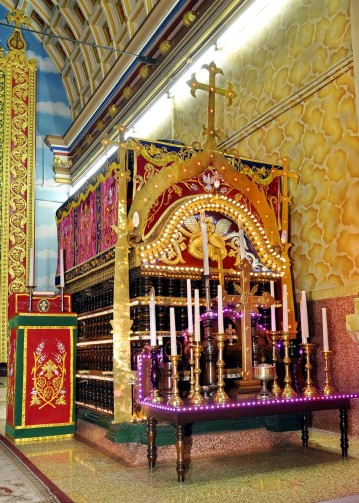
On the following day, Kanni 20 (September 30, 1685), the mortal remains of St. Mor Baselios Yeldho
were laid to rest with great honor and reverence. He was entombed in the western side of the Madbaha
(sanctuary) of St. Thomas Church, Kothamangalam, in a place of honor befitting his rank and his
holiness. The tomb was prepared with care, and the holy body was interred there with all the prayers
and ceremonies prescribed by the Church for the burial of a bishop.
Although the saint had been physically present in Malankara for only two weeks—from Kanni 11 to
Kanni 19—his impact on the Malankara Church was profound and lasting. His arrival had electrified
the Syrian Christian community, proving to them that the Mother Church at Antioch had not forgotten
them and was willing to send even the Maphrian himself to their aid. His very presence had
strengthened the faith of those who were wavering and had demonstrated the falseness of Roman
Catholic propaganda. His consecration of Mor Ivanios ensured continuity of episcopal leadership. And
his tomb became a permanent reminder of the bond between Antioch and Malankara.
✨Miracles and Continuing Intercession
From the day of his burial until the present time, the tomb of St. Mor Baselios Yeldho has been
recognized as a holy place where God's grace is manifestly present and where miracles occur through
the saint's intercession. The faithful, recognizing that they had been blessed with the presence of
a true man of God, began coming to his tomb to pray, to seek his intercession for their needs, and
to venerate his memory. They were not disappointed—countless miracles and answered prayers have been
attributed to St. Baselios Yeldho over the more than three centuries since his death.
The types of miracles associated with the saint are numerous and varied, touching every aspect of
human need. Physical healings have been perhaps the most frequently reported category of miracle.
People suffering from chronic illnesses, diseases that had resisted medical treatment, sudden
afflictions, and disabilities of all kinds have found healing through prayer at the saint's tomb.
Blind eyes have been opened, deaf ears unstopped, lame legs strengthened, and chronic pain relieved
through the prayers of St. Baselios Yeldho.
Particularly notable is the saint's reputation for helping couples who are struggling with
infertility. Countless families have testified to conceiving and bearing children after praying at
his tomb. The practice has become so common that many parents, in gratitude for the gift of a child
received through the saint's intercession, name their sons "Yeldho" or "Basil" (or the feminine
forms of these names for daughters). These names serve as a perpetual reminder of the blessing
received and as a sign of the family's devotion to the saint. It is believed that children named
after the saint receive his special protection and guidance throughout their lives, as if he serves
as their guardian angel.
Cases of demonic oppression and possession have been resolved through prayer at St. Baselios
Yeldho's tomb. Those afflicted with torment from evil spirits are brought to the church, special
prayers and services are conducted, and many have experienced complete deliverance. The power that
the saint wielded over the tiger in the forest and over the forces of nature during his earthly life
continues to manifest in his ability to drive away demons and to liberate those held captive by the
evil one.
Help in times of material need has also been frequently reported. Families facing financial ruin,
farmers threatened with crop failure, fishermen unable to catch fish, businesspeople on the verge of
bankruptcy—all have found help through the saint's intercession. While spiritual blessings are
primary, the saint's care extends to the temporal needs of the faithful as well, demonstrating that
God is concerned with every aspect of our lives.
Students preparing for examinations frequently seek St. Baselios Yeldho's blessing and intercession,
asking for help in their studies and for success in their tests. Many families bring their young
children to the church for a ceremony called "Ezhuthiniruthu"—the initiation into the world of
letters—seeking the saint's blessing as the child begins formal education. This ceremony takes place
before the holy tomb, with the priest blessing the child and helping them write their first letters,
asking St. Baselios Yeldho to be the child's heavenly patron in their educational journey.
What is particularly remarkable is that the saint's help is not limited to members of the Syriac
Orthodox Church or even to Christians. As was evident from the miracle at Kozhippilli, where the
Hindu man and his family received such blessing, St. Baselios Yeldho has continued to show
compassion to people of all faiths who come to his tomb with sincere hearts. Hindus, Muslims, and
people of other religious backgrounds regularly visit the tomb seeking help, and many testify to
receiving answers to their prayers. This universal appeal testifies to both the saint's Christlike
love for all people and to the universality of God's mercy.
🎉Annual Feast and Pilgrimage
The Dhukrono (memorial feast) of St. Mor Baselios Yeldho is celebrated annually with great solemnity
and joy at St. Thomas Church (Mor Thoma Cheriapally) in Kothamangalam. The feast is popularly known
as "Kanni 20 Perunnal" (the Great Feast of Kanni 20), named for the date in the Malayalam calendar
on which the saint was buried. According to the Gregorian calendar, this typically falls on October
2-3, and the celebrations extend over these two days, drawing pilgrims from throughout Kerala and
beyond.
The scale of the pilgrimage to Kothamangalam during the saint's feast is truly extraordinary.
Thousands upon thousands of faithful converge on this church during the feast days, making it one of
the largest religious gatherings in the region. The streets of Kothamangalam fill with pilgrims,
many of whom have traveled great distances specifically to pray at the saint's tomb and to
participate in the feast day celebrations.
Many pilgrims undertake walking pilgrimages to reach Kothamangalam, sometimes traveling on foot for
many miles from their homes. This practice of walking pilgrimage, undertaken as an act of devotion
and penance, is particularly common among those who have made vows to the saint—for example, someone
who promised that if the saint would grant their petition (healing, a child, financial help), they
would walk to his tomb in thanksgiving. These walking pilgrims often travel through the night,
singing hymns and praying as they go, arriving at the church weary in body but filled with spiritual
joy.
A unique and beautiful feature of the feast day celebrations is the role of the Hindu family
descended from the man who was blessed by the saint at Kozhippilli on the evening of his arrival. In
remembrance of the miracles that occurred that day—the cattle protected by the invisible circle, the
coconut tree bending down, the successful childbirth after drinking the blessed coconut water—the
descendants of that family are given the honor of leading the Rasa (liturgical procession) during
the feast. They carry the traditional lamp of the church at the head of the procession, a living
testimony to the miracle that occurred over three centuries ago and to the continuing bond of
friendship between that Hindu family and the Syriac Orthodox Church.
The liturgical celebrations during the feast are conducted with special solemnity. The Divine
Liturgy is celebrated with full episcopal presence when possible, with beautiful music, with the
participation of large numbers of clergy, and with congregations that pack the church and overflow
into the surrounding areas. The name of St. Mor Baselios Yeldho is commemorated in the Fifth Tubden
(diptych) during the liturgy, having been officially added to this sacred list of departed fathers
and teachers of the Church in 1987.
A particularly significant practice associated with the saint is the "Saniyazhicha Qurbana"—the
Saturday Mass. Because St. Mor Baselios Yeldho died on a Saturday (Kanni 19), every Saturday has
special significance for devotees of the saint. A special liturgy is celebrated at Kothamangalam
every Saturday, and thousands attend this service seeking the saint's blessing, protection, and
intercession. Many parents bring their children to be baptized on Saturdays specifically to place
them under the special patronage and protection of St. Baselios Yeldho, believing that the saint
will serve as a guardian angel for children baptized on his day.
Another devotional practice is the "Madhyastha Prarthana"—special prayers of intercession offered at
the tomb. Faithful who cannot come to Kothamangalam in person can send their prayer requests to the
church, and these petitions are brought before the saint's tomb during special prayer services. Many
families maintain this practice regularly, sending requests for prayer on a monthly or annual basis,
seeking the saint's ongoing intercession for their needs and concerns.
📜Official Recognition as Saint
While the faithful of Malankara had venerated Mor Baselios Yeldho as a saint from the time of his
death, recognizing the extraordinary holiness of his life and the miracles worked through his
intercession, official ecclesiastical recognition came in two stages across the twentieth century,
involving both the Indian Orthodox Church and the Syriac Orthodox Church.
The first official declaration of sanctity came from within India itself. On November 2, 1947, His
Holiness Baselios Geevarghese II, who served as Catholicos of the East and Malankara Metropolitan,
officially declared Mor Baselios Yeldho to be a saint of the Church. This declaration, made on the
Feast of All Saints (a particularly appropriate date for such a pronouncement), recognized what the
faithful had known for over 260 years—that the Maphrian who had come to Malankara in 1685 was indeed
numbered among the blessed in heaven.
Four decades later, the Universal Syriac Orthodox Church added its own official recognition. On
October 20, 1987, His Holiness Mor Ignatius Zakka I Iwas, the 122nd Patriarch of Antioch and All the
East and supreme head of the Syriac Orthodox Church worldwide, formally canonized Mor Baselios
Yeldho as a saint of the universal Church. This solemn declaration by the Patriarch meant that St.
Baselios Yeldho's veneration was not limited to the Malankara region but was extended to the entire
Syriac Orthodox Church throughout the world.
In conjunction with this formal canonization, Patriarch Zakka I authorized the inclusion of St. Mor
Baselios Yeldho's name in the Fifth Tubden (diptych) of the Divine Liturgy. This liturgical
commemoration is one of the highest honors the Church can bestow, as it means that the saint's name
is recited during every celebration of the Holy Qurbono in churches that use the Syriac Orthodox
liturgy. The Fifth Tubden lists the great fathers and teachers of the Church from apostolic times
onward, and to be included in this sacred catalogue is to be recognized as one who has made an
exceptional contribution to the Church's faith and life.
The name of St. Mor Baselios Yeldho is now recited in the Fifth Tubden of churches throughout the
Syriac Orthodox world—in the Middle East, in India, in Europe, in the Americas, in Australia,
wherever the Syriac Orthodox faithful gather to celebrate the Divine Liturgy. Thus, the humble monk
who was born in a small village near Mosul and who died in a church in Kerala after only two weeks
in India has become a beloved saint of the universal Church, remembered and venerated by millions of
faithful around the globe.
⛪Legacy and Institutions
The impact of St. Mor Baselios Yeldho on the Malankara Church and on the broader Christian community
in Kerala extends far beyond his brief physical presence there. His legacy is visible in numerous
ways, from the strengthening of Orthodox identity to the establishment of important institutions
that continue to serve the community to this day.
First and most importantly, the saint's arrival in Malankara at such a critical moment in the
Church's history provided exactly the boost that was needed to strengthen Orthodox resolve. His
willingness to resign as Maphrian and to travel thousands of miles at age ninety-two demonstrated
beyond any doubt that the Apostolic See of Antioch truly cared for the Malankara Church. The
faithful who had been confused by Roman Catholic propaganda or who had been tempted to give up the
struggle were reinvigorated by his presence. The Orthodox cause, which might have faltered without
such dramatic support, was strengthened and went on to flourish.
The consecration of Mor Ivanios Hidayatulla as Metropolitan proved to be providentially important.
After the death of the Maphrian, Mor Ivanios continued the work of strengthening the Church, working
alongside Mar Thoma II to visit parishes, ordain clergy, teach the faith, and defend against
Catholic encroachment. The mission that St. Baselios Yeldho began, though cut short by his death
after only two weeks, was faithfully continued by his disciple.
The town of Kothamangalam itself has been transformed by the presence of the saint's tomb. What was
once a relatively small and obscure parish has become one of the most important pilgrimage centers
in the Syriac Orthodox Church. The church has been enlarged and beautified over the centuries to
accommodate the thousands of pilgrims who come to venerate the saint. The town's economy and
development have been significantly influenced by the pilgrimage trade, with numerous shops, hotels,
and services catering to the needs of visitors.
Numerous educational and healthcare institutions in Kothamangalam and the surrounding area have been
established in the saint's name or under the patronage of the church where he is buried. These
include Mar Baselios Medical Mission Hospital, which provides healthcare to thousands; Mar
Athanasius College of Engineering; Mar Athanasius College; Mar Baselios Dental College; and several
schools including Mar Basil Higher Secondary School. These institutions, which serve the entire
community regardless of religious affiliation, are living expressions of the saint's compassion and
concern for human welfare. They demonstrate that the Church's mission, following the example of St.
Baselios Yeldho, extends to meeting both spiritual and temporal needs.
The devotion to St. Mor Baselios Yeldho has spread beyond Kerala to wherever Malankara Syrian
Christians have migrated. In the Middle East, Europe, North America, Australia, and other parts of
the world, churches and prayer groups dedicated to St. Baselios Yeldho have been established. Many
of these communities maintain the practice of celebrating his feast day, of offering special prayers
of intercession through his patronage, and of teaching new generations about the saint who saved
their Church.
The names "Yeldho" and "Basil" (along with their various forms and derivatives) have become
extremely popular among Malankara Syrian Christians, making the saint's memory a living presence in
countless families. When parents name their children after the saint, they are not only honoring his
memory but are also invoking his protection over their children, believing that those who bear his
name will receive his special care throughout their lives.
💫Spiritual Lessons from His Life
The life of St. Mor Baselios Yeldho offers profound spiritual lessons that remain relevant for
Christians in every age. Perhaps the most striking lesson is about the meaning of true service and
sacrifice. Here was a man who had already given a lifetime of faithful service to God and His
Church, who had risen to one of the highest positions in the ecclesiastical hierarchy, and who had
reached an age when he could reasonably have expected to spend his remaining days in rest and
peaceful prayer. Yet when the Church called, when there was a need that he could meet, he did not
hesitate to give up his position, to undertake a dangerous journey, and ultimately to give his life
in service.
This teaches us that Christian discipleship knows no retirement age, that true service is measured
not by the duration or comfort of our actions but by the love and self-sacrifice they embody. St.
Baselios Yeldho reminds us that we are called to serve as long as we have breath, that age is no
excuse for refusing God's call, and that the greatest acts of service often come when we give beyond
what seems reasonable or safe.
The saint's humility provides another crucial lesson. Despite being Maphrian of the East—the
second-highest ranking prelate in the Syriac Orthodox Church—he willingly resigned that position to
become a simple missionary to a distant land. He did not insist on the honors due to his rank but
served humbly wherever God called him. When he encountered the Hindu man with his cattle, he did not
stand on his dignity as a great hierarch but patiently waited and performed miracles of compassion.
True greatness in God's Kingdom is measured not by titles or positions but by humble service
motivated by love.
The saint's faith and trust in God's providence shine through every episode of his journey. Whether
facing a tiger in the forest, warning villagers of an impending flood, or undertaking a journey of
thousands of miles at an advanced age, he never doubted that God would protect and guide him. His
faith was active and practical—he took reasonable precautions, but he also stepped forward boldly
when God called, trusting that divine grace would sustain him. This combination of prudence and
daring faith is a model for all who seek to follow God's will in challenging circumstances.
The universality of the saint's compassion, as evidenced by his care for the Hindu man and his
family, teaches us that Christian love knows no boundaries of religion or ethnicity. While remaining
faithful to Orthodox Christianity and working to strengthen the Church, St. Baselios Yeldho did not
limit his compassion only to fellow Christians. He saw in every person a human being created in
God's image, worthy of help and blessing. This is authentic Christian love—particular in its
commitment to the truth but universal in its compassion.
Finally, the brevity of the saint's ministry in Malankara teaches us that impact is not measured by
duration but by faithfulness and intensity. He was physically present in India for only two weeks,
yet his impact has lasted for over three centuries and continues to grow. He did not accomplish
everything he might have hoped to do, yet he accomplished what God called him to do in that moment.
This reminds us that we are responsible for being faithful in the opportunities given to us, however
limited they may seem, trusting that God will multiply our faithful efforts far beyond what we can
imagine.
Prayer for Intercession
O Holy Father Baselios Yeldho, blessed Maphrian of the East who left your exalted position and
traveled from the banks of the Tigris to the shores of Kerala to save the Orthodox faith in
Malankara, we turn to you with love and reverence. You who at ninety-two years of age undertook a
perilous journey through forests and mountains, facing tigers and floods, teach us courage in
service to Christ and His Church. You who consecrated a Metropolitan and strengthened the wavering
faithful though you had only two weeks among them, remind us that faithful service in God's Kingdom
is measured not by duration but by love. You who worked miracles of compassion for a Hindu family,
showing that Christ's love extends to all people, help us to love without boundaries while remaining
faithful to truth. You who prophesied the miraculous sign at your death and whose tomb has become a
fountain of grace for millions, intercede for us before the throne of God. We ask your prayers for
healing of our bodies, comfort in our sorrows, help in our material needs, blessing upon our
children, success in our studies, strength in our spiritual struggles, and growth in holiness. May
those who bear your name receive your special protection. May couples seeking children find help
through your intercession. May all who come to your holy tomb with faith and devotion receive the
blessings they seek according to God's will. May we follow your example of humble service, complete
trust in God's providence, and selfless love, until we join you in the Kingdom of Heaven where you
dwell in glory with Christ our Lord and Savior, to whom be honor and worship with the Father and the
Holy Spirit, now and forever. Amen.