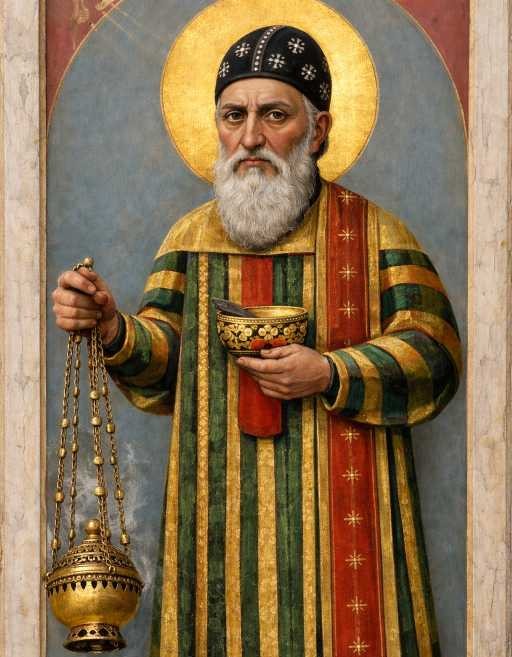
📖Early Life and Childhood
Saint Mor Ephrem the Syrian, whom the Church has gloriously titled "The Harp of the Holy Spirit" and
"The Sun of the Syrians," was born around the year 306 AD in the ancient and venerable city of
Nisibis, located in northern Mesopotamia (present-day Nusaybin in southeastern Turkey). This blessed
city, which stood as a bastion of Christianity in the eastern regions of the Roman Empire, would
become the cradle of one of the greatest theological minds and most prolific hymnographers the
Church has ever known.
According to the sacred tradition preserved in our Holy Church, Ephrem was born into a Christian
family, though some ancient sources suggest his father may have been a pagan priest who later
converted to Christianity. While some later sources claim that his father was a
heathen priest who worshiped an idol called Abnil, Ephrem's own writings affirm with clarity that he
was raised in a Christian family from his earliest days. What is certain is that from his earliest
years, young Ephrem
demonstrated an extraordinary spiritual sensitivity and a profound love for the Holy Scriptures.
In his work "Adversus Haereses," Ephrem himself writes: "I was born in the way of truth: though my
boyhood understood not the greatness of the benefit, I knew it when trial came." More explicitly, in
a Confession preserved in Greek, he declares: "I had been early taught about Christ by my parents;
they who begat me after the flesh, had trained me in the fear of the Lord... My parents were
confessors before the judge: yea, I am the kindred of martyrs."
These words reveal not only his Christian heritage but also the courageous faith of his parents who
stood as confessors during times of persecution. Growing up in this atmosphere of faithful witness,
young Ephrem was formed in an environment where devotion to Christ was paramount, even at the cost
of suffering. His heart burned with devotion to Christ, and even as a youth, he showed remarkable
wisdom beyond his
years.
The city of Nisibis, where our saint spent his formative years, was not merely a political center
but a thriving hub of Christian learning and theological discourse. It was here that the famous
School of Nisibis flourished, an institution that would later become renowned throughout the
Christian world for its rigorous scriptural exegesis and theological education. This intellectual
and spiritual environment profoundly shaped the young Ephrem's understanding of the faith and his
development as a theologian and poet.
In his youth, Ephrem experienced a profound spiritual awakening. According to ancient traditions, he
had a vision in his sleep wherein he saw a vine growing from his tongue, spreading its branches over
all the earth and producing abundant fruit. This mystical vision was interpreted as a divine
prophecy of the spiritual fruitfulness that would characterize his life's work—his countless hymns,
homilies, and theological writings that would nourish the souls of countless believers throughout
the ages.
✝️Spiritual Formation and Discipleship
The turning point in Ephrem's spiritual life came when he encountered the saintly Bishop Jacob of
Nisibis (Mor Ya'qub d'Nsibin), one of the great luminaries of the fourth century Church. Bishop
Jacob, who had been appointed in 308 and who himself would later be venerated as a saint, recognized
the extraordinary spiritual gifts
residing in the young Ephrem. Under this holy bishop's guidance, Ephrem was baptized and received
into the fullness of the Christian faith, beginning a relationship that would profoundly shape his
entire spiritual and theological formation.
Bishop Jacob became Ephrem's spiritual father, teacher, and mentor. The holy bishop discerned in his
disciple not only intellectual brilliance but also a heart aflame with love for God and a soul
devoted to prayer and asceticism. Ephrem was baptized as a youth and almost certainly became a "son
of the covenant" (bar qyāmā), an
unusual form of early Syriac proto-monasticism characterized by celibacy, asceticism, and dedicated
service to the Church. He was ordained as a deacon around AD 338, a rank he maintained throughout
his life, never seeking elevation to the priesthood despite his profound theological wisdom and
spiritual authority. This humble choice reflected his deep sense of unworthiness before the sacred
mysteries and his desire to serve the Church in a capacity of humble service.
As a deacon, Ephrem assisted Bishop Jacob in his pastoral duties and accompanied him to the First
Ecumenical Council of Nicaea in 325 AD, that momentous gathering where the Church fathers assembled
to refute the Arian heresy and proclaim the eternal truth of Christ's divinity. Bishop Jacob
participated as a signatory at the historic First Council of Nicaea. Though Ephrem
himself was not listed among the official delegates, tradition holds that he witnessed these
historic proceedings, and the theological clarity achieved at Nicaea would deeply influence his own
doctrinal writings and hymns defending the orthodox faith.
Under Bishop Jacob's tutelage, Ephrem immersed himself in the study of the Holy Scriptures, learning
to penetrate their depths with both intellectual rigor and spiritual insight. He was appointed as a
malp̄ānâ (teacher), a title that continues to carry great
respect among Syriac Christians to this day. He mastered the Syriac
language—that sacred tongue which had been sanctified as the language of our liturgy—and began to
compose his first hymns and metrical homilies, those sublime madrashe that would become his
signature contribution to the Church's treasury of worship.
In his hymns, he sometimes refers to himself humbly as a "herdsman"
('allānâ), to his bishop as the "shepherd" (rā'yâ), and to his community as a "fold" (dayrâ). Though
later tradition would credit him as the founder of the School of Nisibis, which in subsequent
centuries became the center of learning for the Church of the East, Ephrem himself lived as a
solitary monk, dedicated to prayer, study, and the composition of sacred poetry.
"I was born in the way of truth: though my boyhood understood not the greatness of the benefit, I
knew it when trial came." — Mor Ephrem, Adversus Haereses
⛪Ministry in Nisibis
For nearly four decades, Saint Ephrem served the Church in his beloved Nisibis, working tirelessly
in the School of Nisibis, which had been established or significantly developed under Bishop Jacob's
patronage. Here, Ephrem taught biblical exegesis, theology, and hymnody to generations of students
who would themselves become teachers, bishops, and spiritual leaders throughout the Syriac-speaking
Christian world.
His teaching method was revolutionary for its time. Rather than relying solely on Greek
philosophical categories, which were becoming increasingly dominant in Western theological
discourse, Ephrem developed a distinctively Syriac theological methodology rooted in biblical
imagery, poetic symbolism, and liturgical expression. He understood that theology must not merely
inform the intellect but must also move the heart and inspire the soul to worship.
In his teaching ministry, Ephrem began to compose hymns and write biblical commentaries as part of
his educational office. During these years in Nisibis, Ephrem composed an enormous corpus of hymns
on virtually every aspect
of Christian doctrine and practice. His hymns on the Nativity, the Passion, the Resurrection, the
Church, Paradise, Faith, and the Nisibene Hymns form a complete theological education expressed in
sublime poetry. Each composition was crafted with meticulous care, employing rich symbolism and
typology that revealed the deep connections between the Old and New Testaments.
The city of Nisibis, however, stood on the frontier between the Roman and Persian Empires, making it
a frequent target of military conflict. Three times the city was besieged by the Persian King Shapur
II, and each time, according to sacred tradition, the prayers of Bishop Jacob and the
faithful—including our holy Ephrem—obtained divine deliverance. These sieges, particularly the
dramatic events of 338, 346, and 350 AD, left deep impressions on Ephrem and inspired some of his
most moving hymns about God's providential care for His people.
🏛️Exile and Migration to Edessa
In the year 363 AD, after the disastrous military campaign of Emperor Julian the Apostate against
Persia, the Roman Empire was forced to cede Nisibis to Persian control as part of a humiliating
peace treaty. This catastrophic turn of events meant that the Christian population of Nisibis faced
the prospect of living under Persian rule, where Christianity was often viewed with suspicion and
hostility. Emperor Jovian, Julian's successor, granted the Christians of Nisibis the opportunity to
evacuate the city.
This marked one of the most sorrowful moments in Ephrem's life. At approximately fifty-seven years
of age, having spent his entire life in Nisibis, he was now forced to leave the city he loved, the
school where he had taught, and the community he had served for decades. Along with many other
Christians, including clergy and teachers from the School of Nisibis, Ephrem made the painful
journey westward, first going to Amida
(modern Diyarbakır) and eventually settling in Edessa (Urhay in Aramaic, modern Şanlıurfa in Turkey)
in 363, another great center of Syriac Christianity.
Edessa, known in Syriac as Urhoy, was already an ancient Christian city with its own distinguished
traditions. According to sacred legend, it had been evangelized during the time of Christ himself
through the correspondence between King Abgar V and our Lord Jesus Christ. Edessa had long been an
important center of the Aramaic-speaking world and the birthplace of the
specific Middle Aramaic dialect known as Syriac. The city boasted a
vibrant Christian community and was home to numerous churches, monasteries, and schools. Here, in
the final decade of his earthly life, Ephrem would produce some of his greatest works and achieve
his widest influence.
The city was also a hotbed of theological
controversy, teeming with rival philosophies and competing religious claims. Ephrem observed that
orthodox Nicene Christians were simply called "Palutians" in Edessa, named after a former bishop,
while Arians, Marcionites, Manichees, Bardaisanites, and various Gnostic sects all proclaimed
themselves as the true church.
Upon arriving in Edessa, Ephrem established himself as a teacher and soon became involved in the
pastoral and theological life of the city. He took up residence in a cave on Mount Edessa, living as
a hermit devoted to prayer, fasting, and literary composition. Despite his ascetic withdrawal from
the world, his reputation for holiness and wisdom drew many seekers to him, and his influence on the
Church of Edessa became profound. He continued his work as a teacher, likely in the School of
Edessa, and wrote a
great multitude of hymns defending Nicene orthodoxy against the heresies prevalent in Edessa.
According to Jacob of
Serugh, a later Syriac writer, Ephrem rehearsed all-female choirs to sing his hymns, which were set
to popular Syriac folk tunes, in the forum of Edessa. This innovative approach—using beauty, melody,
and accessible poetry to teach sound doctrine—proved remarkably effective in reaching the hearts of
common believers.
⚔️Combat Against Heresies
Much of Ephrem's literary activity during this period was directed against the principal heresies
threatening the orthodox faith. He understood that these false teachings were not merely academic
errors but spiritual dangers that could lead souls away from Christ. With the passion of a true
shepherd and the skill of a master poet, he composed numerous works refuting heretical doctrines.
Among his theological controversies, Ephrem engaged vigorously in defending orthodox Christology
against various heresies of his time. He wrote extensively against the followers of Bardaisan,
Marcion, and Mani, whose teachings threatened to corrupt the pure faith. He also composed hymns
refuting the Arians, who denied the full divinity of Christ, and addressed the errors of those who
questioned the full humanity of our Lord.
-
Marcionism
Ephrem vigorously opposed Marcion's dualistic teachings that rejected the Old Testament and claimed
the God of Israel was different from the God revealed by Christ. Through hymns and commentaries,
Ephrem demonstrated the unity of Scripture and the continuity of God's saving plan.
-
Bardaisanism
Bardaisan (Bar-Daisan) of Edessa had composed popular Gnostic hymns that led many astray. Ephrem saw
that heresy spread through beautiful poetry, so he countered with orthodox hymns of even greater
beauty, using the same melodies to teach true doctrine.
-
Manichaeism
Against Mani's dualistic system that posited eternal conflict between light and darkness, Ephrem
affirmed the goodness of creation and the sovereign power of the one true God.
-
Arianism
Perhaps most importantly, Ephrem wrote extensively against the Arian heresy, which denied the full
divinity of Christ. His hymns celebrated Christ as truly God and truly man, defending the Nicene
formula with poetic fervor and theological precision.
-
Anomoeanism
This radical form of Arianism taught that the Son was completely unlike the Father. Ephrem's
writings emphasized the consubstantiality of the Father and the Son, affirming the orthodox doctrine
of the Trinity.
Ephrem's Battle Cry
"The harp of the Spirit sings against the heretics who would divide the Godhead. Let us sing with
one voice that Christ is God, consubstantial with the Father, one in essence and undivided in
glory."
📚Literary Genius and Theological Works
Saint Ephrem's literary output stands as one of the most impressive achievements in the history of
Christian literature. He wrote exclusively in Syriac, the Edessene dialect of Aramaic. His mastery
of this sacred
language was unparalleled, and through his writings, he elevated Syriac literature to heights never
before achieved. He is credited with composing over four hundred hymns (madrashe), numerous
prose homilies (mêmrê), biblical commentaries, and various other theological treatises. His works
represent the golden age of Syriac Christian
literature and have profoundly influenced the liturgical, theological, and spiritual traditions of
the Syriac Orthodox Church. While his works were later translated into Armenian, Greek, and
subsequently into
Latin and Slavonic, many works attributed to him in these languages are not genuine. The authentic
corpus of his Syriac writings, however, remains a treasure of the universal Church.
The madrashe, metrical hymns designed to be sung in liturgical settings, were Ephrem's most
distinctive and influential contribution. These compositions were organized into cycles focusing on
particular themes: the Hymns on Faith, the Hymns on Paradise, the Hymns on the Nativity, the Hymns
on the Epiphany, the Hymns on the Crucifixion, and many others. Each hymn was crafted with intricate
poetic structure, employing sophisticated literary devices including parallelism, typology, paradox,
and rich symbolic imagery.
Ephrem's theological method was profoundly biblical and liturgical rather than philosophical. He
preferred to express theological truths through concrete biblical images and symbols rather than
abstract concepts. His theology is characterized by what scholars have called a "theology of
paradox"—he delighted in exploring the mysterious paradoxes of the Christian faith: the Word
becoming flesh, the eternal God being born as an infant, the immortal One dying on the Cross, divine
transcendence dwelling in human immanence.
His exegetical method extensively employed typology and symbolism, seeing in the Old Testament
prefigurations of Christ and the Church. Every detail of Scripture held layers of meaning for
Ephrem—the literal, the typological, and the spiritual. His commentaries reveal a mind steeped in
prayer, a heart inflamed with love for the Word of God, and an imagination sanctified by the Holy
Spirit.
He wrote widely regarded biblical
commentaries, most notably on the Book of Genesis and on Tatian's Diatessaron (a harmony of the four
Gospels that was the standard Gospel text in the early Syriac church). His commentary on the
Diatessaron demonstrates his exegetical skill and his ability to draw out the spiritual
and moral significance of Scripture. His commentaries on Genesis and Exodus reveal his mastery of
typological interpretation, seeing in the events of the Old Testament profound foreshadowings of the
mysteries of Christ and the Church.
🎵The Harp of the Holy Spirit: Madrāshē and
Memrē
The title "Harp of the Holy Spirit," by which Saint Ephrem is most widely known and venerated, was
not merely an honorific but a recognition of the unique charisma that manifested in his hymnographic
gift. Church tradition teaches that his compositions were not merely products of human literary
skill but were inspired utterances granted by the Holy Spirit for the edification of the Church.
Over 500 genuine hymns of Mor Ephrem survive to this day, works of extraordinary beauty, theological
depth, and spiritual insight. Syriac churches honor him with the sublime title "The Lyre of the Holy
Spirit" (kinnārā d-Rūḥā d-Qudshā), recognizing that his poetry was not merely human artistry but
divinely inspired sacred song.
Ephrem understood the power of sacred music and poetry to shape the faith of the Christian
community. In an era when heretical teachers were composing attractive songs to spread false
doctrines among the simple faithful, Ephrem responded by creating orthodox hymns of such beauty and
theological depth that they became the preferred expression of popular piety. His strategy was
brilliant: he would take the melodies popular in his day and compose new, orthodox texts that the
congregation could sing, thereby inoculating them against heresy through beauty and truth.
His poetry falls into two distinct genres: madrāshē (hymns proper, characterized by stanzaic form
and refrain) and memrē (verse homilies in couplets). After his death, these hymns were carefully
arranged into thematic cycles, preserving his legacy for future generations.
He organized choirs of women and girls, training them to sing his hymns in liturgical contexts and
public processions. This innovation was particularly important because women, though not permitted
to preach or teach publicly, could participate fully in this form of proclamation through song.
Through these choirs, Ephrem's hymns penetrated deeply into the devotional life of the Syriac
Church, becoming an integral part of the liturgical tradition that continues to this day.
The musical and poetic sophistication of Ephrem's madrashe is remarkable. Each hymn was composed in
a specific meter and was meant to be sung to particular melodies. The poems often employed
acrostics, intricate stanzaic patterns, and sophisticated rhetorical devices. Yet despite their
literary complexity, they remained accessible to ordinary believers, speaking to both the educated
theologian and the simple peasant with equal power.
His hymns have been described as "theology in poetry" and "prayer in verse." They do not merely
state doctrines but invite the singer and listener into a contemplative encounter with divine
mysteries. When one sings or hears an Ephremic hymn, one is not merely learning about God but is
entering into communion with Him, experiencing the movement of the heart toward its Creator.
Hymns on Faith
Including the famous "Hymns on the Pearl," defending Nicene orthodoxy
against Arianism
Hymns on Paradise
Mystical meditations on the Garden of Eden and the heavenly paradise
Hymns on Nisibis
Including hymns on the Descent of Christ into Hades, theological and
historical
Hymns on the Nativity
Celebrating the Incarnation with wonder and theological precision
Hymns on the Crucifixion
Profound meditations on the passion and death of Christ
Hymns on the Resurrection
Triumphant celebrations of Christ's victory over death
Hymns on the Church
Ecclesiology in verse, celebrating the Church as the Bride of Christ
Hymns on the Epiphany
Celebrating the manifestation of Christ to the world
His liturgical poetry had a transformative influence on both Syriac and Greek hymnography. The
structure, theological content, and spiritual depth of his hymns became models for subsequent
generations of Christian poets. Even today, Syriac Orthodox, Maronite, and other Eastern Christian
liturgies incorporate his hymns, allowing the faithful to pray with the words of this great saint.
💎The Pearl: Symbol of Christ
Among Ephrem's most celebrated works are his "Hymns on the Pearl," part of the larger cycle of Hymns
on Faith. In these hymns, Ephrem uses the pearl as a multifaceted symbol of Christ and the mysteries
of faith. The pearl—formed in the depths, hidden in a shell, precious beyond measure—becomes a
meditation on the Incarnation, the hiddenness and revelation of divine truth, and the beauty of
orthodox doctrine.
The pearl cannot be grasped by force but must be received as a gift from the sea. Similarly, the
knowledge of God cannot be seized by human intellect alone but must be received in humility through
revelation. The heretics, Ephrem suggests, are like those who try to measure the pearl with crude
instruments, missing its beauty and value. The orthodox believer, by contrast, gazes upon the pearl
with wonder, allowing its beauty to speak without violating its mystery.
From the Hymns on the Pearl
"I saw the pearl, brethren, and began to speak concerning it. The pearl is the Son, the pure One of
the sea, who has come forth from the deep. The diver who brought Him up is the womb of the Blessed
Mary. He put on, when He was born, the beauty of the pearls. Blessed is He, whose birth was full of
wonder!"
📚Selected Works and Writings
Among Saint Ephrem's vast literary corpus, certain works stand out for their theological importance,
spiritual depth, and continuing influence on the Church. The Hymns on Faith (Madrāshē d-Haymānūthā)
comprise a collection addressing fundamental doctrines of the Christian faith, defending orthodox
teaching against various heresies while positively articulating the Church's beliefs about the
Trinity, Christology, and salvation.
The Hymns on Paradise (Madrāshē d-'al Pardaysā) present a mystical vision of the heavenly paradise
and the soul's journey toward it. These compositions employ rich symbolic imagery drawn from
Scripture to depict the blessed state of those who have been saved through Christ. They explore
themes of spiritual ascent, purification, and union with God, offering both theological instruction
and spiritual inspiration.
The Hymns on the Nativity celebrate the mystery of the Incarnation, the birth of Christ as the
fulfillment of Old Testament prophecies and the inauguration of the new creation. These hymns are
sung during the Feast of the Nativity in Syriac Orthodox churches, filling the liturgy with profound
theological reflection on what it means that "the Word became flesh and dwelt among us."
The Nisibene Hymns (Madrāshē Nṣībāyē) were composed in connection with the history of Nisibis,
particularly the sieges of the city and Ephrem's eventual exile. These hymns blend historical
narrative with theological interpretation, seeing in the concrete events of history the working out
of God's providential plan. They also express Ephrem's deep love for his native city and his sorrow
at having to leave it.
His Commentary on the Diatessaron remains one of the most important early Christian biblical
commentaries. In this work, Ephrem expounds the Gospel narrative as harmonized by Tatian, drawing
out moral, spiritual, and theological lessons from each episode in Christ's life. The commentary
demonstrates his exegetical skill and his ability to make Scripture come alive for his readers.
The Hymns on the Church focus on ecclesiology, celebrating the Church as the Bride of Christ, the
repository of divine mysteries, and the community of salvation. These compositions emphasize the
importance of unity in faith, the authority of apostolic tradition, and the sacramental life through
which believers are united to Christ and to one another.
📜Theological Themes and Spiritual Teachings
The theological vision of Saint Ephrem encompasses the entirety of Christian doctrine, but certain
themes appear repeatedly throughout his works, forming the core of his spiritual teaching. Central
to his thought is the theology of symbols—the understanding that the material creation is filled
with divine significance, pointing beyond itself to spiritual realities. For Ephrem, every element
of creation is a "symbol and type" revealing something of God's nature and purposes.
His Christology emphasizes the wonder of the Incarnation, that unfathomable mystery whereby the
Eternal Word assumed human flesh. He delights in exploring the paradoxes of Christ's person: fully
God yet fully human, the Creator becoming creature, the Infinite contained in Mary's womb, the
Ancient of Days born as an infant. Yet Ephrem's wonder never descends into confusion; he affirms
clearly and consistently the orthodox teaching of Christ's two natures united in one person.
Ephrem's Mariology—his theology concerning the Blessed Virgin Mary—is particularly rich and
influential. He celebrates Mary as the New Eve, whose obedience reversed the consequences of the
first Eve's disobedience. He praises her purity, her faith, and her unique role in the economy of
salvation. Many of his most beautiful hymns are addressed to or concern the Theotokos, the Mother of
God, and these compositions have deeply influenced Marian devotion throughout the Church.
The doctrine of the Church occupies a central place in Ephrem's teaching. He sees the Church as the
Bride of Christ, the New Paradise, the Ark of Salvation, and the Temple of the Holy Spirit. He
emphasizes the importance of Church unity, warning against schism and heresy. His ecclesiology is
thoroughly sacramental; he teaches that through Baptism, Chrismation, and the Holy Eucharist,
believers are incorporated into Christ and participate in divine life.
Ephrem's eschatology—his teaching about the last things—combines sobering warnings about judgment
with hopeful confidence in God's mercy. His hymns on Paradise paint vivid pictures of the blessed
state awaiting the righteous, while his meditations on death and judgment call believers to
watchfulness and repentance. Yet his vision is ultimately one of hope; he trusts in the victory of
Christ over death and the final restoration of all things.
Throughout his works, Ephrem emphasizes the necessity of repentance, humility, and love. He teaches
that the Christian life is a journey of continual conversion, a daily dying to self and rising with
Christ. He warns against pride, the root of all sins, and exhorts believers to cultivate humility
after the example of Christ who humbled Himself even unto death. Above all, he proclaims that
love—love for God and love for neighbor—is the fulfillment of the law and the prophets.
🙏Ascetic Life and Spiritual Disciplines
Beyond his literary and theological achievements, Saint Ephrem was renowned throughout his lifetime
as a man of exceptional holiness and ascetic rigor. From his youth, he embraced a life of voluntary
poverty, fasting, and continual prayer. Though serving actively in the life of the Church, he
maintained the spirit of a hermit, seeking solitude for contemplation and intercession whenever
possible.
His life in the cave on Mount Edessa exemplified his commitment to ascetic discipline. Here he would
spend long hours in prayer, often weeping tears of compunction as he meditated on human sinfulness
and divine mercy. Ancient sources record that he slept little, ate sparingly—often subsisting on
bread and water alone—and devoted himself to unceasing prayer. His appearance reflected his austere
lifestyle; he was described as thin and worn, with a countenance that nonetheless radiated spiritual
peace and joy.
Ephrem practiced what he preached. His hymns and homilies are filled with exhortations to
repentance, self-denial, and spiritual watchfulness. He warned against the dangers of wealth,
comfort, and worldly honor, calling believers to embrace the narrow path of discipleship. Yet his
asceticism was never harsh or life-denying; rather, it was motivated by a passionate love for God
and a longing to be free from all attachments that might hinder union with the Divine.
Despite his personal austerity, Ephrem was known for his compassion toward others, particularly the
poor and suffering. He never demanded of others the same rigorous standards he imposed upon himself,
but instead met each person with gentleness and pastoral sensitivity. His humility was legendary; he
consistently referred to himself as a sinner unworthy of God's grace, and he shunned honors and
public recognition.
💧Love for the Poor and Ministry of Charity
The final act of Saint Ephrem's earthly life demonstrated the authentic character of his sanctity.
In the year 372 AD, a devastating famine struck the region of Edessa and its surrounding
territories. Crops had failed, food supplies were exhausted, and the population faced starvation.
The suffering was particularly acute among the poor, the widows, the orphans, and those who had no
resources to fall back upon. The saint,
though advanced in years and weakened by decades of ascetic practices, emerged from his cell to
organize relief efforts.
When Ephrem emerged from his cave hermitage and witnessed the desperate conditions of the people,
his heart was moved with profound compassion. Despite his advanced age and his preference for
solitude, he immediately threw himself into organizing relief efforts. He chastised the wealthy
citizens of Edessa for hoarding their resources while the poor starved.
He approached the wealthy
citizens of Edessa, challenging them to open their storehouses and distribute grain to the hungry.
Many had been reluctant to help, some from selfishness, others from a misplaced distrust of those
who might distribute the aid.
Ephrem's reputation for holiness and integrity was such that even the wealthy who had been unmoved
by others' pleas could not refuse him. They entrusted him with their resources, confident that he
would distribute them justly. The holy deacon organized a comprehensive relief operation,
establishing distribution centers, arranging for the care of the sick, and even constructing
temporary shelters for those who had been displaced by the famine. Through his preaching and
personal example, he convinced the rich to contribute funds. He then
personally oversaw the distribution of food and the care of the sick.
For months, Ephrem labored tirelessly in this service of charity, personally attending to the needs
of the suffering. He who had lived for decades in ascetic withdrawal now worked day and night in the
midst of crowds, directing the relief efforts, comforting the afflicted, and using every ounce of
his energy to alleviate human suffering. This practical service of love was the incarnation of all
his theological teachings about mercy, compassion, and the Christian duty to care for "the least of
these."
The famine eventually subsided, and Ephrem, exhausted by his labors, returned to his cave on the
mountain. But the exertion had taken its toll on his aged body. Within a month of returning to his
hermitage, having given his final strength in service to others, the "Harp of the Holy Spirit"
prepared to return to his Creator.
This episode reveals an essential aspect of Ephrem's spirituality: true orthodoxy of belief must
express itself in orthopraxis—right action. The same man who defended the mysteries of the Trinity
with sublime poetry also served the poor with his own hands. Contemplation and action, theology and
charity, were inseparable in his life.
☦️Blessed Repose and Final Days
On June 9, 373 AD, Saint Mor Ephrem the Syrian peacefully surrendered his soul to God. He departed
this life as he had lived it—in prayer, simplicity, and humility. Sensing his approaching death, he
composed his spiritual testament, a final instruction to the faithful and a summary of his life's
work. According to tradition, he
composed his own funeral hymn shortly before his death, a moving meditation on mortality, judgment,
and the hope of resurrection. In this final composition, he requested that he be buried simply,
without elaborate ceremony, and that no marble tomb be erected over him—requests that reflected his
lifelong commitment to poverty and humility.
The testament begins with profound humility: "I, Ephrem, am dying and writing my testament." He
exhorted his disciples to remain faithful to orthodox doctrine, to avoid all heresy, to maintain the
ascetic disciplines he had taught them, and above all to preserve love for Christ and His Church.
The entire city of Edessa mourned his passing. The Christians recognized that they had lost not
merely a teacher or a poet but a true father in the faith, a living saint whose very presence had
been a blessing to their community. His funeral was attended by vast crowds, including bishops,
priests, monks, and lay faithful from across the region. The Church choirs sang his own hymns as
they accompanied his body to its resting place.
Mor Ephrem departed to his heavenly rest at approximately 67 years of age. Though
he had held no high ecclesiastical office—remaining a deacon throughout his life—his influence on
Christian theology, spirituality, and worship was immeasurable. He was buried in Edessa, and his
tomb became a place of pilgrimage.
Almost immediately after his death, the veneration of Saint Ephrem began. Miraculous healings were
reported at his tomb, and his intercession was sought by countless believers. Within a generation,
his hymns had spread throughout the Syriac-speaking Christian world, and his literary works were
being translated into Greek, Armenian, Coptic, and eventually Latin, carrying his theological
insights to the entire Christian Church.
The Church Fathers who came after him spoke of Ephrem with profound reverence. Saint Basil the
Great, Saint Jerome, and numerous other luminaries praised his sanctity and his theological
contributions. Saint Jerome, writing in the late fourth century, noted that Ephrem's writings were
read publicly in some churches after the Holy Scriptures themselves—a testament to the spiritual
authority attributed to his words.
"I, Ephrem, am dying and writing my testament... Pray for me, brethren, that I may find mercy in that
day. Though I am a sinner, I have not strayed from the faith, but have held fast to the truth which
I was taught. Forgive me, and may the Lord forgive you all." — From the Testament of Mor Ephrem
📜The Testament of Mor Ephrem
In his final testament, Mor Ephrem left instructions that beautifully summarize his life and
teaching. He requested to be buried simply, without elaborate ceremony, emphasizing that a
Christian's glory is not in worldly honor but in faithful service to Christ. He asked that his
brothers continue in prayer, in study of Scripture, in defense of the faith, and in love for one
another.
The testament concludes with a plea that remained characteristic of Ephrem throughout his life: that
believers would remember him in their prayers. The great theologian, the "Lyre of the Holy Spirit,"
the defender of orthodoxy, desired nothing more than to be counted among the faithful who need God's
mercy. This profound humility, combined with his extraordinary gifts, makes Mor Ephrem not only a
saint to be venerated but a spiritual father whose example continues to guide the Church.
✨Miracles and Wonders
Both during his lifetime and after his blessed repose, Saint Ephrem has been associated with
numerous miracles and wonders that testify to his sanctity and to the power of God working through
him. While Ephrem himself eschewed attention and claimed no special powers, the faithful have
consistently witnessed divine interventions connected to his prayers and intercession.
During the sieges of Nisibis, when the city was threatened by the Persian armies, tradition records
that Ephrem's prayers contributed to the miraculous deliverance of the city. On one occasion, it is
said that a cloud of mosquitoes and flies descended upon the Persian camp, tormenting the soldiers
and their animals so severely that the siege had to be abandoned. The faithful attributed this
deliverance to the intercessions of their bishops and deacons, including the holy Ephrem.
Numerous accounts tell of individuals healed through Ephrem's prayers during his lifetime. The sick
would come to his cave seeking his blessing, and many departed healed in body and soul. Yet Ephrem
always directed attention away from himself, insisting that any healing came from God's mercy alone
and that faith in Christ was the true source of wholeness.
After his death, his tomb in Edessa became a site of pilgrimage, and countless miracles of healing
were reported by those who visited it with faith. The blind received sight, the lame walked, the
possessed were freed from demons, and the afflicted found comfort. These wonders continued through
the centuries, strengthening the faith of believers and drawing many to venerate the "Harp of the
Holy Spirit."
Even today, faithful throughout the world testify to receiving help through Saint Ephrem's
intercession. Whether seeking healing from illness, guidance in difficult decisions, protection from
danger, or strength in spiritual struggles, believers turn to this great saint with confidence that
he continues to care for the Church he served so faithfully during his earthly life.
👑Legacy and Universal Recognition
In 1920, Pope Benedict XV declared St. Ephrem a Doctor of the Universal Church, formally recognizing
what Christians East and West had long known: that this Syrian deacon's teachings possess enduring
authority and universal relevance. He is the only Syriac-speaking saint to receive this honor, and
one of the few deacons ever named a Doctor of the Church. Yet for us in the Syriac Orthodox Church,
Ephrem has always held this exalted
status. He is our teacher par excellence, the one who shaped our liturgical life, formed our
theological language, and gave voice to our deepest spiritual aspirations.
His influence extends far beyond the Syriac Orthodox Church. The Byzantine liturgical tradition,
Armenian Christianity, Coptic spirituality, and even Western medieval theology all bear traces of
Ephrem's thought. His hymns were translated and adapted, his exegetical methods studied and
emulated, his theological insights incorporated into the broader Christian tradition.
The legacy of Saint Mor Ephrem the Syrian extends far beyond his own lifetime and continues to shape
the life of the Church to this day. His hymns form a substantial portion of the Syriac Orthodox
liturgical cycle, being sung in our churches throughout the year. The Divine Liturgy, the Offices of
Prayer, and the various feast days all echo with Ephremic compositions, making him a constant
companion in our worship.
His theological method—rooted in biblical imagery, liturgical expression, and poetic symbolism
rather than philosophical speculation—represents an alternative to the more abstract theological
traditions that developed in the West. Ephrem reminds us that theology must nourish the soul and
inspire worship, not merely satisfy intellectual curiosity. His approach to Scripture, which sees
the entirety of the Bible as a unified tapestry woven together by divine providence, offers a
holistic vision of salvation history.
The Syriac Orthodox Church has preserved and transmitted Ephrem's literary heritage with great care.
Numerous manuscripts containing his works have been copied and recopied throughout the centuries,
and modern editions and translations have made his writings accessible to contemporary readers. The
Monastery of St. Ephrem in the Netherlands and various other institutions continue to study and
promote his theological and spiritual legacy.
Yet Ephrem remains, in a special way, the glory of the Syriac Church. No other figure so perfectly
embodies the genius of Syriac Christianity—its love of symbolic and poetic expression, its deep
rootedness in Semitic culture and biblical ways of thinking, its balance of mystical depth and
practical charity, its fierce loyalty to orthodox faith combined with pastoral tenderness toward
ordinary believers.
Churches and monasteries dedicated to Saint Ephrem exist throughout the Syriac Orthodox world and
beyond. In the Middle East, Europe, India, and the Americas, communities of believers gather in
sanctuaries bearing his name to worship God according to the traditions he helped to establish. His
feast day, celebrated on January 28 in the Syriac tradition and June 9 universally, is observed with
great solemnity, and
his intercession is invoked for countless needs. The Syriac Orthodox Church also commemorates St.
Ephrem on the first Saturday of the Great Lent, honoring
him as a pillar of faith, a defender of orthodoxy, and the greatest poet of the Syriac tradition.
When Syriac Christians sing Ephrem's hymns in their ancient language, they do more than preserve a
cultural heritage. They participate in a living tradition of prayer that has ascended to God
continuously for over sixteen centuries. They join their voices with countless generations who have
found in Ephrem's words the perfect expression of their faith, their struggles, their joys, and
their hopes.
His title as the "Harp of the Holy Spirit" reminds us that sacred poetry and music are not mere
ornaments to worship but are themselves vehicles of divine grace. Through beauty, truth becomes more
accessible; through melody, doctrine becomes memorable; through poetry, the heart is moved to love
God more deeply. Ephrem understood that the aesthetic dimension of Christian life is not optional
but essential.
🌟Patron and Intercessor
Saint Mor Ephrem the Syrian is venerated as a patron and heavenly intercessor for numerous causes
and groups within the Church. He is particularly invoked as the patron of hymnographers, poets, and
liturgical composers, inspiring all who seek to praise God through sacred music and verse. Many
composers of sacred hymns throughout history have sought his prayers and guidance, recognizing him
as the master of their craft.
Theologians and biblical scholars likewise look to Saint Ephrem as their patron, admiring his
profound understanding of Scripture and his ability to articulate the mysteries of faith. Students
and teachers in seminaries and theological schools often begin their studies by invoking his
intercession, asking that they might receive a portion of the wisdom and insight that characterized
his teaching ministry.
Those engaged in works of charity and service to the poor remember Saint Ephrem's final months, when
he organized famine relief in Edessa, and seek his prayers in their own efforts to serve those in
need. His example reminds us that theological learning must bear fruit in practical love, and that
contemplation and action are not opposed but complementary dimensions of authentic Christian
discipleship.
The faithful also invoke Saint Ephrem's intercession in times of spiritual struggle, particularly
when facing temptations, doubts, or dryness in prayer. His own experience as a spiritual guide and
his emphasis on repentance, humility, and perseverance make him an understanding and powerful
advocate for all who struggle along the path of discipleship.
In the Syriac Orthodox tradition, no liturgical celebration is complete without the presence of
Ephremic hymns. His words continue to give voice to the Church's prayer, articulating our deepest
longings, our profoundest beliefs, and our most fervent hopes. Through these hymns, Saint Ephrem
remains not a figure of the distant past but a living presence in the Church's ongoing worship and
witness.
A Prayer by Mor Ephrem
"O Lord and Master of my life, take from me the spirit of sloth, despair, lust of power, and idle
talk. But give rather the spirit of chastity, humility, patience, and love to Thy servant. Yea, O
Lord and King, grant me to see my own sins and not to judge my brother, for Thou art blessed from
all ages to all ages. Amen."
Prayer for Intercession
O Holy Father Ephrem, Harp of the Holy Spirit and Prophet of the Syrians, you who were granted the
grace to sing the praises of God with such beauty and power that heaven and earth rejoiced to hear
your voice, intercede for us before the throne of the Most High. You who penetrated the depths of
divine mysteries and expressed them in hymns that continue to nourish the Church, obtain for us
wisdom to understand the faith, fervor to embrace it wholeheartedly, and eloquence to proclaim it
faithfully. You who served the poor with tender compassion and lived in humble obedience to the
Gospel, teach us to love without counting the cost and to serve without seeking recognition. Through
your prayers, may we be strengthened in times of trial, comforted in sorrow, guided in confusion,
and preserved in the true faith until we join you in the eternal praise of our Lord Jesus Christ, to
whom be glory with the Father and the Holy Spirit, now and forever. Amen.
The Syriac Orthodox Church commemorates St. Ephrem on the first Saturday of the Great Lent, on
January 28 (Syriac tradition), and on June 9 (Universal), honoring
him as a pillar of faith, a defender of orthodoxy, and the greatest poet of the Syriac tradition.