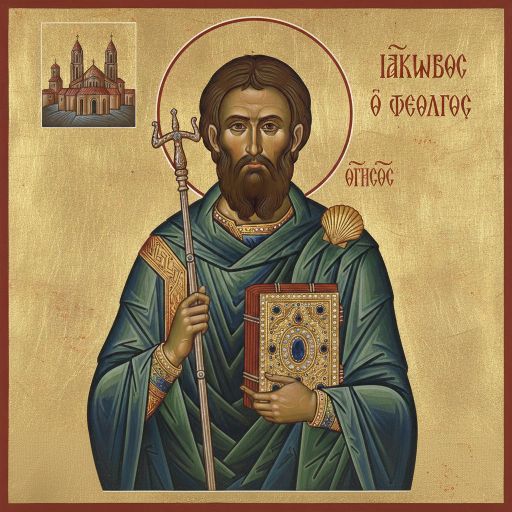
⚡Son of Thunder
St. James, known as James the Greater to distinguish him from James the Less (son of Alphaeus), was
one of the most prominent figures among the Twelve Apostles of Jesus Christ. Born to Zebedee, a
prosperous fisherman, and Salome, a devoted follower of Jesus, James grew up in Galilee along the
shores of the Sea of Galilee. His family's fishing business was successful enough to employ hired
servants, suggesting they were among the more affluent families in the region. His younger brother
John would become the beloved disciple and author of the Fourth Gospel.
James and John were working with their father Zebedee, mending their fishing nets, when Jesus called
them to follow Him. The Gospel of Mark records this pivotal moment: "He walked along a little
farther and saw James, the son of Zebedee, and his brother John. They too were in a boat mending
their nets. Then He called them. So they left their father Zebedee in the boat along with the hired
men and followed Him" (Mark 1:19-20). Without hesitation, the two brothers abandoned their family
business and their father to follow this itinerant rabbi from Nazareth.
Jesus gave James and his brother John the Aramaic surname "Boanerges," which Mark translates as
"Sons of Thunder" (Mark 3:17). This striking nickname reveals something essential about the
temperament and character of these two brothers. They were men of passion, intensity, and fierce
loyalty—qualities that could manifest as both zealous devotion and impulsive action. The thunder
metaphor suggests both their powerful voices in proclaiming the Gospel and their sometimes
tempestuous personalities.
The Call to Discipleship
"When He had gone a little farther from there, He saw James the son of Zebedee, and John his
brother, who also were in the boat mending their nets. And immediately He called them, and they left
their father Zebedee in the boat with the hired servants, and went after Him." — Mark 1:19-20
⭐Member of the Inner Circle
Among the Twelve Apostles, James held a place of special honor alongside his brother John and Simon
Peter. These three formed an inner circle within the apostolic band, privileged to witness moments
of Christ's ministry that the other nine did not see. This selection by Christ reveals James's
special intimacy with the Lord and his role as one of the foundational pillars of the early Church.
The first of these exclusive moments occurred when Jesus went to the house of Jairus, a synagogue
ruler whose twelve-year-old daughter had died. While Jesus allowed the crowd to follow Him to the
house, once there, "He permitted no one to follow Him except Peter, James, and John the brother of
James" (Mark 5:37). Inside, these three apostles witnessed one of Christ's most profound
miracles—the raising of a dead child to life. When Jesus took the girl by the hand and said,
"Talitha, cumi" ("Little girl, I say to you, arise"), she immediately stood up and walked. This
intimate witness to Christ's power over death itself left an indelible mark on James's faith.
The second exclusive event was perhaps the most glorious of all—the Transfiguration on Mount Tabor.
Jesus took Peter, James, and John up a high mountain, and there He was transfigured before them. His
face shone like the sun, His garments became white as light, and Moses and Elijah appeared,
conversing with Him about His coming passion and death in Jerusalem. The three apostles saw Christ's
divine glory unveiled, heard the voice of God the Father declaring, "This is My beloved Son, in whom
I am well pleased. Hear Him!" (Matthew 17:5). This theophany—this manifestation of God's
glory—confirmed for James that Jesus was indeed the promised Messiah, the very Son of God.
The third moment was one of profound sorrow rather than glory. In the Garden of Gethsemane, on the
night of His betrayal, Jesus took Peter, James, and John deeper into the garden to watch and pray
with Him. There they witnessed Christ's human agony as He faced the approaching crucifixion. "My
soul is exceedingly sorrowful, even to death," Jesus told them. "Stay here and watch with Me"
(Matthew 26:38). Though the three apostles struggled to stay awake, they were granted a glimpse of
Christ's perfect humanity—His genuine dread before suffering, His obedient submission to the
Father's will, His profound sorrow for the sins He would bear. For James, this moment revealed that
the glorious Christ of Tabor was also the suffering servant prophesied by Isaiah.
The three moments Jesus shared exclusively with Peter, James, and John—the raising of Jairus's
daughter, the Transfiguration, and Gethsemane—revealed three essential aspects of Christ's identity:
His power over death, His divine glory, and His willing acceptance of suffering for our salvation.
🔥Zeal and Ambition
The Gospel accounts reveal that James's passionate temperament sometimes manifested in ways that
required correction from the Lord. On one occasion, when Jesus and His disciples were traveling
through Samaria on their way to Jerusalem, a Samaritan village refused to receive them because they
were heading to the rival worship center in Jerusalem. James and John were indignant at this
rejection. They asked Jesus, "Lord, do you want us to command fire to come down from heaven and
consume them, just as Elijah did?" (Luke 9:54). Their zeal for Christ's honor was genuine, but their
solution was harsh and vengeful. Jesus turned and rebuked them, teaching that the Son of Man came
not to destroy lives but to save them.
This incident reveals both the intensity of the brothers' devotion to Christ and their need to learn
that the kingdom of God operates differently than earthly kingdoms. The fire they sought to call
down was the fire of judgment, but Christ's mission at His first coming was one of mercy and
redemption. The "Sons of Thunder" had to learn that the thunder of God's judgment would wait until
the last day, while the present age was one of grace and patient invitation to repentance.
Another revealing moment occurred when James and John, either directly or through their mother
Salome (the Gospel accounts differ), approached Jesus with an ambitious request. They asked for the
places of highest honor in His kingdom—to sit at His right hand and His left hand when He came into
His glory (Mark 10:35-37; Matthew 20:20-21). This request betrayed a misunderstanding of the nature
of Christ's kingdom and sparked indignation among the other ten apostles, who were presumably
offended that James and John had tried to secure the best positions.
Jesus's response was both gentle and profound. He asked them, "Are you able to drink the cup that I
drink, and be baptized with the baptism that I am baptized with?" (Mark 10:38). Not fully
comprehending what He meant, they confidently replied, "We are able." Jesus then made a sobering
prophecy: "You will indeed drink the cup that I drink, and with the baptism I am baptized with you
will be baptized; but to sit at My right hand and at My left is not Mine to give, but it is for
those for whom it is prepared" (Mark 10:39-40).
Jesus then taught all the disciples a crucial lesson about leadership in His kingdom: "Whoever
desires to become great among you shall be your servant. And whoever of you desires to be first
shall be slave of all. For even the Son of Man did not come to be served, but to serve, and to give
His life a ransom for many" (Mark 10:43-45). For James, this teaching would prove prophetic. He
would indeed drink from Christ's cup of suffering and be baptized with a baptism of blood, becoming
the first of the apostles to be martyred for the faith.
✝️First Apostolic Martyr
After the Resurrection and Ascension of Christ, and empowered by the Holy Spirit at Pentecost, St.
James boldly proclaimed the Gospel in Jerusalem and the surrounding regions. His preaching was
marked by the same passionate intensity that had characterized him as a disciple, but now tempered
by the Holy Spirit and focused entirely on bearing witness to the risen Christ. He spoke with
authority about what he had seen and heard, testifying that Jesus of Nazareth, who had been
crucified, was indeed risen from the dead and exalted as Lord and Messiah.
The Book of Acts records the circumstances of James's martyrdom with stark brevity: "Now about that
time Herod the king stretched out his hand to harass some from the church. Then he killed James the
brother of John with the sword" (Acts 12:1-2). These simple words mark one of the most significant
moments in the early Church—the first martyrdom of one of the Twelve Apostles, occurring around 44
AD, approximately eleven to fourteen years after Christ's crucifixion.
The Herod mentioned here was Herod Agrippa I, grandson of Herod the Great, who had sought to kill
the infant Jesus. Agrippa had been raised in Rome and was a friend of the emperors Caligula and
Claudius. The Roman authorities had granted him rule over a reunified Jewish kingdom, and he sought
to consolidate his power by pleasing the Jewish religious establishment. The growing Christian
movement, with its claims about a crucified Messiah and its challenge to traditional Jewish
authority, provided him an opportunity to demonstrate his zeal for Jewish traditions.
James's execution was carried out by beheading with the sword, a Roman method of capital punishment
typically reserved for citizens or those of higher status. This manner of death fulfilled Christ's
prophecy that James would indeed drink from the cup He drank and be baptized with His baptism. The
"Son of Thunder" became the first of the apostolic band to follow his Master in laying down his life
for the Gospel. His martyrdom set a precedent that would be followed by nearly all the other
apostles in time.
Early Christian tradition, preserved by Clement of Alexandria (as recorded by Eusebius), adds a
powerful detail to the account of James's death. According to this tradition, the man who led James
to judgment was so moved by the apostle's courageous testimony that he became a Christian on the
spot. As they were both being led to execution, this convert asked James for forgiveness. James,
after a moment of consideration, embraced him and said, "Peace be with you," and kissed him. Both
men were then beheaded together, united in their confession of Christ.
The Acts of the Apostles records that when Herod saw that James's execution pleased the Jewish
leaders, he proceeded to arrest Peter as well, intending to execute him after Passover. However, an
angel miraculously freed Peter from prison. The contrast is striking—James was allowed to drink the
cup of martyrdom, while Peter was delivered for a time. This reminds us that God's purposes are
sovereign and diverse; He calls some to witness through death and others to witness through
continued ministry, according to His perfect wisdom.
St. James's martyrdom around 44 AD makes him the first of the Twelve Apostles to die for Christ,
fulfilling Jesus's prophecy that he would drink from the same cup and receive the same baptism. His
courageous witness unto death inspired countless Christians who would follow in the way of
martyrdom.
🐚The Tradition of Spain and Santiago de
Compostela
James in Hispania: Legend and Devotion
A cherished tradition, developed particularly in medieval Spain, holds that St. James traveled
to the Iberian Peninsula to preach the Gospel before returning to Jerusalem where he was
martyred. According to this tradition, James evangelized various regions of what is now Spain,
though he met with limited success in converting the pagan population. After his martyrdom in
Jerusalem, the tradition states that his disciples transported his body by boat to Galicia in
northwestern Spain, where he was buried.
The tradition further relates that James's tomb was lost for centuries until its miraculous
rediscovery in the early 9th century (around 814 AD) during the reign of Alfonso II of Asturias.
A hermit named Pelayo reported seeing strange lights and hearing angelic music in a field.
Investigation led to the discovery of a tomb believed to contain the relics of St. James. The
location became known as "Campus Stellae" (Field of the Star), which evolved into "Compostela."
A church was built over the site, which eventually became the magnificent Cathedral of Santiago
de Compostela.
While historians debate the historical reliability of James's mission to Spain (early church
fathers make no mention of it, and it first appears in written form in the 7th century), the
tradition became immensely significant in medieval European Christianity. Santiago de Compostela
became one of the three great pilgrimage destinations of medieval Christianity, alongside Rome
and Jerusalem. The pilgrimage route, known as the Camino de Santiago (Way of St. James),
attracted millions of pilgrims throughout the Middle Ages and continues to draw hundreds of
thousands annually today.
St. James became the patron saint of Spain, known there as "Santiago" (a contraction of "Sant
Iago," or Saint James). The scallop shell became his symbol, as pilgrims walking the Camino
would wear shells to identify themselves. During the Reconquista, the centuries-long effort to
reclaim Spain from Muslim rule, James was invoked as "Santiago Matamoros" (St. James the
Moor-slayer), and many military victories were attributed to his intercession. Churches, cities,
and even nations in the Americas were named after him—Santiago de Chile, San Diego (Spanish for
St. James), and countless others.
📅Timeline of St. James's Life
-
c. 5-1 BC - Birth
Born in Bethsaida or Capernaum, Galilee, to Zebedee and Salome
-
c. 28-29 AD - Called by Christ
Jesus calls James and John from their fishing boats; they immediately follow Him
-
c. 29 AD - Named "Son of Thunder"
Jesus gives James and John the surname "Boanerges" (Sons of Thunder)
-
c. 30 AD - Raising of Jairus's Daughter
Witnesses Jesus raise a young girl from the dead
-
c. 32 AD - The Transfiguration
With Peter and John, witnesses Christ transfigured in glory on Mount Tabor
-
c. 33 AD - Garden of Gethsemane
Keeps watch with Jesus during His agony before the crucifixion
-
33 AD - Witnesses Resurrection
Sees the risen Christ and receives His commission to proclaim the Gospel
-
33 AD - Pentecost
Receives the Holy Spirit in the Upper Room, empowered for ministry
-
33-44 AD - Ministry in Jerusalem
Preaches boldly in Jerusalem and Judea, witnesses to the resurrection
-
44 AD - Martyrdom
Beheaded by order of Herod Agrippa I in Jerusalem, first apostle martyred
⚔️The Fiery Apostle Transformed
The life of St. James presents a profound portrait of transformation through discipleship. The
ambitious young man who wanted to call down fire from heaven and secure the best seats in Christ's
kingdom was gradually shaped into a humble servant willing to give his life for the Gospel. The "Son
of Thunder" learned to channel his passionate intensity not toward selfish ambition or vengeful
judgment, but toward courageous witness and sacrificial love.
This transformation did not eliminate James's natural temperament but redirected it. His zeal
remained, but it became zeal for God's glory rather than his own. His fierce loyalty remained, but
it was now loyalty to Christ unto death. His desire for greatness remained, but he learned that true
greatness comes through service and self-sacrifice. The fire he once wanted to call down on
Samaritan villages became the fire of the Holy Spirit burning in his heart, compelling him to
proclaim Christ regardless of the cost.
James's privileged position in the inner circle came with corresponding responsibility. He who had
witnessed the Transfiguration's glory was called to witness unto death. He who had seen Christ's
power over death in Jairus's daughter would himself die trusting in resurrection. He who had watched
Jesus submit to the Father's will in Gethsemane would submit to martyrdom rather than deny his Lord.
Every grace given carried with it a corresponding call to faithful stewardship.
The prophecy Jesus made to James and John—"You will drink the cup that I drink, and be baptized with
the baptism I am baptized with"—was fulfilled in James more quickly than in any other apostle.
Approximately eleven years after Christ's ascension, James drank the cup of suffering and was
baptized in blood. His martyrdom demonstrated that following Christ means embracing the cross, not
avoiding it. It showed the early Church that the way of Jesus leads through suffering to glory,
through death to resurrection.
👨👩👦The Sons of Zebedee: A Family of Faith
The family of Zebedee contributed significantly to the apostolic mission. Both James and his brother
John were chosen by Christ to be among the Twelve, and both became pillars of the early Church.
Their mother Salome was among the faithful women who followed Jesus, supported His ministry
financially, witnessed the crucifixion from afar, and came to the tomb on Easter morning to anoint
His body. She is identified in Mark's Gospel as one of the myrrh-bearing women and is traditionally
understood to be a sister of the Virgin Mary, making James and John cousins of Jesus according to
the flesh.
This family connection helps explain certain elements of the Gospel narrative. When Salome asked
Jesus for her sons to sit at His right and left in His kingdom, she was not merely displaying
ambition for her children; she may have believed that their kinship with Jesus gave them a special
claim to positions of honor. Jesus's response, emphasizing servanthood over status, taught both
mother and sons that the kingdom of God operates on principles radically different from human
kingdoms.
The fact that Zebedee allowed his sons to leave the family business to follow Jesus, and apparently
supported this decision, suggests that he too recognized something extraordinary in Christ's call.
The family's relative prosperity meant they had the means to support the itinerant ministry of Jesus
and His disciples, which the women who followed Jesus (including Salome) did. The entire family, it
seems, contributed to the spread of the Gospel in different ways.
The bond between James and John was clearly profound. They were called together, they were nicknamed
together ("Sons of Thunder"), they approached Jesus together with their request for special
positions, and they are consistently mentioned together in the Gospel accounts. While John would go
on to write five books of the New Testament and live to old age, becoming the last surviving
apostle, James's earlier death meant he would be the first to experience the fulfillment of Christ's
promise of resurrection to eternal life.
The Cup and the Baptism
"Jesus said to them, 'You will indeed drink the cup that I drink, and with the baptism I am baptized
with you will be baptized; but to sit at My right hand and at My left is not Mine to give, but it is
for those for whom it is prepared.'" — Mark 10:39-40
📖James in Early Christian Memory
The early Church fathers held St. James in high esteem, remembering him as one of the most prominent
apostles and the protomartyr of the apostolic college. Clement of Alexandria, writing in the late
2nd century, preserved the tradition about James's courage in the face of death and his convert's
request for forgiveness. Eusebius of Caesarea, the great 4th-century Church historian, included this
account in his Ecclesiastical History, ensuring it would be remembered by subsequent generations.
St. Isidore of Seville (6th-7th century) was among the first to write about the tradition of James
preaching in Spain, and this tradition became increasingly developed in the medieval period. Whether
or not James physically traveled to Spain, the devotion to him there and the phenomenon of the
Santiago pilgrimage represent a genuine expression of Christian faith and have borne spiritual fruit
in countless lives transformed through pilgrimage and prayer.
The brevity with which the Book of Acts records James's martyrdom—just two verses—is itself
significant. The early Church accepted martyrdom as a natural consequence of faithful witness. There
was no need to elaborate or embellish; the simple fact that James had been killed for his faith in
Christ was sufficient testimony to his character and commitment. His blood, like that of all
martyrs, became seed for the Church's growth.
In the liturgical tradition of the Syriac Orthodox Church and other ancient Christian traditions,
St. James is commemorated with special hymns and prayers that celebrate his witness. He is
remembered as one who was close to Christ in earthly life and who proved his love by following Him
even unto death. His feast day on July 25th has been observed since ancient times, and in Spain, it
is a national holy day celebrated with special fervor.
💎Lessons from the First Apostolic Martyr
St. James teaches us that passionate, intense personalities can be channels of great grace when
surrendered to Christ. His natural zeal and ambition, which initially manifested in problematic
ways, became virtues when redirected toward God's purposes. The Church needs believers with fire in
their hearts—people who will not compromise, who will stand for truth, who will boldly proclaim
Christ. But this fire must be the Holy Spirit's fire, not the fire of self-will or worldly ambition.
James's inclusion in Christ's inner circle teaches us that intimacy with Jesus brings both privilege
and responsibility. Those who see more of Christ's glory are called to bear more of His cross.
Greater revelation demands greater obedience. James witnessed the Transfiguration, but he also
witnessed Gethsemane. He saw divine glory unveiled, but he also saw the cost of redemption. These
experiences together shaped him into a man ready to lay down his life.
The martyrdom of James reminds us that suffering and death for Christ's sake are not defeats but
victories. When Herod's sword ended James's earthly life, it simultaneously perfected his witness
and secured his eternal crown. The apparent triumph of evil was actually the triumph of faith.
James's blood watered the seeds of the Gospel in Jerusalem, and his example inspired generations of
Christians to remain faithful even unto death.
Finally, James's transformation from ambitious disciple to sacrificial martyr demonstrates the power
of sustained fellowship with Christ. Three years of walking with Jesus, witnessing His miracles,
hearing His teaching, and experiencing His love gradually reshaped James's character and priorities.
The same process occurs in every believer who persistently abides in Christ. We may come to Him with
mixed motives, selfish ambitions, and rough edges, but sustained communion with Jesus transforms us
into His image, from glory to glory.
🙏Veneration and Intercession
The Syriac Orthodox Church venerates St. James the Greater as one of the chief apostles and the
first of the Twelve to receive the crown of martyrdom. His feast day on July 25th is celebrated with
special liturgies that commemorate his calling by Christ, his privileged witness to the
Transfiguration, and his courageous martyrdom. The liturgical hymns praise him as a "Son of Thunder"
whose voice proclaimed the Gospel with power and authority.
St. James is invoked as a patron of pilgrims, reflecting the medieval tradition of pilgrimage to
Santiago de Compostela. He is also patron of Spain, laborers, pharmacists, and those suffering from
rheumatism and arthritis. Christians facing persecution or martyrdom particularly seek his
intercession, asking for the same courage he displayed before Herod Agrippa. His example encourages
all believers to remain faithful to Christ regardless of the cost.
The scallop shell, symbol of the Santiago pilgrimage, has become a universal symbol of pilgrimage
and journey in Christian iconography. It reminds believers that the Christian life itself is a
pilgrimage toward the heavenly Jerusalem, and that like James, we are all called to journey
faithfully until we reach our eternal home. The shell also symbolizes baptism and rebirth,
connecting to Christ's words about the baptism James would receive.
Whether one accepts the tradition of James's mission to Spain or not, the devotion to him at
Santiago de Compostela has enriched Christian spirituality for over a millennium. Millions of
pilgrims have walked the Camino, seeking spiritual renewal, penance, or deeper communion with God.
The bones enshrined in the cathedral—whether truly James's or not—have served as a focal point for
prayer and pilgrimage, and countless testimonies attest to spiritual transformation experienced
along the way.
Prayer to St. James the Greater
O glorious Saint James, Son of Thunder and beloved apostle of Christ, you who witnessed the
glory of the Transfiguration and the agony of Gethsemane, who drank from the cup of martyrdom
and were baptized with blood: grant us courage to follow Christ faithfully through both glory
and suffering. You who left your nets and your father to follow Jesus without hesitation:
inspire in us the same readiness to abandon all for the sake of the Gospel. You who learned to
transform zealous ambition into humble service: teach us to seek greatness through servanthood
and love. O first of the apostles to be martyred, patron of pilgrims and intercessor for all who
face persecution: strengthen us in our earthly pilgrimage toward the heavenly kingdom. May we,
like you, remain faithful unto death and receive the crown of life that Christ promises to those
who love Him. Through your prayers and those of all the martyrs, may we be counted worthy to
stand before the throne of God. Amen.