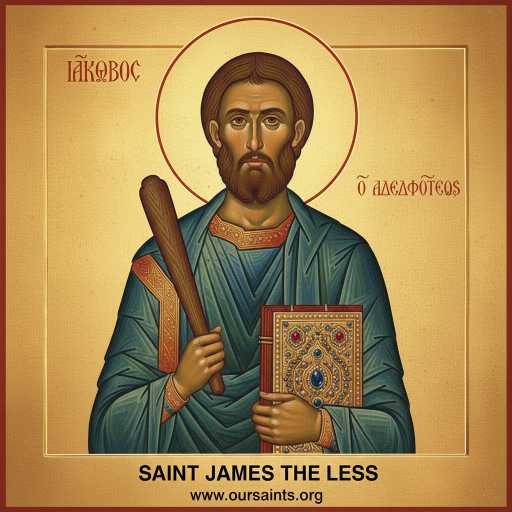
📖Identity and Nomenclature
In the Holy Scriptures, we encounter multiple persons named James (Ya'akov in Hebrew, Ἰάκωβος in
Greek): James son of Zebedee, James son of Alphaeus (listed among the Twelve), James called "the
brother of the Lord," and James the author of the canonical Epistle. The relationship among these
figures—whether they represent one, two, three, or four distinct persons—has been debated since
antiquity. The Western tradition, following St. Jerome, generally identifies James son of Alphaeus
with James "the brother of the Lord" and the author of the Epistle, viewing them as one person. The
Eastern traditions, including the Syriac Orthodox Church, have tended to distinguish between James
the Apostle (son of Alphaeus) and James the brother of the Lord (understood as Jesus's cousin or
stepbrother).
"James the Less" or "James the Younger" (to distinguish him from James the son of Zebedee) stands
at the convergence of several New Testament figures whose identities have been variously
understood in different Christian traditions.
However, for the purposes of this fuller biography within our Syriac Orthodox context, the tradition
that has been most commonly received in both East and West regarding the Apostle James son of
Alphaeus, acknowledging where our tradition intersects with or diverges from other interpretations.
The epithet "the Less" (ὁ μικρός, meaning "the smaller" or "the younger") may refer to his stature,
his age relative to James son of Zebedee, or the chronology of his call to apostleship. In Syriac
sources, he is known as Ya'qub Zur'o (ܝܰܥܩܽܘܒ ܙܥܽܘܪܳܐ), "James the Small."
Note on Tradition: The Syriac Orthodox Church, drawing on ancient Eastern tradition,
generally distinguishes James the Apostle (son of Alphaeus) from James the brother of the Lord,
though recognizing that both figures are intimately connected with the Jerusalem Church. This
biography focuses primarily on James son of Alphaeus as one of the Twelve, while acknowledging the
complex interweaving of these traditions in patristic literature.
👨👦Family Background and Early Life
James was the son of Alphaeus (also called Clopas or Cleopas in various Gospel accounts), a name
which in Hebrew is Halphai or Chalphai. According to ancient tradition preserved in both Greek and
Syriac sources, Alphaeus was related to the Holy Family. The early Church historian Hegesippus
(preserved by Eusebius) indicates that Clopas was the brother of St. Joseph, making James a cousin
of our Lord Jesus Christ according to the flesh. This familial connection would explain why James
and others are called "brothers of the Lord" in Scripture—a term that in Semitic usage can denote
various degrees of kinship including cousins.
James's mother is identified in the Gospel accounts as Mary, wife of Clopas. In John 19:25, we read
of the women at the Cross: "Now there stood by the cross of Jesus His mother, and His mother's
sister, Mary the wife of Clopas, and Mary Magdalene." This Mary, wife of Clopas (Alphaeus), is also
called "Mary the mother of James the Less and of Joses" in Mark 15:40. She was among the faithful
women who followed Jesus, witnessed His crucifixion, and came to the tomb on the morning of the
Resurrection. Thus James grew up in a family deeply devoted to the Lord, with his mother being one
of the myrrh-bearing women honored in our liturgical tradition.
According to tradition, James had brothers including Joses (Joseph), Simon, and Judas (not
Iscariot), who are mentioned in the Gospels as "brothers" of Jesus (Matthew 13:55, Mark 6:3). The
Syriac tradition, following Hegesippus and other early witnesses, understands these as cousins of
the Lord. Two of these brothers—Simon and Judas—would also become apostles (Simon the Zealot and
Judas called Thaddeus or Lebbaeus), forming a remarkable apostolic family closely connected to our
Savior.
James would have grown up in Galilee, likely in or near Nazareth, in close proximity to the Holy
Family. He would have been raised in the Jewish faith, learning the Torah, attending synagogue, and
observing the festivals and traditions of his ancestors. Being a kinsman of Jesus, he would have
known the Lord from childhood, witnessing His growth in wisdom and stature. However, the Gospels
suggest that Jesus's relatives did not initially understand or accept His messianic mission (Mark
3:21, John 7:5), though they later became devoted followers after the Resurrection.
✝️Call to Apostleship
James son of Alphaeus appears in all four canonical lists of the Twelve Apostles (Matthew 10:2-4,
Mark 3:16-19, Luke 6:14-16, Acts 1:13), always mentioned in the second group of apostles. While the
Gospels do not provide a detailed narrative of his individual call as they do for some of the
others, we may presume that he was among those whom Jesus called during His public ministry in
Galilee, responding to the Lord's invitation to follow Him and become a "fisher of men."
The fact that James was chosen as one of the Twelve is itself profoundly significant. Our Lord Jesus
Christ spent an entire night in prayer before selecting the Twelve (Luke 6:12-13), indicating the
divine will in their selection. James, along with his fellow apostles, was chosen not merely for
natural ability or social standing, but according to God's sovereign purpose. He would be a
foundation stone of the Church, an authoritative witness to Christ's ministry, death, and
resurrection.
As one of the Twelve, James accompanied our Lord throughout His Galilean and Judean ministries. He
witnessed the miracles—the healing of the sick, the cleansing of lepers, the casting out of demons,
the raising of the dead, the multiplication of loaves, the walking on water. He heard the parables
and the Sermon on the Mount. He was present at the Last Supper when Jesus instituted the Holy
Eucharist and washed the disciples' feet. He witnessed the agony in Gethsemane, the betrayal, and
the arrest, though like the others he fled in fear when Jesus was seized.
After the Crucifixion, James experienced the joy of the Resurrection. The Risen Lord appeared to the
apostles multiple times over forty days, instructing them concerning the Kingdom of God and
preparing them for their mission. James was present when Christ ascended into heaven from the Mount
of Olives, and he returned with the others to the Upper Room in Jerusalem to await the promised Holy
Spirit. On the day of Pentecost, James received the tongues of fire, was filled with the Holy
Spirit, and began to preach boldly in the name of Jesus Christ.
🏛️Ministry in Jerusalem and Judea
According to the consistent witness of Syriac, Greek, and Latin traditions, St. James son of
Alphaeus exercised his apostolic ministry primarily in and around Jerusalem and Judea. While other
apostles took the Gospel to distant lands—Peter to Rome, Thomas to India, Philip to Asia Minor—James
remained in the holy city, serving as a pillar of the mother church from which the Gospel radiated
to the ends of the earth.
The early Church in Jerusalem faced unique challenges. It was composed largely of Jewish believers
who continued to observe the Mosaic Law while confessing Jesus as Messiah. The community lived in a
delicate tension with the broader Jewish society, which viewed the followers of Jesus with suspicion
or hostility. Within this context, James ministered with wisdom and prudence, maintaining continuity
with Jewish tradition while proclaiming the fulfillment of that tradition in Christ.
Tradition holds that James was known for his rigorous asceticism and his devotion to prayer. The
historian Hegesippus reports that James "was holy from his mother's womb," that he "drank no wine or
strong drink, nor did he eat flesh," and that "he alone was permitted to enter the Holy Place"
(meaning he was held in such high esteem that even the Jewish authorities respected his piety).
Whether these details apply specifically to James son of Alphaeus or to James the brother of the
Lord, they reflect the tradition of a James in Jerusalem who embodied the highest ideals of
Jewish-Christian piety.
As an apostle and leader in the Jerusalem Church, James would have participated in the momentous
events recorded in the Acts of the Apostles: the communal life of the early believers, the choosing
of the seven deacons, the persecution that arose after Stephen's martyrdom, the missionary journeys
that expanded the Church into Samaria and beyond. He would have known Peter, John, Paul, Barnabas,
and the other great figures of the apostolic age. He would have witnessed the miraculous growth of
the Church despite fierce opposition.
⚖️Episcopal Leadership and the Jerusalem Church
In the Syriac Orthodox tradition, as in other ancient Christian traditions, James son of Alphaeus is
honored as having served in episcopal capacity over the Church in Jerusalem. While some traditions
attribute the bishopric of Jerusalem more specifically to James "the brother of the Lord," the close
association—if not identification—of these two figures in many sources means that the episcopal
ministry of James is firmly rooted in apostolic memory.
As bishop of Jerusalem, James would have been responsible for the oversight of the local Christian
community, the ordination of presbyters and deacons, the celebration of the Divine Liturgy, the
administration of baptism, the teaching of doctrine, and the settling of disputes. The Jerusalem
Church served as the mother church of Christianity, the place where the faith was first preached
after Pentecost, and its bishop held a position of unique authority and honor.
One tradition attributes to St. James the authorship or transmission of an early form of the Divine
Liturgy. The "Liturgy of St. James," one of the most ancient Eucharistic prayers still in use in
Eastern Christianity (including occasionally in the Syriac Orthodox Church), is traditionally
associated with James of Jerusalem. While modern scholarship debates the precise origins of this
liturgical text, the tradition reflects the deep connection between the apostolic witness and the
Church's worship. The anaphora of St. James is characterized by its theological richness, its
emphasis on the holiness of God, and its comprehensive recounting of salvation history—all
reflecting the Jewish-Christian milieu of first-century Jerusalem.
In his pastoral role, James would have faced the challenge of guiding Jewish Christians in their
relationship to the Law of Moses and to Gentile believers. The question of whether Gentile converts
needed to be circumcised and observe the full Mosaic Law was a defining issue of the early Church.
While Acts 15 depicts James "the brother of the Lord" as a key figure at the Council of Jerusalem,
the principle would have applied to the ministry of any James serving the Jerusalem community: the
Gospel of Christ transcends ethnic and legal boundaries while respecting the conscience of Jewish
believers who wished to maintain their ancestral customs.
📜The Epistle of St. James
The New Testament includes an Epistle attributed to "James, a servant of God and of the Lord Jesus
Christ" (James 1:1). This letter, addressed to "the twelve tribes which are scattered abroad," is a
masterpiece of early Christian ethical teaching, emphasizing the integration of faith and works, the
importance of controlling the tongue, the dangers of favoritism and worldliness, and the necessity
of patience in suffering.
Traditional attribution of this Epistle has varied. Western tradition, following St. Jerome,
typically attributes it to James son of Alphaeus (identified with James the brother of the Lord).
Eastern tradition, including aspects of Syriac Christianity, has sometimes distinguished the
apostolic author from the Jerusalem bishop, though acknowledging the close connection between them.
Regardless of the precise identification, the Epistle reflects the wisdom and pastoral concern of a
leader deeply rooted in both Jewish wisdom literature and the teachings of Jesus.
The Epistle's emphasis on practical righteousness, its concern for the poor and oppressed, its
warnings against the misuse of wealth, and its call to endurance under trial all reflect the context
of a Jewish-Christian community facing persecution and economic hardship. The letter's style—with
its vivid imagery, rhetorical questions, and proverbial wisdom—echoes the teaching methods of Jesus
Himself and the wisdom tradition of the Old Testament.
For the Syriac Orthodox faithful, the Epistle of James is received as canonical Scripture, read in
the liturgy, and cherished for its practical guidance in Christian living. Whether written by James
son of Alphaeus or another James, the letter carries apostolic authority and continues to instruct
the Church in every generation. Its famous declaration—"faith without works is dead" (James
2:26)—stands as a corrective to any tendency toward cheap grace, reminding us that genuine faith
necessarily produces fruits of righteousness.
🕊️Character and Spiritual Qualities
From the limited direct information in Scripture and the broader witness of tradition, we can
discern certain qualities that characterized St. James son of Alphaeus. First, he was a man of
faithfulness and perseverance. Unlike those who followed Jesus only when it was popular or
convenient, James remained committed through controversy, persecution, and the challenges of
establishing the early Church. He did not seek fame or recognition; his ministry was marked by
humble service in the shadow of more prominent apostles.
Second, James embodied the integration of Jewish piety and Christian faith. He understood that the
Gospel did not abolish the Law but fulfilled it. He honored the traditions of his fathers while
recognizing Jesus as the Messiah who inaugurated the New Covenant. This balance—respecting
continuity with the past while embracing the new work of God—is a model for all believers who must
navigate the relationship between tradition and innovation, between cultural particularity and
universal truth.
Third, tradition emphasizes James's asceticism and devotion to prayer. Whether these specific
practices belonged to James son of Alphaeus or to James the brother of the Lord, they reflect an
ideal of apostolic holiness: self-denial, discipline of the body, and constant communion with God.
In the Syriac Orthodox tradition, which has always honored monasticism and ascetical practice, this
dimension of James's witness is particularly significant. He reminds us that apostolic authority is
rooted not in worldly power but in spiritual depth.
Fourth, James demonstrated wisdom and discernment in leadership. Managing the diverse Jerusalem
community—with its competing visions of how to be both Jewish and Christian, its conflicts between
Hebraic and Hellenistic believers, its debates over the admission of Gentiles—required great
pastoral skill. James (whether as apostle or bishop or both) helped navigate these challenges,
preserving unity in the midst of diversity, upholding truth without crushing the weak, and
maintaining the Church's missional focus.
👑Martyrdom and Witness unto Death
According to multiple ancient sources, St. James son of Alphaeus (or James of Jerusalem, depending
on the identification) suffered martyrdom in the holy city around the year 62 AD. The circumstances
of his death are recounted most famously by Hegesippus (via Eusebius) and Josephus, though with some
variations in detail. While these accounts are typically applied to James "the brother of the Lord,"
they are part of the broader tradition associated with the apostolic ministry in Jerusalem.
The tradition states that James was held in high regard even among non-Christian Jews for his
righteousness and piety. However, certain members of the Sanhedrin—particularly the high priestly
party—saw him as a threat because of his bold proclamation that Jesus was the Messiah and the Son of
God. During a period when the Roman procurator's office was vacant (between the death of Festus and
the arrival of Albinus), the high priest Ananus took advantage of the power vacuum to move against
James.
According to one account, James was brought to the pinnacle of the Temple and asked to denounce
Jesus before the crowds gathered for Passover. Instead, he testified boldly to Christ, declaring Him
to be the Son of Man seated at the right hand of Power. Enraged, his enemies cast him down from the
Temple height. Surviving the fall, James knelt in prayer, asking God to forgive those who were
killing him—echoing the words of both Jesus on the Cross and Stephen at his stoning. As he prayed,
his assailants stoned him, and finally a fuller (one who cleanses cloth) struck him on the head with
a club, delivering the death blow.
Other traditions describe variations of this account, including the possibility that James was
stoned to death more directly. The Jewish historian Josephus mentions the execution of "James the
brother of Jesus who was called Christ" by the high priest Ananus, an action which Josephus suggests
contributed to Ananus's removal from office due to its illegality and the outrage it provoked even
among non-Christian Jews.
Regardless of the precise details, the tradition is clear: James died as a martyr, bearing witness
to Jesus Christ unto death, and his blood, like that of Stephen before him, watered the seed of the
Church. In the Syriac Orthodox tradition, martyrdom is the supreme act of witness (μαρτυρία/martyria
means "witness" in Greek), the ultimate conformity to Christ who gave His life for the world.
James's martyrdom stands as a testimony to the truth of the Gospel and an example of faithfulness
for all who would follow Christ, even at the cost of their lives.
🌟Legacy and Veneration in the Syriac Orthodox
Church
In the liturgical and devotional life of the Syriac Orthodox Church, St. James son of Alphaeus is
honored as one of the holy and glorious Twelve Apostles, pillars of the faith, and foundation stones
of the Church. His feast is celebrated on October 23 (along with the commemoration of James the
brother of the Lord) and on May 3 in some calendars. These feast days are occasions for the faithful
to remember his apostolic witness, to seek his intercession, and to be inspired by his example of
faithfulness, humility, and martyric courage.
In Syriac liturgical texts and hymnography, James is invoked as a heavenly intercessor, one who
stands before the throne of God pleading for the Church on earth. The troparion and kontakion
appointed for his feast praise his apostolic labors, his episcopal ministry, and his martyr's crown.
The prayers of the faithful implore St. James to pray for the forgiveness of sins, the strengthening
of faith, the preservation of the Church in unity and truth, and the salvation of souls.
The Syriac Orthodox tradition, rooted in the Antiochene heritage, has always maintained strong
connections to Jerusalem and the primitive Church. The memory of St. James—whether as James son of
Alphaeus, James the Just, or the synthesis of these figures in popular piety—links the faithful to
the very origins of Christianity. To honor James is to honor the apostolic foundation, to affirm
continuity with the first witnesses, and to embrace the call to be living stones in the temple that
the apostles began to build.
Beyond liturgical observance, St. James's witness carries practical implications for the Christian
life. His integration of faith and works challenges any dichotomy between belief and practice; his
asceticism calls believers to discipline and self-denial; his martyrdom reminds us that following
Christ may require suffering; his episcopal ministry demonstrates the importance of pastoral wisdom
and leadership; his connection to Jerusalem roots the Church in its historical and theological
origins. For Syriac Orthodox Christians—many of whom have faced persecution, displacement, and
martyrdom in recent centuries—the example of St. James is particularly poignant and relevant.
📚Historical and Theological Reflections
As a historian and believer, I must acknowledge the complexities surrounding the identity and
biography of St. James son of Alphaeus. The New Testament provides limited direct information about
him, and later traditions sometimes conflate or confuse different figures named James. Modern
critical scholarship has intensively debated the relationship between James the Apostle, James the
brother of the Lord, and the author of the Epistle, with various theories proposed and no universal
consensus achieved.
Within the Syriac Orthodox tradition, we approach these questions with reverence for the received
tradition while maintaining scholarly integrity. We recognize that some details of hagiography
reflect theological and devotional concerns more than strict historical reporting. We acknowledge
that different branches of Christianity have preserved somewhat different traditions regarding James
and other apostolic figures. We accept that certainty on every detail is not possible given the
distance of time and the nature of our sources.
Nevertheless, the core of the tradition stands firm: there was an apostle named James, son of
Alphaeus, chosen by Christ as one of the Twelve, filled with the Holy Spirit at Pentecost, active in
the Jerusalem Church, and ultimately faithful unto death. Whether all the traditions associated with
"St. James of Jerusalem" belong precisely to this James or to another James closely associated with
him, the witness remains the same: Christ founded His Church on apostolic testimony, and that
testimony was sealed in blood.
From a theological perspective, St. James embodies several crucial themes. First, he represents the
continuity between Israel and the Church. As a Jewish believer who honored the Law while confessing
Jesus as Messiah, he shows that Christianity is not a rejection of Judaism but its fulfillment.
Second, he exemplifies the diversity of apostolic ministry. Not all apostles were called to
world-traveling evangelism like Paul; some, like James, were called to stable, local ministry of
equal importance. Third, he demonstrates that holiness requires both faith and works. The tradition
of James's asceticism and the epistle's emphasis on practical righteousness stand against any
antinomianism or cheap grace.
Finally, St. James points us to the centrality of Jerusalem in salvation history. While the Gospel
goes forth to all nations, it remains rooted in the particular history of God's covenant with
Israel, the incarnation of God's Son in first-century Palestine, the founding of the Church in
Jerusalem at Pentecost. James, whether as apostle or bishop or both, served as a living link to
these origins, a guardian of the tradition, a witness to the events on which our faith is founded.
🙏Spiritual Lessons for Contemporary Believers
What does the life and witness of St. James son of Alphaeus teach us as contemporary believers in
the Syriac Orthodox Church? First, faithfulness in obscurity. James was not the most famous apostle;
he did not write a Gospel; he is not always clearly distinguished from others with the same name.
Yet he was chosen by Christ, filled with the Spirit, and faithful unto death. This reminds us that
God values hidden service, that not all are called to prominence, and that faithfulness in small
things is precious in God's sight.
Second, the integration of tradition and innovation. James honored his Jewish heritage while
embracing the new thing God was doing in Christ. For us today, this means respecting the deposit of
faith handed down through the centuries while being open to how God might be speaking in new
contexts. It means neither abandoning tradition for novelty nor clinging to tradition in a way that
stifles the Spirit's movement. It means, as James did, finding the path of wisdom that preserves
what is essential while adapting what is accidental.
Third, the necessity of works alongside faith. The Epistle attributed to James famously declares
that "faith without works is dead." This is not a contradiction of the Pauline emphasis on grace and
faith; rather, it is the necessary complement. Genuine faith produces good works. True belief in
Christ transforms behavior. Authentic spirituality issues in justice, mercy, and holiness of life.
James challenges any complacency that would separate salvation from sanctification, justification
from justice.
Fourth, the cost of discipleship. James's martyrdom reminds us that following Christ is not about
personal fulfillment or worldly success; it is about taking up the cross. For many Syriac Orthodox
Christians, particularly those in the Middle East, this is not a metaphor but a reality.
Persecution, discrimination, and violence have marked the Church's experience in its ancestral
lands. The witness of St. James—and of countless martyrs who have followed—strengthens the faithful
to endure, to forgive, and to remain steadfast in hope.
Fifth, the importance of prayer and asceticism. The tradition of James's ascetical practice, whether
historically precise or not, reflects a truth: spiritual authority comes from spiritual depth.
Leaders in the Church are called not merely to organizational skill or rhetorical ability, but to a
life of prayer, self-denial, and union with God. Laity, too, are called to discipline their desires,
to fast, to pray without ceasing, to cultivate the inner life that is the wellspring of genuine
witness.
Finally, James points us to the eschatological hope of the Church. He lived in tension between the
"already" of Christ's resurrection and the "not yet" of the final consummation. He endured
persecution and difficulty while waiting for the Lord's return. His epistle counsels patience: "Be
patient, therefore, brethren, until the coming of the Lord" (James 5:7). For us, living two
millennia later, this patience remains necessary. We live between the times, witnessing to a Kingdom
already inaugurated but not yet fully realized, faithful in hope that the Lord who called James will
complete His work in us.
✝️Conclusion: An Apostolic Life Well-Lived
St. James son of Alphaeus, whether considered as a distinct figure from James the brother of the
Lord or as the same person under different designations, stands in the memory of the Syriac Orthodox
Church as a holy apostle, a faithful bishop, a wise teacher, and a courageous martyr. His life, from
his youth in Galilee as a kinsman of Jesus, through his call to apostleship and his ministry in
Jerusalem, to his ultimate witness in martyrdom, exemplifies the apostolic vocation: to be sent by
Christ, filled with the Spirit, and faithful unto death.
In the communion of saints, St. James continues to intercede for the Church, bringing before the
throne of grace the prayers of the faithful. His witness—preserved in Scripture, tradition, and
liturgy—continues to instruct and inspire. His martyrdom—joining the great cloud of witnesses who
have shed their blood for Christ—stands as a testimony to the truth of the Gospel and the reality of
the resurrection.
Prayer for Intercession
Glory be to the Father, and to the Son, and to the Holy Spirit; now and forever, and unto ages
of ages. Amen.
"O Holy Apostle James, you who were called by Christ and faithful unto death, you who served the
Church in Jerusalem with wisdom and courage, you who wrote words of life that guide us
still—intercede for us before the merciful God. Pray that our faith may be genuine and fruitful,
that our lives may integrate belief and practice, that we may endure persecution with patience, that
we may shepherd God's people with wisdom, and that we may, like you, receive the crown of life
promised to those who love the Lord. Through your prayers and those of all the saints, may we be
strengthened in faith, established in truth, and preserved in holiness until we stand with you
before the throne of the Lamb. Amen."