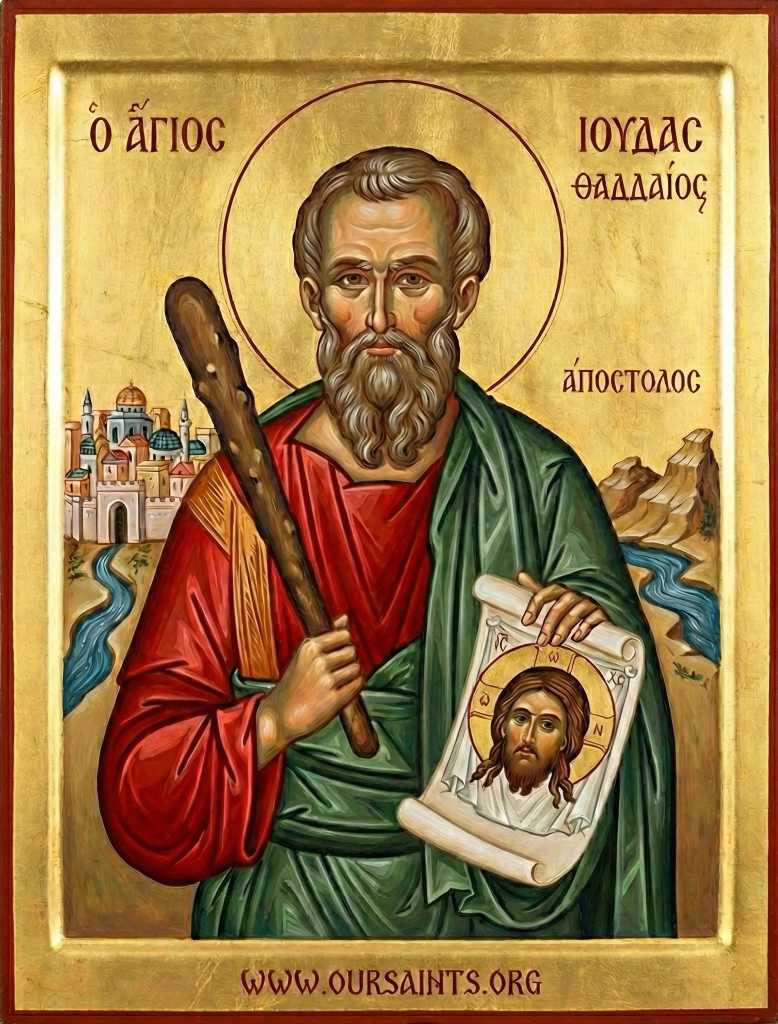
📖Names, Identity, and the Syriac Tradition
St. Jude Thaddeus with profound reverence, for he stands as one of the most significant apostolic
figures in our tradition—the very foundation upon which the Churches of Mesopotamia, Edessa, and the
East were built. However, before we can fully appreciate his ministry and legacy, we must carefully
examine the complex questions of his identity and nomenclature, which have occupied patristic and
modern scholars alike.
In the canonical lists of the Twelve Apostles, we encounter this holy figure under various names.
Matthew 10:3 calls him "Lebbaeus, whose surname was Thaddaeus" (in some manuscripts). Mark 3:18
names him simply "Thaddaeus." Luke 6:16 and Acts 1:13 identify him as "Judas the son of James"
(Ἰούδας Ἰακώβου). The Gospel of John mentions "Judas, not Iscariot" who asked our Lord a question at
the Last Supper (John 14:22). These various appellations—Judas, Jude, Thaddeus (Θαδδαῖος),
Lebbaeus—all refer, according to the consistent testimony of tradition, to the same apostle.
The name "Judas" (Ἰούδας in Greek, Yehudah in Hebrew, Ihuda or Yehuda in Aramaic) was common in
first-century Judaism, honoring Judah the patriarch. To distinguish this apostle from Judas Iscariot
the betrayer, he is called "Judas not Iscariot," or more commonly by his surname Thaddeus. The name
"Thaddeus" likely derives from the Aramaic word meaning "heart" or "courageous one" (from tad,
related to tadda, meaning breast or heart), suggesting a man of courage and devotion. "Lebbaeus"
similarly derives from the Hebrew leb, meaning "heart." Thus both surnames emphasize his heartfelt
devotion to Christ.
In the Syriac tradition, this apostle is intimately connected with the name "Addai" (ܐܰܕܰܝ), which
presents a fascinating historical and theological question. The ancient Syriac text known as the
"Doctrine of Addai" (or "Teaching of Addai"), one of our most precious early Christian documents,
recounts how the apostle Addai was sent by the Apostle Thomas to Edessa (modern Urfa/Şanlıurfa in
Turkey) to heal King Abgar V and evangelize that city. Some traditions identify Addai as one of the
Seventy disciples rather than one of the Twelve. However, the broader Syriac Orthodox tradition has
often understood Addai to be either identical with Thaddeus or so closely associated as to represent
the same apostolic mission to Mesopotamia.
Whether we understand Jude Thaddeus and Addai as the same historical person, or as two figures whose
ministries became conflated in tradition, or as master and principal disciple, the essential truth
remains: the apostolic faith came to Mesopotamia through apostolic witness, and the Churches of
Edessa, Nisibis, and the Syriac-speaking East trace their foundation to this holy apostle. For the
purposes of this fuller biography, following the venerable tradition of the Syriac Orthodox Church,
I shall treat Jude Thaddeus and Addai as representing the unified apostolic mission to the East,
while acknowledging the scholarly complexities.
Scholarly Note: The relationship between Thaddeus and Addai remains a subject of
historical inquiry. The "Doctrine of Addai" presents Addai as one of the Seventy sent by Thomas,
while Western and some Eastern traditions identify Thaddeus as one of the Twelve who evangelized
Mesopotamia. The Syriac Orthodox Church honors both the historical complexity and the unified
apostolic witness to the East, recognizing that whether through Thaddeus directly or through his
disciple Addai, the apostolic faith was planted in Mesopotamian soil.
👨👦Family, Background, and Early Life
According to the witness of Scripture and the testimony of tradition, Judas Thaddeus was the son of
Alphaeus (also called Clopas or Cleopas) and Mary wife of Clopas, making him the brother of James
the Less and a cousin of our Lord Jesus Christ. The Gospels mention the "brothers of the
Lord"—James, Joses, Simon, and Judas (Matthew 13:55, Mark 6:3)—which the Syriac Orthodox tradition,
following Hegesippus and other early witnesses, understands as referring to Jesus's cousins, the
sons of Alphaeus who was the brother of St. Joseph the Betrothed.
Thus Judas Thaddeus grew up in intimate connection with the Holy Family. He was raised in Galilee,
likely in or near Nazareth, in a pious Jewish household that observed the Law of Moses, attended
synagogue, and awaited the consolation of Israel. His father Alphaeus was the brother of St. Joseph,
making the two families closely connected by both blood and faith. His mother Mary was among the
faithful women who followed Jesus, stood at the foot of the Cross, and came to the tomb on the
morning of the Resurrection—one of the holy myrrh-bearing women honored in our liturgical tradition.
Growing up alongside Jesus, Judas would have witnessed the holy Child's growth in wisdom and
stature. However, like other members of Jesus's extended family, the Gospels suggest that Judas did
not initially recognize his cousin's messianic identity. John 7:5 notes that "even His brothers did
not believe in Him" during the early stages of His public ministry. This makes Judas's later
transformation all the more remarkable—from skeptical family member to devoted apostle, from one who
questioned to one who would carry the Gospel to distant lands and seal his witness with martyrdom.
The fact that three of Alphaeus's sons—James, Simon, and Judas—were chosen as apostles testifies to
the spiritual vitality of this family. It suggests that despite their initial doubts, they were men
of deep religious sensibility, grounded in Scripture, and ultimately open to the working of God's
Spirit. When Jesus called Judas Thaddeus to be one of the Twelve, He was calling a kinsman, a man
who knew Him personally, who had observed His character from childhood, and who would bring that
intimate knowledge to his apostolic witness.
✝️Call Among the Twelve and Ministry with Christ
Judas Thaddeus appears in all four canonical lists of the Twelve Apostles, though under varying
names as we have noted. His selection as one of the Twelve occurred after our Lord spent an entire
night in prayer on the mountain (Luke 6:12-13), indicating that his apostleship was according to the
divine will and purpose. To be chosen as one of the Twelve was to be designated a foundation stone
of the Church, an authoritative witness to Christ's teaching and resurrection, and a bearer of
apostolic authority.
During our Lord's earthly ministry, Judas Thaddeus witnessed the full spectrum of Christ's works:
the preaching of the Kingdom, the healing of the sick, the casting out of demons, the raising of the
dead, the multiplication of loaves, the walking on water, the transfiguration (though perhaps not as
an eyewitness, as only Peter, James, and John were present), and all the mighty works by which Jesus
demonstrated His divine authority and messianic identity. Judas heard the parables, the Sermon on
the Mount, the discourses in the Temple, and the intimate teachings given to the Twelve in private.
The Gospel of John preserves for us one precious glimpse into Judas Thaddeus's character. At the
Last Supper, after Jesus had spoken of manifesting Himself to those who love Him, "Judas (not
Iscariot) said to Him, 'Lord, how is it that You will manifest Yourself to us, and not to the
world?'" (John 14:22). This question reveals several things about Judas: his attentiveness to
Jesus's teaching, his desire to understand, his concern for how the kingdom would be established,
and perhaps his expectation that the Messiah would reveal Himself publicly and triumphantly to all
Israel.
Jesus's response to Judas's question is profound and directly relevant to the apostle's future
mission: "If anyone loves Me, he will keep My word; and My Father will love him, and We will come to
him and make Our home with him" (John 14:23). This teaching—that Christ manifests Himself not
through worldly power but through the indwelling presence of the Trinity in those who love and
obey—would become central to Judas Thaddeus's proclamation. The Gospel spreads not through coercion
but through transformation; Christ's kingdom is established not through political revolution but
through hearts converted by love.
After the Crucifixion, Judas experienced the joy of the Resurrection. He was present in the Upper
Room when the Risen Lord appeared, showing His hands and side, breathing the Holy Spirit upon the
apostles, and commissioning them to forgive sins. He witnessed the Ascension from the Mount of
Olives and returned with the others to Jerusalem to await the promised Paraclete. On the Day of
Pentecost, Judas Thaddeus received the tongues of fire, was filled with the Holy Spirit, and began
to preach boldly in the name of Jesus Christ. From that moment, he was no longer merely the cousin
who had known Jesus in the flesh; he was an apostle empowered by the Spirit, commissioned to take
the Gospel to the ends of the earth.
🌍The Apostolic Mission to Mesopotamia
According to the venerable tradition of the Syriac Orthodox Church, preserved in numerous ancient
sources including the "Doctrine of Addai," the Acts of Mari, and various liturgical and
hagiographical texts, St. Jude Thaddeus (Addai) was called to bring the light of Christ to
Mesopotamia—that ancient land between the Tigris and Euphrates rivers, the cradle of human
civilization, the homeland of Abraham, and a region that would become one of the great centers of
Syriac Christianity.
The "Doctrine of Addai" narrates a beautiful tradition: King Abgar V Ukkama ("Abgar the Black") of
Edessa, suffering from an incurable disease (traditionally leprosy or gout), heard of Jesus's
healing miracles in Palestine. He sent a letter to Jesus via his courier Ananias, inviting the Lord
to come to Edessa either to heal him or to take refuge from the hostility of the Jews. Jesus,
according to this tradition, dictated a reply promising that after His ascension, He would send one
of His disciples to heal Abgar and preach the Gospel in Edessa.
Following the Ascension and Pentecost, the Apostle Thomas (according to the Doctrine of Addai) or
Jude Thaddeus himself (according to other traditions) was divinely directed to send Addai to Edessa
to fulfill Christ's promise. Whether Addai was identical with Thaddeus or was his principal disciple
and representative, the mission was apostolic in authority and origin. Addai arrived in Edessa, was
received by King Abgar, proclaimed the Gospel of Jesus Christ crucified and risen, healed the king
of his affliction, and began the systematic evangelization of the city and surrounding region.
The conversion of Edessa was not an isolated event but the beginning of a movement that would
transform Mesopotamia. From Edessa, the Gospel spread to Nisibis, Arbela, Seleucia-Ctesiphon, and
throughout the Persian Empire. Churches were established, bishops were ordained, the Scriptures were
translated into Syriac (the Aramaic dialect of the region), and a distinctively Syriac Christian
culture began to flourish. The liturgy, hymnography, theological reflection, and ascetical practices
that would characterize Syriac Christianity for centuries had their roots in this apostolic
foundation.
St. Jude Thaddeus (Addai) established the Church of Edessa on the apostolic pattern. He ordained
bishops, presbyters, and deacons. He taught the faithful the apostolic doctrine, the sacraments, the
moral life, and the hope of the resurrection. He worked miracles in the name of Jesus Christ—healing
the sick, casting out demons, raising the dead—signs that authenticated the Gospel message. He
composed or transmitted liturgical prayers and forms of worship that would influence Syriac
Christian worship for generations. He laid the foundation upon which would rise the great
theological schools of Edessa and Nisibis, the monastic movements of Syria and Mesopotamia, and the
missionary expansion that would eventually reach India, Central Asia, and China.
The Abgar Legend: Modern critical scholarship debates the historicity of the Abgar
correspondence and the details of Addai's mission to Edessa. However, the core tradition—that
apostolic Christianity came to Edessa and Mesopotamia in the first century, that the Church there
traced its origins to apostolic witness, and that this foundation shaped all subsequent Syriac
Christianity—remains historically defensible and theologically significant for the Syriac Orthodox
Church.
📜The Epistle of St. Jude
The New Testament preserves a short but powerful letter attributed to "Jude, a servant of Jesus
Christ, and brother of James" (Jude 1:1). This canonical Epistle, accepted by the Syriac Orthodox
Church as inspired Scripture, is traditionally attributed to Jude Thaddeus the Apostle. The
identification as "brother of James" aligns perfectly with the tradition that Judas Thaddeus was the
brother of James the Less, both sons of Alphaeus and cousins of the Lord.
The Epistle of Jude is a clarion call to "contend earnestly for the faith which was once for all
delivered to the saints" (Jude 3). Writing in the face of false teachers who had infiltrated the
Church—promoting licentiousness, denying Christ's lordship, and leading believers astray—Jude
exhorts his readers to remain steadfast in apostolic truth, to build themselves up in the most holy
faith, to pray in the Holy Spirit, and to keep themselves in the love of God while awaiting the
mercy of our Lord Jesus Christ unto eternal life.
The letter is remarkable for several features. First, its use of vivid Old Testament examples: the
Israelites destroyed in the wilderness, the fallen angels, Sodom and Gomorrah, Cain, Balaam, and
Korah's rebellion. These historical warnings serve to illustrate the fate of those who reject divine
authority. Second, its references to non-canonical Jewish literature: the dispute between Michael
and the devil over Moses's body (Jude 9, possibly from the Assumption of Moses), and the prophecy of
Enoch (Jude 14-15, from 1 Enoch). These allusions demonstrate that Jude, like other New Testament
authors, could draw on widely known Jewish traditions to make his point, without necessarily
endorsing these texts as Scripture.
Third, the Epistle's powerful doxology at its conclusion: "Now to Him who is able to keep you from
stumbling, and to present you faultless before the presence of His glory with exceeding joy, to God
our Savior, who alone is wise, be glory and majesty, dominion and power, both now and forever. Amen"
(Jude 24-25). This magnificent benediction has been incorporated into Christian worship across
traditions and centuries, including in Syriac Orthodox liturgical usage.
For the Syriac Orthodox faithful, the Epistle of Jude serves as a perpetual reminder of the need for
vigilance in faith, discernment of true and false teaching, and perseverance in apostolic tradition.
St. Jude Thaddeus, having witnessed false teachers threatening the Church he had planted in
Mesopotamia, wrote this letter as a permanent guard against heresy and apostasy. His concern was not
merely doctrinal correctness but the spiritual welfare of believers: that they might be kept from
stumbling, presented faultless before God's glory, and saved unto eternal life through Jesus Christ
our Lord.
⛪Ecclesiastical Organization and Succession
According to Syriac tradition, St. Jude Thaddeus (Addai) established the ecclesiastical structure of
the Mesopotamian Church on the apostolic model. In Edessa, he ordained Aggai as the first bishop to
succeed him, establishing a line of episcopal succession that would continue unbroken through the
centuries. Aggai was followed by other early bishops including Mari, who according to tradition
extended the Church's reach further into Persia and Babylonia.
The tradition holds that Mari (or Maris), a disciple of Addai, was sent to establish the Church in
the region of Seleucia-Ctesiphon (near modern Baghdad), which would eventually become the
patriarchal see of the Church of the East. Thus, from the apostolic foundation laid by Jude Thaddeus
in Edessa, Christianity spread throughout Mesopotamia and Persia, creating a vast network of
churches that would eventually stretch from the Mediterranean to the Indian Ocean and from Armenia
to China.
The Syriac Orthodox Church traces its apostolic succession through these ancient lines. While the
historical details of the first century are sometimes obscured by time and legend, the principle
remains clear: the Church in Syria and Mesopotamia was founded by apostolic witness, organized
according to apostolic order (with bishops, presbyters, and deacons), and transmitted apostolic
doctrine through episcopal succession. This apostolic foundation gives the Syriac Orthodox Church
its confidence in the authenticity of its faith and the validity of its sacraments.
St. Jude Thaddeus did not merely preach the Gospel; he built the Church. He ordained ministers to
continue the work after his departure. He established patterns of worship that would endure. He
taught doctrine that would be preserved and defended. He formed communities that would grow,
multiply, and send forth missionaries in their turn. The Church in Mesopotamia, which would produce
towering figures like St. Ephrem the Syrian, St. Isaac of Nineveh, and countless martyrs and
confessors, owed its very existence to the apostolic labor of St. Jude Thaddeus.
🗡️Further Missions and Evangelistic Journeys
Beyond his foundational work in Edessa and Mesopotamia, tradition attributes to St. Jude Thaddeus
extensive missionary journeys throughout the regions of the East. According to various ancient
sources, he preached the Gospel in Armenia, Persia (modern Iran), Libya, and possibly as far as
India, though traditions sometimes diverge on the precise itinerary of his travels.
The Armenian Apostolic Church maintains a strong tradition that St. Jude Thaddeus, together with St.
Bartholomew, evangelized Armenia and established the Christian faith in that ancient kingdom.
Armenia would later become the first nation to adopt Christianity as its state religion
(traditionally dated to 301 AD under King Tiridates III and St. Gregory the Illuminator), but the
seeds of faith were planted centuries earlier by apostolic witness. The Armenian tradition holds
that both Jude and Bartholomew suffered martyrdom in Armenia, their blood sanctifying the soil and
founding the Church.
In Persia, St. Jude faced the challenge of preaching Christ in a land dominated by Zoroastrianism,
the ancient Persian religion. The magi-priests of Zoroaster wielded significant religious and
political power, and they viewed Christianity as a threat to their authority and the traditional
order. Despite opposition, Jude proclaimed the Gospel, worked miracles that demonstrated God's power
over the false gods and spirits, and won converts from among both Jews and Gentiles dwelling in the
Persian realm.
Some traditions, particularly those preserved in Syriac and Persian Christian sources, suggest that
St. Jude Thaddeus penetrated even further east, possibly reaching the regions of Parthia or even
India. While the Apostle Thomas is most strongly associated with the evangelization of India (where
the Saint Thomas Christians trace their origins), some traditions credit multiple apostles with
eastern missions. Whether Jude personally reached India or whether his disciples extended his
mission in that direction, the tradition testifies to the eastward expansion of Christianity from
its Mesopotamian base—an expansion that would eventually create Christian communities across Asia.
Throughout these journeys, St. Jude Thaddeus demonstrated the same apostolic pattern: fearless
proclamation of Christ crucified and risen, authentication of the message through signs and wonders,
establishment of local churches with ordained leadership, instruction in doctrine and discipline,
and willingness to suffer for the Name. He was not merely a wandering preacher but a church-planter,
an organizer, a teacher, a spiritual father to the communities he founded. His ministry combined
evangelistic zeal with pastoral care, prophetic boldness with practical wisdom.
👑Martyrdom: The Final Witness
According to the consistent testimony of tradition preserved in multiple ancient sources, St. Jude
Thaddeus sealed his apostolic witness with his blood, suffering martyrdom for the sake of Christ and
the Gospel. The precise circumstances and location of his martyrdom vary somewhat in different
accounts, reflecting the multiple traditions associated with his extensive missionary journeys, but
the essential fact remains constant: he died a martyr's death, faithful unto the end.
The most widespread tradition, shared by both Eastern and Western Christianity, places Jude's
martyrdom in Persia or Armenia around the year 65 AD, during the reign of the Roman Emperor Nero
(though the dating is somewhat uncertain). According to this tradition, Jude was evangelizing in the
region when he encountered fierce opposition from the pagan priests and local authorities who saw
Christianity as a dangerous foreign superstition that threatened the traditional religious and
social order.
The traditional account narrates that St. Jude Thaddeus, together with St. Simon the Zealot (who
according to many traditions was his companion in these eastern missions and possibly also his
brother), preached boldly in Persia, converting many and establishing churches. Their success
provoked the wrath of the Zoroastrian magi-priests, who convinced the local ruler that these foreign
preachers must be silenced. After refusing to sacrifice to the Persian deities and continuing to
proclaim Christ as the only true God, both apostles were condemned to death.
Different accounts describe the manner of Jude's martyrdom variously. Some traditions state that he
was beaten with clubs and then beheaded; others that he was pierced with spears or arrows; still
others that he was martyred by axe or sword. The Armenian tradition specifically places his
martyrdom in the region of Ararat (in Armenia), where he was killed alongside Bartholomew.
Regardless of the precise manner—whether by club, axe, or sword—the meaning is clear: St. Jude
Thaddeus gave his life rather than deny his Lord, preferring death to apostasy, choosing martyrdom
over compromise.
In the moments before his death, tradition holds that St. Jude prayed for his persecutors as Jesus
had taught, asking God to forgive those who were killing him. He exhorted the faithful to remain
steadfast, promised that his death would be the seed of the Church's growth, and commended his
spirit into the hands of the Lord Jesus Christ. Thus he fulfilled the Lord's prophecy: "You will be
My witnesses in Jerusalem, and in all Judea and Samaria, and to the end of the earth" (Acts 1:8).
Jude had carried the witness from Jerusalem to the uttermost parts, and now he gave the ultimate
witness—martyrdom—sealing the Gospel with his blood.
The relics of St. Jude Thaddeus, according to various traditions, were preserved by the faithful and
eventually translated to different locations. Some traditions claim his relics were brought to Rome
and now rest in St. Peter's Basilica. Others maintain that portions of his relics remain in the
East, in Armenia or Mesopotamia, honored by the churches he founded. The multiplication and
distribution of relics, while raising historical questions, reflects the universal veneration of
this great apostle throughout Christianity.
The Martyrological Tradition: While the precise details of St. Jude's martyrdom vary
in different sources, the core tradition is consistent across East and West: he died a martyr for
Christ in the eastern regions (Persia/Armenia) in the mid-to-late first century. For the Syriac
Orthodox Church, his martyrdom represents the ultimate expression of apostolic faithfulness and the
foundation of the Church in blood as well as in word.
⭐Significance in Syriac Orthodox Tradition
From the perspective of the Syriac Orthodox Church, St. Jude Thaddeus (Addai) occupies a position of
unique significance and honor. He is not merely one apostle among twelve, but the very foundation of
our Church, the apostolic father of Syriac Christianity, the one through whom the Gospel came to our
ancestors and established our ecclesiastical identity. Without St. Jude Thaddeus, there would be no
Church of Edessa, no Syriac Christian tradition, no continuity with the apostolic age in our region.
The "Doctrine of Addai," one of our most treasured early texts, preserves not merely a historical
account (however legendary some details may be) but a theological statement: our Church was founded
by apostolic authority, commissioned by Christ Himself, authenticated by apostolic succession, and
rooted in the same Gospel preached in Jerusalem on the day of Pentecost. When we trace our lineage
to St. Jude Thaddeus, we are affirming our place in the universal Church, our continuity with
apostolic faith, and our authority to preach the Gospel and administer the sacraments.
The Syriac Orthodox Church has faced numerous challenges throughout its history: persecution under
Persian, Roman, and later Islamic rule; theological controversies and schisms (particularly
surrounding Christology after the Council of Chalcedon in 451 AD); cultural and political pressures;
and in modern times, genocide, displacement, and marginalization. Through all these trials, the
memory of St. Jude Thaddeus has remained a source of strength and identity. If the Church could be
founded in the first century by apostolic witness, survive Roman persecution, flourish under the
Parthian and early Abbasid periods, produce saints and scholars of the caliber of Ephrem and Isaac,
then it can endure whatever challenges the present age brings.
In Syriac liturgical life, St. Jude Thaddeus is commemorated with great solemnity. His feast days
are occasions for the faithful to remember the apostolic foundation of the Church, to give thanks
for the Gospel brought to our ancestors, and to seek his intercession before the throne of God. The
hymns and prayers composed in his honor praise his evangelistic zeal, his courage in the face of
persecution, his love for Christ, and his care for the churches he established. Iconography depicts
him holding the Gospel or an epistle, symbolizing his role as a bearer of apostolic truth, and
sometimes with instruments of his martyrdom—club, axe, or sword—representing his witness unto death.
Moreover, St. Jude Thaddeus serves as a model for contemporary Syriac Orthodox Christians in several
ways. First, he demonstrates that the Gospel transcends ethnic and linguistic boundaries. Though a
Jew from Galilee, he brought Christ to Aramaic-speaking Mesopotamians, Persians, and Armenians.
Today, as the Syriac Orthodox diaspora spreads throughout the world, we are called to the same
cross-cultural mission. Second, his integration of proclamation and church-building reminds us that
evangelism is not complete until converts are incorporated into the worshiping, sacramental
community of the Church. Third, his willingness to suffer martyrdom challenges us to faithfulness in
our own trials, whether the physical persecution faced by many Middle Eastern Christians or the more
subtle pressures of secularism and materialism faced by Christians in the West.
🕊️Character and Spiritual Qualities
From the limited direct information in Scripture and the broader witness of tradition, we can
discern certain qualities that characterized St. Jude Thaddeus. First, he was a man of courage—true
to the meaning of his surname "Thaddeus." To carry the Gospel into Mesopotamia and Persia,
territories dominated by Zoroastrianism and hostile to foreign religions, required extraordinary
bravery. To continue preaching when threatened with death, to refuse to sacrifice to false gods even
at the cost of his life, demonstrates a courage rooted not in human strength but in the power of the
Holy Spirit.
Second, Jude exemplified missionary zeal. He did not remain in the relative safety of Jerusalem or
Judea, nor did he limit his ministry to those who shared his ethnic or cultural background. Instead,
he ventured into distant lands, learned new languages and customs, adapted his presentation of the
Gospel to different contexts, and planted churches among peoples far removed from Jewish tradition.
This cross-cultural flexibility, combined with uncompromising theological integrity, is a model for
all missionary endeavor.
Third, St. Jude demonstrated spiritual discernment and vigilance against false teaching. His
canonical Epistle shows his acute awareness of the dangers posed by those who would corrupt the
Gospel, whether through antinomian license or through denial of Christ's lordship. He understood
that truth matters, that doctrine shapes life, and that the Church must guard the deposit of faith
with vigilant care. In an age when theological relativism and syncretism threaten Christian
identity, Jude's call to "contend earnestly for the faith" remains urgently relevant.
Fourth, Jude embodied pastoral love. His Epistle, while severe in its warnings against false
teachers, is tender in its concern for the faithful. He urges believers to build themselves up, to
pray, to keep themselves in God's love, to have mercy on those who doubt, and to save others by
snatching them from the fire (Jude 20-23). This combination of firmness and compassion, of doctrinal
rigor and pastoral sensitivity, characterizes mature Christian leadership. Jude was not content
merely to condemn error; he actively sought to strengthen the faithful and recover the wavering.
Fifth, St. Jude Thaddeus displayed humility. Though he was the Lord's cousin, one of the Twelve, the
founder of churches, and a worker of miracles, he identified himself simply as "a servant of Jesus
Christ" (Jude 1:1). He did not claim authority based on his kinship with Jesus or his apostolic
rank, but based on his service to Christ. This humility is a rebuke to all forms of spiritual pride
and a reminder that greatness in the Kingdom is measured by servanthood, not status.
Finally, Jude demonstrated persevering faithfulness. From his initial call as an apostle through
decades of missionary labor, through hardships, persecutions, and dangers, to his final martyrdom,
he remained faithful to his commission. He did not grow weary in well-doing, did not abandon his
post when the opposition intensified, did not compromise his message to gain acceptance. He finished
his course, kept the faith, and received the crown of righteousness. In a world where commitment is
increasingly rare and perseverance is undervalued, St. Jude Thaddeus stands as a powerful witness to
the beauty and necessity of lifelong faithfulness to Christ.
🙏Veneration and Devotion
Throughout Christian history, St. Jude Thaddeus has been venerated as a powerful intercessor,
particularly for desperate or seemingly hopeless causes. This association with "hopeless cases" is
ancient and widespread, found in both Eastern and Western Christianity. The theological basis for
this devotion is sound: if St. Jude could bring the Gospel to distant, pagan lands and establish the
Church in the midst of fierce opposition, then surely he can intercede for those facing seemingly
insurmountable difficulties.
In the Syriac Orthodox Church, devotion to St. Jude takes liturgical form. His feast days—June 19 in
some calendars, October 28 in others (often celebrated jointly with St. Simon the Zealot)—are marked
by special prayers, hymns, and the celebration of the Divine Liturgy in his honor. The faithful
gather to remember his life, to learn from his example, and to seek his intercession. Churches
dedicated to his name serve as centers of pilgrimage and devotion, particularly in the Middle East
where Syriac Christianity originated.
The troparion (hymn) for St. Jude Thaddeus typically praises him as "apostle of Christ and
enlightener of the nations, teacher of truth and vanquisher of error," asking his intercession for
the salvation of souls and the protection of the Church. The kontakion emphasizes his apostolic
labors in the East, his establishment of churches in Mesopotamia, and his martyric witness. These
liturgical texts keep alive the memory of his ministry and make his example present to each
generation of believers.
Personal devotion to St. Jude includes prayers for his intercession in times of trial, the
veneration of his icons, and the reading of his Epistle as spiritual instruction. Many Syriac
Orthodox families have maintained special devotion to St. Jude, passing down from generation to
generation stories of his miracles and accounts of answered prayers through his intercession. This
popular piety, while sometimes incorporating legendary elements, reflects a living relationship with
the communion of saints and confidence in the power of prayer.
The invocation of St. Jude's intercession is rooted in the Orthodox understanding of the communion
of saints. We believe that the saints in heaven, being alive in Christ and united with Him in glory,
continue to care for the Church on earth and to present our prayers before God's throne. St. Jude,
who labored to establish the Church and gave his life for its sake, continues his pastoral care from
heaven, interceding for those who call upon him, strengthening the faithful in their struggles, and
helping to build up the Body of Christ until the Lord returns in glory.
📚Historical and Critical Considerations
As a historian and scholar, I must acknowledge the complexities surrounding the traditions about St.
Jude Thaddeus, particularly regarding his relationship to Addai and the evangelization of Edessa.
Modern critical scholarship has subjected the "Doctrine of Addai" and related texts to intense
scrutiny, raising questions about their historical reliability. Some scholars argue that Addai was
not one of the Twelve but one of the Seventy disciples; others suggest that the Abgar correspondence
is legendary rather than historical; still others propose various reconstructions of how
Christianity actually came to Edessa.
From a scholarly perspective, we must acknowledge several points. First, the "Doctrine of Addai" as
we have it was composed in Syriac in the late fourth or early fifth century, though it likely
incorporates earlier traditions. It cannot be treated as a straightforward historical document from
the first century. Second, the absence of mention of Edessa or Abgar in the canonical New Testament
and early patristic sources (before Eusebius) raises questions about the antiquity of these
traditions. Third, the conflation of Thaddeus and Addai, or the identification of Addai as one of
the Seventy rather than one of the Twelve, reflects genuine historical uncertainty.
However, several counterpoints merit consideration. First, the early presence of Christianity in
Edessa and Mesopotamia is not seriously disputed; the question is how and by whom it arrived.
Second, the absence of mention in Western sources may reflect the limited communication between the
eastern and western parts of the Roman Empire and beyond in the first century, rather than the
absence of apostolic mission. Third, oral tradition often preserves core historical truths even when
specific details are embellished or confused. Fourth, the theological and ecclesiastical
significance of the tradition transcends questions of precise historical detail.
Within the Syriac Orthodox Church, we approach these questions with both critical awareness and
faithful reverence. We recognize that not every detail of our hagiographical tradition may be
historically verifiable by modern academic standards. We acknowledge the role of legend in
preserving and transmitting religious memory. We understand that faith does not depend on proving
every element of tradition with archaeological precision. Nevertheless, we maintain that the core
affirmations stand: Christianity came to Mesopotamia in the apostolic era; this mission had
apostolic authorization and succession; St. Jude Thaddeus, whether personally or through his
associate Addai, played a foundational role; and our Church legitimately traces its origins to this
apostolic witness.
The relationship between historical criticism and religious tradition is complex and need not be
adversarial. Faith is not the enemy of honest historical inquiry, nor is historical inquiry
incompatible with religious commitment. As a believing scholar, I can affirm both the legitimate
questions raised by modern research and the enduring truth preserved in ancient tradition. The
Church's memory of St. Jude Thaddeus—however filtered through centuries of retelling and
embellishment—points to a fundamental reality: the Gospel came to the East, churches were planted,
apostolic succession was established, and our Syriac Orthodox identity is rooted in this apostolic
foundation.
💡Lessons for Contemporary Christians
What does the life and witness of St. Jude Thaddeus teach us as believers in the twenty-first
century? First, the call to mission. Like Jude, we are sent into a world that does not know Christ,
a culture increasingly post-Christian in the West and often hostile to Christianity in the East. We
are called to cross boundaries—geographical, cultural, linguistic—to bring the Gospel to those who
have not heard or who have forgotten. This does not necessarily mean overseas missionary service
(though for some it does), but it certainly means engagement with our neighbors, colleagues, and
communities, sharing the faith through word and example.
Second, the necessity of courage. St. Jude faced opposition, persecution, and ultimately death for
his proclamation of Christ. While many Western Christians do not face physical martyrdom, we do face
cultural pressure to conform, to privatize faith, to compromise biblical teaching for social
acceptance. Middle Eastern Christians continue to face actual persecution, displacement, and the
threat of extinction in their ancestral lands. The courage of St. Jude—rooted not in natural bravery
but in the power of the Holy Spirit—is needed by all Christians today.
Third, the importance of guarding the faith. St. Jude's Epistle warns against false teachers who
pervert the grace of God into licentiousness and deny the lordship of Christ. Today's threats may
look different—theological liberalism that denies the supernatural, prosperity gospel that reduces
Christianity to material success, relativism that claims all paths lead to God—but the need for
discernment remains constant. We must "contend earnestly for the faith" while maintaining love and
humility.
Fourth, the integration of evangelism and church-building. St. Jude did not merely preach; he
established churches, ordained leaders, taught doctrine, formed communities. Too often modern
Christianity emphasizes either evangelism (winning converts) or discipleship (forming mature
believers) at the expense of the other. Jude's example shows they are inseparable: evangelism must
lead to incorporation into the Church, and the Church exists to evangelize the world.
Fifth, perseverance in face of difficulty. The apostolic mission to Mesopotamia must have seemed
impossible by human standards: a small band of witnesses facing vast empires, established religions,
linguistic barriers, and violent opposition. Yet by faithfully proclaiming Christ, performing the
works God gave them to do, and entrusting the results to God, they saw the Gospel take root,
churches multiply, and nations transformed. When we feel discouraged by the challenges facing
Christianity today, the example of St. Jude reminds us that God's power is made perfect in weakness,
and that faithful witness, even unto death, bears fruit beyond our imagining.
Finally, hope in desperate situations. St. Jude's association with hopeless causes is not merely
sentimental but deeply theological. The Gospel itself is God's solution to the hopeless situation of
humanity enslaved to sin and death. Christ's resurrection is the ultimate reversal of a hopeless
situation—death defeated, life restored, hope reborn. St. Jude, who brought that Gospel to the ends
of the earth and who now intercedes from heaven, reminds us that no situation is beyond God's reach,
no prayer beyond His hearing, no person beyond His saving grace.
✝️Conclusion: Apostle of the East, Servant of
Christ
St. Jude Thaddeus stands in the memory of the Syriac Orthodox Church as our apostolic father, the
one who brought to our ancestors the light of Christ, the one through whom the seed of the Gospel
was planted in Mesopotamian soil, the one whose blood watered that seed and whose legacy continues
to bear fruit two millennia later. His life—from his youth as Jesus's cousin in Galilee, through his
calling as one of the Twelve, his empowerment at Pentecost, his mission to the East, his
establishment of the Church in Edessa and Mesopotamia, to his ultimate witness in
martyrdom—exemplifies the apostolic vocation in its fullness.
In the communion of saints, St. Jude Thaddeus continues his apostolic ministry. He who planted
churches on earth now intercedes for those churches from heaven. He who evangelized the nations now
prays for their salvation. He who contended for the faith now strengthens us in our own contending.
He who suffered martyrdom now encourages us to faithfulness in our trials. The apostolic witness did
not end with the first century; it continues through the saints who, having fought the good fight
and kept the faith, now behold the face of God and present our prayers before His throne.
As we conclude this fuller biography, let us pray in the spirit of our Syriac Orthodox tradition: "O
Holy Apostle Jude Thaddeus, faithful witness of Jesus Christ, courageous preacher of the Gospel,
enlightener of Mesopotamia, foundation of the Church in Edessa, valiant martyr for the
faith—intercede for us before the merciful God. Through your prayers, may the Church you planted
continue to flourish, may the faith you defended remain pure and undefiled, may the Gospel you
proclaimed reach the ends of the earth, and may we who call upon your name be strengthened in our
witness, purified in our faith, and preserved in holiness until we stand with you and all the saints
before the throne of the Lamb. Through the mercy of our Lord Jesus Christ, to whom with the Father
and the Holy Spirit be glory, honor, and worship, now and forever, and unto ages of ages. Amen."
May the blessing of St. Jude Thaddeus, Apostle and Martyr, rest upon all who read this account,
and may his example inspire us to faithfulness, courage, and persevering love for our Lord Jesus
Christ. Glory to God in the highest, and peace on earth. Amen.