📖Introduction: The Youngest Crown of Martyrdom
As a devoted son of the Syriac Orthodox Church and a humble student of our martyrological tradition,
I approach the sacred memory of St. Kuriakose Sahadha—known also as St. Cyriacus or Quiriacus in
Greek and Latin traditions—with profound wonder and reverence. For in this blessed child, we
encounter one of the most remarkable witnesses in the history of Christian martyrdom: a
three-year-old boy who confessed Christ before governors and emperors, who chose the Kingdom of
Heaven over earthly life, who died proclaiming faith in Jesus Christ our Lord.
St. Kuriakose holds a unique place in the Syriac Orthodox Church's treasury of saints. He is our
youngest martyr, the child-confessor whose story moves us to tears and fills us with awe at the
power of the Holy Spirit working through the weakest vessels. His martyrdom, inseparably united with
that of his holy mother St. Yulithyā (Julitta in Western traditions), demonstrates that faith knows
no age limits, that courage is a divine gift rather than a human achievement, and that the Kingdom
of Heaven truly belongs to such as these little ones.
In the Syriac tradition, we know them as "Mor Yulithyā w'Mor Kuriakose Sahadhé"—their names forever
joined as mother and son, martyr and martyr, witness and witness. They are commemorated together on
July 15 in our liturgical calendar, and their story is preserved not only in ancient martyrologies
but in the living memory of our Church, passed down through generations of faithful parents who have
told their children about the little boy who loved Jesus more than life itself.
What makes St. Kuriakose's witness particularly powerful for the Syriac Orthodox faithful is that it
combines several themes central to our spiritual tradition: the purity of childhood innocence, the
strength of maternal faith, the power of confession in the face of death, and the victory of divine
grace over human weakness. His story is not merely an ancient tale but a living witness that
continues to inspire, comfort, and challenge us today—especially parents raising children in faith,
children learning what it means to follow Christ, and all believers seeking courage to confess
Christ in a hostile world.
Out of the Mouths of Babes: The martyrdom of St. Kuriakose fulfills the prophetic
word: "Out of the mouths of babes and nursing infants You have ordained strength, because of Your
enemies, that You may silence the enemy and the avenger" (Psalm 8:2). Jesus Himself quoted this
verse when children praised Him in the Temple (Matthew 21:16), demonstrating that God chooses the
weak and foolish things of the world to shame the strong and wise (1 Corinthians 1:27).
🌍Historical Context: The Great Persecution
Under Diocletian
To understand the martyrdom of St. Kuriakose and his mother, we must first understand the historical
context in which they lived and died. The early fourth century—specifically the years 303 to 311
AD—witnessed what historians call the "Great Persecution" or "Diocletianic Persecution," the most
systematic and severe attempt by the Roman Empire to eradicate Christianity from its territories.
Emperor Diocletian, who ruled from 284 to 305 AD, had initially maintained a policy of relative
tolerance toward Christians, though tensions always simmered beneath the surface. However,
influenced by his Caesar (junior emperor) Galerius, who harbored deep antipathy toward Christianity,
and by various pagan intellectuals and priests who saw Christianity as a threat to traditional Roman
religion and social order, Diocletian issued a series of edicts beginning in February 303 AD that
unleashed the most ferocious persecution Christians had yet faced.
These edicts ordered the destruction of churches and Christian scriptures, the prohibition of
Christian worship, the imprisonment of clergy who refused to sacrifice to pagan gods, and eventually
the requirement that all citizens of the empire offer sacrifice to the traditional Roman deities on
pain of death. What had been sporadic, localized persecution became empire-wide and systematic. The
goal was nothing less than the elimination of Christianity as a religious force within the Roman
world.
The persecution was particularly intense in the eastern provinces of the empire—in Asia Minor
(modern Turkey), Syria, Palestine, and Egypt—where Christian populations were largest and most
visible. In these regions, zealous governors and local officials, eager to demonstrate their loyalty
to the emperor and to the traditional gods, enforced the edicts with brutal efficiency. Churches
were razed, sacred vessels confiscated, scriptures publicly burned, and Christians who refused to
apostatize were subjected to imprisonment, torture, and execution by various horrific methods:
beheading, burning, crucifixion, being thrown to wild beasts, and other forms of death designed both
to kill and to terrorize.
Yet despite—or perhaps because of—this ferocious persecution, Christianity did not disappear but
grew stronger. The blood of the martyrs became, as Tertullian had predicted a century earlier, the
seed of the Church. Those who witnessed the courage, joy, and peace of Christians facing death were
often moved to conversion. The Church, driven underground, developed stronger bonds of community and
commitment. And the martyrs themselves, through their witness, demonstrated that the power of Christ
was greater than the power of Caesar, that the Kingdom of Heaven was more real and more desirable
than any earthly kingdom, and that death itself had been conquered through the resurrection of Jesus
Christ.
It was in this context—of systematic persecution, of Christians fleeing their homes seeking safety,
of governors and officials enforcing the imperial edicts with varying degrees of zeal—that the
tragedy and triumph of St. Yulithyā and St. Kuriakose unfolded.
👩👦St. Yulithyā: A Mother's Faith and Flight
St. Yulithyā (in Syriac: Yulitaya or Yulita; in Greek: Ioulitta; in Latin: Julitta or Julita) was a
Christian widow from the city of Iconium in Lycaonia, a region of south-central Asia Minor
(modern-day Konya, Turkey). Iconium had been an important Christian center since apostolic times—St.
Paul and St. Barnabas had preached there during their first missionary journey (Acts 14:1-6), and a
Christian community had flourished there ever since.
According to the ancient Acts of the Martyrs, Yulithyā came from a noble and wealthy family. She had
been married to a prominent citizen, but her husband had died, leaving her a widow with considerable
property and social standing. She had one son, Kuriakose, who was approximately three years old at
the time of the persecution. As a wealthy widow with a young child, she had every worldly reason to
compromise her faith—she had much to lose and much to protect. Yet her faith in Christ was deeper
than her attachment to wealth or status or even to physical safety.
When Diocletian's persecution reached Iconium, the local governor—a man named Alexander, known for
his zealous enforcement of the imperial edicts—began systematically hunting down Christians. He
particularly targeted the wealthy and prominent, knowing that their apostasy would demoralize the
broader Christian community and that their property, once confiscated, would enrich the imperial
treasury. Yulithyā, as a wealthy Christian widow, was an obvious target.
Recognizing the danger, St. Yulithyā made the difficult decision to flee Iconium, taking her infant
son and what portable possessions she could carry. She first sought refuge in Seleucia (likely
Seleucia Pieria, the port city of Antioch, though some sources suggest Seleucia in Isauria), but
finding no lasting safety there, she continued her flight to Tarsus, the capital of Cilicia, a major
city on the southern coast of Asia Minor.
Tarsus held significance in Christian memory as the birthplace of St. Paul (Acts 21:39), and it had
a substantial Christian community. Perhaps Yulithyā hoped to find refuge among fellow believers
there, to disappear into the urban anonymity of a large city, to protect her child and maintain her
faith until the persecution passed. But providence—or more precisely, the divine will that allows
martyrdom as the supreme witness to Christ—had other plans.
What kind of woman was St. Yulithyā? The ancient sources describe her as a woman of exceptional
piety, learning, and courage. She was well-educated (unusual for women of her era, suggesting her
family's wealth and status), able to debate theological points with pagan philosophers and
governors. She was devoted to prayer, to works of mercy, to the study of Scripture. Most
importantly, she had raised her son Kuriakose in the Christian faith from his infancy, teaching him
to pray, to love Christ, to know the stories of Scripture. This early formation—this transmission of
faith from mother to child—would bear fruit in the most dramatic way possible when the time of
testing came.
⚖️Arrest and Trial: A Mother Before the Governor
St. Yulithyā's hope of finding safety in Tarsus was short-lived. The very governor she had
fled—Alexander—had been transferred to Tarsus as the new governor of Cilicia, or had followed her
there in pursuit, or (according to some accounts) recognized her when she appeared in the city. The
details vary in different versions of the martyrology, but the essential fact is clear: she was
discovered, arrested, and brought before Governor Alexander for trial.
The trial of Christians during the Diocletianic persecution followed a fairly standard pattern. The
accused would be brought before the governor or magistrate, publicly identified as a Christian, and
ordered to renounce their faith by offering sacrifice to the Roman gods—typically by burning incense
before a statue of the emperor or the traditional deities, by pouring out a libation, or by
declaring "Caesar is Lord" rather than "Jesus is Lord." Those who complied were released, though
often with the loss of property or social standing. Those who refused faced torture designed to
break their will, and if they continued to refuse, execution.
St. Yulithyā, brought before Governor Alexander with her young son clinging to her, was given the
standard ultimatum: sacrifice to the gods and live, or refuse and die. The governor may have been
particularly eager to make an example of her, given her social prominence and the fact that she had
fled his jurisdiction in Iconium. Her apostasy would be a significant victory for the persecution;
her martyrdom, while satisfying in its demonstration of imperial power, might inspire other
Christians to similar resistance.
The ancient Acts record St. Yulithyā's response with simple eloquence: "I am a servant of Christ the
Lord, and I will never offer sacrifice to lifeless idols made by human hands. My body you may
destroy, but my soul belongs to God, and no power on earth can take it from me." This
confession—brief, clear, uncompromising—echoed the words of countless martyrs before her and would
be echoed by countless martyrs after her. It was the essential Christian witness: Christ is Lord,
and therefore Caesar is not; the living God is worthy of worship, and therefore dead idols are not;
eternal life with Christ is more valuable than temporal life in this world.
Governor Alexander, hearing this defiance, began the process of persuasion and coercion that
typically preceded execution. He pointed out what she would lose—her wealth, her property, her
social standing, her life. He reminded her of her responsibility to her young son, who would be
orphaned if she persisted in this folly. He perhaps offered compromises: just this once, just a
pinch of incense, just a pro forma gesture that need not reflect inner conviction. These offers were
standard tactics, and they worked on some Christians, who rationalized that external compliance did
not affect inner faith.
But St. Yulithyā would not be moved. She knew, as all serious Christians knew, that apostasy was not
merely an external act but a betrayal of Christ, a denial of the One who had died for her. Jesus had
said clearly: "Whoever denies Me before men, him I will also deny before My Father who is in heaven"
(Matthew 10:33). To offer sacrifice to idols, even as an empty gesture, was to deny Christ. And this
she would not do, regardless of consequences.
Frustrated by her obstinacy, the governor ordered her to be tortured. The ancient sources describe
various torments: she was beaten with rods, her flesh was torn with iron hooks, she was suspended by
her hair or hands, she was subjected to the rack that stretched her limbs. Yet through it all, she
did not cry out or beg for mercy. Instead, witnesses reported, she praised God, declared her faith
in Christ, and expressed joy at being counted worthy to suffer for His name. Her face, despite the
physical agony, showed a supernatural peace that astonished and disturbed those who watched.
Throughout these tortures, St. Yulithyā held her son Kuriakose close to her whenever possible, or he
was held nearby by guards. The child witnessed his mother's suffering, heard her confessions of
faith, saw her courage and peace. And in that witnessing, as we shall see, the Holy Spirit was
preparing him for his own witness, forming him into a confessor and martyr despite his tender age.
👶The Child's Witness: "I Am a Christian"
Seeing that torture was not breaking St. Yulithyā's resolve, Governor Alexander decided to use her
maternal love as a weapon against her. He reasoned that while she might be willing to endure
suffering herself, she would not be able to bear seeing her child threatened or harmed. He ordered
that the boy Kuriakose be taken from his mother's arms and brought before him.
This is the moment when the truly remarkable dimension of this martyrdom begins. Kuriakose was
approximately three years old—barely old enough to speak in full sentences, certainly not old enough
to understand complex theological arguments, seemingly far too young to make mature decisions about
faith and martyrdom. Yet what transpired next demonstrates the truth of Jesus's words: "I thank You,
Father, Lord of heaven and earth, that You have hidden these things from the wise and prudent and
have revealed them to babes" (Matthew 11:25).
The ancient Acts of the Martyrs describe the scene with vivid detail that suggests eyewitness
testimony or sources very close to the events. The governor, holding or standing before the small
boy, spoke to him gently, employing the tactics one might use with any child—kindness, promises of
rewards, appeal to childish desires. According to the traditional account, he said something like:
"Come here, little one. Look at these beautiful things I can give you—toys, sweets, fine clothes. I
will make you a prince in Caesar's court. All you have to do is worship our gods and persuade your
mother to do the same. Then you can both go home, and everything will be wonderful."
The governor expected the child to be frightened, confused, or enticed by the promises. What he did
not expect was what actually happened. The little boy, looking at the governor with clear, unafraid
eyes, spoke words that astonished everyone present: "I am a Christian. I worship Christ, the Son of
the living God. Your gods are not real—they are demons, made by human hands. I will not worship
them, and neither will my mother."
Where did these words come from? How could a three-year-old child articulate such a clear confession
of faith? The Syriac Orthodox tradition, following the ancient martyrologies, attributes this to the
direct action of the Holy Spirit. Just as the Holy Spirit enabled the apostles to speak in tongues
they had not learned (Acts 2), and just as Christ promised that the Spirit would give His followers
the words to speak when brought before governors and kings (Matthew 10:19-20), so the Spirit gave
little Kuriakose the words of witness. His mouth spoke what the Spirit inspired, confessing Christ
with a clarity and courage that no three-year-old could naturally possess.
But we should not discount the role of his mother's early formation. St. Yulithyā had taught her son
to pray, had told him about Jesus, had instilled in him from infancy a love for Christ. Children of
this age are remarkably perceptive and absorb more than we often realize. Kuriakose had heard his
mother pray, had listened to Scripture being read, had learned the basic confession "Jesus is Lord."
When the moment of testing came, what he had absorbed from infancy flowed forth, empowered by the
Holy Spirit.
The governor, shocked and angered by this defiance from a mere child, attempted to coax him again.
According to some versions of the Acts, he tried different tactics—speaking more firmly, showing him
instruments of torture, threatening harm. But the child remained steadfast. Some sources include
additional words from the child, variations on the theme: "I belong to Christ. Do what you will; my
Jesus will receive me into His Kingdom. My mother is right to worship God; you are wrong to worship
idols."
The court officials, the soldiers, and the onlookers were amazed. Some were moved to secret
conversion, recognizing in this child's witness something supernatural, something that could only be
explained by divine grace. Others were disturbed, perhaps even fearful—if a child could speak such
things, what power stood behind the Christians? The governor himself was likely both embarrassed (he
had been confounded by a toddler) and enraged (his authority had been challenged by the weakest of
witnesses).
The Spirit's Witness Through Children: Throughout Christian history, there are
accounts of young martyrs—the Holy Innocents slain by Herod, the child martyrs of the early Church,
children who died in various persecutions. The Syriac Orthodox Church sees in these young martyrs
the fulfillment of Christ's teaching that we must become like children to enter the Kingdom (Matthew
18:3). Children's simplicity, trust, and lack of worldly calculation make them capable, when filled
with the Spirit, of pure and powerful witness.
✝️The Martyrdom: A Child's Crown of Glory
What happened next is the most tragic and yet most glorious moment of this martyrdom. Governor
Alexander, consumed with rage at being defied by a small child, lost control of himself. He ordered
his soldiers to strike the boy, to beat him into submission or silence. The ancient sources describe
the soldiers reluctantly obeying—even hardened military men were uncomfortable with beating a
three-year-old child—and the boy enduring the blows without crying out, maintaining his confession:
"I am a Christian. Jesus is my Lord."
But the governor's fury was not satisfied by the beating. In a moment of uncontrolled violence, he
seized the child from the soldiers' hands. According to the most consistent version of the account
preserved in Syriac, Greek, and Latin martyrologies, the governor—whether intending to terrorize the
child and break his mother's will, or simply acting in blind rage—hurled the small boy with great
force. The child's head struck the marble steps of the judgment seat, and he died instantly, his
pure soul departing to the Lord he had confessed.
Some versions of the martyrology add supernatural details to this moment. They report that as
Kuriakose's soul departed, a brilliant light filled the courtroom, a heavenly fragrance was
perceived, and the voice of angels was heard singing. These elements, whether literal or symbolic,
express the theological truth that the Syriac Orthodox Church confesses: martyrdom is not defeat but
victory, not tragedy but triumph, not an ending but a glorious beginning. The child who lost his
earthly life gained eternal life; the infant who was killed became a prince in the Kingdom of
Heaven; the martyr who fell gained a crown of glory.
The effect on those present was profound and varied. St. Yulithyā, seeing her son's lifeless body,
did not despair but rather rejoiced. According to the Acts, she lifted her eyes to heaven and
prayed: "I thank You, Lord Jesus Christ, that You have found my son worthy to confess Your name. I
thank You that You have received his innocent soul into Your Kingdom. Grant now that I may soon join
him, that together we may glorify You forever among the company of martyrs and saints." Her prayer
expresses the authentic Christian understanding of martyrdom: it is not a tragedy to be mourned (at
least not primarily) but a victory to be celebrated, a privilege to be desired, a grace to be
received with thanksgiving.
Some of the soldiers and courtiers who witnessed these events were secretly moved to faith. The
Syriac tradition preserves accounts of several who later sought baptism, confessing that they had
seen in the mother and child something that could not be explained by natural causes—a power, a
peace, a joy that demonstrated the reality of the Christian faith. The blood of the martyrs, once
again, became the seed of the Church.
Governor Alexander, however, was seized with terror. According to the tradition, immediately after
killing the child, he was struck with sudden blindness—his eyes, which had looked upon the murder of
an innocent child-martyr, lost their sight. He fell to the ground, trembling, crying out in pain and
fear. His attendants carried him away, but he did not recover. The ancient sources report that he
died within a few days, tormented by visions of the child he had killed, his body wracked with
disease or injury, an example of divine judgment upon those who persecute the innocent.
Whether these details about Alexander's fate are historically verifiable or represent theological
interpretation of events (divine retribution as a literary theme is common in martyrologies), they
express the Church's faith that God does not abandon His martyrs, that He avenges the innocent, and
that those who shed martyrs' blood will face judgment.
👑The Completion: St. Yulithyā's Martyrdom
After the death of her son, St. Yulithyā's martyrdom was completed. She had endured torture, had
witnessed her child's death, and had remained faithful throughout. The new governor (or perhaps
another official, following Alexander's incapacitation and death) ordered her execution. According
to most sources, she was beheaded—the standard method of execution for Roman citizens and the
"merciful" form of capital punishment (as opposed to crucifixion, burning, or being thrown to wild
beasts, which were reserved for non-citizens or particularly heinous crimes).
St. Yulithyā went to her death with joy and peace, according to the ancient accounts. She knelt
before the executioner, prayed briefly, commending her spirit to God and asking to be reunited with
her son, and then received the fatal blow. Her martyrdom completed what her son's had begun—a mother
and child united in witness, joined in death as they had been joined in life, now sharing the same
crown of glory in the Kingdom of Heaven.
The date of their martyrdom is traditionally given as 304 AD, during the height of the Diocletianic
persecution, though some sources suggest 303 or 305. The location was Tarsus in Cilicia. Their
bodies were initially taken by Roman authorities, but faithful Christians—risking their own
lives—retrieved the holy remains and buried them with honor. These relics became sources of healing
and blessing, objects of pilgrimage, and focal points for the veneration of the martyrs.
📿Veneration and Cult: Spread Across the
Christian World
The veneration of St. Kuriakose and his mother St. Yulithyā spread rapidly throughout the Christian
world. Within decades of their martyrdom, churches were being dedicated to them, their names were
being invoked in prayers, and their story was being told as an example of faithful witness. The cult
(in the technical sense of liturgical veneration) of these martyrs became widespread across multiple
Christian traditions.
In the Syriac-speaking world—the region stretching from Antioch through Mesopotamia and into
Persia—they became particularly beloved. Churches dedicated to Mor Kuriakose and Mor Yulithyā were
established in Edessa (Urhoy), Nisibis, Mardin, and throughout Tur Abdin. Monasteries bearing their
name served as centers of prayer and learning. Their relics, or portions of their relics, were
preserved and venerated in these churches, becoming sources of miraculous healings according to
local tradition.
In the Greek-speaking Byzantine world, they were known as St. Cyriacus (or Kyrikos) and St. Julitta,
and their cult flourished especially in Asia Minor, where their martyrdom had occurred. Icons
depicting them were painted, hymns composed in their honor, and their feast day celebrated
liturgically. The Byzantine Church produced detailed services (akolouthiai) for their commemoration,
including special hymns, biblical readings, and prayers.
In the West, the Latin Church also venerated them, though under slightly different name forms
(Quiriacus or Cyricus, and Julitta). Churches dedicated to them were built in various parts of
Europe, and their story was included in Western martyrologies and legendary collections. Some
medieval sources even claimed that relics of the martyrs had been translated to various Western
cities, though the authenticity of such claims varied.
Most significantly for our purpose, in the Syriac Orthodox Church of Malankara (India), St.
Kuriakose Sahadha became one of the most beloved saints. The Malankara tradition, which traces its
origins to the apostolic mission of St. Thomas to India and which maintained strong connections with
the Syriac Orthodox Church of Antioch, embraced the cult of St. Kuriakose with particular fervor.
Numerous churches throughout Kerala are dedicated to him, and his feast day is celebrated with
special solemnity in many parishes.
🎨Iconography and Liturgical Representation
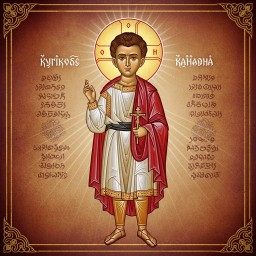
In Syriac Orthodox iconography, St. Kuriakose Sahadha is typically depicted as a small child,
reflecting his age at martyrdom. The iconographic conventions include several standard elements:
Red Garments: The child is usually clothed in red or crimson vestments, symbolizing
his martyrdom—the blood he shed for Christ. Red is the liturgical color of martyrdom throughout
Orthodox tradition, representing both suffering and victory, death and life.
Palm Branch: In his hand, St. Kuriakose often holds a palm branch, the ancient
Christian symbol of martyrdom and victory. This symbol comes from Revelation 7:9, where the
multitude of the redeemed stand before God's throne holding palm branches, and it appears in early
Christian art in the catacombs. The palm indicates that though the martyr died, he triumphed; though
he was defeated in earthly terms, he achieved victory in spiritual terms.
Cross: Sometimes the child holds or embraces a cross, the instrument of Christ's
passion which becomes for Christians the means of salvation and the symbol of faith. This emphasizes
that the martyr's death is united with Christ's death, that his suffering participates in Christ's
suffering.
Crown: A crown or halo of light surrounds the child's head, representing the "crown
of life" promised to those who are faithful unto death (Revelation 2:10, James 1:12). This crown
indicates his status as a victor, as one who has completed the race and received the prize.
White Garments: In some icons, instead of red, the child wears white—the color of
purity, innocence, and resurrection. This emphasizes his tender age and the innocence of childhood,
as well as the baptismal imagery of being "clothed in white" as a sign of new life in Christ.
With His Mother: Most commonly, St. Kuriakose is depicted together with his mother
St. Yulithyā. She is shown as a young or middle-aged woman, dressed in robes appropriate to her
status (sometimes shown as a widow), also bearing the palm branch of martyrdom. The two are
positioned side by side or with the child standing before or beside his mother, emphasizing their
unity in witness and martyrdom.
In the Malankara tradition specifically, there are distinctive iconographic traditions. Some
churches possess ancient icons brought from the Middle East or painted by local artists following
Syrian patterns. These icons are objects of particular veneration, with lamps kept burning before
them, flowers placed as offerings, and special prayers said in their presence. On the feast day of
the saints, these icons are processed through the church, venerated by the faithful, and placed in
positions of honor for the liturgical celebration.
🎵Liturgical Hymns: The Poetry of Martyrdom
The Syriac Orthodox liturgical tradition is renowned for its rich hymnography, and the commemoration
of St. Kuriakose and St. Yulithyā includes some particularly beautiful examples of Syriac liturgical
poetry. These hymns, known as madrashe (singular: madrasha), are composed in classical Syriac meter
and employ the characteristic features of Syriac hymnography: vivid imagery, biblical typology,
theological depth, and emotional intensity.
One traditional hymn preserved in the Beth Gazo (the liturgical treasury of chants) celebrates the
child martyr:
"Blessed is the child who fought the good fight,
The pure lamb slain for the Shepherd's sake.
His voice silenced on earth,
Yet it thunders in heaven,
Crying: 'Glory to You, O Christ,
Who strengthen the little ones!'"
This hymn employs several theological images: the child as "pure lamb" (connecting his innocence to
Christ the Lamb of God), his earthly voice silenced but his heavenly voice amplified, and the
paradox that weakness becomes strength through divine grace. The final line attributes glory to
Christ who enables the weak to overcome—the ultimate source of martyric courage is not human
strength but divine power.
Another ancient verse sung during the feast proclaims:
"The babe in arms became a warrior,
The tongue of innocence silenced the idolaters,
The mother saw her child crowned,
And her tears became pearls of glory."
This hymn develops the warrior imagery common in martyrological literature—the martyr as soldier of
Christ, engaging in spiritual warfare. The "tongue of innocence" that silences idolaters recalls
Psalm 8:2, while the final line transforms the mother's tears from signs of sorrow into "pearls of
glory"—a beautiful image suggesting that even the suffering of martyrdom contains beauty and value.
A longer liturgical poem, portions of which are sung during the Divine Liturgy on the feast day,
includes these stanzas:
"The child Kuriakose wore the crown before the warriors,
His blood became the ink of truth,
And his smile the victory song of the Church.
The tyrant's rage could not prevail,
For the Almighty made the infant strong.
O three-year-old confessor,
Your martyrdom puts us to shame—
We who fear men more than God,
We who love comfort more than Christ.
Intercede for us, little saint,
That we may have courage like yours,
Faith like your mother's,
And victory like you both achieved."
This extended hymn combines celebration (of the martyrs' victory) with exhortation (calling the
faithful to imitate their courage) and petition (asking for their intercession). The self-critical
note—acknowledging that we who are older and theoretically wiser often lack the courage shown by a
three-year-old—is characteristic of Syriac hymnography's honesty about human weakness.
🙏Popular Devotion and Miracles
Beyond formal liturgical veneration, St. Kuriakose Sahadha has been the object of intense popular
devotion throughout the Syriac Orthodox world, particularly in the Malankara Church of India. This
devotion expresses itself in various practices and is sustained by accounts of miracles attributed
to the saint's intercession.
Patron of Children: St. Kuriakose is particularly invoked as a protector and
intercessor for children. Parents bring sick or endangered children to churches dedicated to the
saint, offering prayers for healing and protection. When children recover from serious illness,
families often make pilgrimage to St. Kuriakose churches to offer thanksgiving. Some families name
their sons Kuriakose (or variations: Kurian, Kuriachan, Kuttappan in Malayalam) in honor of the
saint or in fulfillment of vows made during pregnancy or childbirth.
Blessing of Children: On the feast day of St. Kuriakose (July 15), many churches
hold special services of blessing for children. Parents bring their young children to the church,
where the priest offers prayers invoking St. Kuriakose's intercession for the children's health,
protection, and spiritual growth. Holy oil blessed for this occasion (representing the saint's
intercession and the Holy Spirit's presence) is applied to the children's foreheads in the sign of
the cross.
Miraculous Healings: The Syriac Orthodox tradition preserves numerous accounts of
healings attributed to St. Kuriakose's intercession. Ancient manuscripts from Edessa record healings
of sick children who were brought to his shrine. Malankara tradition includes accounts of children
recovering from serious illnesses after prayers to St. Kuriakose, of difficult childbirths that
ended safely after the mother invoked his aid, of children protected from accidents or dangers
through his intercession. While the Church does not require belief in every reported miracle, these
accounts sustain devotion and express the faithful's confidence that the saints in heaven hear our
prayers and intercede for us.
Visions and Appearances: Syriac hagiographical literature includes several accounts
of visions of St. Kuriakose granted to particularly holy individuals. One famous account, preserved
in a manuscript from Tur Abdin, describes a monk who saw in vision the child-martyr standing among
the ranks of martyrs before God's throne, radiant with light, singing praises to Christ. When the
monk asked how such a young child could endure martyrdom, the saint replied: "The fire of love for
Christ was greater than the pain of the world. And the Holy Spirit gave me strength beyond my
years." This vision emphasizes the theological understanding that martyrdom is achieved not through
human courage but through divine grace.
📚Theological Significance in Syriac Tradition
For the Syriac Orthodox Church, the martyrdom of St. Kuriakose carries profound theological
significance that goes beyond the historical facts of a child's death. His witness illuminates
several central themes of Syriac theology and spirituality:
Grace Perfecting Weakness: St. Paul wrote, "My grace is sufficient for you, for My
strength is made perfect in weakness" (2 Corinthians 12:9). St. Kuriakose's martyrdom exemplifies
this principle perfectly. He was the weakest of witnesses—a three-year-old child, lacking strength,
understanding, or eloquence by natural standards. Yet through divine grace, he became a powerful
confessor who confounded governors, converted onlookers, and earned the martyr's crown. This
demonstrates that salvation and sanctification are entirely works of divine grace, not human
achievement.
Baptism and Martyrdom: In Syriac theology, martyrdom is understood as a "second
baptism"—baptism by blood that completes and perfects the baptism by water. St. Kuriakose, baptized
as an infant, received this second baptism at age three, his baptismal grace coming to full flower
in martyrdom. This connection between the two baptisms is fundamental to the Church's understanding
of martyrdom: it is not merely dying for a cause but dying into Christ, uniting oneself completely
with His death in order to share His resurrection.
The Communion of Saints: St. Kuriakose's martyrdom, accomplished in union with his
mother, illustrates the reality of the communion of saints—the organic unity of the Church on earth
and in heaven. Mother and child, united in faith and witness during their earthly life, remain
united in glory. Their shared martyrdom demonstrates that the Church is not merely an organization
but a family, a body whose members share one another's joys and sufferings.
Childhood and the Kingdom: Jesus taught, "Unless you are converted and become as
little children, you will by no means enter the kingdom of heaven. Therefore whoever humbles himself
as this little child is the greatest in the kingdom of heaven" (Matthew 18:3-4). St. Kuriakose
embodies this teaching. His simplicity, trust, and lack of worldly calculation made him capable of
pure witness. He could confess Christ without the complications, compromises, and calculations that
often hinder adults. In this sense, he exemplifies the childlike faith that all Christians are
called to cultivate.
The Role of Parents in Faith Formation: St. Yulithyā's role in her son's martyrdom
cannot be overlooked. She had formed him in the faith from infancy, teaching him to pray, telling
him about Jesus, creating a home environment saturated with Christian faith and practice. When the
moment of testing came, what she had planted bore fruit. This emphasizes the crucial role of
Christian parents—particularly mothers—in the transmission of faith. The home is the first church,
parents are the first teachers, and early formation shapes a person's entire spiritual trajectory.
🌟Contemporary Relevance and Application
What does the martyrdom of St. Kuriakose Sahadha mean for contemporary Syriac Orthodox Christians
and for all Christians today? How does a story from the early fourth century speak to our
twenty-first-century context? Several applications suggest themselves:
For Parents: St. Yulithyā's example challenges Christian parents to take seriously
the spiritual formation of their children. In an age when many parents outsource religious education
entirely to the church or neglect it altogether, she reminds us that parents are the primary
teachers of faith. The prayers we pray with our children, the stories we tell them, the example we
set, the home environment we create—all of these shape their souls and prepare them (or fail to
prepare them) for the tests they will face in life.
For Children and Youth: St. Kuriakose demonstrates that age is no barrier to
faithfulness. Young people today face pressures to compromise Christian faith and morality—from peer
pressure, from media and entertainment, from educational institutions, from cultural norms that
contradict Christian teaching. The child-martyr reminds young Christians that courage is possible,
that faithfulness is worth any cost, and that God honors those who confess Him even when it's
difficult.
For the Persecuted Church: Syriac Orthodox Christians in the Middle East continue
to face persecution, discrimination, and existential threats. Children have been among the victims
of recent violence—killed by ISIS, displaced by war, traumatized by persecution. St. Kuriakose's
martyrdom assures us that God sees the suffering of innocent children, that their blood is precious
in His sight, and that those who die confessing Christ—whether intentionally or simply because they
are Christians—receive the martyr's crown.
For All Believers: In Western contexts where Christians face not violent
persecution but cultural marginalization and social pressure to compromise, St. Kuriakose challenges
us to examine our courage. If a three-year-old could confess Christ before governors, can we confess
Him before our colleagues, neighbors, and friends? If he valued Christ more than life, can we value
Christ more than comfort, convenience, and social acceptance? His example measures our own
faithfulness and often finds us wanting.
For Those Suffering Loss: St. Yulithyā's witness speaks powerfully to parents who
have lost children. Her faith that her son was safe with Christ, her joy in his martyrdom despite
her maternal grief, her trust that they would be reunited in the resurrection—all of this provides a
model for Christian grieving. This does not mean suppressing grief (which is natural and healthy)
but framing it within hope, trusting that "to be absent from the body is to be present with the
Lord" (2 Corinthians 5:8).
✝️Conclusion: The Eternal Child of Light
The life and martyrdom of Mor Kuriakose Sahadha remain a luminous testimony in the history and
spirituality of the Syriac Orthodox Church. Though his earthly life was brief—a mere three years—his
spiritual legacy spans seventeen centuries and continues to inspire, comfort, and challenge
believers today. He is the child who became a warrior, the innocent who confounded the powerful, the
weakest who proved strongest through divine grace.
Together with his blessed mother St. Yulithyā, he stands in the great company of martyrs who have
borne witness to Christ throughout the ages. Their names are inscribed in the Diptychs, their memory
is preserved in the liturgy, their intercession is invoked in prayer, and their example is held
before each new generation of Christians as a model of faithful witness.
In the Malankara tradition particularly, St. Kuriakose occupies a place of special affection in the
hearts of the faithful. He is our child-saint, our little martyr, our heavenly brother who remains
forever young in glory. Parents invoke his protection over their children, children learn to pray
through his example, families find hope and comfort in his story, and the entire Church is reminded
that the Kingdom of Heaven belongs to such as these.
As we conclude this fuller account of his life and witness, let us pray in the words of the Syriac
liturgical tradition: "O Mor Kuriakose Sahadha, blessed child-martyr, you who confessed Christ with
your infant lips and sealed your witness with your innocent blood—intercede for us before the throne
of grace. Pray for all children, that they may grow in faith, wisdom, and holiness. Pray for all
parents, that they may form their children in the knowledge and love of Christ. Pray for all who
suffer persecution, that they may have courage to remain faithful. Pray for the Church universal,
that she may never cease to bear witness to the truth of the Gospel. Through your prayers and those
of your holy mother St. Yulithyā, and through the mercy of Christ our God who loves children and
calls them to Himself, may we all be kept in the true faith, strengthened in times of trial, and
brought at last to the Kingdom where you now dwell in eternal joy and glory. Amen."
"Blessed is the child who fought the good fight, the pure lamb slain for the Shepherd's sake.
His voice silenced on earth, yet it thunders in heaven, crying: 'Glory to You, O Christ, who
strengthen the little ones!'" — Syriac Hymn to St. Kuriakose Sahadha
✠ Shubho l'Abo w'L'Bro w'L'Ruh Qadisho
Glory be to the Father, and to the Son, and to the Holy Spirit
Now and forever, and unto ages of ages. Amen.