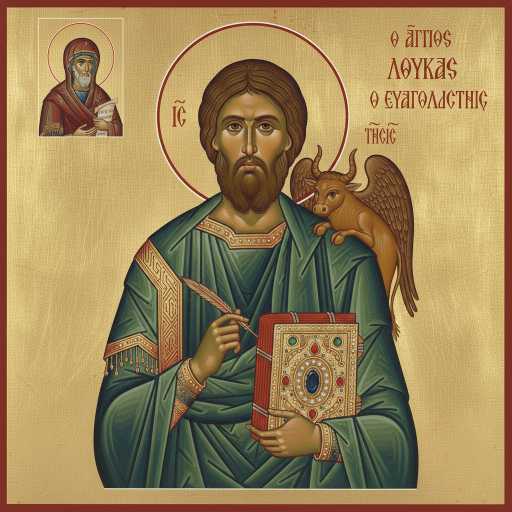
🏛️The Gentile Convert and Physician
Saint Luke the Evangelist holds a unique and honored place among the sacred writers of the New
Testament as the only Gentile author whose works have been preserved in Holy Scripture. According to
the ancient and unanimous tradition of the Syriac Orthodox Church, confirmed by Church Fathers
including Saint Jerome, Eusebius, and Saint Ephrem the Syrian, Luke was born in Antioch of
Syria—that great city where the disciples were first called Christians, and which became one of the
principal centers of early Christianity alongside Jerusalem and Rome.
Born into a Greek-speaking Gentile family, Luke received an excellent education in the Hellenistic
tradition, becoming skilled in the arts, literature, and most significantly, the medical sciences.
Saint Paul himself refers to him as "Luke the beloved physician" in his epistle to the Colossians, a
title that reveals both his profession and the deep affection in which he was held. His training in
medicine would have required years of study and apprenticeship, making him a man of learning,
precision, and careful observation—qualities that would later serve him magnificently in his role as
an Evangelist and historian of the early Church.
The circumstances of Luke's conversion to Christianity are not explicitly recorded in Scripture, but
tradition holds that he was among the seventy disciples sent out by our Lord during His earthly
ministry, or that he came to faith through the preaching of the Apostles in Antioch shortly after
Pentecost. What is certain is that by the time he joined Saint Paul's missionary journeys, Luke was
already a mature and committed Christian, well-versed in the teachings of Christ and devoted to the
service of the Gospel.
⛵Faithful Companion of Saint Paul
Saint Luke's relationship with Saint Paul represents one of the most beautiful friendships in
Christian history. Luke became Paul's companion, traveling companion, and faithful supporter during
some of the Apostle's most difficult and dangerous journeys. The Book of Acts contains four
so-called "we-passages" (Acts 16:10-17; 20:5-15; 21:1-18; 27:1-28:16), where the narrative suddenly
shifts from third person to first person plural, indicating that Luke himself was present during
these events. These passages reveal that Luke accompanied Paul during the second missionary journey
into Macedonia, remained with him through his arrest and imprisonment in Caesarea, and stayed by his
side during the harrowing sea voyage to Rome, including the dramatic shipwreck on Malta.
During Paul's imprisonments—first in Caesarea for two years under Felix and Festus, and later in
Rome—Luke remained faithfully at his side. While others abandoned Paul or were sent on missions,
Luke stayed, providing not only medical care for the aging and suffering Apostle but also
companionship, encouragement, and practical assistance. In Paul's final epistle, written from his
death cell in Rome during Nero's persecution, the Apostle poignantly notes: "Only Luke is with me."
This simple statement speaks volumes about Luke's character: steadfast, loyal, willing to share in
suffering, and devoted unto death.
It was during these long periods of Paul's imprisonment that Luke had the opportunity to conduct the
meticulous research that would form the foundation of his Gospel and the Acts of the Apostles. While
in Caesarea and Jerusalem, he interviewed eyewitnesses, consulted with the Apostles, spent time with
James the brother of the Lord, and most significantly, may have had extended conversations with the
Theotokos herself, from whom he learned the intimate details of the Annunciation, the Visitation,
and the Nativity that are unique to his Gospel.
"Inasmuch as many have taken in hand to set in order a narrative... it seemed good to me also, having
had perfect understanding of all things from the very first, to write to you an orderly account." —
Luke 1:1-3
📖The Gospel of Luke: The Gospel of Mercy
The Gospel according to Saint Luke, written approximately between 60-63 AD, is the longest and most
literary of the four Gospels. Addressed to "most excellent Theophilus"—possibly a Roman official or
a generic address meaning "lover of God"—Luke's purpose was to provide "an orderly account" of the
life, teachings, death, and resurrection of Jesus Christ for Gentile readers who were unfamiliar
with Jewish customs and Palestinian geography.
What distinguishes Luke's Gospel above all is its emphasis on the mercy, compassion, and universal
love of Christ. More than any other Evangelist, Luke highlights Jesus's concern for the poor, the
outcast, the sinners, women, Samaritans, and Gentiles. His Gospel contains parables found nowhere
else: the Good Samaritan, which teaches that love knows no ethnic boundaries; the Prodigal Son, the
supreme parable of divine mercy and forgiveness; the Rich Man and Lazarus, warning against
indifference to the poor; and the Pharisee and the Tax Collector, exalting humble repentance over
self-righteousness.
Luke's Gospel gives special prominence to women, recording details about the Theotokos that no other
Evangelist provides. The first two chapters, known as the "Infancy Narrative," present a magnificent
account of the Annunciation, the Visitation, the Magnificat, the birth of John the Baptist, the
Nativity of Christ, the presentation in the Temple, and the finding of the child Jesus among the
teachers. These chapters, written with exquisite literary beauty and theological depth, have been
the foundation of Marian devotion throughout Christian history. Luke also records the ministry of
women who supported Jesus and the Apostles, Mary and Martha, the women at the Cross, and the
myrrh-bearing women at the Resurrection.
As a physician, Luke shows particular interest in Jesus's healing miracles, often providing more
medical detail than the other Evangelists. He notes the specific nature of illnesses, the severity
of conditions, and the completeness of cures. Yet his medical knowledge never overshadows his
theological purpose: to show that Christ came as the Great Physician of souls and bodies, bringing
healing and salvation to all humanity.
🕊️The Acts of the Apostles: History of the
Early Church
Saint Luke's second work, the Acts of the Apostles, is a continuation of his Gospel and represents
the only detailed historical account of the first three decades of the Christian Church. Written
around 63 AD, shortly after his Gospel, Acts bridges the gap between the Gospels and the Epistles,
showing how the message of Christ spread from Jerusalem to Rome, from a small Jewish sect to a
universal faith embracing all nations.
The structure of Acts follows Jesus's commission: "You shall be witnesses to Me in Jerusalem, and in
all Judea and Samaria, and to the end of the earth." The first twelve chapters focus primarily on
Peter and the Jerusalem church, recording Pentecost, the early miracles, the martyrdom of Stephen,
the conversion of Cornelius, and Peter's deliverance from prison. The latter chapters (13-28)
concentrate on Paul's missionary journeys, his trials, and his journey to Rome. Throughout, Luke
demonstrates how the Holy Spirit guided the Church's expansion, overcoming obstacles, inspiring
courage, and bringing Jew and Gentile together in one Body of Christ.
Acts provides invaluable historical information about the early Church's worship, organization, and
challenges. It records the selection of the seven deacons, the Council of Jerusalem (which decided
that Gentile converts need not be circumcised), the establishment of churches throughout the Roman
Empire, and the conflicts with both Jewish and pagan authorities. Luke's account is characterized by
careful chronology, geographical precision, and attention to political and social details, all of
which have been repeatedly confirmed by archaeological discoveries.
In the Syriac Orthodox tradition, the Acts of the Apostles holds a place of special honor, as it
records the events in Antioch and Syria, showing how our region became one of the primary centers of
Christianity. The Antiochene church's role in sending out Paul and Barnabas, the first Gentile
church, and the city where believers were first called "Christians" are all carefully documented by
Luke, preserving for us our sacred heritage.
🎨Luke the Icon Painter
Ancient tradition, particularly strong in the Eastern Churches including the Syriac Orthodox Church,
holds that Saint Luke was not only a physician and evangelist but also the first iconographer of the
Christian Church. According to this venerable tradition, Luke painted three icons of the Theotokos
with the Christ Child during her lifetime, which she blessed and approved. These icons, known as the
Hodegetria (She Who Shows the Way), Eleousa (Tenderness), and Hagioritissa, became the prototypes
for all subsequent Marian iconography in Orthodox Christianity.
Whether Luke literally painted these icons with his own hands or whether this tradition symbolically
attributes to him the theological and artistic patterns of early Christian iconography, the
tradition expresses a profound truth: that Luke's Gospel, with its tender and detailed account of
the Theotokos, became the "icon in words" from which all visual representations of Mary draw their
inspiration. His literary portraits of the Mother of God are so vivid, so reverent, and so
theologically profound that they have shaped Christian devotion and art for two millennia.
⛪Later Ministry and Martyrdom
After Saint Paul's martyrdom in Rome around 67 AD, Saint Luke continued his apostolic ministry.
According to various traditions preserved in the Church, he preached the Gospel in Italy, Dalmatia,
Macedonia, and Greece. The most persistent tradition, recorded by Saint Jerome and other early
historians, states that Luke spent his final years in Boeotia, Greece, where he continued to write,
teach, and establish churches until his death.
The manner of Saint Luke's death varies in different traditions. Some accounts state that he died
peacefully at the age of 84, having never married and having devoted his entire life to the service
of Christ and His Church. Other traditions, including those preserved in some Syriac sources, hold
that he was martyred, either by being hanged on an olive tree by pagan priests who were enraged by
his successful evangelization, or by other means of execution. Regardless of the specific manner of
his death, all traditions agree that he remained faithful to Christ until the end, never abandoning
the faith he had so eloquently proclaimed and carefully documented.
Saint Luke's relics were initially buried in Thebes, Greece. In the year 357, during the reign of
Emperor Constantius II, his sacred remains were translated to Constantinople and enshrined in the
Church of the Holy Apostles alongside the relics of Saints Andrew and Timothy. In modern times, his
relics are venerated in Padua, Italy, where they were brought during the Latin occupation of
Constantinople. His head, however, according to tradition, rests in the Vatican, and portions of his
relics are treasured in various churches throughout the Christian world.
✨Legacy and Significance in the Syriac Orthodox
Church
In the Syriac Orthodox tradition, Saint Luke holds a place of profound honor and affection. As a son
of Antioch—the mother see of our Church—he represents the Gentile mission that has always
characterized Syrian Christianity. His Gospel is read extensively in the liturgy, particularly
during feasts of the Theotokos, whose story he preserved with such care and reverence. The
Magnificat, recorded only in Luke's Gospel, is chanted daily in our prayers, and the narrative of
the Annunciation forms the foundation of our Marian theology.
Saint Luke's emphasis on mercy, forgiveness, and God's preferential love for the poor and
marginalized resonates deeply with the social teachings of the Syriac Orthodox Church. His parables
of the Good Samaritan and the Prodigal Son have shaped Christian ethics and our understanding of
divine love. His careful historical documentation in Acts has preserved the memory of the Antiochene
church's pivotal role in the spread of Christianity, reminding us of our heritage as one of the
apostolic sees.
As a physician, Saint Luke is the patron saint of doctors, surgeons, and all medical professionals.
As an evangelist and historian, he is patron of artists, painters, iconographers, and writers. His
life demonstrates that secular learning and professional skill, when consecrated to Christ, become
powerful instruments for the Gospel. His medical knowledge served Paul's physical needs, his
literary ability preserved the sacred history, and his artistic sensitivity captured the beauty and
mercy of Christ in words that continue to heal and inspire.
Prayer for Intercession
O Holy Apostle and Evangelist Luke, beloved physician, faithful companion of Saint Paul, divinely
inspired author of the Gospel of Mercy and the Acts of the Apostles, first iconographer of the Most
Holy Theotokos—we seek your powerful intercession before the throne of grace. You who carefully
investigated all things from the beginning and recorded them for our instruction, who remained
faithful through trials and persecution, who used your gifts of healing and writing for the glory of
God—pray for us. Grant that we may imitate your diligence in seeking truth, your faithfulness in
friendship, your compassion for the suffering, and your devotion to preserving and proclaiming the
Gospel. Through your prayers, may we be healed in body and soul, and may we one day stand with you
before the Great Physician, Christ our Lord. Amen.