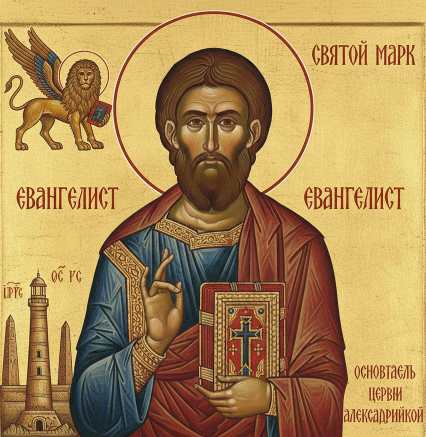
📖Identity and Names: John Called Mark
The Holy Gospel according to St. Mark that we have received one of our four canonical
accounts of the life, teachings, death, and resurrection of our Lord Jesus Christ. St. Mark stands
as an evangelist, a disciple of the apostles, a founder of one of the great patriarchal sees of
Christendom, and a martyr who sealed his witness with blood. His life and work are intimately woven
into the fabric of the Church's faith, worship, and mission.
St. Mark is known by two names that appear throughout the New Testament: "John" (Ἰωάννης in Greek,
Yohanan in Hebrew, ܝܽܘܚܰܢܳܢ in Syriac) and "Mark" or "Marcus" (Μάρκος in Greek, Marcus in Latin,
ܡܰܪܩܳܘܣ in Syriac). This dual naming reflects the bicultural reality of first-century Jewish
life—many Jews bore both a Hebrew name (used within the Jewish community and for religious purposes)
and a Greek or Latin name (used in wider Hellenistic society and for practical purposes). "John" was
his Jewish birth name, meaning "Yahweh is gracious" or "the Lord has been gracious," a common and
honored name in Jewish tradition. "Mark" (from Marcus) was his Roman cognomen, possibly indicating
Roman citizenship or simply adoption of a Latin name for convenience in the broader Mediterranean
world.
In the Acts of the Apostles, he is most commonly referred to as "John, whose surname was Mark" (Acts
12:12, 25) or "John called Mark" (Acts 15:37), emphasizing both identities. As his ministry
developed and extended beyond Jewish contexts, he became known primarily as "Mark," the name by
which the Church has remembered him and the name attached to his Gospel. In the Epistles, St. Peter
refers to him affectionately as "Mark my son" (1 Peter 5:13), indicating a close spiritual
relationship, while St. Paul mentions him simply as "Mark" or "Marcus" in his letters (Colossians
4:10, 2 Timothy 4:11, Philemon 24).
This John Mark is clearly distinguished in the New Testament from other figures bearing similar
names: he is not John the Baptist, not John the son of Zebedee (the beloved disciple and
evangelist), not John the Elder mentioned by Papias, though connections and confusion among these
figures sometimes appear in later tradition. The clarity of the New Testament witness, preserved in
Syriac as well as Greek manuscripts, leaves no doubt that John Mark the evangelist is a distinct
individual whose life and work can be traced through Scripture and sacred tradition.
🏠Family and Early Life in Jerusalem
According to the witness of Holy Scripture, St. Mark came from a prominent and pious Jewish family
in Jerusalem. His mother was Mary, a woman of means and devotion who placed her home at the service
of the early Church. The Book of Acts records a crucial detail: when St. Peter was miraculously
delivered from prison by an angel (around 44 AD), he went directly "to the house of Mary, the mother
of John whose surname was Mark, where many were gathered together praying" (Acts 12:12). This single
verse reveals much about Mark's family and their role in the nascent Church.
First, Mary's house was large enough to accommodate a significant gathering of believers—"many were
gathered together"—suggesting her family's wealth and social standing. Second, her home served as a
regular meeting place for the Jerusalem Christian community, indicating her commitment to the faith
and her willingness to risk hosting what Roman and Jewish authorities considered a subversive sect.
Third, the believers were engaged in fervent prayer for Peter's deliverance at the very moment he
appeared at the door—Mary's house was a place of prayer, of spiritual power, of communion with God.
Growing up in such a household, Mark would have been immersed in Christian faith and practice from
the earliest days of the Church.
Some ancient traditions, preserved in various patristic and liturgical sources, identify Mary's
house in Jerusalem as the location of the Last Supper—the Upper Room where Jesus instituted the Holy
Eucharist, where He appeared to the disciples after the Resurrection, and where the Holy Spirit
descended at Pentecost. While this identification cannot be proven with historical certainty, it is
ancient, widespread, and carries significant theological and devotional weight. If true, it would
mean that Mark grew up in the very house where the Church was born, that he witnessed or was
intimately connected to the foundational events of salvation history. Even if not literally the same
location, the tradition testifies to the centrality of Mary's household in the life of the Jerusalem
Church.
Mark's father is not mentioned in Scripture, leading many commentators to conclude that he had died
by the time of the events recorded in Acts, leaving Mary as head of the household. According to
tradition preserved by several Church Fathers, Mark was from the tribe of Levi, the priestly tribe
of Israel, though he was not himself a priest. This Levitical connection, if historical, would
explain his family's religious devotion, their knowledge of Temple worship, and their ease in
understanding the fulfillment of Old Testament liturgy in Christian sacraments.
Mark had at least one cousin: Barnabas, who was himself a Levite from Cyprus (Acts 4:36) and who
became one of the most significant leaders of the early Church. The New Testament explicitly states
that Mark was "the cousin of Barnabas" (Colossians 4:10, where the Greek word ἀνεψιός means cousin
or nephew). This family connection to Barnabas would profoundly shape Mark's life and ministry, as
Barnabas brought him into closer contact with the apostolic mission and vouched for him when others
doubted.
Growing up in Jerusalem during the 20s and 30s AD, Mark would have witnessed the public ministry of
Jesus, though he was likely too young to be a formal disciple. Some traditions suggest that Mark was
the young man who fled naked when Jesus was arrested in Gethsemane (Mark 14:51-52)—an incident
recorded only in Mark's Gospel, perhaps as a personal signature or autobiographical note. Whether
this identification is correct or not, Mark certainly knew of Jesus, heard His teaching, perhaps saw
His miracles, and was profoundly affected by the events of the Passion, Resurrection, and Pentecost.
The Young Man in the Garden: The Gospel of Mark contains a unique detail: when Jesus
was arrested, "a certain young man followed Him, having a linen cloth thrown around his naked body.
And the young men laid hold of him, and he left the linen cloth and fled from them naked" (Mark
14:51-52). Many Church Fathers and modern scholars identify this young man as Mark himself,
inserting his own witness into the Gospel narrative. If so, it demonstrates Mark's presence at this
crucial moment and his later humility in recording his own frightened flight.
✝️Companion of the Apostles: Ministry with Paul
and Barnabas
St. Mark's active participation in apostolic ministry begins to emerge clearly in the Acts of the
Apostles during the late 40s AD. When Barnabas and Saul (Paul) completed their relief mission to
Jerusalem, bringing financial aid from the church in Antioch during a time of famine (around 46-47
AD), "they also took with them John whose surname was Mark" (Acts 12:25). This was Mark's
introduction to wider missionary work, leaving Jerusalem with two of the Church's most dynamic
leaders to participate in the evangelization of the Gentile world.
Mark accompanied Paul and Barnabas on what is traditionally called Paul's First Missionary Journey
(Acts 13-14, approximately 47-48 AD). The team sailed from Antioch to the island of Cyprus,
Barnabas's homeland. There they proclaimed the Word of God in the Jewish synagogues, and Mark served
as their "assistant" or "helper" (ὑπηρέτης, hyperetes in Greek—a term that can mean attendant,
minister, or servant). In Paphos, they encountered the Roman proconsul Sergius Paulus and the Jewish
false prophet Bar-Jesus (Elymas), resulting in the proconsul's conversion after Paul struck Elymas
with blindness—a dramatic demonstration of apostolic power that Mark witnessed firsthand.
However, when the missionary team sailed from Cyprus to the mainland of Asia Minor, landing at Perga
in Pamphylia (southern Turkey), something happened that would have lasting consequences. The
Scripture records tersely: "Now John, departing from them, returned to Jerusalem" (Acts 13:13). No
explanation is given for Mark's departure. He left Paul and Barnabas at Perga and returned home to
Jerusalem, abandoning the mission at what might have seemed a crucial juncture as they were about to
push inland into more difficult and dangerous territory.
The reasons for Mark's departure have been debated by commentators across the centuries. Some
suggest he was homesick, unused to the rigors of missionary travel, or perhaps frightened by the
dangers ahead. Others propose that he disagreed with the mission's increasing focus on Gentiles
rather than Jews, or that he had theological reservations about Paul's message. Still others note
that Acts 13:13 marks the point where "Saul" becomes "Paul" and where Paul begins to take leadership
from Barnabas—perhaps Mark, loyal to his cousin, was uncomfortable with this shift in dynamics.
Whatever the reason, Mark's departure was significant enough that it later became a point of serious
contention.
After returning to Jerusalem, Mark appears to have remained there for several years, continuing to
serve the Church in his mother's household and the wider Jerusalem community. He was present for the
Jerusalem Council (Acts 15, around 49 AD), though he is not mentioned as a participant—a silence
that may reflect his reduced standing after abandoning the first journey. It was at this council
that the apostles and elders decided that Gentile converts need not be circumcised or follow the
full Mosaic Law, establishing the principle of salvation by grace through faith rather than by works
of the Law—a decision that would shape all subsequent Christian mission.
When Paul and Barnabas prepared for a second missionary journey to revisit the churches they had
planted, "Barnabas was determined to take with them John called Mark. But Paul insisted that they
should not take with them the one who had departed from them in Pamphylia, and had not gone with
them to the work" (Acts 15:37-38). This disagreement was not a minor difference of opinion but a
"sharp contention" (παροξυσμός, paroxysmos—a sharp disagreement or dispute) that resulted in the
dissolution of one of the early Church's most effective ministry partnerships. Barnabas took Mark
and sailed to Cyprus, while Paul chose Silas and went through Syria and Cilicia (Acts 15:39-41).
For those of us in the Syriac Orthodox Church who hold high the unity of the Body of Christ, this
incident is simultaneously troubling and instructive. It troubles us because it shows that even
apostolic leaders, filled with the Holy Spirit and devoted to Christ, could disagree sharply over
practical ministry decisions. Yet it instructs us because it demonstrates several important truths:
first, that God can work through human disagreement to expand His mission (one team became two);
second, that restoration and reconciliation are possible even after serious conflict (as we shall
see, Paul and Mark were later reconciled); third, that character formation often requires patience,
and that those who fail once may yet become faithful servants if given grace and opportunity.
📚Restoration and Maturity: Becoming a Valuable
Minister
After the separation from Paul, Mark continued his ministry under Barnabas's mentorship. They
returned to Cyprus, Barnabas's homeland, where Mark would have had opportunity to mature in faith
and ministry without the pressure of Paul's demanding presence. Barnabas, whose very name means "Son
of Encouragement" (Acts 4:36), lived up to his designation by giving his young cousin a second
chance, believing in his potential even after failure, and providing the patient guidance necessary
for restoration and growth.
The biblical record does not detail Mark's activities during the 50s AD, but tradition and later
references suggest he was busy in ministry, growing in maturity, proving himself faithful, and
building relationships with the apostles. By the late 50s or early 60s, something remarkable had
occurred: Mark had not only been restored to good standing but had become a valued co-worker whom
the apostles specifically requested and commended.
The evidence of Mark's restoration and maturity appears in three crucial Pauline passages. First,
writing to the Colossians around 60-62 AD from his imprisonment in Rome, Paul sends greetings from
"Mark the cousin of Barnabas (about whom you received instructions: if he comes to you, welcome
him)" (Colossians 4:10). Several things are remarkable about this reference: Paul mentions Mark
positively, identifies him as Barnabas's cousin (perhaps acknowledging that Barnabas had been right
to give Mark another chance), and indicates that the Colossian church had received prior
instructions to welcome Mark—suggesting that reconciliation between Paul and Mark had been achieved
and was known to the churches.
Second, in the brief letter to Philemon (written at the same time as Colossians), Paul includes
"Mark, Aristarchus, Demas, Luke, my fellow laborers" among those sending greetings (Philemon 24).
Mark is listed alongside Paul's closest companions, called a "fellow laborer" (συνεργός, synergos)—a
title of honor indicating one who works together in the Gospel. The young man who had once abandoned
Paul's mission was now recognized as a co-worker in that same mission.
Third, and most remarkably, in what may be Paul's final letter, written from his second Roman
imprisonment shortly before his martyrdom (around 67 AD), the apostle writes to Timothy: "Get Mark
and bring him with you, for he is useful to me for ministry" (2 Timothy 4:11). Consider the
significance: facing death, Paul specifically requests Mark's presence. The one who had once deemed
Mark unsuitable for ministry now declares him "useful" (εὔχρηστος, euchrestos—useful, serviceable,
profitable) for ministry. This is not mere politeness but genuine commendation. Paul wanted Mark at
his side during his final days—a powerful testimony to Mark's restoration, maturity, and value.
What transformed Mark from an unreliable deserter into a useful minister? Several factors suggest
themselves: the patient mentorship of Barnabas, who gave him space to grow without crushing him with
expectations; the passage of time, allowing maturity to develop; the work of the Holy Spirit,
conforming Mark to the image of Christ; and Mark's own faithfulness in smaller tasks, proving
himself worthy of greater responsibilities. For believers in every generation, Mark's story offers
hope: failure need not be final; restoration is possible; those who are unreliable in youth may
become pillars in maturity; and God's grace can transform anyone willing to persevere.
👨🏫Interpreter of Peter and Author of the
Gospel
Perhaps the most significant dimension of St. Mark's ministry was his close relationship with St.
Peter and his role as Peter's interpreter and the author of the Second Gospel. The evidence for this
connection is both scriptural and patristic, and it is this role that has made Mark's name immortal
in the Church.
In his First Epistle, St. Peter sends greetings from "Babylon" (understood by most scholars as a
cryptic reference to Rome): "She who is in Babylon, elect together with you, greets you; and so does
Mark my son" (1 Peter 5:13). The affectionate designation "my son" (ὁ υἱός μου) indicates a close
spiritual relationship—Peter was Mark's spiritual father, his mentor in the faith, the source of his
apostolic authority. This was not merely formal courtesy but genuine paternal affection and
spiritual kinship.
The early Church Fathers provide extensive testimony about the relationship between Peter and Mark
and the origin of Mark's Gospel. Papias of Hierapolis (early second century), as quoted by Eusebius,
states: "Mark, having become the interpreter of Peter, wrote down accurately everything that he
remembered, though not in order, of the things either said or done by Christ. For he neither heard
the Lord nor followed Him, but afterward, as I said, followed Peter, who adapted his teachings to
the needs of his hearers but had no intention of giving an ordered account of the Lord's sayings.
Consequently Mark made no mistake in writing down thus some things as he remembered them, for he
made it his one care not to omit anything that he heard or to make any false statement in them."
This early testimony establishes several crucial points: Mark was not himself an eyewitness to
Jesus's ministry (though he may have seen Jesus from a distance in Jerusalem); he was the
"interpreter" (ἑρμηνευτής, hermeneutes) of Peter, meaning he translated Peter's Aramaic preaching
into Greek and/or organized Peter's memories into narrative form; he wrote "accurately" (ἀκριβῶς,
akribos) based on Peter's testimony; his Gospel may not be in strict chronological order but
reflects the way Peter preached; and Mark's concern was for accuracy and completeness rather than
for literary polish or chronological precision.
Other Church Fathers corroborate and expand this testimony. Irenaeus (late second century) writes:
"After their departure [the deaths of Peter and Paul], Mark also, the disciple and interpreter of
Peter, transmitted to us in writing the things preached by Peter." Clement of Alexandria (late
second/early third century) provides additional detail: "When Peter had publicly preached the word
at Rome, and by the Spirit had proclaimed the Gospel, those present, who were many, exhorted Mark,
as one who had followed him for a long time and remembered what had been spoken, to make a record of
what was said; and that he did this, and distributed the Gospel among those that asked him."
Tertullian (early third century) states: "The Gospel which Mark published is affirmed to be Peter's,
whose interpreter Mark was."
From the perspective of the Syriac Orthodox Church, this testimony is precious and authoritative.
Our tradition has always recognized that the four canonical Gospels come to us through apostolic
authority: Matthew and John were themselves apostles and eyewitnesses; Luke was the companion of
Paul and received his information from eyewitnesses (Luke 1:1-4); and Mark, though not an apostle
himself, wrote under the authority and based on the testimony of Peter, the chief of the apostles.
Thus all four Gospels bear apostolic witness and possess the same divine authority as Holy Scripture
inspired by the Holy Spirit.
The Gospel of Mark itself bears internal evidence of its Petrine source. It begins with John the
Baptist and Jesus's baptism (not with Jesus's birth, as in Matthew and Luke), which corresponds to
how Peter began his preaching in Acts 10:37—"you know the message which spread throughout all Judea,
beginning from Galilee after the baptism which John proclaimed." Mark's Gospel emphasizes Jesus's
actions and deeds more than His discourses, reflecting Peter's focus on what he witnessed Jesus
doing. The Gospel includes vivid details that suggest eyewitness testimony—the exact Aramaic words
Jesus used (Talitha cumi in Mark 5:41, Ephphatha in Mark 7:34, Abba in Mark 14:36), specific times
and places, emotional responses—details that read like someone's memories being recorded.
Notably, Mark's Gospel is also the harshest on Peter, recording his failures and weaknesses with
unflinching honesty: his presumptuous rebuke of Jesus (Mark 8:32-33), his boastful claim of
faithfulness before his denial (Mark 14:29-31), his three denials (Mark 14:66-72), and his confusion
and fear at the Transfiguration (Mark 9:5-6). This candor suggests that Peter himself, in his
preaching, did not spare himself but honestly recounted his failures as a warning and as testimony
to Christ's grace. Mark faithfully recorded what Peter preached, including Peter's own sins and
restoration.
📖The Gospel According to St. Mark: Character
and Theology
The Gospel of Mark is the shortest of the four canonical Gospels, containing sixteen chapters in our
current editions (with scholarly debate about whether Mark originally ended at verse 16:8 or
included the longer ending found in most manuscripts). Despite its brevity, or perhaps because of
it, Mark's Gospel is a powerful, fast-paced narrative that emphasizes Jesus's actions and authority,
presenting Him as the Son of God who came to serve and to give His life as a ransom for many.
The Gospel begins with a clear theological statement: "The beginning of the gospel of Jesus Christ,
the Son of God" (Mark 1:1). The title "Son of God" frames the entire narrative and is confirmed by
divine testimony at Jesus's baptism ("You are My beloved Son, in whom I am well pleased," Mark
1:11), at the Transfiguration ("This is My beloved Son. Hear Him!" Mark 9:7), and finally by the
Roman centurion at the cross ("Truly this Man was the Son of God!" Mark 15:39). For Mark, Jesus's
identity as God's unique Son is the fundamental truth around which everything else revolves.
Mark's Gospel is characterized by a sense of urgency and immediacy. The word "immediately" (εὐθύς,
euthys) appears over forty times, more frequently than in any other Gospel. Events follow one
another in rapid succession: Jesus is baptized, immediately driven into the wilderness by the
Spirit, immediately begins preaching, immediately calls disciples, immediately begins healing and
exorcising demons. This literary technique creates a sense of momentum and urgency—the Kingdom of
God has broken into history, and there is no time to waste. For readers of Mark's Gospel in the
Syriac Orthodox Church, this urgency challenges any complacency in faith and calls us to immediate,
decisive response to Christ's call.
The Gospel emphasizes Jesus's power and authority over all creation. He commands demons, and they
obey (Mark 1:27); He rebukes the wind and sea, and they are calmed (Mark 4:39); He heals every kind
of sickness with a word or a touch (throughout Mark); He raises the dead (Mark 5:41-42); He walks on
water (Mark 6:48-50); He feeds thousands with a few loaves and fish (Mark 6:35-44, 8:1-9). For Mark,
these miracles are not mere displays of power but signs of Jesus's divine authority and the
in-breaking of God's Kingdom. They demonstrate that in Christ, God has invaded enemy-occupied
territory (the world under Satan's dominion) and is liberating His creation.
Mark's Gospel also emphasizes the theme of discipleship and its costs. Jesus repeatedly calls people
to follow Him, to leave everything, to take up their cross. He teaches that "whoever desires to save
his life will lose it, but whoever loses his life for My sake and the gospel's will save it" (Mark
8:35). He warns that "many who are first will be last, and the last first" (Mark 10:31). He models
servant leadership, declaring that "whoever desires to become great among you shall be your servant.
And whoever of you desires to be first shall be slave of all. For even the Son of Man did not come
to be served, but to serve, and to give His life a ransom for many" (Mark 10:43-45). For Syriac
Orthodox Christians, this emphasis on suffering, service, and self-denial as the path of
discipleship resonates deeply with our Church's historical experience of persecution and martyrdom.
The Gospel culminates in the Passion narrative, which occupies approximately one-third of the entire
book (Mark 11-16). Mark gives extensive attention to Jesus's suffering: the agony in Gethsemane, the
betrayal and arrest, the trials before the Sanhedrin and Pilate, the mocking and scourging, the
crucifixion and death. The crucifixion scene is particularly stark—Jesus cries out in apparent
abandonment ("My God, My God, why have You forsaken Me?" Mark 15:34), dies with a loud cry, and the
Temple veil is torn in two. Yet this moment of apparent defeat is the moment of victory, as the
centurion's confession demonstrates: "Truly this Man was the Son of God!" (Mark 15:39). The cross,
for Mark, is the ultimate revelation of who Jesus is and what He came to do.
The Gospel of Mark was likely written in Rome (based on the patristic testimony and internal
evidence such as the explanation of Jewish customs for Gentile readers) during the 60s AD, possibly
during or shortly after Nero's persecution of Christians (64-68 AD). If written during this period
of suffering, the Gospel's emphasis on Jesus's suffering, the disciples' failures and restoration,
and the call to take up one's cross would have had immediate, practical relevance for the Roman
Christians facing martyrdom. For Syriac Orthodox believers, who have faced waves of persecution
throughout history, Mark's Gospel speaks powerfully to our situation—calling us to faithful witness
even unto death, assuring us that Christ has gone before us in suffering, and promising that
apparent defeat is actually victory when endured in faith.
The Longer Ending of Mark: Most ancient manuscripts include Mark 16:9-20, the
"longer ending" that describes Jesus's post-resurrection appearances and the Great Commission. Some
early manuscripts end at Mark 16:8. The Syriac Orthodox Church, following ancient tradition, accepts
the longer ending as canonical Scripture, inspired by the Holy Spirit and transmitted by the Church.
This ending emphasizes the apostolic commission to preach the Gospel to all creation and promises
that signs will follow believers—themes central to our Church's missionary identity.
🦁The Symbol of the Lion: Mark's Iconographic
Identity
In Christian iconography and art, each of the four Evangelists is represented by one of the four
"living creatures" described in the visions of Ezekiel (Ezekiel 1:10) and the Revelation of St. John
(Revelation 4:7): the man/angel (Matthew), the lion (Mark), the ox/calf (Luke), and the eagle
(John). This symbolic identification, established by the Church Fathers (particularly Irenaeus in
the second century), connects the Gospels to the four cherubic beings that surround God's throne in
heavenly worship.
St. Mark is symbolized by the lion for several reasons rooted in his Gospel. First and most
obviously, his Gospel begins in the wilderness with John the Baptist—"The voice of one crying in the
wilderness: 'Prepare the way of the LORD'" (Mark 1:3). The lion is the king of the wilderness, and
this beginning in the desert wilderness suggests the lion symbol. Second, the lion represents
royalty, power, and majesty, and Mark's Gospel strongly emphasizes Jesus's authority and power—over
demons, disease, nature, and death. Jesus is presented as the powerful Son of God whose authority
none can resist. Third, ancient tradition held that lion cubs were born dead and came to life three
days later when the father lion roared over them—a vivid parallel to Christ's resurrection on the
third day, which is central to Mark's Gospel.
In Syriac Orthodox iconography, St. Mark is typically depicted as a mature man with a beard, often
holding a scroll or book representing his Gospel. The lion appears either beside him or incorporated
into the decorative elements of the icon. Sometimes Mark is shown writing his Gospel with the lion
at his feet or behind him, symbolizing that his Gospel comes with the authority and power of the
lion—Christ the King. The colors used in icons of Mark often include red (symbolizing martyrdom),
gold (divine glory), and deep blues or greens (heavenly wisdom).
The winged lion specifically—a lion with eagle's wings—became particularly associated with St. Mark
and is most famously the symbol of Venice, Italy, which claims to possess Mark's relics and made him
their patron saint. The winged lion combines the earthly power of the lion with the heavenly
aspiration of wings, suggesting that Mark's Gospel connects earth and heaven, reveals the divine
power working in earthly history, and lifts human minds to contemplate divine mysteries.
⛪Founding the Church of Alexandria: Apostle to
Egypt
According to the ancient and venerable tradition of the Coptic Orthodox Church of Alexandria—our
sister church in the family of Oriental Orthodoxy—St. Mark was the founder and first bishop of the
Church of Alexandria, Egypt. This tradition, preserved in Coptic, Greek, Syriac, and other early
Christian sources, places Mark's arrival in Alexandria around 60-62 AD, during the reign of the
Emperor Nero.
Alexandria in the first century was one of the great cities of the ancient world—second only to Rome
in size and importance. Founded by Alexander the Great in 331 BC, it had become a center of
Hellenistic culture, learning, and commerce. The famous Library of Alexandria housed the largest
collection of manuscripts in the ancient world. The Museum was a center of scientific and
philosophical research. The city had a massive Jewish population (possibly numbering in the hundreds
of thousands), and it was here that the Septuagint—the Greek translation of the Hebrew
Scriptures—had been produced in the third century BC. Alexandria was cosmopolitan, diverse,
intellectually vibrant, and religiously pluralistic, with Jews, Greeks, Egyptians, and others living
side by side.
According to tradition, Mark arrived in Alexandria after leaving Rome (where he had been with Peter)
and began preaching the Gospel in this sophisticated metropolis. The "Acts of Mark" (an early text,
though not of the same historical reliability as canonical Scripture) narrates that Mark initially
faced hardship in Alexandria. His sandal broke, and he went to a cobbler named Anianus to have it
repaired. When the cobbler injured his hand with his awl, he cried out "O one God!" (Greek: Εἷς
Θεός, Heis Theos). Mark took this as a divine sign, healed the man's hand in Jesus's name, and began
teaching him about the true One God who had revealed Himself in Jesus Christ. Anianus became Mark's
first convert in Alexandria, and subsequently his house became the gathering place for the growing
Christian community.
From this beginning, Mark systematically evangelized Alexandria, preaching in both the Jewish
synagogues (where his message would find ready hearers among those who knew the Scriptures) and
among the pagan population (where he would confront the polytheistic Egyptian religion and the Greek
philosophical traditions). He established a church, ordained bishops, presbyters, and deacons,
organized liturgical worship, instructed converts in Christian doctrine and practice, and laid the
foundations for what would become one of the great patriarchal sees of Christendom.
The Church of Alexandria, founded by Mark, would go on to produce some of the greatest theologians,
teachers, and martyrs in Christian history. The Catechetical School of Alexandria, established in
the late second century, produced luminaries such as Clement of Alexandria, Origen, Didymus the
Blind, and Cyril of Alexandria. Egyptian monasticism, which began with St. Anthony in the third
century and flourished in the desert, gave birth to the entire monastic movement that would spread
throughout Christianity. The Coptic martyrs—countless thousands who died during the Diocletian
persecution and subsequent waves of persecution—demonstrated a courage and faithfulness that has
marked the Egyptian Church to this day. All of this builds on the foundation laid by St. Mark in the
first century.
From the perspective of the Syriac Orthodox Church, the Church of Alexandria is not foreign or
distant but our sister and partner in faith. We are both part of the Oriental Orthodox family that
maintained the Cyrillian Christology ("one nature of God the Word Incarnate") and rejected the
Christological formulation of the Council of Chalcedon (451 AD). Throughout history, the Syriac
Orthodox Church and the Coptic Orthodox Church have maintained communion, theological agreement, and
mutual support. We recognize each other's apostolic succession, accept each other's sacraments, and
honor each other's saints. When we commemorate St. Mark the Evangelist, we honor not only the author
of the Second Gospel but also the apostolic founder of our sister church in Egypt.
👑Martyrdom: The Crown of Apostolic Witness
According to the consistent witness of ancient tradition, St. Mark sealed his evangelistic witness
with martyrdom in Alexandria, Egypt, on April 25, 68 AD (some sources give alternative dates, but
this is the most widely attested). His martyrdom came during a pagan festival—the tradition
identifies it as the festival of Serapis, one of the most important Greco-Egyptian deities whose
cult was particularly strong in Alexandria.
The traditional account, preserved in the "Acts of Mark" and corroborated by other early sources,
narrates that Mark's successful evangelization of Alexandria had provoked intense hostility from the
pagan priesthood and populace. Christianity's claim that Jesus Christ is the only true God, and that
all other so-called gods are demons or human inventions, directly threatened the religious, social,
and economic structures built around pagan worship. The priests of Serapis particularly opposed
Mark, as his preaching was drawing people away from their temple and undermining their authority and
livelihood.
On the feast day of Serapis, which coincided with Easter in the year 68, Christians gathered to
celebrate the Resurrection of Christ. This dual celebration—pagans worshiping their false god while
Christians worshiped the true God who had conquered death—created a volatile situation. A pagan mob,
incited by the priests, attacked the Christian gathering. They seized Mark, bound him with ropes,
and began dragging him through the streets of Alexandria. The traditional sites mentioned include
Bukelah (or Baucalis), a district of Alexandria where the first church had been established.
Throughout the night and into the next day, Mark was dragged through the city's streets. The
pavement stones tore at his flesh, blood marked his path, and his body was brutalized. Yet according
to tradition, Mark did not cry out in pain or curse his persecutors but prayed and praised God. He
encouraged the Christians who witnessed his suffering to remain faithful. He blessed those who were
torturing him, following Christ's command to love enemies and pray for persecutors. His endurance
and joy in suffering astonished observers and became a powerful witness to the reality of his faith.
During the night, Mark was thrown into prison, where he received a divine vision. An angel appeared
to him, strengthening him and assuring him of his imminent entrance into eternal glory. More
remarkably, according to tradition, the Lord Jesus Christ Himself appeared to Mark, saying "Peace be
with you, Mark my evangelist." This visitation—reminiscent of Christ's appearances to Paul and other
apostolic figures—confirmed Mark's faithful witness and prepared him for his final testimony.
The next morning, the mob returned for Mark. They continued dragging him through the streets until,
mercifully, he died from his injuries and suffering. His body, broken and bloodied, was left in the
street where dogs might devour it—the ultimate indignity in ancient culture, denying him proper
burial. However, faithful Christians, at great personal risk, retrieved Mark's body and gave it
honorable burial. They interred him in a cave-tomb in Bukelah, which became a site of pilgrimage and
veneration, and over which would later be built a church (and eventually, a great cathedral)
dedicated to his memory.
St. Mark's martyrdom exemplifies several crucial truths that resonate deeply with the Syriac
Orthodox Church's theology and experience. First, martyrdom is the ultimate witness (μαρτυρία,
martyria in Greek means both "witness" and "martyrdom")—it is the complete giving of oneself for
Christ, holding nothing back, loving not one's life even unto death. Second, martyrdom unites the
believer with Christ in His passion—Mark's dragging through streets, his beating, his suffering
parallels Christ's own passion. Third, martyrdom demonstrates that the power of the Gospel
transcends physical suffering—Mark's joy and praise in agony testified more powerfully than any
sermon that Christ is real, that the resurrection is true, that eternal life is worth any temporal
cost. Finally, martyrdom is not defeat but victory—Mark died, but the Church in Alexandria continued
and flourished, built on the foundation of his blood.
⚱️Relics and Veneration: The Apostle's Ongoing
Presence
Following his martyrdom, St. Mark's body was buried by faithful Christians in Alexandria at the site
of his death in the Bukelah district. This became one of the holiest sites in Egyptian Christianity,
and a church was built over his tomb. The relics remained in Alexandria for several centuries,
becoming a focus of pilgrimage and a source of miracles, healings, and spiritual power for those who
venerated them with faith.
In 828 AD, a dramatic and controversial event occurred: Venetian merchants, with the cooperation of
two Coptic monks (according to Venetian sources) or through theft (according to Coptic sources),
removed Mark's relics from Alexandria and transported them to Venice. The Venetians claimed they
were rescuing the relics from possible desecration by Muslim authorities (though the Coptic Church
maintained that the relics were stolen). Regardless of the circumstances, Mark's relics arrived in
Venice and were enshrined in a specially built basilica—the magnificent St. Mark's Basilica, which
remains one of the great churches of Christendom and the cathedral of Venice.
Venice adopted St. Mark as its patron saint, replacing their previous patron St. Theodore. The
winged lion of St. Mark became the symbol of the Venetian Republic and remains the symbol of Venice
to this day. The Basilica of St. Mark, with its distinctive Byzantine architecture (reflecting
Venice's close ties with the Eastern Roman Empire), became a major pilgrimage site in medieval
Christianity. The city's identity became intimately connected with the apostle-evangelist, and "San
Marco" (St. Mark in Italian) became synonymous with Venetian power, prestige, and piety.
However, the translation of Mark's relics to Venice left the Coptic Church without the bodily
presence of its apostolic founder—a source of grief that endured for over eleven centuries. In a
remarkable gesture of ecumenical goodwill, Pope Paul VI of Rome returned a portion of St. Mark's
relics to the Coptic Orthodox Church in 1968, on the 1900th anniversary of Mark's martyrdom. These
relics were received with great joy by Pope Cyril VI of Alexandria and enshrined in the new
Cathedral of St. Mark in Cairo, built on land donated by Egyptian President Gamal Abdel Nasser. This
return, while symbolic (as the majority of the relics remain in Venice), represented a healing of
historical wounds and a recognition of the Coptic Church's rightful connection to its apostolic
founder.
From the perspective of Orthodox theology, the veneration of relics is neither superstition nor
idolatry but a profound expression of the Christian understanding of the human person and the
communion of saints. The bodies of the saints, having been temples of the Holy Spirit during their
earthly lives and destined for resurrection and glorification at the Last Day, remain holy even
after death. Through the relics, the saint's intercession is particularly tangible, and God is
pleased to work miracles for those who approach with faith. The presence of Mark's relics in Venice,
Cairo, and possibly other locations (some churches claim to possess smaller relics), far from
dividing his sanctity, multiplies his presence and makes him accessible to more people seeking his
intercession and help.
🙏Liturgical Veneration and Feast Days
In the liturgical tradition of the Syriac Orthodox Church, St. Mark the Evangelist is commemorated
with profound reverence on his principal feast day of April 25, the anniversary of his martyrdom.
This feast is observed with the celebration of the Divine Liturgy, special hymns and prayers
composed in his honor, readings from his Gospel, and reflection on his life, witness, and ongoing
intercession for the Church.
The liturgical texts for St. Mark's feast emphasize several themes: his role as evangelist and
author of the Second Gospel, his close relationship with St. Peter, his apostolic ministry in
founding the Church of Alexandria, his courage in martyrdom, and his continuing presence as an
intercessor before God's throne. The troparion (hymn) typically praises him as "holy apostle and
evangelist Mark, proclaimer of the Gospel of Jesus Christ, preacher in Alexandria, witness unto
death, and intercessor for our souls." The kontakion emphasizes his faithfulness, his inspired
writing, and his martyric courage.
The Scripture readings appointed for St. Mark's feast typically include selections from the Acts of
the Apostles that mention him (Acts 12:12, 25 or Acts 15:36-39), an Epistle reading about apostolic
witness (often from 2 Timothy, which mentions Mark), and a Gospel reading from Mark's own
Gospel—frequently the passage about the Great Commission (Mark 16:14-20), which emphasizes the
apostolic mission to preach the Gospel to all creation and promises that signs will follow
believers. These readings connect Mark's life and work to the broader apostolic witness and remind
the liturgical assembly that the same mission Mark fulfilled continues in the Church today.
In addition to the principal feast on April 25, some Syriac Orthodox communities observe a
commemoration of St. Mark on September 29, in connection with the Feast of the Cross, or on other
dates according to local custom. The flexibility of commemorative dates in different Orthodox
traditions reflects the Church's understanding that the saints are alive in Christ and can be
honored at any time, though certain dates have special historical or liturgical significance.
During the Divine Liturgy celebrated on St. Mark's feast, the faithful receive Holy Communion with
heightened awareness of the connection between Word and Sacrament. Mark's Gospel, read throughout
the liturgical year, becomes living bread through the Church's liturgical proclamation. The
Eucharist, which embodies Christ's self-giving unto death, connects the faithful to Mark's own
martyrdom—his complete self-offering for Christ. In receiving the Body and Blood of Christ, Orthodox
Christians enter into communion not only with the Lord but with all the saints, including St. Mark,
who have "gone before us with the sign of faith and sleep the sleep of peace."
🌟Significance in Syriac Orthodox Tradition and
Theology
From the perspective of the Syriac Orthodox Church, St. Mark holds a position of unique and
multifaceted significance that extends far beyond his role as author of one of the four Gospels,
though that alone would be sufficient to establish his importance. As we reflect on Mark's life and
legacy through the lens of our theological tradition and historical experience, several dimensions
of meaning emerge with particular clarity.
First, St. Mark exemplifies the principle of restoration and growth through grace. His early
failure—abandoning Paul and Barnabas during the first missionary journey—might have ended his
ministry permanently in a less gracious system. But through Barnabas's mentoring, Paul's eventual
forgiveness, and his own faithfulness, Mark was restored, matured, and became "useful for ministry."
For the Syriac Orthodox Church, which has always emphasized that salvation is not merely juridical
(a legal declaration) but transformational (actual change in character), Mark's life is a case study
in how divine grace, working through human relationships and time, produces genuine sanctification.
We all stumble; what matters is whether we persist in faithfulness and allow God to complete His
work in us.
Second, Mark represents the vital connection between apostolic witness and written Scripture. He was
not himself an eyewitness to Jesus's ministry (though he may have seen Jesus), yet his Gospel bears
apostolic authority because it transmits Peter's eyewitness testimony. This demonstrates a crucial
truth the Syriac Orthodox Church has always maintained: Scripture does not exist in isolation from
the Church but is the Church's book, written by the Church, for the Church, within the Church. The
authority of Mark's Gospel rests not merely on its antiquity or its literary quality but on its
connection to apostolic witness, its recognition by the Church as inspired Scripture, and its
liturgical use in the Church's worship and instruction. Scripture and Tradition are not competing
sources of authority but complementary expressions of the one apostolic faith.
Third, St. Mark's founding of the Church of Alexandria creates a profound bond between the Syriac
Orthodox Church and the Coptic Orthodox Church. We are sister churches in the Oriental Orthodox
family, both maintaining the Cyrillian Christological formula against the perceived innovations of
Chalcedon, both preserving ancient liturgical traditions in sacred languages (Syriac and Coptic),
both having endured centuries of persecution and marginalization, both maintaining unbroken
apostolic succession from the first century. When Syriac Orthodox Christians venerate St. Mark, we
are not merely honoring a biblical figure but celebrating our living connection to the Egyptian
Church and acknowledging our shared apostolic foundation. The Coptic Patriarch bears the title "Pope
of Alexandria and Patriarch of the See of St. Mark"—a reminder that Mark's legacy continues in the
living episcopate of that ancient church.
Fourth, Mark's martyrdom speaks powerfully to the Syriac Orthodox experience. Our Church has been a
martyr church throughout its history. From the Diocletian persecution in the early fourth century,
through the Persian persecutions of the Sassanid period, through the Mongol invasions, through the
Ottoman era, to the modern genocides of Sayfo (1915) and the recent persecution by ISIS and other
extremist groups—the Syriac Orthodox Church has been baptized in blood repeatedly. Mark's
witness—his courage under torture, his praise during suffering, his faithfulness unto death—is not
ancient history but contemporary reality for many of our people. When we commemorate Mark's
martyrdom, we are not merely remembering the past but connecting our own suffering to the apostolic
pattern, finding strength in his example, and affirming that martyrdom is victory, not defeat.
Fifth, Mark's Gospel, with its emphasis on suffering, service, and the cross, provides a theological
framework particularly suited to the Oriental Orthodox understanding of salvation. Mark presents
Jesus as the Suffering Servant who "came not to be served but to serve, and to give His life a
ransom for many" (Mark 10:45). This self-emptying, this kenosis, is central to Syriac Orthodox
Christology. We confess that the eternal Word of God, without ceasing to be God, took on full
humanity, suffered genuinely, died truly, and through this condescension accomplished our salvation.
Mark's Gospel, more than any other, emphasizes Jesus's real suffering and death—not as mere
appearance or symbol, but as the reality through which redemption was achieved.
Sixth, the symbol of the lion—powerful, majestic, courageous—reminds us that the Gospel comes with
authority. Mark's Gospel repeatedly emphasizes Jesus's authority (ἐξουσία, exousia)—He teaches with
authority, casts out demons with authority, forgives sins with authority, even dies with authority
(giving up His spirit, not having it taken from Him). For the Syriac Orthodox Church, the Gospel is
not merely good advice or inspiring stories but the authoritative Word of God that commands
obedience, demands response, and transforms those who receive it in faith. The lion roars, and those
who have ears to hear must listen and obey.
Finally, St. Mark models the integration of contemplation and action, of scholarship and mission, of
writing and witness. He was both an intellectual—carefully preserving Peter's memories, organizing
them into coherent narrative, writing in clear Greek for a Gentile audience—and an
activist—traveling on missionary journeys, founding churches, facing martyrdom. The Syriac Orthodox
Church has always rejected any dichotomy between theology and practice, between faith and works,
between worship and service. Mark shows us that genuine Christianity requires both: faithful
preservation and transmission of apostolic truth, and courageous proclamation and embodiment of that
truth in mission and martyrdom.
💡Lessons for Contemporary Believers
As we reflect on the life and witness of St. Mark the Evangelist from our contemporary vantage point
in the twenty-first century, what lessons emerge that speak to our situation as Syriac Orthodox
Christians today? How does this first-century evangelist and martyr continue to instruct and inspire
us?
First, Mark teaches us that failure need not be final. His abandonment of the first missionary
journey could have ended his ministry. Some might have written him off as unreliable, unsuitable for
serious work. But Barnabas gave him another chance, Paul eventually forgave and valued him, and Mark
proved himself faithful in the long run. How many of us have failed—in our discipleship, in our
witness, in our service—and felt disqualified or hopeless? Mark's restoration offers hope. God's
grace is sufficient; His power is made perfect in weakness. Those who persevere, who accept
mentoring, who continue serving faithfully in small things, can be restored and become useful for
great things.
Second, Mark demonstrates the importance of humility in ministry. He was content to be Peter's
interpreter, to write down another's testimony rather than insisting on his own perspective. He did
not need to be in the spotlight; he served faithfully behind the scenes. In our age of
self-promotion, personal branding, and attention-seeking, Mark's humble service challenges us. The
question is not "How can I make a name for myself?" but "How can I faithfully serve Christ and His
Church, even if my service goes unrecognized by the world?"
Third, Mark shows us the vital role of preserving and transmitting apostolic witness. Without Mark's
Gospel, we would have a significantly impoverished understanding of Jesus's ministry. Mark took the
time to write down carefully what Peter preached, ensuring that Peter's eyewitness testimony would
be available to future generations. For Syriac Orthodox Christians today, this emphasizes our
responsibility to preserve and transmit our own tradition—our Syriac language, our liturgy, our
theology, our history. In an age of rapid change and assimilation, we are called to be faithful
stewards of what has been handed down to us, ensuring that future generations will have access to
the apostolic faith in its fullness.
Fourth, Mark's founding of the Alexandrian Church demonstrates the ongoing relevance of apostolic
mission. The Gospel is not meant to remain in comfortable, familiar places—it must go to new
territories, cross cultural boundaries, engage with different intellectual and religious traditions.
For Syriac Orthodox Christians, many of whom now live in diaspora communities far from our ancestral
Middle Eastern homeland, Mark's missionary work challenges us: How are we engaging our new contexts?
Are we merely maintaining ethnic enclaves, or are we actually evangelizing and making disciples? The
diaspora is not merely a tragedy or a challenge; it is also an opportunity for mission, to bring the
apostolic faith to new territories as Mark brought it to Egypt.
Fifth, Mark's martyrdom reminds us to count the cost of discipleship. For Christians in the Middle
East, this is not hypothetical—persecution is real, violent, and ongoing. For Christians in the
West, the costs are different but still real: social marginalization, career limitations, cultural
pressure to compromise biblical teaching. Mark's example challenges all of us: Are we willing to
suffer for Christ? Will we remain faithful when it costs us something? Or will we compromise, remain
silent, or abandon our confession when the pressure increases? Mark shows us that faithfulness unto
death is possible, that divine grace sustains those who endure, and that martyrdom—whether literal
or figurative—is the Christian vocation.
Sixth, Mark's life demonstrates the transformative power of community and relationships. Barnabas's
mentoring made the difference between Mark's failure ending his ministry and his failure becoming
the beginning of growth. Paul's eventual forgiveness and commendation restored Mark to full
fellowship. Peter's spiritual fatherhood gave Mark the foundation for writing his Gospel. None of us
grow in isolation; we need the Body of Christ, the communion of saints, the mutual encouragement and
accountability of fellow believers. Mark challenges us to be both Barnabases (encouraging and
mentoring those who have failed) and Marks (receiving mentoring with humility and growing through
it).
Finally, Mark's Gospel—brief, urgent, action-oriented—reminds us that the Kingdom of God has broken
into history and demands immediate response. "Immediately" appears throughout Mark's Gospel because
there is no time to waste. For contemporary Christians, who often treat faith as one lifestyle
option among many, as something to fit into our schedules when convenient, Mark's Gospel challenges
our complacency. The time is fulfilled, the Kingdom of God is at hand—repent and believe in the
Gospel! There is urgency to the Christian faith; we must respond now, witness boldly, live
radically, because the King has come and is coming again.
✝️Conclusion: The Evangelist Who Served
Faithfully
St. Mark the Evangelist stands in the memory and worship of the Syriac Orthodox Church as a model of
faithful service, restored ministry, apostolic witness, and martyric courage. From his privileged
upbringing in a Jerusalem household at the center of the early Church, through his early failure and
subsequent restoration, to his role as Peter's interpreter and Gospel writer, to his founding of the
Alexandrian Church and his final witness in martyrdom—Mark's life demonstrates the transforming
power of grace and the fruit of persevering faithfulness.
In the communion of saints, St. Mark continues his ministry. He who wrote the Gospel that proclaims
Christ's victory over sin and death now shares in that victory eternally. He who founded the Church
in Alexandria now intercedes for that church and all churches facing trial. He who was dragged
through streets and martyred for Christ's sake now wears the crown of life and stands before God's
throne. His witness did not end with his death but continues through his Gospel, through the Church
he founded, through the example he set, and through his ongoing intercession for those who call upon
him.
As we conclude this fuller biography, let us pray in the tradition of our Syriac Orthodox Church: "O
Holy Apostle and Evangelist Mark, faithful servant of Christ and beloved son of Peter, you who
preserved for us the Gospel of our salvation, who planted the Church in Alexandria, who endured
torture and martyrdom with courage—intercede for us before the merciful God. Pray that we may
receive your Gospel with faith, that we may imitate your perseverance after failure, that we may
show your courage in trial, and that we may remain faithful in our witness unto the end. Help us to
preserve the apostolic faith you transmitted, to proclaim the Gospel you wrote, and to follow the
example you set. Through your prayers and those of all the evangelists, apostles, martyrs, and
saints, may we be strengthened in the true faith, preserved in holiness, and brought at last to
share in the Kingdom that is proclaimed in your Gospel—the Kingdom of our Lord Jesus Christ, to whom
with the Father and the Holy Spirit be glory, honor, and worship, now and forever, and unto ages of
ages. Amen."
May the blessing of St. Mark the Evangelist, writer of the Gospel of the Son of God, founder of
the Church of Alexandria, and martyr of Christ, rest upon all who read this account. May his
Gospel transform our lives, his example strengthen our faith, and his intercession bring us
safely to our heavenly home. Glory to the Father, and to the Son, and to the Holy Spirit, now
and forever. Amen.