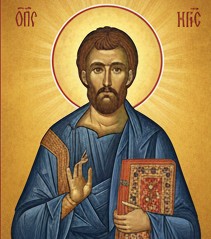
👣Faithful Disciple from the Beginning
Saint Matthias holds a unique place among the Holy Apostles as the one chosen by divine lot to
complete the sacred number of the Twelve after the betrayal and death of Judas Iscariot. Yet his
distinction does not begin with his selection; rather, it is rooted in his faithful discipleship
from the very beginning of Christ's earthly ministry. According to the criteria set forth by Saint
Peter in the upper room, Matthias was among those who "accompanied us during all the time that the
Lord Jesus went in and out among us, beginning from the baptism of John until the day when He was
taken up from us."
This testimony is profound: Matthias was present throughout our Lord's three-year ministry. He heard
the Sermon on the Mount, witnessed the miracles of healing and provision, saw the Transfiguration's
glory, stood in the shadow of the Cross, and beheld the Risen Christ in His forty days of
post-Resurrection appearances. He was numbered among the seventy (or seventy-two) disciples whom
Christ sent out to preach the Kingdom, heal the sick, and proclaim that the Messiah had come. His
faithfulness was constant, his devotion unwavering, even when many turned back and no longer walked
with the Lord.
🎯The Divine Selection
After the Ascension of our Lord, during the days between the Feast of the Ascension and Pentecost,
the Apostles gathered in the upper room in Jerusalem with the Theotokos and the faithful
disciples—approximately one hundred and twenty souls. Saint Peter stood among them and spoke under
the inspiration of the Holy Spirit, declaring that the prophetic words of King David in the Psalms
must be fulfilled: "Let another take his office" and "His bishopric let another take."
The void left by Judas's betrayal was not merely numerical; it was theological and mystical. The
number twelve carried profound significance: twelve tribes of Israel, twelve foundations of the New
Jerusalem, twelve thrones upon which the Apostles would sit judging the twelve tribes. The sacred
number had to be restored before Pentecost, before the Holy Spirit descended to empower the Church
for its universal mission.
Two men met the rigorous qualifications: Matthias and Joseph called Barsabbas, surnamed Justus. Both
had been faithful disciples from the beginning, both had witnessed the Resurrection, and both were
deemed worthy. The Apostles did not rely on human wisdom or democratic vote; instead, they turned to
prayer and the ancient practice of casting lots, allowing God Himself to reveal His chosen vessel.
"You, O Lord, who know the hearts of all, show which one of these two You have chosen," they prayed.
The lot fell upon Matthias, and he was numbered with the eleven Apostles, restoring the fullness of
the apostolic college.
"And they cast lots for them, and the lot fell on Matthias, and he was numbered with the eleven
apostles." — Acts 1:26
🔥Pentecost and Apostolic Ministry
Saint Matthias was present in the upper room on the Day of Pentecost when the Holy Spirit descended
upon the Apostles like tongues of fire, empowering them to speak in languages they had never learned
and to proclaim the Gospel with boldness and authority. He participated in that first great harvest
of souls when three thousand were baptized in a single day, and he joined his fellow Apostles in
performing signs and wonders in Jerusalem, breaking bread from house to house, and teaching the new
converts in the Way of the Lord.
According to the ancient traditions preserved in the Syriac Orthodox Church and testified to by
Church historians such as Nicephorus Callistus and Dorotheus of Tyre, Saint Matthias's apostolic
labors extended far beyond Jerusalem. He preached first in Judea, strengthening the infant Church
and converting many Jews to the faith of Christ. His ministry then took him to the regions around
the Black Sea, including Cappadocia and the wild lands inhabited by cannibalistic tribes, where
through his preaching and miracles, he brought the light of the Gospel to those dwelling in
spiritual darkness.
The most persistent tradition, honored particularly in the Ethiopian Orthodox and Syriac Orthodox
Churches, holds that Saint Matthias labored extensively in Ethiopia (ancient Æthiopia, which
encompassed regions of modern Sudan and Ethiopia). There he proclaimed Christ, established churches,
ordained clergy, and performed countless miracles. His preaching was characterized by simplicity,
clarity, and power—he taught that repentance, faith in Christ, and love for one another were the
essence of the Christian life.
⚔️Martyrdom and Legacy
The circumstances of Saint Matthias's martyrdom are recorded with variations in different ancient
sources, reflecting the challenges of preserving historical details across vast distances and
centuries. The most widely accepted tradition in the Syriac Orthodox Church states that he was
martyred in Colchis (modern-day Georgia) or in Ethiopia, where his preaching had brought multitudes
to Christ but also aroused fierce opposition from pagan priests and authorities who saw their power
threatened.
According to one account, Saint Matthias was seized by an angry mob stirred up by pagan leaders. He
was subjected to brutal torture: first stoned by the crowd in an attempt to kill him as a
blasphemer, then, when stoning proved insufficient, beheaded with an axe or sword. Another tradition
states that he was crucified and then beheaded while still on the cross. In every account, what
remains constant is that he bore his suffering with patience and courage, praying for his
persecutors even as they took his life, and died as a faithful witness—a martyr—for the Name of
Christ.
Saint Matthias departed this life around the year 80 AD. His sacred relics were initially preserved
in Jerusalem, then later translated to Rome, where they were placed in the Basilica of Saint Mary
Major. Portions of his relics are also venerated in Trier, Germany, where a magnificent abbey bears
his name. Throughout the centuries, his intercession has been sought by the faithful, and numerous
miracles have been attributed to his prayers.
📚Theological Significance
The selection of Saint Matthias carries deep theological meaning for the Church. It demonstrates
that apostolic authority is not self-appointed but divinely bestowed. The Apostles did not presume
to choose based on personal preference or political calculation; they prayed and allowed God to
reveal His will through the sacred lot. This establishes a pattern for all ecclesiastical
appointments: they must be made in prayer, seeking the will of God, recognizing that all ministry is
a divine calling, not a human achievement.
Furthermore, Matthias's replacement of Judas symbolizes the victory of fidelity over betrayal, of
grace over sin, of the Church's indefectibility despite human weakness. Just as the Israel of God is
restored and perfected in the New Covenant, so too is the apostolic number restored and completed.
The Church marches forward, undeterred by the falling away of individuals, because Christ continues
to call new laborers into His harvest.
In the Syriac Orthodox tradition, Saint Matthias is honored as a model of patient discipleship. He
followed Christ faithfully for years without recognition or special status, content to be one among
many disciples. When the time came for his elevation to apostolic rank, he did not seek it or
campaign for it; rather, God Himself chose him. This teaches us the virtue of humble service, of
doing our duty faithfully without seeking glory, trusting that God sees and rewards those who serve
Him with pure hearts.
Prayer for Intercession
O Holy Apostle Matthias, chosen by divine lot to complete the sacred number of the Twelve, faithful
witness of Christ's Resurrection and bearer of the Gospel to distant lands, we seek your powerful
intercession before the throne of God. You who walked with our Lord from His baptism to His
Ascension, who received the tongues of fire at Pentecost, who preached Christ fearlessly and sealed
your testimony with martyrdom—pray for us. Grant that we, like you, may be faithful in obscurity,
patient in waiting, humble in service, and steadfast unto death. Through your prayers, may we be
counted worthy to stand among the saints in the Kingdom of Heaven. Amen.