📖The Name and the Revolutionary: Understanding
Simon the Zealot
As a scholar devoted to the Syriac Orthodox tradition and the witness of Holy Scripture and sacred
tradition, I approach the life of St. Simon the Zealot with profound fascination, for he represents
one of the most intriguing transformations recorded in apostolic history—the conversion of a
revolutionary zealot into an apostle of the Prince of Peace. His biography challenges us to consider
how Christ takes our human passions, even those that might seem contrary to the Gospel, and
redirects them toward the Kingdom of God.
In the canonical lists of the Twelve Apostles, this holy figure appears under two different
designations that have occasioned much scholarly discussion. In the Gospels of Matthew and Mark, he
is called "Simon the Canaanite" or "Simon the Cananaean" (Σίμων ὁ Καναναῖος). In the Gospel of Luke
and the Acts of the Apostles, he is identified as "Simon called Zelotes" or "Simon the Zealot"
(Σίμων ὁ καλούμενος Ζηλωτής). Far from being contradictory, these designations are complementary and
reveal something profound about Simon's background and character.
The term "Canaanite" or "Cananaean" in this context does not refer to the ancient inhabitants of
Canaan, but is rather an Aramaic word—qan'an or qana'i (קנאי)—meaning "zealot" or "zealous one." The
Greek word Zelotes (Ζηλωτής) is a direct translation of this Aramaic term. Thus, Matthew and Mark
preserve the original Aramaic designation while Luke, writing for a Greek-speaking audience,
translates it. Both forms point to the same reality: Simon was known by the epithet "the Zealot,"
indicating either his temperament, his political associations, or both.
But what does it mean to be a "Zealot"? In first-century Jewish Palestine, this term carried
significant political and religious connotations. At its most general level, it could simply mean
someone who was zealous for the Law of Moses, passionate about the covenant traditions of Israel,
fervent in religious observance. In this sense, St. Paul could describe himself as "extremely
zealous for the traditions of my fathers" (Galatians 1:14), and Phinehas in the Old Testament was
praised for his "zeal" in defending God's honor (Numbers 25:11-13).
However, by the time of Jesus's ministry, "Zealot" (with a capital Z) had also become associated
with a specific revolutionary movement—a group of Jewish patriots who sought to overthrow Roman
occupation through armed resistance. These Zealots believed that Israel should have no king but God,
that paying taxes to Caesar was tantamount to idolatry, and that violent resistance against Rome was
not merely permissible but a religious duty. They would later play a significant role in the Jewish
Revolt of 66-70 AD, which culminated in the destruction of Jerusalem and the Temple.
Whether Simon was formally associated with this organized Zealot movement (which may not have been
fully developed during Jesus's early ministry) or was simply known for his zealous, revolutionary
temperament, the epithet indicates that he was a man of intense passion, nationalistic fervor, and
possibly violent political convictions. He likely harbored deep resentment toward Rome and its
collaborators, dreamed of Israel's liberation, and may have been prepared to fight and die for that
cause. Into this crucible of revolutionary zeal, Jesus Christ called Simon to follow Him—not to lead
an armed rebellion, but to preach a kingdom "not of this world," to love enemies rather than destroy
them, and to conquer through suffering love rather than through the sword.
Historical Context: First-century Jewish Palestine was a powder keg of political,
religious, and social tensions. Roman occupation was deeply resented. Heavy taxation, periodic
brutality, and the presence of Gentile soldiers in the Holy Land were constant irritants. Various
groups responded differently: Pharisees focused on legal observance, Sadducees collaborated with
Rome, Essenes withdrew to the wilderness, and Zealots advocated armed resistance. Simon came from
this latter tradition of passionate, even violent, commitment to Israel's freedom.
👨👦Family Background and Identity
According to the consistent witness of tradition preserved in Syriac, Greek, and Latin sources,
Simon the Zealot was the son of Alphaeus (Clopas) and Mary wife of Clopas, making him the brother of
James the Less and Judas Thaddeus, and a cousin of our Lord Jesus Christ. The Gospels refer to the
"brothers of the Lord"—James, Joses, Simon, and Judas (Matthew 13:55, Mark 6:3)—which the Syriac
Orthodox Church, following the testimony of Hegesippus and other early witnesses, understands as
referring to Jesus's cousins, the sons of Alphaeus who was the brother of St. Joseph the Betrothed.
This familial connection is profoundly significant. It means that Simon grew up in close proximity
to Jesus, knew Him from childhood, witnessed His development in wisdom and grace, and shared in the
complex dynamics of being part of the extended Holy Family. It also means that three brothers from
this one family—James, Simon, and Judas—were chosen by Christ as apostles, testifying to the
spiritual vitality of their household despite (or perhaps because of) their initial skepticism about
Jesus's messianic claims.
The question naturally arises: how could a kinsman of Jesus, presumably raised in a pious Jewish
home, become associated with revolutionary Zealotism? Several factors may explain this. First,
growing up in Galilee under Roman occupation, Simon would have witnessed daily the humiliation of
foreign rule. Second, the combination of religious devotion and nationalistic fervor was not
unusual; many Jews believed that faithfulness to God required resistance to Caesar. Third, the very
fact that Jesus was Simon's cousin may have initially fueled Simon's revolutionary hopes—perhaps he
expected Jesus to be the warrior-Messiah who would drive out the Romans and restore David's kingdom.
Simon's mother, Mary wife of Clopas, was among the faithful women who followed Jesus, stood at the
foot of the Cross, and came to the tomb on Resurrection morning. She was one of the holy
myrrh-bearing women honored in Orthodox liturgical tradition. It is deeply moving to imagine this
mother watching her revolutionary son gradually transformed by Jesus's teaching—from a man ready to
kill for God's kingdom to a man ready to die proclaiming that kingdom is established through love
rather than violence, through the cross rather than the sword.
✝️The Call to Apostleship: Transformation Begins
Simon the Zealot appears in all four canonical lists of the Twelve Apostles (Matthew 10:2-4, Mark
3:16-19, Luke 6:14-16, Acts 1:13), consistently identified by his distinctive epithet. His selection
as one of the Twelve occurred after Jesus spent an entire night in prayer (Luke 6:12-13), indicating
that Simon's call was according to divine purpose, not human calculation. To be chosen as one of the
Twelve meant being designated a foundation stone of the Church, an authoritative witness to Christ's
ministry and resurrection, and a bearer of apostolic authority.
Consider the remarkable nature of Jesus's choice. Among the Twelve, we find Simon the Zealot—a
revolutionary who hated Roman collaborators—and Matthew (Levi) the tax collector—the very embodiment
of collaboration with Rome. These two men, who in any other context would have been mortal enemies,
were brought together in the apostolic band, forced to live, travel, eat, and minister side by side.
Only the transforming power of Christ could overcome such enmity and create genuine brotherhood
between a Zealot and a tax collector.
What must have drawn Jesus to Simon? Certainly his passion, his intensity, his willingness to
sacrifice everything for what he believed. Jesus saw in Simon's zealous temperament not something to
be destroyed but something to be redirected. The energy that might have gone into violent revolution
could be channeled into spiritual warfare—not against flesh and blood, but against principalities
and powers, against the spiritual forces of wickedness. The courage that might have made Simon a
guerrilla fighter could make him a fearless preacher of the Gospel. The commitment that might have
led him to die in a futile uprising could lead him to die as a martyr, bearing witness to eternal
truth.
As Simon followed Jesus, he underwent a profound transformation. He heard the Sermon on the Mount:
"Love your enemies, bless those who curse you, do good to those who hate you, and pray for those who
spitefully use you and persecute you" (Matthew 5:44). How revolutionary these words must have
sounded to a Zealot! He witnessed Jesus healing the servant of a Roman centurion and praising the
centurion's faith (Matthew 8:5-13). He heard Jesus say, "My kingdom is not of this world. If My
kingdom were of this world, My servants would fight" (John 18:36). He saw Jesus submit to arrest,
trial, and crucifixion without resistance, praying "Father, forgive them" for His executioners.
These experiences must have been profoundly disorienting for Simon. Everything he had believed about
how God's kingdom would come—through armed resistance, military victory, the overthrow of Rome—was
being challenged and overturned. Yet gradually, he came to see that Jesus was indeed establishing
God's kingdom, but through means infinitely more powerful than the sword: through self-giving love,
through suffering service, through the cross and resurrection. Simon's zeal was not extinguished but
purified and redirected. He remained a zealot, but now for Christ and His Gospel rather than for a
nationalistic political program.
🔥Ministry with Christ: Learning a New
Revolution
During our Lord's earthly ministry, Simon the Zealot witnessed the full spectrum of Christ's
teaching and miracles. He was present for the great discourses—the Sermon on the Mount, the parables
of the Kingdom, the bread of life discourse, the eschatological teachings. He witnessed the
miracles—healings, exorcisms, nature miracles, resurrections of the dead. He observed Jesus's
interactions with Pharisees, Sadducees, scribes, tax collectors, sinners, Samaritans, Romans, and
Gentiles. All of these experiences contributed to his transformation.
Particularly significant for Simon would have been Jesus's teaching about the nature of His kingdom.
When James and John asked to sit at Jesus's right and left in His glory, seeking positions of power
in what they imagined as a political kingdom, Jesus responded: "You do not know what you ask. Are
you able to drink the cup that I drink, and be baptized with the baptism that I am baptized with?"
(Mark 10:38). The path to glory leads through suffering; greatness in God's kingdom is measured by
service, not by domination; the first shall be last and the last first.
Simon also witnessed Jesus's repeated interactions with Roman authority without violence or
rebellion. When asked whether it was lawful to pay taxes to Caesar, Jesus asked for a coin, noted
Caesar's image on it, and said, "Render to Caesar the things that are Caesar's, and to God the
things that are God's" (Mark 12:17). This was not the answer of a revolutionary Zealot, yet it did
not constitute collaboration either. It represented a third way—acknowledging earthly authority
while maintaining ultimate allegiance to God, refusing both armed rebellion and idolatrous
submission.
At the Last Supper, Simon participated in the institution of the Eucharist, that mystical meal in
which Jesus gave His body and blood as food and drink for eternal life. He heard Jesus say, "A new
commandment I give to you, that you love one another; as I have loved you, that you also love one
another. By this all will know that you are My disciples, if you have love for one another" (John
13:34-35). The revolutionary kingdom Jesus was establishing would be recognized not by military
might or political power, but by the mutual love of His followers—a love so radical and
counter-cultural that it would astonish the world.
When Jesus was arrested in Gethsemane and Peter drew a sword to defend Him, Jesus commanded, "Put
your sword in its place, for all who take the sword will perish by the sword" (Matthew 26:52). Simon
the Zealot, who might once have been the first to draw a sword against Rome's representatives, now
witnessed his Lord forbidding violent resistance even in self-defense. As Jesus was led away to
trial, torture, and crucifixion, Simon learned the deepest lesson of all: God's power is made
perfect in weakness, victory comes through apparent defeat, and the cross—symbol of Roman execution
and humiliation—would become the instrument of the world's salvation.
🕊️Pentecost and the Birth of the Church
After the Crucifixion and Resurrection, Simon the Zealot was among the apostles who gathered in the
Upper Room in Jerusalem, along with the women and Jesus's mother Mary, "continuing with one accord
in prayer and supplication" (Acts 1:14). This is a remarkable detail: Simon, who once may have
plotted revolution against Rome, was now praying in unity with his fellow apostles, including
Matthew the former tax collector. The enmities that once divided them had been overcome by their
common experience of Christ's death and resurrection.
On the Day of Pentecost, Simon received the Holy Spirit in the form of tongues of fire. The same
Spirit who had anointed Jesus at His baptism now filled the apostles, empowering them for their
mission. For Simon, this represented the completion of his transformation. The zeal that had once
fueled revolutionary violence was now channeled into spiritual power. The courage that might have
made him a guerrilla fighter now made him a fearless witness to Christ. The passion that had been
directed toward nationalistic politics was now focused on the Kingdom of God.
The early Church in Jerusalem, as described in Acts, embodied principles that would have resonated
deeply with Simon's original revolutionary ideals—but transformed by grace. The believers "had all
things in common, and sold their possessions and goods, and divided them among all, as anyone had
need" (Acts 2:44-45). This was economic revolution, but achieved through voluntary love rather than
violent redistribution. The apostles preached boldly despite official prohibition, declaring, "We
ought to obey God rather than men" (Acts 5:29). This was resistance to authority, but through
prophetic witness and suffering service rather than armed rebellion.
As the Church grew and faced persecution, Simon witnessed the martyrdom of Stephen and later of his
brother James (son of Zebedee, not his own brother James the Less). He saw the Gospel begin to
spread beyond Jerusalem to Samaria, to the Ethiopian eunuch, to the Gentiles through Peter's vision
and the conversion of Cornelius, and eventually through Paul's missionary journeys to the far
reaches of the Roman Empire. The revolution Jesus had inaugurated was indeed transforming the world,
but through the power of the Gospel rather than the power of the sword.
🌍Apostolic Mission: Revolutionary Zeal
Redirected
According to the various traditions preserved in Syriac, Greek, Latin, and Coptic sources, St. Simon
the Zealot undertook extensive missionary journeys, carrying the Gospel to distant lands and
peoples. While the traditions vary in their specific details—a common phenomenon with apostolic
figures whose ministries took them far from the centers of early Christian record-keeping—several
consistent patterns emerge regarding Simon's mission field.
The most widespread and consistent tradition, shared across multiple ancient sources, places Simon's
primary apostolic ministry in Egypt, Cyrene (North Africa), Mauritania, and eventually Persia
(modern Iran), often in company with his brother Judas Thaddeus. The tradition of the two brothers
traveling together as missionary companions has deep roots in the early Church and reflects the
pattern established by Jesus, who sent out His disciples "two by two" (Mark 6:7).
In Egypt, tradition holds that Simon preached in Alexandria and throughout the Nile valley,
establishing churches and winning converts from among both the Jewish diaspora and the pagan
Egyptian population. Egypt was a natural mission field for the early Church—it had large Jewish
communities familiar with the Hebrew Scriptures, Greek-speaking urban centers influenced by
Hellenistic culture, and ancient religious traditions that created both challenges and opportunities
for Christian proclamation. The Coptic Orthodox Church of Alexandria, which traces its origins to
the Evangelist Mark, also honors the apostolic witness of Simon and other apostles who labored in
Egypt.
From Egypt, tradition extends Simon's mission westward along the North African coast to Cyrene and
Mauritania (modern Libya and Morocco/Algeria). This region had substantial Jewish populations dating
back centuries, as well as Berber and other indigenous peoples. The spread of Christianity along the
North African coast would eventually produce some of the Church's greatest minds—Tertullian,
Cyprian, Augustine—though these came in later generations. Simon's missionary work in North Africa
represented pioneering apostolic witness in regions that would become flourishing centers of
Christian life and thought.
The Eastern tradition, particularly strong in Syriac sources, emphasizes Simon's mission to Persia
in company with Judas Thaddeus. According to this tradition, after establishing churches in Egypt
and North Africa, Simon joined his brother Judas (who had been laboring in Mesopotamia and Edessa)
for a mission into the Persian Empire. Persia presented unique challenges: it was the domain of
Zoroastrianism, an ancient and sophisticated religion with powerful priestly castes; it was
politically hostile to Rome and thus potentially suspicious of any religion originating in Roman
territory; and it represented one of the great civilizations of the ancient world, with its own
proud cultural and religious heritage.
Yet Simon and Judas preached Christ boldly in Persia. They proclaimed that Jesus was not merely a
Jewish prophet or a Roman cult figure, but the universal Lord, the Savior of all humanity, the one
in whom both Jew and Gentile, both Roman and Persian, could find salvation. They worked miracles in
Christ's name—healings, exorcisms, even resurrections—that demonstrated God's power over disease,
demons, and death. They confronted the Zoroastrian magi, not with violence but with spiritual power,
showing that the God revealed in Jesus Christ was the true and living God before whom all other
claims to divinity must bow.
Western Traditions: Some Western medieval traditions, particularly in Britain, claim
that St. Simon visited Britain and preached there, either before or after his Persian mission. While
these traditions are less firmly established than the Egyptian and Persian missions, they reflect
the widespread veneration of Simon in the Western Church and the desire to claim apostolic origins.
The Syriac Orthodox Church, while respecting these Western traditions, primarily emphasizes Simon's
work in Egypt, North Africa, and Persia.
⚔️The Nature of Simon's Revolutionary Witness
As we reflect on Simon's apostolic ministry, it is crucial to understand how his original
revolutionary zeal was transformed but not extinguished by his encounter with Christ. Simon remained
a revolutionary to the end of his life—but the revolution he now served was far more radical and
far-reaching than any political uprising could have been.
First, Simon proclaimed a revolution of the heart. The Kingdom Jesus inaugurated begins with
internal transformation—the new birth, the renewal of the mind, the circumcision of the heart.
Before one can change society, one must be changed by God. Simon's preaching called for repentance,
faith in Christ, and the reception of the Holy Spirit. This was revolutionary because it placed
spiritual transformation ahead of political action, because it insisted that true freedom comes from
liberation from sin rather than merely from liberation from foreign rule.
Second, Simon embodied a revolution of values. The Sermon on the Mount, which had so challenged his
Zealot assumptions, became the charter of his apostolic ministry. He preached that the meek will
inherit the earth, that peacemakers are blessed, that we must love our enemies and pray for our
persecutors. He demonstrated that greatness is measured by service, that the last shall be first,
that self-giving love is stronger than self-assertion. These values directly contradicted both the
Roman imperial cult (which glorified power, conquest, and domination) and the Zealot ideology (which
sought to overcome Roman violence with Jewish violence).
Third, Simon championed a revolution of community. The Church he helped establish was a radically
inclusive community that transcended the boundaries of ethnicity, class, and social status. In
Christ, there is neither Jew nor Greek, slave nor free, male nor female (Galatians 3:28). The Church
brought together people who would never have associated in the surrounding society—Jews and
Gentiles, rich and poor, educated and illiterate, former Zealots and former collaborators. This
social revolution, achieved through the reconciling power of the Gospel, was far more transformative
than any political revolution could have been.
Fourth, Simon practiced a revolution of method. Unlike the Zealots who sought to establish God's
kingdom through violence, Simon spread the Gospel through persuasion, witness, suffering, and love.
When persecuted, he did not retaliate but blessed his persecutors. When imprisoned, he did not plot
escape but praised God and converted his jailers. When threatened with death, he did not flee but
stood firm in his confession of Christ. This method—the way of the cross—proved far more powerful
than the sword in establishing Christ's kingdom.
Finally, Simon proclaimed a revolution with cosmic scope. The Zealot revolution aimed to liberate
Israel from Rome. Christ's revolution aimed to liberate humanity from sin, death, and the devil. The
Zealot revolution sought to restore David's earthly kingdom. Christ's revolution inaugurated an
eternal kingdom that will never pass away. The Zealot revolution would have affected one nation for
one generation. Christ's revolution transforms all nations for all time. Simon came to see that in
exchanging Zealot ideology for the Gospel, he had not given up revolutionary zeal but had found its
true and ultimate object.
👑Martyrdom: The Final Revolutionary Act
According to the consistent testimony of ancient tradition, St. Simon the Zealot sealed his
apostolic witness with martyrdom, dying for the sake of Christ and the Gospel he had proclaimed. The
precise circumstances and date of his martyrdom vary somewhat in different sources—a common
phenomenon with apostolic figures who ministered far from the centers of Christian
record-keeping—but the essential narrative remains consistent: Simon died a martyr's death in
Persia, faithful to the end.
The most widespread tradition places Simon's martyrdom in Persia around the year 65-70 AD, though
some sources suggest a later date extending into the early second century. According to this
tradition, Simon was evangelizing in Persia together with his brother Judas Thaddeus when they
encountered fierce opposition from the Zoroastrian magi-priests and local authorities. Their success
in converting many Persians to Christianity—including persons from noble families and positions of
influence—provoked the wrath of those who saw the Christian faith as a threat to traditional Persian
religion and social order.
The narrative of Simon's martyrdom follows a pattern familiar from other apostolic martyrologies.
After refusing to sacrifice to the Persian deities and continuing to preach Christ boldly despite
prohibitions and threats, Simon and Judas were arrested and brought before the authorities. They
were given the choice: renounce Christ and live, or persist in their faith and die. Like their
Master before them, they chose faithfulness over survival, witness over comfort, eternity over
temporal life.
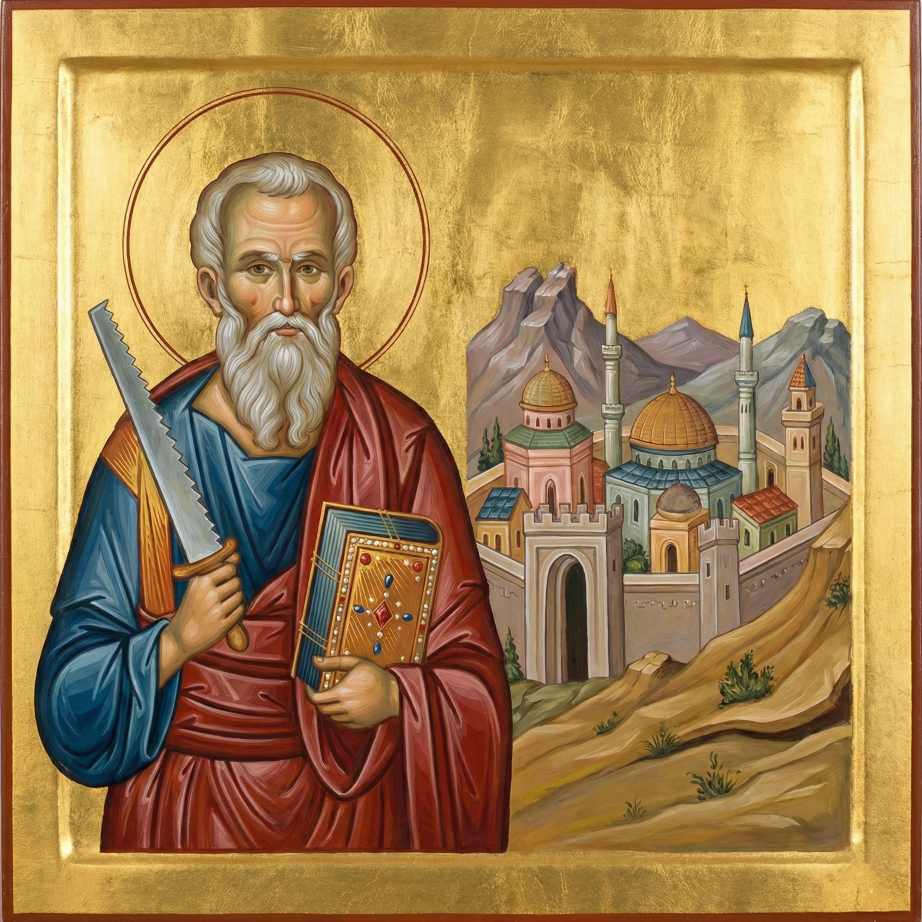
According to the traditional account, St. Simon the Zealot was martyred by being sawn in half with a
saw—a particularly cruel and prolonged method of execution that gave him ample time to suffer and to
testify to his faith. Other traditions mention death by crucifixion or by the sword. The Armenian
tradition, which claims that Simon evangelized in Armenia along with Judas Thaddeus and Bartholomew,
sometimes places his martyrdom in Armenian territory. Regardless of the precise manner—whether by
saw, sword, or cross—the tradition is unanimous that Simon died as a martyr, bearing witness to
Christ through his death.
As Simon faced death, tradition holds that he prayed for his executioners, blessed those who were
killing him, encouraged the faithful to remain steadfast, and commended his spirit into the hands of
the Lord Jesus Christ. The revolutionary who once might have died fighting the enemies of Israel
instead died praying for the enemies of Christ—a transformation that testifies to the power of the
Gospel more eloquently than any words. His blood, mingled with that of his brother Judas and
countless other martyrs, watered the seed of the Church and bore fruit in the conversion of many
Persians and others who witnessed his courage and love.
The relics of St. Simon, according to various traditions, were preserved by faithful Christians and
eventually translated to different locations. Some traditions place his final resting place in
Persia, others in Rome (where relics are venerated in St. Peter's Basilica), and still others in
various locations in the East. The multiplication of relic traditions, while raising historical
questions, reflects the universal veneration of this great apostle throughout Christianity and the
desire of different communities to maintain connection with his witness.
🌟Significance in Syriac Orthodox Tradition
From the perspective of the Syriac Orthodox Church, St. Simon the Zealot occupies a position of
significant honor and provides a powerful model for Christian discipleship. While he may not have
been the primary founder of our Church in the way that Judas Thaddeus (Addai) was through the
mission to Edessa, Simon's witness is nonetheless deeply significant for several reasons.
First, Simon represents the transformation of human passion and zeal by divine grace. The Syriac
Orthodox tradition, with its strong emphasis on asceticism and the struggle against the passions,
recognizes that zeal in itself is not evil—it is a powerful human energy that can be directed either
toward destructive ends or toward the service of God. Simon shows us that Christ does not destroy
our passionate nature but purifies and redirects it. The intensity that made Simon a Zealot, when
surrendered to Christ, made him a fearless apostle. This is a profound encouragement for all
believers: whatever our temperament, whatever our struggles, Christ can transform us and use us for
His purposes.
Second, Simon embodies the tension between the "already" and "not yet" of God's kingdom. As a
Zealot, he longed for God's kingdom to come and for God's will to be done on earth as in heaven.
Christ did not rebuke that longing but redirected it. Yes, God's kingdom is coming, but not through
human violence. Yes, God's will shall be done, but through the cross and resurrection. Yes, the
world will be transformed, but through the power of the Gospel rather than the power of the sword.
For Syriac Orthodox Christians, many of whom have suffered under various political regimes and long
for justice and peace, Simon's example is both challenging and comforting. We work and pray for
God's kingdom while recognizing that its fullness awaits Christ's return.
Third, Simon demonstrates the possibility of reconciliation across deep divides. His companionship
with Matthew the tax collector in the apostolic band, and his later missionary partnership with his
brother Judas, show how the Gospel creates genuine community among those who were formerly enemies.
In the Syriac Orthodox Church, which has often existed as a minority community in Muslim-majority
contexts, and which has experienced both persecution and periods of coexistence, Simon's witness to
reconciliation and peace is particularly relevant. We are called to love our neighbors, to seek
peace, to bear witness to Christ through love rather than hatred, even when we suffer injustice.
Fourth, Simon's mission to Persia and the East connects him directly to the missionary expansion of
Syriac Christianity. While the primary apostolic foundation of our Church is attributed to Judas
Thaddeus (Addai) and Thomas, Simon's work in the Persian realm contributed to the spread of
Christianity in territories that would become important centers of Syriac Christian life. The Church
of the East, which would eventually extend from Mesopotamia to India and China, owed something to
the apostolic witness of Simon and Judas in Persia. Their martyrdom in that land sanctified it and
laid a foundation for the flourishing of Christian faith in subsequent centuries.
Finally, Simon's martyrdom speaks powerfully to the Syriac Orthodox experience. Throughout our
history, from the Persian persecutions of the early centuries, through the trials under various
Islamic caliphates, to the modern genocides and displacements in the Middle East, the Syriac
Orthodox Church has been a church of martyrs. Simon's witness—his refusal to deny Christ even at the
cost of his life, his prayer for his executioners, his courage in the face of torture—provides a
model and inspiration for all who suffer for Christ's sake. If the apostle could endure, so can we.
If his blood bore fruit, so will ours.
🙏Character and Spiritual Qualities
From Scripture, tradition, and theological reflection, we can discern several characteristics that
marked St. Simon the Zealot. First and most obviously, he was a man of passion and intensity. His
very designation as "the Zealot" speaks to the fervor of his temperament. Simon was not lukewarm,
not moderate, not cautious. He threw himself wholly into whatever cause claimed his allegiance. This
intensity, when directed toward revolution, made him potentially dangerous. When redirected toward
Christ, it made him a dynamic and effective apostle.
Second, Simon demonstrated remarkable capacity for transformation. To move from violent
revolutionary to apostle of peace, from hating Rome to preaching love for enemies, from trusting in
the sword to trusting in the cross—this required a fundamental reorientation of his entire
worldview. Simon's transformation was not superficial or merely behavioral; it went to the root of
his identity and values. This teaches us that no one is beyond the reach of God's grace, no
temperament too difficult for God to work with, no past too checkered to be redeemed.
Third, Simon exemplified courage and fearlessness. Whether facing Roman soldiers as a Zealot or
pagan priests as an apostle, Simon did not shrink from danger. His courage was not reckless bravado
but settled conviction rooted in faith. He knew what he believed, he knew for whom he was willing to
die, and no threat could shake his resolve. In an age when confession of Christ is increasingly
costly—whether through social marginalization in the West or actual persecution in the East—Simon's
courage is a powerful model.
Fourth, Simon displayed the capacity for brotherhood across differences. His relationship with
Matthew the tax collector, and his missionary partnership with his brother Judas, demonstrate his
ability to work with others despite different backgrounds and temperaments. The same man who once
might have killed a tax collector as a traitor learned to call Matthew "brother" and to serve
alongside him in the apostolic mission. This capacity for reconciliation and collaboration, rooted
in their common devotion to Christ, is essential for the Church in every age.
Fifth, Simon embodied persevering faithfulness. He did not abandon his mission when it became
difficult, did not return home when persecution arose, did not compromise his message to gain
acceptance. From his call as an apostle through decades of missionary labor, through hardships,
dangers, and finally martyrdom, he remained faithful to Christ and the Gospel. His perseverance
teaches us that Christian discipleship is not a sprint but a marathon, not a momentary enthusiasm
but a lifelong commitment.
Finally, Simon demonstrated the proper ordering of loyalties. As a Zealot, he had been willing to
die for Israel's political freedom. As an apostle, he was willing to die for something far
greater—the proclamation of eternal truth, the establishment of Christ's kingdom, the salvation of
souls. He learned that while earthly kingdoms rise and fall, God's kingdom endures forever; while
political freedom is valuable, spiritual freedom is infinitely more precious; while national
identity has its place, identity in Christ transcends all earthly boundaries. This proper ordering
of loyalties—God first, then all other goods in their rightful place—is essential for Christian
discipleship.
📿Liturgical Veneration and Devotion
In the liturgical life of the Syriac Orthodox Church, St. Simon the Zealot is commemorated with
great honor. His feast is celebrated on May 10 in some calendars, and on October 28 in others (often
jointly with St. Jude Thaddeus, reflecting their brotherhood and their shared martyrdom in Persia).
These feast days are occasions for the faithful to remember Simon's apostolic witness, to give
thanks for his transformation from revolutionary to apostle, and to seek his intercession before the
throne of God.
The troparion (hymn) for St. Simon typically praises him as "holy apostle of Christ, zealous
preacher of the Gospel, courageous witness unto death, and intercessor for our souls." The kontakion
emphasizes his transformation from Zealot to apostle, his missionary labors in Egypt and Persia, and
his martyrdom with his brother Judas. These liturgical texts keep alive the memory of his witness
and make his example present to each generation of believers.
Iconography depicts St. Simon in various ways. He is sometimes shown holding a saw, the instrument
of his martyrdom, symbolizing his willingness to suffer for Christ. Other icons show him holding a
book or scroll, representing the Gospel he preached, or a cross, symbolizing his faith in Christ
crucified. Some icons depict him alongside his brother Judas Thaddeus, reflecting their missionary
partnership and shared martyrdom. The artistic tradition thus preserves multiple dimensions of
Simon's identity and ministry.
Personal devotion to St. Simon includes prayers for his intercession, particularly in matters
requiring courage, transformation, and perseverance. Those struggling with violent or passionate
impulses may seek his prayers, asking that their energy be redirected as his was. Those facing
persecution or difficult witness may invoke his intercession for courage. Those working for
reconciliation and peace may ask his help, remembering how he learned to love former enemies. Those
simply seeking to grow in holiness may look to Simon as an example of radical transformation by
grace.
The invocation of St. Simon's intercession is rooted in the Orthodox understanding of the communion
of saints. We believe that the saints in heaven, being alive in Christ and perfected in love,
continue to care for the Church on earth and to present our prayers before God. St. Simon, who
labored to proclaim Christ and gave his life for the Gospel, continues his apostolic ministry from
heaven, interceding for those who call upon him, strengthening the faithful in their struggles, and
helping to build up the Body of Christ until the Lord returns.
📚Historical Considerations and Questions
As a historian and scholar, I must acknowledge the complexities surrounding the traditions about St.
Simon the Zealot. The New Testament provides very little direct information about him beyond his
name and designation in the apostolic lists. We do not have narratives of his call, accounts of his
questions to Jesus, or descriptions of his post-Pentecost ministry in the way we do for Peter, John,
or Paul. The details of his missionary journeys and martyrdom come from later tradition rather than
from canonical Scripture or first-century sources.
Several historical questions merit consideration. First, the relationship between "Zealot" as a
general descriptor of temperament and "Zealot" as membership in an organized revolutionary movement.
Some scholars argue that the organized Zealot party did not emerge until closer to the Jewish Revolt
of 66-70 AD, after Jesus's ministry. If so, Simon's designation might reflect his zealous
temperament rather than formal political affiliation. However, even if formal organization came
later, the ideology and impulse of revolutionary resistance to Rome certainly existed during Jesus's
ministry.
Second, the identification of Simon as the brother of James the Less and Judas Thaddeus. This
identification, while ancient and widespread in tradition, is not explicitly stated in the New
Testament. The listing of Jesus's "brothers" in Matthew 13:55 and Mark 6:3 includes a Simon, and
patristic tradition generally identifies him with Simon the apostle, but this connection requires
interpretive work. The Syriac Orthodox Church, following Hegesippus and other early witnesses,
accepts this identification while acknowledging that it rests on tradition rather than explicit
Scripture.
Third, the precise itinerary of Simon's missionary journeys. The traditions placing him in Egypt,
North Africa, and Persia are ancient and widespread, but they are not without variation and
contradiction. Some Western medieval traditions add Britain to his itinerary, though these claims
are less well-established. The nature of apostolic missions—covering vast distances, often in
hostile territory, with limited communication back to Christian centers—makes precise historical
reconstruction difficult. We must balance respect for ancient tradition with acknowledgment of
historical uncertainty.
Fourth, the circumstances and date of his martyrdom. While the tradition of martyrdom in Persia with
Judas Thaddeus is widespread and ancient, the details vary. Some sources place it around 65 AD,
others extend it into the early second century. The manner of death is variously reported as sawing,
crucifixion, or beheading. These variations do not necessarily indicate falsehood but rather reflect
the challenges of preserving accurate information across distances and generations.
Within the Syriac Orthodox Church, we approach these questions with both critical awareness and
faithful reverence. We recognize that not every detail of hagiographical tradition can be verified
by modern historical methods. We acknowledge the role of legend and pious elaboration in
transmitting religious memory. We understand that faith does not require absolute historical
certainty about every particular. Nevertheless, we maintain that the core affirmations stand: Simon
was one of the Twelve, called by Christ, empowered by the Holy Spirit, sent to preach the Gospel,
and faithful unto martyrdom. These essentials are sufficient for our faith and provide a solid
foundation for our devotion.
💡Lessons for Contemporary Christians
What does the life and witness of St. Simon the Zealot teach believers in the twenty-first century?
First, the transforming power of the Gospel. Simon's conversion from violent revolutionary to
apostle of peace demonstrates that Christ can take our most problematic traits—our anger, our
violence, our passionate intensity—and redirect them toward His purposes. No one is beyond
redemption, no temperament too difficult for God to work with. If Christ could transform Simon the
Zealot, He can transform any of us.
Second, the proper response to injustice and oppression. First-century Jewish Palestine groaned
under Roman occupation, and Simon's revolutionary zeal was a response to real injustice. Jesus did
not deny the reality of injustice or counsel passive acceptance of oppression. Rather, He taught a
third way—neither violent rebellion nor passive collaboration, but active resistance through love,
witness, suffering service, and prophetic truth-telling. For Christians today facing
injustice—whether political persecution, economic exploitation, or social marginalization—Simon's
transformation teaches us to resist evil while refusing to become evil, to fight injustice without
becoming unjust ourselves.
Third, the danger of confusing God's kingdom with political programs. Simon initially imagined God's
kingdom in political terms—the overthrow of Rome and the restoration of David's throne. Jesus taught
him that God's kingdom transcends politics, that it comes through spiritual transformation rather
than political revolution, that it is established by the cross rather than the sword. This does not
mean Christians should be apolitical or indifferent to justice. It means we must not reduce the
Gospel to any political ideology, whether of left or right, whether revolutionary or conservative.
The Gospel judges all political systems and calls all people to repentance and faith.
Fourth, the possibility of reconciliation across deep divides. Simon's companionship with Matthew
the tax collector, despite their radically different backgrounds and former enmities, demonstrates
that in Christ barriers can be overcome and enemies can become brothers. In our divided
world—divided by politics, race, class, nationality, religion—the Church is called to be a community
where such reconciliation is actually lived out. Simon challenges us to examine our own prejudices
and hatreds and to allow Christ to transform them.
Fifth, the necessity of courage in Christian witness. Simon was not a coward as a Zealot, and he was
not a coward as an apostle. He faced danger for his beliefs before his conversion, and he faced even
greater danger afterward. But his courage as an apostle was different—it was rooted not in human
bravado but in confidence in God, not in trust in weapons but in trust in the Holy Spirit, not in
willingness to kill but in willingness to die. Christians today, facing various forms of opposition
and persecution, need Simon's courage—courage to witness, courage to stand for truth, courage to
love enemies, courage to suffer rather than compromise.
Finally, the priority of eternal over temporal values. Simon learned that while political freedom is
valuable, spiritual freedom is more precious; while national identity matters, identity in Christ
transcends all earthly identities; while we work for justice in this world, we look ultimately to
the world to come. This proper ordering of priorities does not make us indifferent to temporal
concerns but puts them in their rightful place. We work for peace, justice, and human flourishing in
this world while recognizing that our ultimate citizenship is in heaven and our ultimate hope is in
Christ's return and the establishment of His eternal kingdom.
✝️Conclusion: The Revolutionary Transformed
St. Simon the Zealot stands in the memory of the Syriac Orthodox Church as a powerful witness to the
transforming power of Christ. From revolutionary to apostle, from man of violence to man of peace,
from zealot for Israel's political liberation to zealot for humanity's spiritual liberation—Simon's
transformation demonstrates that Christ can take our human passions, even those that seem most
opposed to the Gospel, and redirect them toward the Kingdom of God.
In the communion of saints, St. Simon continues his apostolic ministry. He who once fought for
earthly kingdoms now intercedes for Christ's eternal Kingdom. He who once hated enemies now prays
for all humanity. He who once trusted in the sword now witnesses to the power of the cross. His
transformation from revolutionary to apostle is not merely a historical curiosity but a living
testimony to what Christ can do in any human heart that surrenders to Him.
As we conclude this fuller biography, let us pray in the tradition of the Syriac Orthodox Church: "O
Holy Apostle Simon, courageous zealot transformed by Christ, fearless preacher of the Gospel,
faithful witness unto death—intercede for us before the merciful God. Pray that our passions may be
purified and redirected toward His service, that our zeal may burn for His Kingdom, that our courage
may never fail in bearing witness to truth, that our love may extend even to our enemies, and that
we may be found faithful, as you were faithful, when we stand before the judgment seat of Christ.
Through the mercy of our Lord Jesus Christ, to whom with the Father and the Holy Spirit be glory,
honor, and worship, now and forever, and unto ages of ages. Amen."
May the blessing of St. Simon the Zealot, transformed revolutionary and martyred apostle, rest
upon all who read this account. May his example inspire us to surrender our passions to Christ,
to love our enemies, to witness boldly, and to remain faithful unto death. To God be all glory.
Amen.