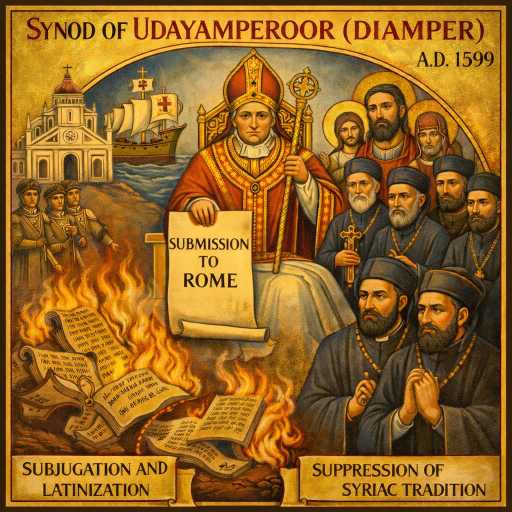
📜Historical Context: The Ancient Apostolic
Community
To understand the tragedy of the Synod of Diamper, one must first appreciate what was lost. The
Saint
Thomas Christians of Malabar (Kerala) traced their origins to the Apostle Thomas himself, who,
according
to our ancient and unwavering tradition, arrived on the Malabar Coast in 52 AD and established seven
churches. For over fifteen centuries, this community flourished as a unique expression of apostolic
Christianity, maintaining its distinct identity while remaining in communion with the broader
Church.
The Malankara Church, as we know it, was an integral part of the East Syriac ecclesiastical world,
maintaining liturgical, theological, and hierarchical connections with the Church of the East
centered
in Mesopotamia. Our forefathers celebrated the Holy Qurbana in the majestic East Syriac liturgical
tradition, sang hymns composed by the great Church Fathers of the Syriac-speaking world, and
organized
their ecclesiastical life under the spiritual authority of the Catholicos of the East.
⏳The Pre-Portuguese Golden Era (52-1498 AD)
Before Portuguese interference, the Malankara Church enjoyed remarkable autonomy and spiritual
vitality.
The community was led by indigenous Archdeacons (Arkadyakons), who exercised both spiritual and
temporal
authority over the faithful. These Archdeacons were not mere administrators but spiritual fathers
who
embodied the apostolic succession handed down from St. Thomas himself.
The liturgical life was conducted entirely in Syriac, the sacred language that connected us directly
to
the Aramaic-speaking world of our Lord Jesus Christ and the early Church. Our theological libraries
contained precious manuscripts in Syriac—commentaries on Scripture, lives of saints, liturgical
texts,
and theological treatises that represented centuries of accumulated spiritual wisdom.
The Saint Thomas Christians maintained cordial relations with the Hindu rulers of Kerala, enjoying
freedom of worship, trading privileges, and social respect. We were known as "Nazranis"
(Christians),
and our community included members from various social strata, though many belonged to the upper
castes,
reflecting our ancient establishment in the region.
The Malankara Church before 1599 was a living testament to the possibility of authentic Christianity
flourishing outside the Greco-Roman world, maintaining apostolic faith and order while expressing it
through Syriac culture and East Syriac ecclesiastical tradition.
⛵Portuguese Arrival and the Seeds of Conflict
(1498-1599)
When Vasco da Gama landed in Calicut in 1498, he was astonished to find an ancient and thriving
Christian
community in India. However, the Portuguese arrival marked the beginning of a century of increasing
tension
and eventual catastrophe for the Saint Thomas Christians. The Portuguese came not merely as traders
but
as
representatives of an aggressive colonial-ecclesiastical project that sought to impose Latin
Christianity
wherever their ships landed.
From the outset, the Portuguese viewed the Malankara Church with suspicion and disdain. They could
not
comprehend how an authentic Christian community could exist outside the immediate jurisdiction of
Rome,
celebrate liturgy in Syriac rather than Latin, and maintain theological formulations different from
the
recently concluded Council of Trent. In their eyes, the Saint Thomas Christians were at best
schismatics
who needed to be "corrected," and at worst, heretics who had fallen into "Nestorian errors."
The Portuguese Padroado (patronage) system claimed exclusive rights over all ecclesiastical matters
in
Portuguese territories. This meant that the ancient connection between the Malankara Church and the
Church
of the East was viewed as illegitimate interference in Portuguese ecclesiastical jurisdiction. The
Portuguese systematically prevented East Syriac bishops from reaching Kerala, intercepting them at
sea
or
imprisoning them when they did arrive.
⚔️Aleixo de Menezes: The Architect of
Latinization
Aleixo de Menezes, appointed as Archbishop of Goa in 1595, arrived in India with a clear mission: to
bring
the Malankara Church completely under Roman jurisdiction and to eradicate what he perceived as
theological
errors. A product of Counter-Reformation zeal, Menezes was convinced that any deviation from Latin
theological formulations and Roman ecclesiastical practice was dangerous heresy that threatened the
salvation of souls.
Menezes was not merely an ecclesiastical administrator; he was an agent of Portuguese colonial
power. He
arrived in Kerala with the full backing of the Portuguese Viceroy and local Portuguese military
forces.
His "visitation" of the Malankara churches was not a pastoral visit but an ecclesiastical invasion,
characterized by intimidation, threats, and the systematic destruction of our heritage.
Before convening the Synod, Menezes spent months traveling through Kerala, visiting Saint Thomas
Christian
churches, examining their liturgical books, interrogating clergy, and building a case for
comprehensive
reform. His methodology was thorough and ruthless—he confiscated manuscripts, imposed penalties on
those
who resisted, and used Portuguese military presence to enforce his authority.
⛪The Synod Itself: June 20-26, 1599
The Synod was convened at St. Mary's Church in Udayamperoor (which the Portuguese called Diamper),
near
Kochi. From a Syriac Orthodox historical perspective, what transpired during those seven days in
June
1599
was not a legitimate ecumenical council seeking truth through dialogue, but rather a coercive
assembly
designed to rubber-stamp predetermined conclusions and impose foreign practices on an ancient
apostolic
community.
The assembly included approximately 153 priests and 660 lay representatives from the Saint Thomas
Christian
community. However, the proceedings were dominated by Menezes himself, assisted by Portuguese Jesuit
fathers who had spent years studying the Syriac texts in order to identify "errors" and prepare
counter-arguments. The Archdeacon George of the Cross (Geevarghese Archdeacon), the traditional
leader
of
the Malankara Church, was present but had already been pressured and intimidated into a position of
compliance.
The language barrier itself created an inherent injustice. The proceedings were conducted primarily
in
Portuguese and Malayalam, with Syriac texts being "translated" and interpreted by Portuguese priests
who
were hostile to the very tradition they were examining. How could such a process yield fair results?
The
Saint Thomas Christian clergy, many of whom could read Syriac liturgically but did not understand
Portuguese theological terminology, were at a severe disadvantage.
📜The Decrees: Systematic Destruction of
Heritage
The Synod produced hundreds of decrees organized into nine "Actions," covering virtually every
aspect of
church life. From a Syriac Orthodox scholarly perspective, these decrees represent a systematic
attempt
to erase the distinctive identity of the Malankara Church and replace it with a Portuguese-Latin
ecclesial
structure.
Decree on Ecclesiastical Authority
The Synod formally declared that the Malankara Church was henceforth subject to the Archbishop of
Goa
and,
through him, to the Pope of Rome. This decree severed fifteen centuries of ecclesiastical connection
with
the Patriarchate of the Church of the East. The ancient relationship whereby bishops and
metropolitans
came from Mesopotamia was condemned as illegitimate. The Portuguese claimed that the "Chaldean"
(East
Syriac) bishops who had served the Malankara Church were heretics and schismatics whose ordinations
and
consecrations were questionable.
This was not merely an administrative reorganization; it was a theological claim that the Malankara
Church
had been in error for fifteen centuries. How could the Church founded by St. Thomas, which had
maintained
apostolic succession and orthodox faith through all those centuries, suddenly be declared deficient
in
its
very foundations? This decree represented an arrogant dismissal of our apostolic heritage.
Destruction of Liturgical Books
Perhaps the most devastating aspect of the Synod was the decree ordering the examination,
correction, or
destruction of all Syriac liturgical and theological books. Menezes and his Jesuit assistants had
identified
what they considered "Nestorian errors" in the East Syriac liturgical texts. Rather than engage in
genuine
theological dialogue about how these expressions should be understood within their proper context,
the
Portuguese simply ordered the texts to be destroyed or "corrected."
Countless irreplaceable manuscripts were burned, defaced, or confiscated. Ancient Syriac gospels,
lectionaries,
liturgical books, and theological commentaries—some dating back many centuries—were lost forever.
This
was
not merely a loss of books; it was cultural genocide, the deliberate destruction of a community's
sacred
heritage. The Portuguese showed no respect for the antiquity or sanctity of these texts, viewing
them
merely
as sources of error to be eliminated.
The "corrected" versions of liturgical texts that emerged from this process were Latinized hybrids
that
removed distinctively East Syriac theological expressions and replaced them with Latin terminology.
The
beautiful, poetic Syriac hymns were altered or replaced. The ancient anaphoras (Eucharistic prayers)
attributed to the Apostles Addai and Mari, and to Theodore of Mopsuestia, were condemned and
forbidden.
A Syriac Orthodox scholar once lamented: "What the Synod of Diamper accomplished in a few days of
burning and correction, centuries of Islamic conquest had failed to achieve in Mesopotamia—the
wholesale
destruction of the Syriac Christian literary and liturgical heritage."
Theological Condemnations
The Synod condemned various theological expressions found in East Syriac tradition, particularly
those
related to Christology. The Portuguese labeled these as "Nestorian heresies," referring to the
ancient
controversy surrounding Nestorius, Patriarch of Constantinople in the 5th century. However, modern
scholarship has demonstrated that the Christology of the Church of the East, while using different
terminology than the Greek fathers, was essentially orthodox in affirming both the full divinity and
full
humanity of Christ.
The tragedy is that the Portuguese condemned without understanding. The Syriac theological tradition
had
its own vocabulary, developed in a different linguistic and cultural context from Greek and Latin
theology.
Terms like "qnoma" (person/hypostasis) and "kyānā" (nature) in Syriac had nuances different from
their
Greek equivalents. Rather than appreciate this theological diversity within orthodoxy, the
Portuguese
demanded conformity to Latin formulations.
The Synod imposed the Tridentine profession of faith, required acceptance of all Roman Catholic
dogmas
including those that had no basis in ancient tradition (such as certain Marian doctrines and papal
claims),
and forbade any theological expression that deviated from Latin scholasticism. This represented not
just
a rejection of East Syriac theology but a fundamental misunderstanding of the nature of theological
development and legitimate diversity within orthodox Christianity.
Reorganization of Ecclesiastical Structure
The ancient office of Archdeacon, which had governed the Malankara Church for centuries, was
systematically
weakened and subordinated to Portuguese bishops. The Synod decreed that henceforth, bishops would be
appointed from Goa, and that they would be Europeans trained in Latin theology and loyal to
Portuguese
interests. The indigenous clergy were viewed with suspicion and subjected to new educational
requirements
designed to re-train them in Latin theology.
Seminaries were to be established following the Tridentine model, where young men would be formed
not in
the Syriac patristic tradition but in Latin scholasticism. The goal was clear: within a generation,
the
Malankara Church would have clergy who knew nothing of their own heritage and everything of Latin
theology
and ecclesiastical practice.
Liturgical Changes
The Synod imposed numerous changes to liturgical practice. Latin ceremonial elements were
introduced,
including genuflection, unleavened bread for the Eucharist, and various devotional practices foreign
to
the Syriac tradition. The ancient East Syriac liturgical calendar was replaced with the Roman
calendar.
Saints venerated in the Syriac tradition but unknown in the West were removed from the calendar,
while
Latin saints were added.
Even the physical arrangement of churches was altered to conform to Latin practice. The traditional
East
Syriac sanctuary arrangement was modified. Images and statues in the Roman style were introduced,
despite
the fact that the Syriac tradition had its own rich iconographic heritage.
⚓Immediate Aftermath: Resistance and Suffering
While the Synod's decrees were proclaimed with great ceremony, their implementation met with
immediate
and
sustained resistance. The Saint Thomas Christians, despite being intimidated and confused by
Portuguese
power, had not abandoned their ancestral faith. Many priests secretly continued to use the old
Syriac
books
that had escaped destruction. Families preserved manuscripts in hidden places. The collective memory
of
the
community retained knowledge of the authentic tradition even as Portuguese authorities tried to
suppress
it.
The Portuguese implemented the Synod's decrees through force. Priests who resisted were suspended or
imprisoned. Churches that refused to adopt the new practices faced closure. The Inquisition, which
had
been
established in Goa in 1560, cast its shadow over Kerala, with accusations of heresy being used to
suppress
dissent. The Santo Ofício (Holy Office) became an instrument of terror, investigating and punishing
those
suspected of maintaining "Nestorian" practices.
Portuguese bishops appointed to govern the Malankara Church were foreign in every sense—they did not
speak
the local languages fluently, did not understand the cultural context, and showed contempt for the
ancient
traditions they were supposed to shepherd. They viewed their appointment as a civilizing mission,
bringing
"true" Christianity to what they considered semi-heretical natives.
✝️The Coonan Cross Oath (1653): The Breaking
Point
The accumulated grievances of decades finally erupted in January 1653, when the Saint Thomas
Christians
learned that yet another bishop sent from Rome—Mar Ahatallah, a Carmelite from the Church of the
East
who
had converted to Catholicism—had been arrested by the Portuguese and had mysteriously died. Rumors
spread
that he had been killed by the Portuguese to prevent him from reaching Kerala. Whether true or not,
this
incident symbolized everything wrong with Portuguese ecclesiastical domination.
On January 3, 1653, a vast multitude of Saint Thomas Christians gathered at the Mattancherry Church
in
Kochi.
There, at an ancient stone cross (the Coonan Cross—"leaning cross"), they took a solemn oath: they
declared
that they would no longer submit to the jurisdiction of the Portuguese Archbishop of Goa or any
Portuguese
ecclesiastical authority. They swore allegiance to their Archdeacon Thomas, whom they would elevate
to
the
episcopate, thereby reasserting their ecclesiastical independence.
This oath represented the complete rejection of everything the Synod of Diamper had tried to
accomplish.
The people declared, in effect, that the forced submission of 1599 had been illegitimate, that their
true
ecclesiastical identity was not Latin but Syriac, and that they would rather have an indigenous
hierarchy,
even if that meant initially not having properly consecrated bishops, than continue under foreign
domination.
The Coonan Cross Oath (Traditional Rendering)
"By the Father, Son, and Holy Spirit, we declare that we shall never more submit to the Portuguese
or to their bishops. We place ourselves under our Archdeacon Thomas, and through him we shall seek
communion with the true apostolic churches of the East. We renounce the innovations and oppressions
of Diamper and return to our fathers' faith."
☦️The West Syriac Connection: A New Chapter
Following the Coonan Cross Oath, the majority of Saint Thomas Christians (about two-thirds of the
community)
found themselves in ecclesiastical limbo. They had rejected Portuguese authority but initially
lacked
bishops
with valid apostolic succession. Archdeacon Thomas had been elevated to the episcopate by the laying
on
of
hands by twelve priests and the assembled people—a procedure that, while expressing the will of the
community, was canonically irregular.
The community actively sought connection with an authentic apostolic See of the East, free from
Portuguese
control. In 1665, Mar Gregorios Abdul Jaleel, a bishop of the Syriac Orthodox Church (West Syriac
tradition)
sent by the Patriarch of Antioch, reached Kerala after a perilous journey. His arrival was
providential.
He
regularized the episcopal consecration of Mar Thomas I and established formal communion between the
Malankara
Church and the Syriac Orthodox Patriarchate of Antioch.
This marked a transition from the East Syriac to the West Syriac tradition. While this represented a
change
in liturgical family, it maintained apostolic succession and orthodox faith. The Malankara Church
gradually
adopted the West Syriac liturgy (Anaphora of St. James and others), theological expressions, and
ecclesiastical
practices, while maintaining its own local governance structure under the Malankara Metropolitan.
From a Syriac Orthodox perspective, this transition was not abandonment of the apostolic heritage
but
rather
its preservation under new circumstances. Both East Syriac and West Syriac traditions are legitimate
expressions of ancient Syriac Christianity. The key point is that the Malankara Church remained
within
the
Syriac Christian family, maintaining Syriac liturgy, Syriac theological heritage, and apostolic
succession—
everything the Synod of Diamper had tried to destroy.
⛓️The Puthenkoor-Pazhayakoor Division
The Coonan Cross Oath created a permanent division in the Saint Thomas Christian community. Those
who
took
the oath and maintained independence from Rome became known as "Puthenkoor" (New Party), while those
who
remained in communion with Rome became "Pazhayakoor" (Old Party)—an ironic nomenclature, since it
was
actually the Puthenkoor who were attempting to maintain the older, pre-Portuguese tradition, while
the
Pazhayakoor were maintaining the Portuguese-imposed order.
The Pazhayakoor faction, also known as the Romo-Syrians or today's Syro-Malabar Catholics, underwent
further
Latinization in subsequent centuries, though they retained some Syriac liturgical elements. The
Puthenkoor
faction developed into what is today the Malankara Orthodox Syrian Church, the Jacobite Syrian
Christian
Church (in communion with the Syriac Orthodox Patriarchate of Antioch), and related communities.
This division, which persists to this day, is a direct consequence of the Synod of Diamper. It
represents
a wound in the body of the Saint Thomas Christians that has never fully healed. Families were
divided,
churches split, and a community that had maintained unity for fifteen centuries was fractured by
colonial
ecclesiastical politics.
⚖️Theological Assessment: Why Diamper Was Wrong
From a Syriac Orthodox theological perspective, the Synod of Diamper was fundamentally flawed on
multiple
levels. It violated basic principles of ecclesiastical order, pastoral care, and theological
discernment.
Violation of Apostolic Autonomy
The ancient Church recognized that apostolic sees—churches founded by apostles—possessed a special
dignity
and autonomy. The Malankara Church, founded by St. Thomas, had every right to maintain its own
ecclesiastical
traditions and governance structures. The Portuguese claim to jurisdiction based solely on colonial
presence
had no basis in ancient canonical principles. If Rome truly respected apostolic tradition, it should
have
approached the Malankara Church as an ancient sister church deserving of honor, not as a wayward
community
to be corrected by force.
Cultural Imperialism Disguised as Orthodoxy
The Synod assumed that Latin theology, Latin liturgy, and Latin ecclesiastical practice represented
the
only legitimate expression of Christianity. This is theological and cultural imperialism. The Church
universal
has always contained diversity—Greek, Latin, Syriac, Coptic, Armenian, Ethiopian, and other
traditions,
each
expressing the one apostolic faith through its own cultural and linguistic heritage. To demand that
Syriac
Christians abandon their heritage and adopt Latin practices is to deny this fundamental catholicity.
Misunderstanding of Theological Development
The Portuguese condemned East Syriac Christology without understanding it. Modern ecumenical
dialogue
has
demonstrated that the Christological controversies of the 5th century were often based on linguistic
and
cultural misunderstandings rather than fundamental theological differences. The Church of the East's
Christology, while using different terminology, affirmed the same essential truths about Christ as
the
Chalcedonian formulation. The Synod's condemnations were based on outdated polemics rather than
genuine
theological discernment.
Destruction of Sacred Heritage
The burning and defacement of ancient manuscripts was an act of sacrilege. These texts were not
merely
historical documents; they were sacred vessels of the faith, liturgical books through which
generations
had
encountered Christ in the sacraments, theological works that had nourished the spiritual life of the
community. Their destruction represented a profound disrespect for the workings of the Holy Spirit
in
the
Syriac Christian tradition.
🌍Long-term Consequences for World Christianity
The Synod of Diamper had consequences extending far beyond Kerala. It represents a cautionary tale
about
the dangers of identifying Christianity too closely with any particular cultural or political power.
The
Portuguese colonial church failed to recognize that the Gospel transcends all cultures and can be
authentically
expressed through many different cultural forms.
The Synod also contributed to the fragmentation of Christianity in India. Instead of recognizing the
Saint
Thomas Christians as allies in the mission of the Church, the Portuguese created division,
suspicion,
and
lasting animosity. The divisions created in 1599 and 1653 continue to affect the Christian community
in
Kerala today, nearly five centuries later.
From a missionary perspective, Diamper represents a failure to practice genuine inculturation.
Rather
than
appreciating how Christianity had already been successfully inculturated in Syriac culture and
Indian
society,
the Portuguese sought to impose a European cultural package along with the Gospel. This approach has
been
rightly criticized by modern missiology as confusing the essential message of Christianity with
contingent
cultural expressions.
📖The Syriac Orthodox Recovery of Heritage
In the centuries following the Synod and the Coonan Cross Oath, the Malankara Church, now in
communion
with
the Syriac Orthodox Patriarchate, worked to recover and preserve its heritage. This included:
- Reintroducing the West Syriac liturgy and restoring Syriac as the primary liturgical language
(though
Malayalam translations were developed for pastoral reasons)
- Establishing theological education rooted in Syriac patristics rather than Latin scholasticism
- Recovering historical consciousness about the pre-Portuguese period and the injustices of
colonialism
- Maintaining and strengthening ties with the Syriac Orthodox Patriarchate of Antioch
- Preserving and studying the few Syriac manuscripts that survived the Portuguese destruction
The Malankara Orthodox Syrian Church, the Jacobite Syrian Christian Church, and related communities
today
proudly maintain their Syriac Orthodox identity. They celebrate the Divine Liturgy according to the
ancient
Syriac rites, honor the Syriac Church Fathers, and maintain communion with the wider Syriac Orthodox
world.
This represents a triumph over the attempts at cultural and ecclesiastical genocide undertaken at
Diamper.
🏫Modern Scholarly Reassessment
Contemporary scholarship, including Catholic scholarship, has become increasingly critical of the
Synod
of
Diamper. Historians recognize it as an example of ecclesiastical colonialism that violated the
rights
and
dignity of an ancient Christian community. The Portuguese Padroado system itself is now widely
acknowledged
as having caused tremendous harm to the Church's mission in Asia.
The Second Vatican Council's emphasis on respect for Eastern Christian traditions and on the
legitimacy
of
liturgical and theological diversity represents, in some sense, a repudiation of the Diamper
approach.
While
the Catholic Church has not formally apologized for Diamper, many Catholic scholars and
ecclesiastics
today
recognize it as a dark chapter that should not be repeated.
Ecumenical dialogues between the Catholic Church and the Oriental Orthodox Churches (including the
Syriac
Orthodox Church) have led to important Christological agreements that demonstrate that the ancient
controversies were based largely on misunderstandings. This vindicates the position that the East
Syriac
theology condemned at Diamper was not actually heretical, and that the violent imposition of Latin
theological
language was unnecessary and harmful.
💡Lessons for Contemporary Christianity
The Synod of Diamper offers important lessons for contemporary Christianity, especially in an age of
continued
globalization and cross-cultural encounter:
- Respect for Diversity: Authentic Christianity can and should be expressed
through
diverse cultural and linguistic forms. Unity in faith does not require uniformity in practice.
- Beware of Power: When the Church becomes too closely aligned with political and
economic power, it risks using coercion rather than persuasion, force rather than love.
- Value Ancient Tradition: Churches with apostolic origins deserve special
respect
and
should not be subjected to the theological fashions or cultural preferences of more powerful
churches.
- Humility in Theological Discourse: Before condemning another tradition's
theological
expressions, one must first understand them deeply and charitably, recognizing that different
linguistic
and cultural contexts produce different theological vocabularies.
- Preserve Heritage: The destruction of manuscripts and sacred texts is always
wrong.
Every Christian tradition's literary and liturgical heritage is a gift to the whole Church.
The Synod of Diamper stands as a warning to all Christian communities: whenever we use political
power
to impose our particular expression of Christianity on others, whenever we confuse our cultural
forms with
the essence of the Gospel, whenever we destroy rather than preserve the diverse heritage of the
Church
universal, we betray the very Gospel we claim to defend.
🏁Conclusion: Memory and Identity
For Syriac Orthodox Christians and for the Malankara Orthodox Church, the memory of the Synod of
Diamper
remains a defining element of communal identity. It represents the moment when our ancestors faced
the
choice between compromise and fidelity, between the easier path of accommodation to power and the
harder
path of maintaining authentic identity at great cost.
The fact that the majority of the community, after enduring fifty years of Portuguese domination,
finally
took the Coonan Cross Oath demonstrates the depth of their commitment to the faith of their fathers.
They
valued their apostolic heritage, their Syriac liturgy, their ecclesiastical autonomy, and their
theological
tradition more than they valued peace with Portuguese power.
Today, when we celebrate the Divine Liturgy in Syriac, when we honor the Syriac Church Fathers, when
we
maintain our communion with the Syriac Orthodox Patriarchate of Antioch, we are continuing the
resistance
that began in 1653. We are affirming that our forefathers were right to reject Diamper, right to
seek
authentic apostolic connection, and right to value their heritage above colonial convenience.
The Synod of Diamper attempted to erase the Syriac Christian identity of the Malankara Church. It
failed.
We remain, by God's grace, a living continuation of the apostolic mission of St. Thomas, maintaining
our
place within the ancient Syriac Christian tradition, bearing witness to the truth that the Gospel of
Jesus
Christ can flourish in every culture and should not be subjected to the political ambitions of
earthly
powers.
🙏A Prayer for Unity and Healing
"O Lord Jesus Christ, who prayed that all Your followers might be one, we remember the wounds
inflicted
on Your Church by human ambition and cultural pride. We ask Your forgiveness for the divisions among
Saint Thomas Christians that resulted from the Synod of Diamper. Grant that all who claim the
heritage
of St. Thomas may grow in mutual respect and understanding, that the ancient apostolic witness of
the
Malankara Church may shine forth in unity and truth. Through the intercessions of the Apostle Thomas
and
all the martyrs and confessors of our tradition, grant us Your peace. Amen."