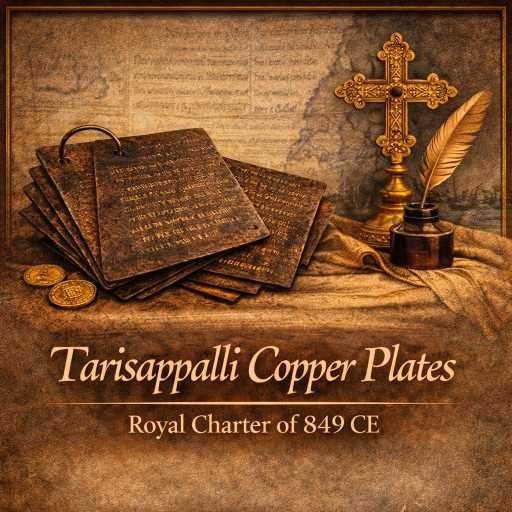
The Tarisappalli copper plates, dated to 849 CE and issued in the name of the Chera king Sthanu
Ravi
Varma, represent far more than a medieval legal charter granting privileges to a merchant
community.
From a Syriac Orthodox theological and ecclesiastical perspective, these plates constitute a
vital
historical witness to the ancient, apostolic, and hierarchical nature of Christianity in Kerala
during
the first millennium. This document, preserved in antiquity on imperishable copper, reveals a
Christian
community that was not a loosely organized fellowship of believers but a structured, sacramental
Church
under episcopal authority, maintaining canonical discipline, celebrating the Divine Liturgy, and
functioning as an integral part of the universal Church of the East.
In what follows, we will examine the Tarisappalli charter through multiple lenses: historical
context,
textual analysis, ecclesiastical structure, theological significance, and canonical
implications. Our
goal is not merely to recount historical facts but to interpret this document within the broader
framework of Syriac Orthodox ecclesiology and tradition, demonstrating how the charter
illuminates the
Church's ancient presence, episcopal governance, liturgical life, and relationship to both the
Mother
Church in Persia and the local Hindu polity.
The Ancient Roots of Christianity in India
Christian tradition, consistently maintained by the Malankara Church, holds that the Gospel
first
reached India through the ministry of the Holy Apostle St. Thomas, who arrived on the Malabar
Coast in
52 CE. This apostolic foundation is not a later pious legend but is attested in multiple
independent
sources: the Acts of Thomas (early 3rd century), Eusebius of Caesarea (4th century), St. Ephrem
the
Syrian (4th century), and various Persian sources. The apostolic origin means that the Indian
Church
does not derive from later missionary activity but stands in direct continuity with the
apostolic age,
possessing the same antiquity as the churches of Antioch, Alexandria, and Rome.
By the time of the Tarisappalli charter in 849 CE, Christianity in Kerala was not a new or
foreign
implant but had existed for approximately eight centuries. The Church had weathered
persecutions, maintained
contact with the Mother Church in Persia through regular episcopal ordinations and liturgical
renewal,
developed indigenous expressions of faith within the Syriac liturgical tradition, and
established itself
as a recognized and respected community within the multi-religious landscape of medieval South
India.
The Church of the East Connection
The Malankara Church's ecclesiastical allegiance was to the Church of the East, centered in
Persia
(modern Iraq and Iran). This connection was not merely administrative but deeply theological and
liturgical. The Church of the East provided bishops for India, transmitted Syriac liturgical
texts and
theological literature, maintained standards of canonical discipline, and ensured continuity
with
apostolic tradition. The Mar Sabr Iso mentioned in the Tarisappalli charter was almost certainly
either
sent from the Catholicos-Patriarch in Persia or ordained by a Persian metropolitan for service
in India.
This connection to the Church of the East is crucial for understanding the Tarisappalli
document. The
charter does not describe an independent, self-governing Christian merchant guild but a
canonical
community under lawful episcopal authority, maintaining communion with the wider Church, and
observing
the liturgical and disciplinary norms of the Syriac Christian tradition.
The Socio-Political Context: Hindu Kingdoms and Christian Communities
Medieval Kerala was ruled by Hindu dynasties, particularly the Chera kings who patronized both
Hinduism
and Jainism. Yet these rulers displayed remarkable religious tolerance, granting significant
autonomy
and privileges to minority communities including Christians, Jews, and Muslims. The Christian
community
in Kerala consisted primarily of merchants and artisans engaged in international
trade—particularly the
spice trade connecting India with Persia, Arabia, and eventually Europe.
The granting of the Tarisappalli charter must be understood in this context of pragmatic
pluralism. The
Chera king recognized the economic value of the Christian merchant community and granted them
substantial
privileges to encourage their continued residence and commercial activity. Yet the charter's
provisions
go far beyond mere economic concessions—they recognize the Church's hierarchical structure,
grant
ecclesiastical authority to the bishop, protect the Church's canonical independence, and ensure
the
material resources necessary for liturgical and pastoral ministry.
The following is a careful translation of the Tarisappalli copper plates, preserved in the
ancient
Vatteluttu script. This translation seeks to capture not only the literal meaning of the
grant but also
its theological and ecclesiastical implications for understanding the structure and
authority of the
9th-century Malankara Church.
The Royal Grant
Opening Formula:
"Hail! Prosperity! In the year 24 of the reign of the victorious Sthanu Ravi Varma, the Lord
of the
Chera Kingdom, by the grace of the divine powers and for the merit of the royal house, the
following
grant has been made to the assembly at Tarisappalli (Quilon)."
The Grantees
The Christian Community:
"To Mar Sabr Iso, the chief of the Tarisappalli church, and to the heads of the Anjuvannam
(the assembly
of Christian merchants) and the Manigramam (the guild of artisans), who have come from the
west and
settled in our kingdom, the following privileges are granted by the royal command."
Land Grant
Territorial Concession:
"The land measuring one hundred and twenty-two velis (a measure of land area) around the
Tarisappalli
church, including all houses, gardens, wells, ponds, tanks, cultivated fields, waste lands,
and all
things appertaining thereto, is hereby granted to the said Mar Sabr Iso and the assembly."
Economic Privileges
Tax Exemptions:
"They shall be exempt from all royal taxes, tolls, and duties on goods bought and sold
within the
granted land. No officer of the king shall levy any tax or demand upon them."
Trade Privileges:
"They may buy and sell freely in all markets of the kingdom. They may use the royal roads,
waterways,
and ports without payment of passage fees. They may weigh their goods using royal weights
and measures."
Revenue Rights:
"All revenues arising from the granted land—including produce taxes, customary dues, market
fees, and
fines—shall belong to the church and assembly. The measuring fee on goods weighed shall be
handed over
to the church for its support."
Legal and Judicial Autonomy
Self-Governance:
"The heads of the Anjuvannam and Manigramam shall enquire into offences committed by their
people and
shall administer justice according to their own customs and laws. The royal courts shall not
interfere
in their internal matters."
Marriage and Family Law:
"Marriages among the Christians shall be celebrated according to their own rites. The
lamp-lighting
ceremony (Christian wedding ritual) shall be performed by the Mar (bishop) or his designated
priest.
Children born of such marriages shall belong to the Christian community."
Right of Protest:
"If any injustice is done to them by royal officers or others, they may seek redress even by
obstructing
the payment of duty and weighing fee until justice is rendered."
Ecclesiastical Authority
Episcopal Headship:
"Mar Sabr Iso, the bishop, shall be the spiritual head of all Christians in the region. He
shall ordain
priests, consecrate churches, administer the sacraments, and exercise ecclesiastical
discipline according
to the canons of the Church."
Church Property:
"All revenues arising from the granted land shall belong to the church for the support of
worship,
clergy, and charitable works. The bishop and assembly heads shall jointly administer these
resources for
the common good."
Governance Structure
Collegiate Authority:
"Only what is done jointly by the two heads—the Mar and the chief of the merchants—shall be
valid in
matters affecting the whole community. Neither may act alone in affairs of common concern."
The Seventy-Two Privileges
Royal Honors:
"We have conferred upon these people the seventy-two privileges, beginning with the ceremony
of earth
and water on elephant-back at marriages."
Perpetual Grant
Enduring Validity:
"This grant shall endure as long as the sun and moon shine, as long as the earth supports
life. It is
binding upon all our successors, officers, and subjects. Whoever violates this grant shall
incur the sin
of killing a thousand cows on the banks of the Ganges."
Witnesses
Multilingual Attestation:
"This grant is witnessed by the following, each signing in their own script:"
- Persian witnesses: [Names in Pahlavi script]
- Arab witnesses: [Names in Arabic script—Kufic]
- Jewish witnesses: [Names in Hebrew script]
- Local Hindu witnesses: [Names in Vatteluttu script]
Conclusion
Royal Seal:
"Given under the royal seal at Mahodayapuram (the Chera capital), in the presence of the
assembled
nobles, merchants, and religious leaders, on the auspicious day of [date]."
The Episcopal Office: Mar Sabr Iso
The central ecclesiastical figure in the Tarisappalli charter is "Mar Sabr Iso," identified as
the head
of the Tarisappalli church. The title "Mar" (Syriac: ܡܳܪܝ, literally "my lord") is the
traditional
honorific for bishops in the Syriac Christian tradition. This is not a courtesy title but
indicates
genuine episcopal rank—Mar Sabr Iso possessed apostolic authority transmitted through the laying
on of
hands in succession from the apostles.
In Syriac Orthodox ecclesiology, the bishop is not merely an administrator or community leader
but the
living icon of Christ in his Church. The bishop stands at the altar as the high priest offering
the
Eucharistic sacrifice; he is the guardian of apostolic doctrine and tradition; he possesses the
fullness
of sacramental authority to ordain, confirm, consecrate, and absolve; and he exercises pastoral
care
over the flock entrusted to him. The Tarisappalli charter's recognition of Mar Sabr Iso's
headship thus
acknowledges not a human organizational structure but a divinely instituted hierarchy essential
to the
Church's very nature.
Sacramental and Liturgical Authority
The charter specifically mentions that marriages "shall be celebrated according to their own
rites" and
that "the lamp-lighting ceremony shall be performed by the Mar or his designated priest." This
reveals
several crucial aspects of ecclesiastical structure:
- Sacramental Authority: Marriage in Syriac Orthodox theology is a holy
mystery
(sacrament) that must be blessed by the Church through her ordained ministers. The reference
to the
Mar performing or delegating the wedding rite indicates that valid Christian marriage
requires
ecclesiastical sanction—it is not a merely civil or social contract but a sacred bond
established
before God and the Church.
- Liturgical Distinctiveness: The phrase "according to their own rites"
acknowledges
that Christians possess a unique liturgical tradition distinct from Hindu ceremonies. This
reflects
the Church's maintenance of the Syriac liturgical heritage, including the Qurbana (Divine
Liturgy),
the seven mysteries, the daily offices of prayer, and the sanctification of life's passages
through
sacramental rites.
- Priestly Ministry: The mention that the Mar may designate a priest for the
ceremony indicates a clerical hierarchy: the bishop ordains priests who serve under his
authority,
celebrating sacraments and conducting pastoral ministry on his behalf. This is the
traditional
three-fold order of bishop, presbyter, and deacon that has existed in the Church since
apostolic
times.
The Anjuvannam and Manigramam: Lay Leadership
The charter repeatedly refers to the "heads of the Anjuvannam and Manigramam" as sharing
governance
responsibilities with the bishop. These terms require clarification:
- Anjuvannam: This appears to be a transliteration of a Syriac term (possibly
related
to ܥܺܕܬܳܐ, edta, "church" or "assembly") referring to the organized Christian merchant
community. In
medieval Kerala, Christians were particularly prominent in the spice trade, and the
Anjuvannam
represented their corporate interests.
- Manigramam: This was a powerful merchant and artisan guild in medieval
South India,
not exclusively Christian but including many Christian members. The Manigramam's inclusion
in the
charter indicates Christian participation in this influential economic organization.
The presence of these lay leaders alongside the bishop does not indicate a congregational or
democratic
church government but rather reflects the Syriac Orthodox principle of symphonia—a harmonious
cooperation between spiritual and temporal authorities. The bishop possesses sole authority in
spiritual
matters (doctrine, sacraments, ordination, ecclesiastical discipline), while lay leaders handle
temporal
affairs (property management, economic transactions, civic relations). Major decisions affecting
the
whole community require consultation and consensus, but each sphere respects the other's proper
domain.
Canonical Discipline and Church Courts
The provision that "the heads of the Anjuvannam and Manigramam shall enquire into offences of
their
people" grants the Christian community judicial autonomy. In Syriac Orthodox understanding, this
is
essential for maintaining canonical order. The Church possesses her own system of law (canon
law)
derived from Scripture, apostolic tradition, and ecumenical councils. This law governs clergy
conduct,
marriage validity, property disputes, penitential discipline, and communal order.
For Christians to be subject to Hindu legal codes in matters touching faith and morals would
compromise
the Church's integrity. The Tarisappalli charter's grant of judicial autonomy thus protects the
Church's
ability to function according to her own sacred laws. Ecclesiastical courts, presided over by
the bishop
and assisted by lay advisors, would hear cases, impose canonical penances, and maintain
discipline
according to the canons received from the apostles and fathers.
The Church as Eucharistic Community
Although the Tarisappalli charter does not explicitly mention the celebration of the Divine
Liturgy
(Qurbana), the very existence of a church building, a bishop, and ordained clergy presupposes
regular
Eucharistic worship. In Syriac Orthodox theology, the Church is constituted by the Eucharist.
Where the
bishop stands at the altar and celebrates the Holy Mysteries, offering the sacrifice of
thanksgiving and
feeding the people with the Body and Blood of Christ—there is the Church in its fullness.
The Tarisappalli church was not merely a meeting house but a sacred space where heaven and earth
meet,
where the altar becomes the throne of God, where bread and wine are transformed into the
life-giving
sacrament. The economic privileges granted by the charter—land, revenues, tax exemptions—all
ultimately
serve this central purpose: to enable the Church to gather regularly for the Divine Liturgy, to
support
the clergy who offer the sacrifice, to maintain the church building as a house of prayer, and to
provide
the material elements (bread, wine, incense, oil) necessary for sacramental celebration.
Episcopal Succession: The Apostolic Link
Mar Sabr Iso's episcopal authority was not self-assumed or democratically conferred but derived
from
apostolic succession—the unbroken chain of episcopal ordinations extending back to the apostles
themselves. In Syriac Orthodox ecclesiology, Christ established the apostolic ministry, the
apostles
ordained bishops as their successors, and these bishops in turn have ordained successive
generations of
bishops down to the present day.
Mar Sabr Iso would have been ordained either by the Catholicos-Patriarch of the Church of the
East in
Persia or by a metropolitan acting under his authority. This means he carried with him not only
ecclesiastical credentials but the grace of the apostolic office itself—the charism transmitted
through
the laying on of hands that empowers a man to act in persona Christi, offering the Eucharistic
sacrifice, forgiving sins, and shepherding the flock. The Tarisappalli charter's recognition of
Mar Sabr
Iso's authority thus implicitly acknowledges the legitimacy of apostolic succession and the
divine
origin of episcopal ministry.
The Church's Material Needs: Incarnational Theology
The charter's extensive economic provisions—tax exemptions, trade privileges, revenue
rights—serve not
worldly enrichment but the Church's spiritual mission. In Syriac Orthodox understanding, the
Church
requires material resources to fulfill its salvific work: clergy must be supported so they can
dedicate
themselves to prayer and ministry (1 Corinthians 9:13-14); churches must be built and maintained
as
houses of God where the Mysteries are celebrated; the poor must be fed and the sick cared for;
children
must be educated in the faith; liturgical books and vestments must be obtained; and
communication with
the Mother Church in Persia must be sustained. Every economic privilege granted by the charter
ultimately serves these spiritual ends, enabling the Church to be the Church—a sacramental,
charitable,
educational, and missional community.
Judicial Autonomy: Canon Law and Ecclesiastical Discipline
The provision that "The heads of the Anjuvannam and Manigramam shall enquire into offences of
their
people" grants the Christian community judicial autonomy—the right to be governed by their own
laws
rather than Hindu legal codes. This is crucial for ecclesial integrity. The Church possesses its
own
canon law, received from the apostles and developed through ecumenical councils, governing
everything
from clergy discipline to marriage law to property disputes to penitential practices. For
Christians to
be subject to Hindu courts in matters touching faith, morals, and church order would compromise
the
Church's ability to maintain apostolic discipline. The charter's grant of judicial autonomy thus
protects the Church's canonical independence, allowing it to function as a self-governing body
under its
own sacred laws—laws that ultimately derive not from human invention but from divine revelation
and
apostolic tradition.
The Right of Protest: Prophetic Resistance to Injustice
Perhaps most remarkable is the provision: "If injustice is done to them, they may seek redress
even by
obstructing the payment of duty and weighing fee." This grants Christians not merely the passive
right
to suffer injustice but the active right to resist it through economic non-cooperation. In
Syriac
Orthodox political theology, this reflects the Church's prophetic role to speak truth to power
and
resist unjust authority. While Christians are commanded to honor rulers and obey legitimate
laws, they
are never obligated to submit to injustice. The Hebrew prophets denounced unjust kings; John the
Baptist
rebuked Herod; the apostles declared "We must obey God rather than men" (Acts 5:29). The
Tarisappalli
charter's recognition of the Christian right to protest injustice enshrines this prophetic
principle in
civil law, acknowledging that there are limits to royal authority and that Christians possess
inherent
rights that no earthly power can justly violate.
Collegiate Governance: The Synodal Principle
The requirement that "only what is done jointly by these two heads shall be valid" establishes a
form
of collegiate or synodal governance. Major decisions require consensus between the
ecclesiastical
authority (Mar Sabr Iso) and the merchant guild leadership. This reflects the Syriac Orthodox
understanding that authority in the Church is never absolute or arbitrary but must be exercised
in
communion and consultation. Even bishops, who hold apostolic authority, traditionally govern in
consultation with presbyters, deacons, and lay representatives. The Tarisappalli arrangement
institutionalizes this consultative principle, preventing either autocratic ecclesiastical rule
or
secular domination of church affairs. Both spiritual and temporal leaders must work together,
each
respecting the other's proper sphere of authority, for the common good of the community.
Church Property and Liturgical Support
The provision that "All revenues arising from the granted land shall belong to the church" and
that
"The measuring fee shall be handed over to the church" establishes enduring financial support
for
liturgical and pastoral work. In Syriac Orthodox ecclesiology, church property is not the
personal
possession of clergy but belongs to Christ and his Church, held in trust for sacred purposes.
These
revenues would have supported the daily liturgical cycle—morning and evening prayer, the Divine
Liturgy
celebrated regularly, the sanctification of time through the liturgical year. They would have
funded the
purchase of incense, wine, and oil for the sacraments; the copying of Syriac liturgical
manuscripts; the
payment of cantors and clergy; the maintenance of the church building and its sacred vessels. By
securing permanent endowment for the church, the charter ensured that the worship of God—the
Church's
primary purpose—could continue uninterrupted across generations.
The Multilingual Witnesses: The Catholic Church
The presence of Persian, Arab, and Jewish witnesses, each signing in their own script, manifests
the
Church's essential catholicity. "Catholic" (from Greek καθολικός, katholikos) means "universal"
or
"according to the whole." The Church transcends ethnic, linguistic, and national boundaries,
uniting
diverse peoples in the one body of Christ. The Tarisappalli charter's multilingual character
witnesses
to this unity in diversity—Persians and Arabs, Jews and Indians, all gathered to witness and
bless the
grant to the Christian community. This assemblage of peoples from across the known world,
converging on
a small church in Kerala, testifies that the Gospel has reached to the ends of the earth and
that the
Church truly is "a people for his own possession" (1 Peter 2:9) drawn from every tribe and
tongue.
The Church in the World but Not of the World
The overall structure of the Tarisappalli charter presents a theological model of the Church's
relationship to the world. The Church receives recognition, protection, and privileges from
worldly
authority (the emperor and local ruler), yet maintains its distinct identity, internal
governance, and
spiritual independence. Christians participate fully in economic and civic life—trading,
crafting,
governing—yet remain a separate people with their own laws, customs, and sacred order. This
balance—in
the world but not of the world (John 17:14-16)—reflects authentic Christian existence. The
Church
neither withdraws from society into isolated sectarianism nor compromises its distinctive
identity for
acceptance and privilege. Instead, it maintains its boundaries where necessary (worship,
governance,
marriage) while engaging collaboratively where possible (trade, civic consultation, cultural
exchange).
The Tarisappalli model shows that faithful Christian witness can receive honor from
non-Christian
authorities without compromising essential faith.
Eschatological Significance: The Church's Endurance
Finally, the very survival of the Tarisappalli plates carries eschatological significance. In
Syriac
Orthodox theology, history moves toward the final consummation when Christ will return and
establish his
eternal kingdom. Until that day, the Church endures through tribulation, persecution, and
upheaval,
bearing witness to Christ across time and space. The Tarisappalli plates, surviving Portuguese
destruction, weathering centuries of colonial oppression, preserved through political chaos and
social
transformation, testify to Christ's promise: "The gates of hell shall not prevail against it"
(Matthew
16:18). The plates' endurance is a sign of the Church's indestructibility. Though kingdoms rise
and
fall, though empires conquer and crumble, though persecutors rage and oppressors destroy, the
Church
remains—bearing her ancient testimony, maintaining her apostolic faith, celebrating her sacred
Mysteries, until the day when Christ returns and all the scattered fragments are gathered into
the
eternal wholeness of God's kingdom.
Conclusion: A Sacred Charter for an Apostolic Church
From this Syriac Orthodox theological perspective, the Tarisappalli copper plates are far more
than a
medieval legal document. They are a sacred charter that documents the Church's apostolic
presence,
episcopal structure, sacramental life, canonical order, and providential protection in
9th-century
India. Every provision of the charter—from marriage ceremonies to tax exemptions, from judicial
autonomy
to revenue rights—serves ultimately to enable the Church to be the Church: a community gathered
around
bishop and altar, celebrating the Divine Liturgy, administering the Holy Mysteries, maintaining
apostolic tradition, serving the poor, and bearing witness to the risen Christ. The charter's
survival
across twelve centuries, through persecution and upheaval, testifies to the faithfulness of God
and the
indestructibility of the Church founded upon the rock of apostolic faith. The Tarisappalli
plates stand
as permanent witnesses—engraved in copper, signed in multiple tongues, preserved by
providence—declaring
to every generation: here stood the Church of Christ, ancient, apostolic, and abiding,
yesterday, today,
and forever.