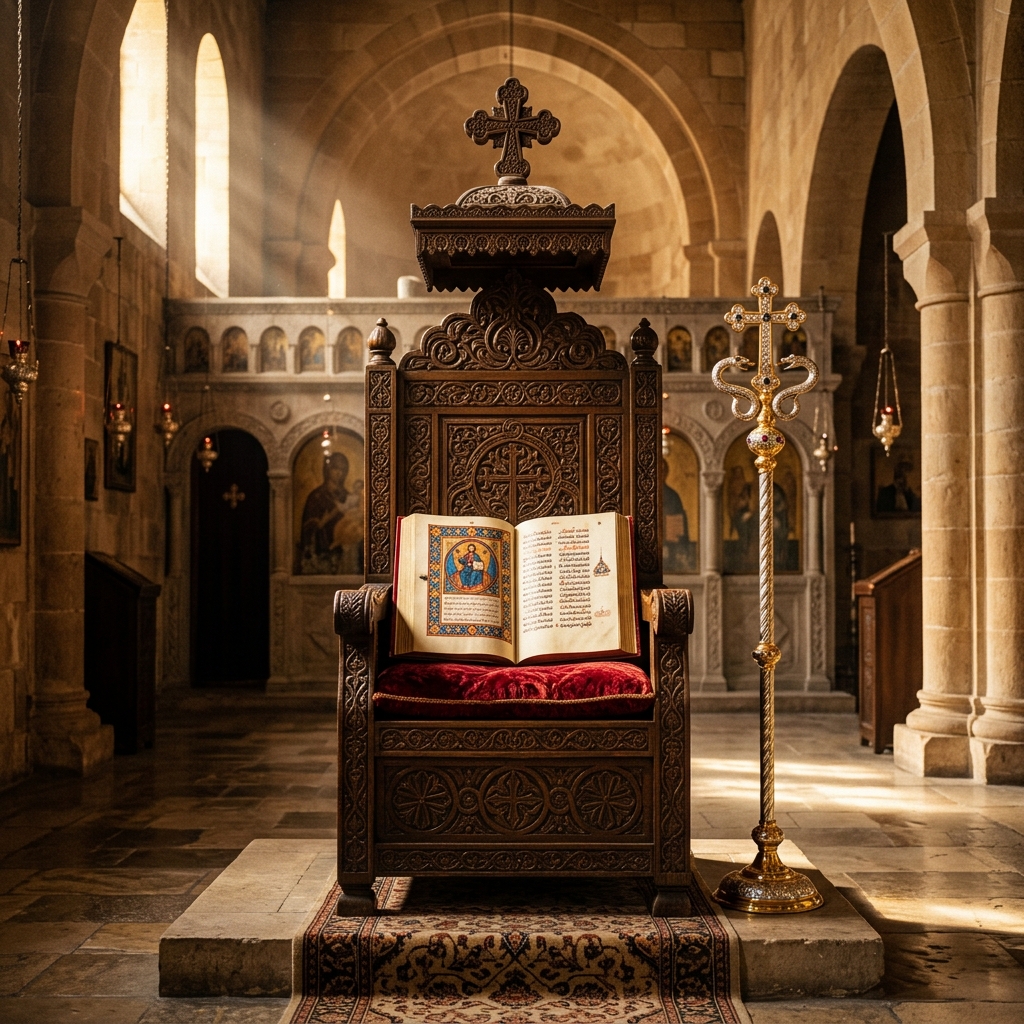
✝️The Holy See of Antioch
The Syriac Orthodox Church of Antioch is held to be the first church of Christianity,
established by the Apostle St. Peter in 37 AD, who thereby became the first Bishop of Antioch.
From that founding moment, an unbroken chain of apostolic succession has extended across twenty
centuries to the present day — a living testimony to the faithfulness of God and the endurance
of the ancient Syriac Christian heritage.
The head of the Syriac Orthodox Church is His Holiness Moran Mor Ignatius Aphrem II Karim, who
resides in Damascus, the capital of Syria. The Church has about 26 archdioceses and
21 Patriarchal Vicariates, with an estimated eight million members globally.
Traditionally, the list of the Patriarchs of Antioch has been inscribed in a spiral form on the
Patriarchal Throne at Dayro d-Mor Hananyo (Deir az-Za'faran), the ancient monastery
near Mardin in present-day Turkey that served for centuries as the Patriarchal seat. As is not
uncommon with historical accounts, sources for the chronological list of Patriarchs differ on
exact dates, particularly for the earlier centuries.
Primary Sources for this Chronological List:
- History of Syriac Literature and Sciences, Patriarch Ignatius Ephrem I Barsoum;
Presseggiata Press, 2000.
- Article by H.H. Moran Mor Ignatius Aphrem Barsoum I, published in the Patriarchal
Journal, Damascus, vol. 17 September 1982, pp. 8–14.
- Syriac Church of Antioch's History, Part 2, by H.E. Severius Yacoub Touma (The
Patriarch); Beirut, 1957, p. 337.
- Suriyani Sabha Charithram Viswasa Sathyangalum, by Very Rev. Dr. Kurian
Kaniamparambil Corepiscopa, 1982.
- Ecclesiastical History of the Patriarchs, by H.E. Metropolitan Y. Dolabani;
Netherlands, 1990.
Non-canonical / Interregnum / Rival claimant
📜Chronological List of Patriarchs
I. The Apostolic & Early Patristic Era (37–323 AD)
| # |
Name |
Tenure |
| 1 |
St. Peter the Apostle |
37 – 67 |
| 2 |
St. Evodius |
67 – 68 |
| 3 |
St. Ignatius I Nurono (the Illuminator) |
68 – 107 |
| 4 |
St. Heron |
107 – 127 |
| 5 |
St. Cornelius |
127 – 154 |
| 6 |
St. Heros |
154 – 169 |
| 7 |
St. Theophilos |
169 – 182 |
| 8 |
St. Maximos I |
182 – 191 |
| 9 |
St. Serapion |
191 – 211 |
| 10 |
St. Ascelpiadis the Confessor |
211 – 220 |
| 11 |
Philitus |
220 – 231 |
| 12 |
Zbina |
231 – 237 |
| 13 |
St. Babylas the Martyr |
237 – 251 |
| 14 |
Fabius |
251 – 254 |
| 15 |
St. Demetrianos |
254 – 260 |
| 16 |
Paul I of Samosate |
260 – 268 (d. 272) |
| 17 |
Domnus I |
268 – 273 |
| 18 |
Timaeus |
273 – 282 |
| 19 |
Cyril I |
283 – 303 |
| 20 |
Tyrannos |
304 – 314 |
| 21 |
Vitalis |
314 – 320 |
| 22 |
St. Philogonus |
320 – 323 |
| 23 |
Paulinos of Tyre |
323 – 324 |
| 24 |
St. Eustatheos |
324 – 337 |
Arian Occupation of the See (331–360)
Following the exile of St. Eustatheos, the Arians seized control of the See of Antioch and
appointed a series of non-canonical occupants. These are not reckoned among the legitimate
Patriarchs in the Syriac Orthodox tradition.
| # |
Name |
Tenure |
| — |
Eulalius |
331 – 333 |
| — |
Euphornius |
333 – 334 |
| — |
Philaclus |
334 – 342 |
| — |
Stephanos |
342 – 344 |
| — |
Leontius |
344 – 357 |
| — |
Eudoxius |
358 – 359 |
| — |
Euzoios |
360 |
II. Post-Nicene to Pre-Chalcedonian Era (360–512 AD)
| # |
Name |
Tenure |
| 25 |
Meletius |
360 – 381 |
| 26 |
St. Flavian I |
381 – 404 |
| 27 |
Porphyros |
404 – 412 |
| 28 |
Alexander |
412 – 417 |
| 29 |
Theodotos |
417 – 428 |
| 30 |
John I |
428 – 442 |
| 31 |
Domnus II |
442 – 449 |
| 32 |
Maximos II |
449 – 455 |
Chalcedonian Occupation (456–482)
After Maximos II abdicated, the Chalcedonians seized control of the See of Antioch and appointed
their own occupants. The legitimate Patriarch Peter II (Qassar) was exiled in 471; the
Chalcedonian line runs parallel until Peter II's restoration in 482.
| # |
Name |
Tenure |
| 33 |
Martoros |
459 – 468 |
| 34 |
Peter II (Qassar) [first tenure; exiled 471] |
468 – 471 |
| — |
Julian (Chalcedonian) |
471 – 476 |
| — |
John II (Orthodox, irregular) cannot be reckoned as legal
patriarch while Peter II lived |
476 – 478 |
| — |
Stephanus II (Chalcedonian) |
478 – 481 |
| — |
Callandion (Chalcedonian) |
481 – 482 |
| 34 |
Peter II the Fuller (Qassar) [restored from exile]
|
482 – 488 |
| 35 |
Palladius |
488 – 498 |
| 36 |
Flavian II |
498 – 512 |
III. St. Severus the Great and the Chalcedonian Schism (512–544)
The tenure of Mor Severus the Great (512–538) marks the decisive separation of the Syriac
Orthodox Church from the Chalcedonian communion. Forced to flee to Egypt in 518 following the
Chalcedonian reconquest, Mor Severus continued to exercise his Patriarchal authority in exile
until his repose in 538. The See of Antioch was vacant from 538 to 544, the year in which
Jacob Baradaeus (Yacoub Burdhono) consecrated Sergius of Tella as Patriarch, restoring
the canonical succession.
| # |
Name |
Tenure |
| 37 |
St. Severus the Great |
512 – 538 |
| — |
Paul the Jew (Chalcedonian) |
518 – 521 |
| — |
Euphrosius (Chalcedonian) |
521 – 528 |
| — |
Ephrem of Amid (Chalcedonian) |
528 – 546 |
| 38 |
Sargius of Tella [consecrated by Jacob Baradaeus] |
544 – 546 |
IV. Early Medieval Era (550–817)
| # |
Name |
Tenure |
| 39 |
Paul II the Black of Alexandria [deposed 575 for joining
Chalcedonians] |
550 – 575 |
| 40 |
Peter III of Raqqa |
581 – 591 |
| 41 |
Julian I |
591 – 595 |
| 42 |
Athanasius I Gammolo |
595 – 631 |
| 43 |
John II of the Sedre |
631 – 648 |
| 44 |
Theodore |
649 – 667 |
| 45 |
Severius II bar Masqeh |
667 – 681 |
| 46 |
Athanasius II Baldoyo |
683 – 686 |
| 47 |
Julian II |
686 – 708 |
| 48 |
Elias I |
709 – 723 |
| 49 |
Athanasius III |
724 – 740 |
| 50 |
Iwannis I |
740 – 754 |
| — |
Iwannis Isaac [appointed at behest of Caliph] |
754 – ? |
| — |
Athanasius al-Sandali [appointed at behest of Caliph]
|
? – 758 |
| 51 |
George I |
758 – 790 |
| 52 |
Joseph |
790 – 792 |
| 53 |
Kyriakos of Takrit |
793 – 817 |
V. High Medieval Era (817–1166)
| # |
Name |
Tenure |
| 54 |
Dionysius I of Tell-Mahre |
817 – 845 |
| 55 |
John III |
846 – 873 |
| — |
The See was vacant from
873 to 878. |
| 56 |
Ignatius II |
878 – 883 |
| 57 |
Theodosius Romanos of Takrit |
887 – 896 |
| 58 |
Dionysius II |
897 – 909 |
| 59 |
John IV Qurzahli |
910 – 922 |
| 60 |
Baselius I |
923 – 935 |
| 61 |
John V |
936 – 953 |
| 62 |
Iwanis II |
954 – 957 |
| 63 |
Dionysius III |
958 – 961 |
| 64 |
Abraham I |
962 – 963 |
| 65 |
John VI Srighta |
965 – 985 |
| 66 |
Athanasius IV of Salah |
986 – 1002 |
| 67 |
John VII bar ʿAbdun |
1004 – 1033 |
| 68 |
Dionysius IV Yahya |
1034 – 1044 |
| — |
The Holy See was vacant
due to internal conflicts for several years. |
| 69 |
John VIII |
1049 – 1057 |
| 70 |
Athanasius V |
1058 – 1063 |
| 71 |
John IX bar Shushan |
1063 – 1073 |
| 72 |
Baselius II |
1074 – 1075 |
| — |
John Abdun [self-appointed; deposed but continued causing
trouble until 1091] |
1075 – 1091 |
| 73 |
Dionysius V Lazaros |
1077 – 1078 |
| 74 |
Iwanis III |
1080 – 1082 |
| 75 |
Dionysius VI |
1088 – 1090 |
| 76 |
Athanasius VI bar Khamoro |
1091 – 1129 |
| 77 |
John X bar Mawdyono |
1129 – 1137 |
| 78 |
Athanasius VII bar Qutreh |
1138 – 1166 |
VI. The Era of Michael I Rabo and His Successors (1166–1421)
| # |
Name |
Tenure |
| 79 |
Michael I Rabo the Great |
1166 – 1199 |
| 80 |
Athanasius VIII |
1200 – 1207 |
| 81 |
John XI Yeshu the Writer |
1208 – 1220 |
| 82 |
Ignatius III David |
1222 – 1252 |
| 83 |
John XII bar Maʿdani |
1252 – 1263 |
| 84 |
Ignatius IV Yeshu |
1264 – 1282 |
| 85 |
Philoxenos I Nemrud |
1283 – 1292 |
| 86 |
Michael II |
1292 – 1312 |
| 87 |
Michael III Yeshu |
1312 – 1349 |
| 88 |
Baselius III Gabriel |
1349 – 1387 |
| 89 |
Philoxenos II the Writer |
1387 – 1421 |
VII. Late Medieval & Early Ottoman Era (1421–1640)
| # |
Name |
Tenure |
| 90 |
Baselius IV Shemʿun of Beth Manʿem |
1421 – 1444 |
| 91 |
Ignatius Behnam al-Hadli |
1445 – 1454 |
| 92 |
Ignatius Khalaf |
1455 – 1483 |
| 93 |
Ignatius John XIII (Mardin) |
1483 – 1493 |
| 94 |
Ignatius Nuh of Lebanon (Ba Qufi) |
1493 – 1509 |
| 95 |
Ignatius Yeshu I (Qilleth) |
1509 – 1512 |
| 96 |
Ignatius Jacob I (Sawro) * |
1512 – 1517 |
| 97 |
Ignatius David I (Maʿdan) |
1517 – 1520 |
| 98 |
Ignatius Abdullah I Stephan (Qalʿat Mara) |
1520 – 1557 |
| 99 |
Ignatius Niʿmet Allah I (Mardin) |
1557 – 1576 |
| 100 |
Ignatius David II Shah (Mardin) |
1576 – 1591 |
| 101 |
Ignatius Pilate I (Mansuriyeh) |
1591 – 1597 |
| 102 |
Ignatius Hadayat Allah (Mardin) |
1597 – 1639 |
VIII. Ottoman Period to the Present (1640–)
| # |
Name |
Tenure |
| 103 |
Ignatius Shemʿun I (Turabdin) |
1640 – 1659 |
| 104 |
Ignatius Yeshu II Qamsheh (Amid-Diyar Bakir) |
1659 – 1662 |
| 105 |
Ignatius Abdul Masih I (Urhoy-Edessa) |
1662 – 1686 |
| 106 |
Ignatius George II (Mosul) |
1687 – 1708 |
| 107 |
Ignatius Isaac ʿAzar (Mosul) |
1709 – 1722 |
| 108 |
Ignatius Shukr Allah (Mardin) |
1722 – 1745 |
| 109 |
Ignatius George III (Urhoy-Edessa) |
1745 – 1768 |
| 110 |
Ignatius George IV (Mosul) |
1768 – 1781 |
| 111 |
Ignatius Matthew (Mardin) |
1782 – 1817 |
| 112 |
Ignatius Yunan (Mosul) |
1817 – 1818 |
| 113 |
Ignatius George V (Aleppo) |
1819 – 1837 |
| 114 |
Ignatius Elias II (Mosul) |
1838 – 1847 |
| 115 |
Ignatius Jacob II (Qalʿat Mara) |
1847 – 1871 |
| 116 |
Ignatius Peter IV (Mosul) |
1872 – 1894 |
| 117 |
Ignatius Abdul Masih II (Qalʿat Mara) [deposed 1905]
|
1895 – 1905 |
| 118 |
Ignatius Abdeh d-Aloho II (Sadad) |
1906 – 1915 |
| 119 |
Ignatius Elias III (Mardin) |
1917 – 1932 |
| 120 |
Ignatius Afram I Barsoum (Mosul) |
1933 – 1957 |
| 121 |
Ignatius Jacob III (Bartelleh) |
1957 – 1980 |
| 122 |
Ignatius Zakka I Iwas (Mosul) |
1980 – 2014 |
| 123 |
Ignatius Ephrem II Karim Current
|
2014 – present |
☩The Apostolic Continuity
From the first century to the twenty-first, the Holy See of Antioch has maintained its apostolic
succession through persecution, exile, schism, conquest, and martyrdom. The Syriac Orthodox Church
of Antioch holds with firm faith that this chain of consecration, reaching back to the Apostle
Peter himself, constitutes the living bond between the early Church of the New Testament and the
faithful of today.
This apostolic legacy extends globally, most notably encompassing the Jacobite Syrian
Christian Church in Malankara (India). Tracing its roots to the missionary labors of
the Apostle St. Thomas, the Malankara Church has for centuries maintained an indissoluble spiritual
and canonical bond with the Patriarchal See of Antioch, looking to the successor of St. Peter as its
supreme spiritual head.
Each Patriarch in this succession assumed the name Ignatius in honor of the martyr
St. Ignatius I Nurono — the third Patriarch of Antioch and one of the Apostolic Fathers — a
tradition that has been maintained without interruption since the medieval period. This practice
is itself a liturgical and theological statement: every Patriarch stands in the same office,
bears the same witness, and is accountable to the same Lord.
His Holiness Moran Mor Ignatius Aphrem II Karim, the 123rd successor of St. Peter in the See
of Antioch, continues to shepherd the global community — from the ancient lands of the Middle East
to the vibrant archdioceses of India and the worldwide diaspora — guiding the faithful amid the
enduring challenges and triumphs of the twenty-first century.