✝️ Who Are the Nasranis?
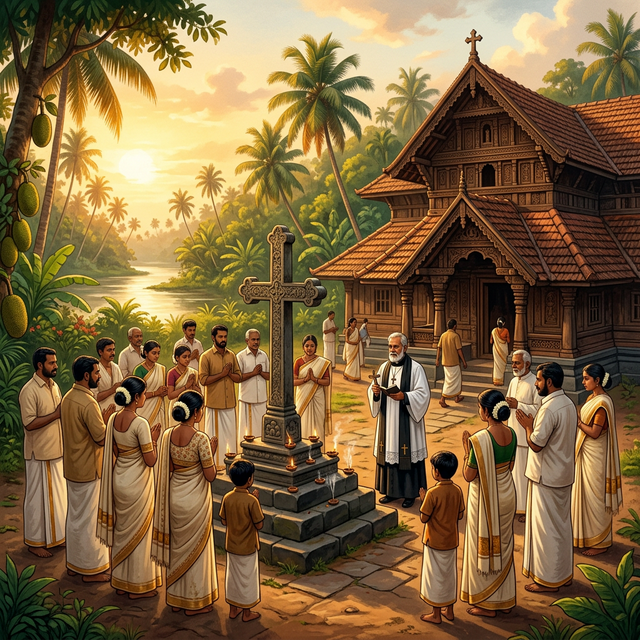
The Nasranis — also known as Saint Thomas Christians, Syrian Christians, or Malankara Christians
— are one of the most ancient Christian communities in the world. Residing predominantly in the
state of Kerala on the southwestern coast of India, they trace their origins to the apostolic
mission of St.
Thomas the Apostle
in 52 AD, more than a millennium before
Christianity reached
most of northern Europe.
The word Nasrani (നസ്രാണി) is derived from the Syriac-Aramaic term Nasraya,
meaning "follower of the Nazarene" — a reference to Jesus of Nazareth. This name has been used
for centuries to identify these Christians in Kerala and reflects their deep roots in the
ancient
Syriac Christian tradition of the Middle East, the very cradle of Christianity itself.
The Nasrani community today numbers several million people across Kerala and the Indian
diaspora.
Despite centuries of external pressures, colonial interference, and internal divisions, they
have
preserved a rich liturgical, cultural, and theological heritage that stands as a living bridge
between the apostolic church of the first century and the Christianity of the modern world.
Their
story is one of extraordinary resilience — a community born in the apostolic age, shaped by the
Syriac tradition of ancient Mesopotamia, nurtured by the Hindu civilization of Kerala, and
surviving intact into the twenty-first century.
✝️ Apostolic Origins: The Mission of St.Thomas (52 AD)
The Arrival of the Apostle
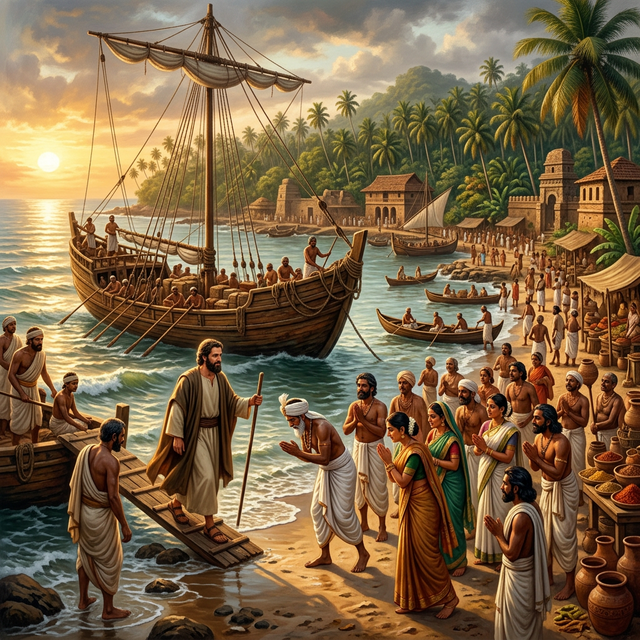
According to the ancient tradition of the Thomas Christians — a tradition held with unbroken
continuity for nearly two millennia — the Apostle Thomas (also called Didymus, meaning "twin")
arrived on the Malabar Coast of Kerala in 52 AD. He is believed to have landed first at
Cranganore (Kodungallur, ancient Muzuris), a major trading port well known to the Greco-Roman
world and connected by the monsoon trade routes to Arabia, Persia, and the Mediterranean.
This date is not merely legend. Ancient trade records, the Periplus of the Erythraean
Sea
(1st century AD), and Pliny the Elder all confirm that Kodungallur (Muzuris) was a thriving port
with Jewish, Arab, and Roman merchant communities at the time of St.Thomas arrival. The
presence of a Jewish diaspora settlement at Kodungallur — the Malabar Jews, or Cochin Jews —
further supports the plausibility of an apostolic mission to the region, as the early Christian
missionaries consistently followed Jewish trade and diaspora routes.
The Seven Churches Founded by St.Thomas
Tradition holds that St.Thomas founded seven churches
(Palliyogam) in Kerala, often
called the Ezharapallikal (Seven and a Half Churches):
- Kodungallur (Cranganore) — the first and most ancient
- Kollam (Quilon)
- Niranam
- Nilackal (Chayal)
- Kokkamangalam
- Kottakkavu (North Paravur)
- Palayur (Paloor) — near Thrissur, believed to be the oldest existing
Christian church in India
These seven churches were established among Jewish settlers and high-caste Hindu Brahmin
families
of the Nambudiri community — a fact consistent with the apostolic method of beginning
evangelization within established, literate communities. The conversion of Brahmin families gave
the nascent Nasrani community a high social standing in the Hindu caste hierarchy, which they
retained for centuries.
The Martyrdom and Legacy of St.Thomas
After his mission in Kerala, St.Thomas is believed to have traveled to the
eastern coast of
India — to Mylapore (present-day Chennai, Tamil Nadu) — where he was martyred around 72 AD,
killed by a spear thrust. His tomb at the Santhome Basilica in Chennai has been a site of
pilgrimage since ancient times. The Portuguese, when they arrived in the 16th century,
identified
the tomb and built a cathedral over it.
The Nasrani community has always held an intense and personal devotion to St.
Thomas as their
founding father. He is venerated not merely as a distant historical figure but as the Apostle of
India — the spiritual patriarch who brought them the Gospel before most of the Western world had
even heard it.
📜 The Ancient Period: Pre-Portuguese Era (52 AD – 1498 AD)
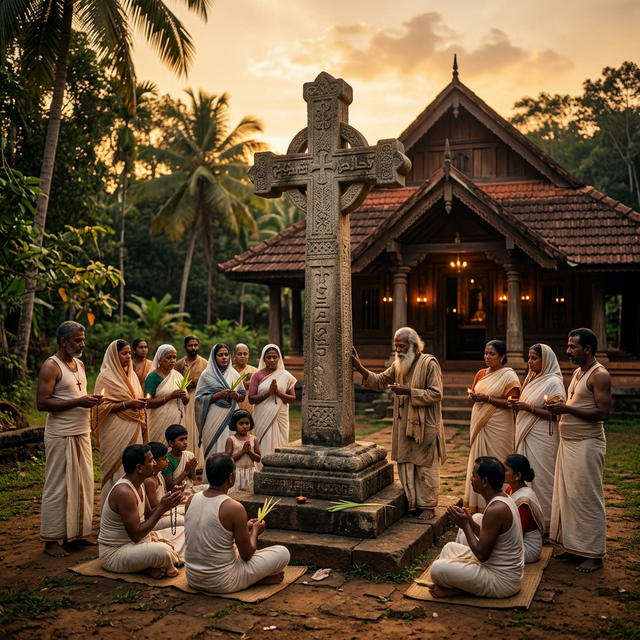
Ecclesiastical Connection with the Church of the East
In the centuries following the apostolic era, the Nasrani community maintained its Christian
identity in relative isolation from the Western church. Their primary ecclesiastical connections
were with the Church of the East (sometimes called the Nestorian Church or Persian Church),
based
in Mesopotamia (modern Iraq), which exercised jurisdiction over the Thomas Christians for many
centuries through the Patriarch of the East based at Seleucia-Ctesiphon, and later at Baghdad.
Bishops, clergy, and liturgical texts came to Kerala from Mesopotamia and Persia, reinforcing
the
Syriac character of the community's worship. The liturgical language remained Classical Syriac
(a direct descendant of Aramaic), the very language spoken in Jesus's homeland. This linguistic
connection meant that the Nasranis were, in a profound sense, praying in the tongue of the
earliest Christians.
A significant event in early Nasrani history was the arrival of a Christian merchant named
Thomas of
Cana (Knāyi Thoma) around 345 AD. He arrived from
Mesopotamia — or possibly Jerusalem — with a group of 72 families of Syriac Christians, bringing
clergy, crosses, and episcopal letters from the Patriarch of the East.
This immigration strengthened the Nasrani community numerically and ecclesiastically, and also
introduced a cultural division that persists to this day: the Southist (Tekkumbhagar)
Christians, who claim descent from the Knanaya settlers, and the Northist
(Vadakkumbhagar)
Christians, who trace their lineage to the original converts of St. Thomas.
Throughout the ancient and medieval periods, the Nasranis enjoyed remarkable social prestige in
Kerala society. The Hindu kings of Kerala granted them special privileges, including the right
to ride palanquins and elephants at church festivals, the right to use umbrellas (a royal symbol
in Kerala), exemption from certain taxes, the right to build churches with flagpoles, and
participation in royal ceremonies alongside Brahmin and Nair nobles.
These privileges are documented in the Tharisa Palli copper
plates
(c. 849 AD), granted by the Venad king Sthanu Ravi Varma to the Thomas Christians under the
leadership of Mar Sabr Iso, a bishop from
the Church of the East. These copper
plates are among the oldest dated documents in Kerala history and survive to this day, bearing
witness in Persian (Pahlavi), Arabic (Kufic), Hebrew, and Malayalam script.
Medieval Contacts and Marco Polo's Testimony
By the 13th and 14th centuries, the Nasrani community had grown considerably across Kerala.
Franciscan and Dominican missionaries from Rome occasionally visited the community but did not
exercise jurisdiction over them. Marco Polo, visiting the Malabar Coast around 1293 AD, recorded
the presence of Indian Christians who venerated the tomb of St. Thomas. The Nasrani community's
fame had clearly spread far beyond India's shores.
⚔️ The Portuguese Era and Latin Domination (1498 – 1653)
The Arrival of Vasco da Gama (1498)
The arrival of Portuguese explorer Vasco da Gama at Calicut (Kozhikode) in 1498 AD marked a
turning point in Nasrani history — and not an entirely welcome one. Initially, the Portuguese
were overjoyed to discover a community of ancient Christians in India, whom they called
"Christians of St. Thomas." The feeling was not entirely mutual; the Nasranis, proud of their
ancient lineage, were bewildered by these western Christians who held unfamiliar doctrines and
practices.
The Portuguese brought political power and military force, and they were determined to bring the
Eastern Christians under Roman Catholic authority. Their theological agenda was driven by the
conviction that the Nasranis, despite their antiquity, were "heretics" because of their
connection with the Church of the East, which had rejected the Council of Ephesus (431 AD) and
the title Theotokos (Mother of God) for the Virgin Mary.
Archbishop Alexis Menezes and the Synod of Diamper (1599)
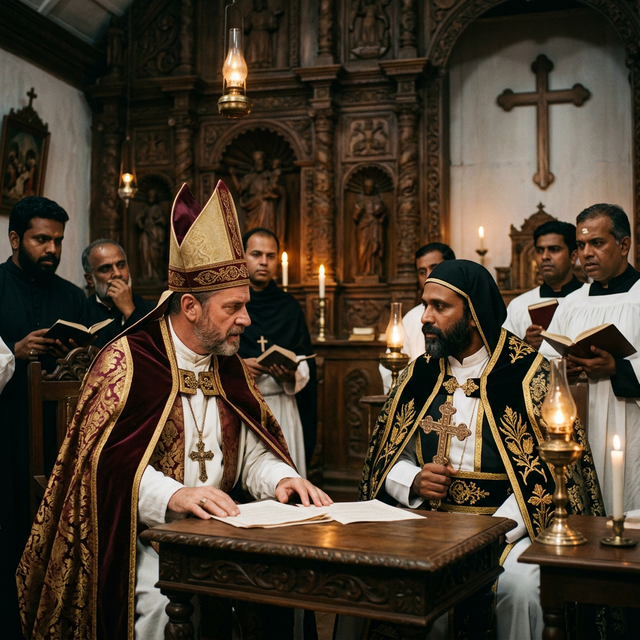
The most dramatic assertion of Portuguese authority came through Archbishop Alexis de Menezes of
Goa, who organized the infamous Synod of Diamper (Udayamperoor),
in 1599. This
synod, held at Udayamperoor near Ernakulam, forcibly Latinized the Nasrani church by:
- Burning ancient Syriac liturgical books and manuscripts deemed heretical
- Abolishing the East Syriac liturgy and replacing it with the Latin Mass
- Declaring the Patriarch of the Church of the East a heretic and severing all ties
- Imposing the authority of Rome and the Archbishop of Goa
- Rewriting liturgical texts to remove elements the Portuguese called "Nestorian"
The Synod of Diamper was a profound violation of the ancient Nasrani church's autonomy and
heritage. Hundreds of irreplaceable Syriac manuscripts — theological texts, liturgical books,
and
historical documents accumulated over fifteen centuries — were destroyed in an act of cultural
vandalism that the Thomas Christians never fully forgave.
The Role of the Archdeacon
Not all Nasranis submitted willingly to Rome. The traditional leader of the Thomas Christians,
the Archdeacon (Jathikkukarthavyan — "Head of the Caste"), continued
to be the de facto civil and ecclesiastical leader of the community. The Archdeacon held
authority over all Nasrani churches, the collection of church revenues, and the appointment of
local clergy. Even under Portuguese pressure, the Archdeacon's position remained influential,
and
he stood as the symbol of Nasrani identity and autonomy against Latin domination.
✝️ The Koonan Kurishu Satyam: The Great Oath (1653)
Background: The Community on the Brink
By the mid-17th century, Portuguese political power in Kerala was declining rapidly under
pressure from the Dutch East India Company (VOC). The Nasrani community had endured over fifty
years of forced Latinization and was deeply resentful of Rome's interference. The community
yearned to reconnect with their ancient Syriac episcopal tradition and to have their own bishop
— not a Latin bishop appointed by Portugal.
In 1653, a bishop named Ahatalla (also called Mar Ignatius) arrived in Kerala claiming to be a
Patriarch sent from Antioch to serve the Thomas Christians. The Portuguese authorities, alarmed
by this threat to their religious control, arrested Ahatalla and took him aboard a ship at
Cochin. The rumor spread among the Nasranis that he had been thrown into the sea — though
historical research suggests he may have been transported to Goa. The news enraged the entire
community.
The Oath at the Leaning Cross
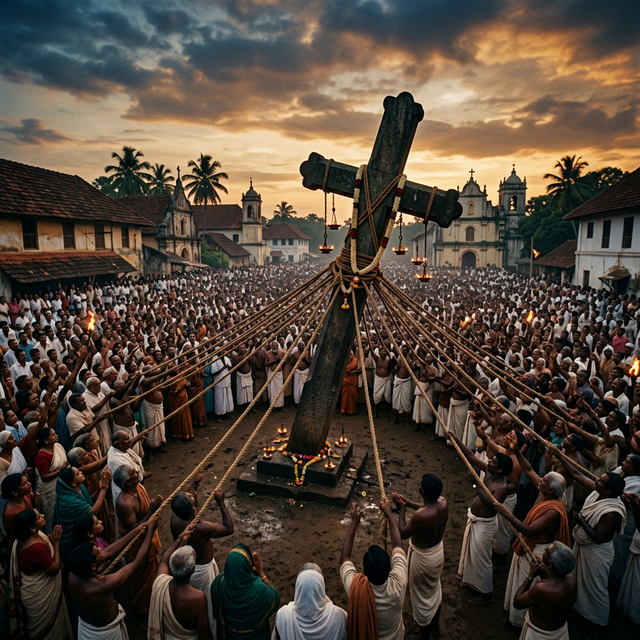
On January 3, 1653, a massive gathering of Nasranis assembled at Mattancherry
(in the premises of Koonen Kurishu — the Leaning Cross) near Cochin. Thousands of people —
clergy and laity, men and women — gathered around a granite cross. In an extraordinary act of
collective defiance, they held ropes tied to the cross and took a solemn oath:
"We will not obey the Franks (Portuguese), nor hold any connection with the Roman church."
— The Koonan Kurishu Satyam, January 3, 1653 AD
This event, known as the Koonan Kurishu Satyam (Oath of the Leaning Cross) or
Coonen Cross Oath, is one of the most dramatic moments in the history of Indian Christianity. It
marked the definitive break of a large segment of the Nasrani community from Roman Catholic
authority. The Nasranis were reclaiming their ancient heritage, their Eastern identity, and
their
spiritual independence.
Consecration of Archdeacon Thomas as Metropolitan
Following the oath, the community faced an ecclesiastical crisis: they had rejected the Latin
bishops, but they had no valid bishop of their own. In an irregular but historically significant
act, twelve priests laid hands on Archdeacon Thomas Kathanar and consecrated
him as the Metropolitan of the Malankara Church, taking the episcopal name
Mor Thoma I.
The irregularity was later corrected when Mor Thoma I received proper episcopal consecration
from
Mar Gregorios of Jerusalem ,
a bishop of the West
Syriac (Syriac Orthodox /
Antiochene) tradition, who arrived in Kerala in 1665. This connection with the Patriarchate of
Antioch permanently reoriented the Malankara Church away from the East Syriac tradition it had
previously followed and established the West Syriac identity that defines the Jacobite Syrian
Church to this day.
⛪ The West Syriac Era and the Antiochene Connection (1665 – 1836)

Mar Gregorios of Jerusalem (1665)
The arrival of Mar Gregorios Abdul Jaleel of Jerusalem in Kerala in 1665 was a
pivotal moment for the Malankara Church. Sent by the Patriarch of Antioch, Mar Gregorios brought
with him the theology, liturgy, and canonical tradition of the West Syriac Church — a tradition
rooted in Antioch, Syria, going back to St. Peter and St. James, the Lord's brother. This
tradition uses the West Syriac Rite (also called the Antiochene Rite or the
Liturgy of St. James), which became the liturgical foundation of the Malankara Church.
Mar Gregorios consecrated Mor Thoma I, regularizing his episcopate. He also introduced the rich
liturgical heritage of the Antiochene tradition: the Qurbono (Divine Liturgy) of St.
James, the Shehimo (daily prayer cycle), and the full range of West Syriac sacramental
theology. The Malankara Church thus shifted from an East Syriac to a West Syriac identity — a
shift that has defined it to this day.
The Jacobite Identity
As the Malankara Church aligned itself with the Syriac Orthodox Church of Antioch — whose
followers are sometimes called "Jacobites" after the 6th-century bishop Mor Yaqub
Burdono who
revitalized Miaphysite Christianity in the Syriac world — the community gradually adopted the
Jacobite identity. The term was used by outsiders and eventually accepted by the community
itself
to describe those Malankara Christians loyal to the Patriarch of Antioch.
Theologically, the Syriac Orthodox tradition adheres to Miaphysitism — the
belief that Christ has one united nature (divine and human) rather than two distinct natures as
defined at the Council of Chalcedon (451 AD). This places the Syriac Orthodox Church alongside
the other Oriental Orthodox churches: the Coptic Orthodox Church of Alexandria, the Ethiopian
Orthodox Church, the Armenian Apostolic Church, and the Eritrean Orthodox Church.
The Mor Thoma Line of Metropolitans
After the Koonan Kurishu Satyam, the Malankara Church was governed by a succession of
Metropolitans known as the Mor Thoma line — from Mor Thoma I through Mor Thoma XIII.
These bishops administered the community, maintained ties with the Patriarchate of Antioch, and
guided the church through a period of relative stability despite continuing challenges from the
remaining Catholic segment and later from the British East India Company.
📖 The 19th Century: Reform, Division, and British Influence

The Mavelikara Padiyola (1836)
The 19th century saw significant upheaval in the Malankara Church, driven partly by the
influence of the Church Missionary Society (CMS) of England. British missionaries established
schools and hospitals among the Thomas Christians and introduced reformed Protestant theological
ideas. A group within the Malankara Church, influenced by Abraham Malpan and his nephew Mathews
Mar Athanasios, sought to reform the church along evangelical Protestant lines.
In 1836, the reformist faction signed the Mavelikara Padiyola — a
document that declared the Malankara Church's willingness to purify its liturgical practices and
align with reformed principles. This eventually led to the formation of the
Mar Thoma Syrian Church, a reformed body that retained Syriac liturgical forms
but adopted Protestant theology on salvation and the sacraments.
The Mulamthuruthy Synod (1876)
The struggle between the Patriarch-loyal traditionalist faction and the reformists came to a
head
through the Mulamthuruthy Synod.
This synod, convened by the Patriarch of Antioch's representative, formally defined the
boundaries of the Jacobite (Patriarch-loyal) community and excommunicated the reformists. It
established canonical norms for the Malankara Jacobite Syrian Church and reaffirmed the
supremacy of the Patriarch of Antioch over the Malankara Church.
The Mulamthuruthy Synod was a landmark
event that consolidated the Jacobite identity of the
Syriac Orthodox community in Kerala and provided the canonical framework that continues to
govern
the Malankara Jacobite Syrian Church to this day.
⛪ The 20th Century: Autonomy, Catholicosate, and Legal Struggles

The Establishment of the Catholicosate (1912)
A major development in the 20th century was the establishment of the
Catholicosate of the East at Devalokam, Kottayam, in 1912. Patriarch Ignatius
Abdul Masih II of Antioch consecrated Mor Paulose Kassis as the Catholicos of the East, creating
a supreme head for the Malankara Church within the framework of the Syriac Orthodox Patriarchate
of Antioch. This gave the Malankara Church greater internal autonomy while remaining in full
communion with Antioch.
However, this move was controversial. Some in the community believed that the establishment of
a Catholicos did not diminish the Patriarch's authority, while others argued it created an
autocephalous church. This controversy laid the seeds for decades of internal conflict.
The Patriarch–Catholicos Dispute
The 20th century was marked by a prolonged legal and ecclesiastical dispute between two factions
within the Malankara Syrian Church: the Patriarch faction, which held that the
Patriarch of Antioch is the supreme head of the Malankara Church, and the
Catholicos faction, which held that the Catholicos in India is autocephalous
(self-governing). This dispute led to numerous Supreme Court cases, including significant
judgments in 1958 and 1995, and a partial unification agreement under Patriarch Mar Ignatius
Yacoub III in 1958.
Today, the Malankara Jacobite Syrian Christian Church remains fully loyal to
the Patriarch of Antioch, while the Malankara Orthodox Syrian Church functions
as an autocephalous body. Both churches are part of the ancient Nasrani heritage and preserve
the West Syriac liturgical tradition.
✝️ The Major Branches of the Nasrani Community Today

The Saint Thomas Christian community today is divided into several distinct churches, each
representing a different historical trajectory from the common Nasrani root:
Also known as the Jacobite Syrian Church, this community is in full communion with the
Syriac Orthodox Patriarchate of Antioch, headquartered in Damascus, Syria. It
recognizes the Patriarch of Antioch as the supreme spiritual head and the Catholicos of India as
the primate in India. This church follows the West Syriac Rite and remains the principal
guardian of the ancient Antiochene liturgical tradition among Kerala Christians.
Malankara Orthodox Syrian Church
The Malankara Orthodox Syrian Church (also called the Indian Orthodox Church)
declared itself fully autocephalous in 1934. It does not recognize the canonical authority of
the Patriarch of Antioch. Its head is the Catholicos of the East and Malankara Metropolitan,
based at Devalokam, Kottayam.
Syro-Malabar Catholic Church
This church represents those Thomas Christians who remained in union with Rome after the Koonan
Kurishu Satyam or who later returned to Catholicism. It follows the East Syriac
(Chaldean) liturgical rite and is a sui iuris Eastern Catholic Church in
full
communion with the Pope of Rome, centered in Ernakulam-Angamaly.
Syro-Malankara Catholic Church
Founded in 1930 by Archbishop Mar Ivanios, who led a portion of the Malankara Orthodox Church
into communion with Rome, the Syro-Malankara Catholic Church follows the West
Syriac Rite while acknowledging papal authority. It is the youngest of the major Nasrani
churches.
Mar Thoma Syrian Church
The Mar Thoma Church is a reformed church that maintains the Syriac liturgical
tradition while adopting Protestant (evangelical Anglican) theology. It emerged from the 19th
century reform movement, is in full communion with the Anglican Communion, and is centered in
Tiruvalla.
Chaldean Syrian Church (Thozhiyoor Church)
A small ancient church maintaining connections to the East Syriac tradition, sometimes called
the Church of Thozhiyoor. It preserves one of the most ancient continuous
episcopal lines in Kerala, independent of both Rome and Antioch.
📜 Culture, Identity, and Heritage of the Nasranis
The most defining characteristic of the Nasrani heritage is its use of
Classical Syriac (Suryani) as the sacred liturgical language. Syriac
is a dialect of Aramaic — the language spoken by Jesus Christ and his disciples. The Thomas
Christians thus have a unique and direct linguistic link to the earliest Christian community.
The Divine Liturgy (Qurbono), the Psalms (Mazmuro), and the daily prayer
cycle (Shehimo) are all celebrated in Syriac to this day in the Jacobite and Orthodox
churches.
Hindu Cultural Elements Within Christian Life
For centuries, the Nasranis lived as a high-caste community within Hindu Kerala society, and
they absorbed numerous Hindu cultural practices while maintaining their Christian faith. These
include the Tali (sacred necklace) used in wedding ceremonies, the Nischayam
(betrothal ceremony) mirroring Hindu engagement customs, the use of coconut oil lamps
(nilavilakku) at church festivals, and naming conventions blending Syriac Christian
names with Malayalam forms. This cultural synthesis made the Nasrani community unique — deeply
Christian in faith and Syriac in liturgy, yet thoroughly Keralite in culture and social life.
Architecture and Artistic Heritage
Nasrani churches are known for their distinctive style blending Kerala's traditional wooden
architecture with Syriac Christian symbolism. Key features include the
Nasrani Menorah (the traditional symbol of the Thomas Christians, reflecting
their ancient Jewish-Christian synthesis), wooden carved interiors with intricate geometric
patterns, the Madhabaha (sanctuary) separated by a veil in traditional churches, and
ancient granite crosses with Pahlavi (Middle Persian) inscriptions dating to the 7th–8th
centuries — silent stone witnesses to fifteen centuries of faith on Indian soil.
✝️ Conclusion: Two Thousand Years of Witness
The history of the Nasranis is ultimately a story of extraordinary resilience. A community
founded by an Apostle, rooted in the Syriac tradition of ancient Mesopotamia, nurtured by the
Hindu civilization of Kerala, battered by Portuguese colonialism, divided by reform movements
and ecclesiastical disputes, and yet surviving into the 21st century as a vibrant, culturally
rich, and spiritually alive people.
The Nasrani community occupies a unique and extraordinary place in world Christian history.
They are among the oldest continuous Christian communities in the world, predating the
Christianization of England, France, Germany, and Scandinavia by many centuries. They are the
oldest Christian community in Asia, keepers of one of the most ancient surviving liturgies —
the West Syriac Rite of St. James — and a living proof that Christianity is not merely a
Western religion but an Eastern religion that spread simultaneously from its birthplace in the
Semitic Middle East.
Whether in the incense-filled sanctuary of a Jacobite church in Kottayam, the reformed worship
of a Mar Thoma congregation in Tiruvalla, or the ancient liturgy of a Syro-Malabar Catholic
parish in Ernakulam, the thread of St. Thomas continues. The Nasranis remain what they have
always been: followers of the Nazarene, children of the Apostle, guardians of an ancient flame
that has burned without interruption for nearly two thousand years on the shores of Kerala —
yesterday, today, and forever.