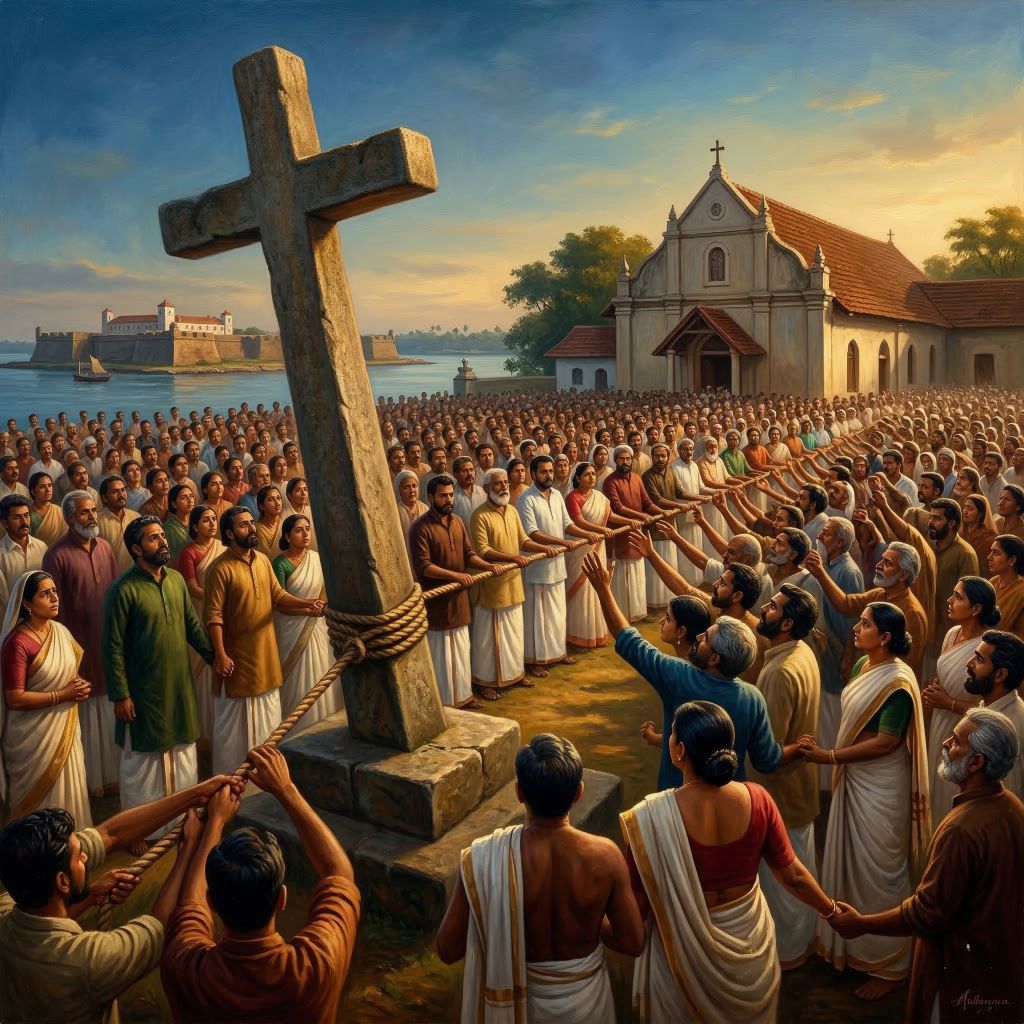
✝️ What Was the Koonan Kurishu Sathyam?
The Koonan Kurishu Sathyam — rendered in English as the Oath of the
Leaning Cross or the Coonen Cross Oath — is the most consequential act of
collective resistance in the entire history of Indian Christianity. On the third day of
January in the year 1653, at the Church of Our Lady in Mattancherry near Cochin, thousands
of Malankara Christians — clergy and laity, men and women, young and old — gathered around
a granite cross and swore a solemn oath, invoking the Holy Trinity, to sever all ecclesiastical
obedience to the Latin Franks (the Portuguese) and to the Bishop of Rome.
It was not an act of rebellion born of political ambition. It was a sacred, liturgically
conceived act of fidelity — fidelity to the Apostle Thomas who had planted the Gospel on
the shores of Malabar in 52 AD; fidelity to the ancient Syriac tradition of the East; and
fidelity to the Apostolic See of Antioch, the throne of St. Peter, from which the Malankara
Church had been forcibly cut off for over half a century.
To understand the full weight of this oath, one must first understand the fifty years of
spiritual captivity that preceded it — a period during which an ancient apostolic church was
systematically dismantled, its manuscripts burned, its bishops blocked, and its liturgy
replaced by foreign Latin customs imposed at the point of a sword.
✝️ The Prelude: Fifty Years of Spiritual Captivity (1599–1653)
The Synod of Diamper (1599): A Canonical Violence
The catastrophe that culminated in the Koonan Kurishu Sathyam began with the Synod of Diamper
(Udayamperoor) in 1599, convened by the Portuguese Archbishop Aleixo de Menezes of Goa.
This synod was an act of canonical violence without precedent in the history of the Malankara
Church. It forcibly Latinized a church that had worshipped for fifteen centuries in the
ancient Syriac tradition — a tradition more ancient than the Latin Rite itself, rooted in
the apostolic community of Antioch and the liturgical heritage of Edessa.
The Synod of Diamper achieved its ends through a combination of political coercion, theological
manipulation, and outright intimidation. The East Syriac liturgy (Qurbana d-Addai
w-Mari), which had been the sacramental heartbeat of the Malankara Church since the
apostolic era, was abolished. The authority of the Patriarch of the Church of the East was
denounced. And the Thomas Christians were placed under the juridical authority of the
Archbishop of Goa and, through him, the Bishop of Rome — a subjugation that was entirely
foreign to their canonical self-understanding as an ancient apostolic church.
The Triple Persecution: Manuscripts, Bishops, and Liturgy
In the half-century following Diamper, the Malankara Church suffered three interlocking
forms of persecution, each designed to sever its connection with its Syriac roots:
-
The Burning of Manuscripts: Sacred Syriac liturgical texts, theological
treatises, and historical documents accumulated over fifteen centuries were systematically
confiscated and destroyed by the Portuguese and Jesuit missionaries. This was not mere
administrative zeal; it was a calculated attempt to erase the theological and liturgical
memory of an ancient church, so that future generations would have no documentary proof
of their pre-Portuguese identity.
-
Apostolic Isolation: The Portuguese, using their naval dominance over
the Indian Ocean, intercepted and blocked every attempt by the Patriarchate of Antioch
and the wider Syriac episcopate to send canonical bishops to Malankara. A church cannot
survive without an unbroken episcopal succession; by cutting off the source of bishops,
the Portuguese sought to ensure that the Malankara Church would eventually die or
be absorbed entirely into Latin Catholicism.
-
The Latinization of Rites: The ancient West Syrian liturgical traditions
that had been entering Malankara through contact with Antioch were suppressed. Latin
vestments,
Latin devotional practices, and Latin theological categories were imposed. The
Madhabaha (sanctuary veil), the Syriac Fenqitho, the onitha
hymns, and the deeply Semitic theological grammar of the East were gradually replaced
by Roman forms alien to the Malankara soul.
Through this triple assault, the Portuguese sought to transform an apostolic Eastern Church
into a mere appendage of the Latin colonial ecclesiastical empire. But they underestimated
the depth of the Malankara Christians' attachment to their ancestral faith — an attachment
that had survived not merely decades but two full millennia.
The Archdeacon: Last Guardian of Malankara Autonomy
Throughout this period of captivity, the institution of the Archdeacon
(Jathikkukarthavyan — "Head of the Caste") served as the last bulwark of Malankara
autonomy. The Archdeacon was the civil and ecclesiastical head of the Thomas Christian
community, empowered to administer church revenues, oversee clergy, and represent the
community before secular rulers. Even under intense Portuguese pressure, this office could
not be abolished without destroying the entire social fabric of the Nasrani community.
It was the Archdeacon who would eventually lead the Malankara Church out of its bondage.
And it was the Archdeacon's righteous fury at a specific act of Portuguese brutality that
ignited the Great Oath.
✝️ The Martyrdom of Mor Ahatallah (1652): The Match That Lit the Fire
A Bishop Sent by Providence
In the year 1652, news spread through the Malankara community that a bishop had arrived —
a bishop sent not by Rome, not by Portugal, but from the East. He was known as
Mor Ahatallah (also recorded as Mar Ignatius Ahatallah), a hierarch
who arrived claiming to have been sent by the Syriac Orthodox Patriarchate to minister to
the suffering Malankara faithful. For a community that had been denied its own canonical
bishop for over five decades, his arrival was nothing less than the answer to a generation
of prayer.
The historical sources regarding Mor Ahatallah's precise ecclesiastical identity are complex.
Some accounts associate him with the West Syriac Patriarchate of Antioch; others suggest
he may have been a representative of a different Eastern tradition. What is beyond dispute
is the community's reception of him: the Thomas Christians of Malankara saw in him their
rightful canonical shepherd, the living symbol of their severed connection with the Apostolic
East, and their hope of liberation from Latin bondage.
Arrest, Custody, and Judicial Murder
The Portuguese authorities, acutely aware of what a free Eastern bishop in Malankara would
mean for their religious control, acted swiftly. Mor Ahatallah was intercepted at Cochin
before he could make contact with the Malankara faithful and was placed in Portuguese
custody at the fort. When Archdeacon Thoma Kathanar and a large body of the Malankara
clergy and laity marched to the Cochin fort to demand his release and the right to receive
their bishop, they were met with contempt and refusal.
The full horror of what followed reached the Malankara community through eyewitness
accounts: Mor Ahatallah had been taken aboard a Portuguese vessel and cast into the
Arabian Sea, drowned like a criminal — a bishop of the Church of God, murdered for the
crime of answering the prayers of an oppressed people. Some historical accounts suggest
he may have been transported to Goa for a formal ecclesiastical trial before his
execution; the precise manner of his end remains a matter of historical debate. But
the Malankara community knew with certainty that their bishop was dead, murdered by
those who called themselves Christian, and that no mercy or justice could be expected
from the men of Lisbon and Rome.
This act broke the final thread of patience. The Malankara Church had endured the burning
of its books. It had endured the suppression of its liturgy. It had endured the blocking
of its bishops. But the murder of Mor Ahatallah — a bishop sent to them by divine
providence — was an act that could not be answered by further endurance. It could
only be answered by the oath.
✝️ The Great Oath at Mattancherry: January 3, 1653
The Gathering of a People
Word spread rapidly across the length of the Malankara Church — from the ancient
parishes of Kottayam and Niranam to the communities of Cochin and Alappuzha. On the
morning of Friday, January 3, 1653, thousands converged upon the Church of Our Lady
at Mattancherry. The gathering was of an extraordinary character: this was not a meeting
of clergy or bishops alone, but of an entire people — the Nasrani community of Malankara
assembled in its corporate identity as a church, a nation, and an apostolic body.
Standing in the churchyard was a great granite cross — ancient, heavy, immovable.
This cross would become the witness of the oath, its physical endurance an image of
the faith the community was resolving to protect.
The Solemn Oath
Archdeacon Thoma Kathanar led the assembly in a collective oath, invoking the Holy Trinity —
Father, Son, and Holy Spirit — the foundational confession of all Christian faith. The
words of the oath, as preserved in Malankara historical tradition, declared:
"By the Father, Son, and Holy Spirit, we shall no longer obey the Jesuits, nor
recognize the authority of the Roman Bishop. We are Christians of the tradition
of St. Thomas; we shall remain so until our last breath."
— The Koonan Kurishu Sathyam, January 3, 1653 AD
To ensure that every single person present — many thousands, crowded beyond the capacity
of any single rope to reach — was included in this holy covenant, a long rope was fastened
to the granite cross. Those nearest held the cross itself; those further back held the rope;
and those at the far edges held onto the garments and hands of those before them. The entire
assembly was thus linked, through a living chain of human contact, to the stone cross at its
centre — a single body, making a single oath, before a single God.
The Miracle of the Koonan Cross
As the multitude pulled in this symbolic act of corporate severance from the oppressors,
the great granite cross is reported to have leaned — to have bent under the collective
weight of a people's prayer. This physical manifestation — whether understood as miracle,
as legend, or as the natural result of enormous combined human force — gave the event its
enduring name: Koonan Kurishu Sathyam, the Oath of the Leaning
Cross (Koonan meaning "bent" or "slanted" in Malayalam).
The cross that leaned without breaking has always been understood by the Malankara faithful
as a sign: their church, bent under the weight of persecution, had not been broken.
And henceforth, by the grace of God and the resolve of their ancestors, it would
stand upright again.
✝️ The Alangad Assembly and the Consecration of Mor Thoma I (1653)
The Canonical Crisis
The Great Oath of Mattancherry created an immediate and urgent canonical crisis.
The Malankara community had with one voice rejected all Latin bishops and the authority
of Rome. But a church without a valid canonical bishop is a church in spiritual peril —
for it is the bishop who ordains priests, consecrates the Holy Qurbana, administers the
sacraments of initiation, and maintains the unbroken apostolic succession stretching back
to the Lord and His Apostles.
No bishop of the Syriac Orthodox tradition or any other Eastern communion was available
in Malankara to fill this void. The community was faced with a choice: to remain without
a bishop indefinitely (and thus risk the collapse of sacramental life), or to act in
a manner without strict canonical precedent, trusting in God's providential mercy.
The Extraordinary Consecration
In May 1653, a gathering was convened at Alangad. There, in an act of
extraordinary and deeply felt canonical urgency, twelve priests of the Malankara Church
laid their hands upon Archdeacon Thoma Kathanar and consecrated him as
Metropolitan of the Malankara Church. He took the episcopal name Mor Thoma I,
thus inaugurating the celebrated line of Malankara Metropolitans that would govern the
church through the next two centuries.
The scholarly and canonical tradition of the Syriac Orthodox Church acknowledges that
this consecration — performed by priests rather than by bishops — was irregular by
the strict canons of episcopal ordination. It was an act of spiritual necessity rather
than a model of canonical regularity. The community itself was aware of this; hence
the urgency with which they continued to seek a proper canonical bishop from the
East. That canonical need was finally and gloriously met twelve years later.
⛪ The Canonical Restoration: Mor Gregorios Abdul Jaleel of Jerusalem (1665)
The Arrival of the Great Hierarch
The crowning providential answer to the Koonan Kurishu Sathyam came in the year 1665,
when Mor Gregorios Abdul Jaleel of Jerusalem
arrived in Kerala, sent by the Patriarch of the Apostolic See of Antioch. Mor Gregorios
was a bishop of the West Syriac tradition — the tradition that traces its liturgical
lineage directly through the Church of Antioch, the city where the followers of Christ
were first called Christians (Acts 11:26), the city where St. Peter first sat as bishop,
and the city from which the Liturgy of St. James — the mother of all Christian liturgies
— was given to the world.
His arrival was not merely a political development. It was the fulfilment of the faith
that had sustained the Malankara Church through fifty years of captivity and the
covenant of the Koonan Kurishu Sathyam. God had heard the oath sworn at Mattancherry.
The Apostolic See of Antioch had not forgotten its children in India.
The West Syriac Identity Established
Mor Gregorios consecrated Mor Thoma I canonically, regularizing his episcopate and
thereby restoring the unbroken apostolic succession to the Malankara Church. With this
act, the canonical irregularity of the Alangad consecration was healed, and the
Malankara Church was received into the full sacramental and theological communion of
the Syriac Orthodox Church of Antioch.
He also introduced to Malankara the full richness of the West Syriac liturgical
tradition: the Qurbono (Divine Liturgy) of St. James, the Shehimo
(the daily cycle of prayer), the Fenqitho (the liturgical compendium of
seasonal hymnody), and the sacramental theology of the Antiochene tradition, which
confesses the Miaphysite Christology — the faith that the Lord Jesus
Christ is one in nature, divine and human, without confusion, without separation,
the perfect union of the two natures in the one Person of the Eternal Word.
This West Syriac reorientation of the Malankara Church — away from the East Syriac
tradition it had partially followed before the Portuguese era — permanently anchored
the Malankara Church in the Antiochene tradition. It is this tradition that defines
the Malankara Jacobite Syrian Orthodox Church to this day, under
the canonical authority of the Patriarch of Antioch and All the East.
The Miaphysite Confession: Our Theological Anchor
It is important for the modern faithful to understand that the canonical restoration
accomplished by Mor Gregorios was not merely administrative. It was profoundly
theological. By entering into full communion with the Syriac Orthodox Church of
Antioch, the Malankara Church formally and permanently embraced the
Miaphysite Christology of the Oriental Orthodox communion —
the faith defined by St. Cyril of Alexandria, proclaimed by the Council of Ephesus
(431 AD), and defended by the Holy Fathers of the pre-Chalcedonian tradition against
the novel definitions of the Council of Chalcedon (451 AD).
In this, the Malankara Church stands in theological fellowship with the Coptic
Orthodox Church, the Ethiopian Orthodox Church, the Armenian Apostolic Church, and
the Eritrean Orthodox Church — together forming the family of Oriental Orthodox
churches that hold fast to the Christological faith of the first three Ecumenical
Councils and the tradition of the undivided Church.
📖 The Painful Division: Those Who Returned to Rome
The Pakalomattom Faction
Not all who took the oath at Mattancherry remained within the Syriac Orthodox communion.
In the months and years following the Great Oath, the Portuguese — weakened but not
absent — worked tirelessly to recover as much of the Malankara community as possible.
Through the agency of a leading clerical family, the Pakalomattom clan, approximately
one quarter of the Malankara Nasrani community was gradually reconciled with Rome.
These communities, re-entering Latin obedience, eventually evolved into what is today
the Syro-Malabar Catholic Church — an Eastern Catholic body in
communion with Rome that has since developed its own canonical identity. From the
perspective of Syriac Orthodox ecclesiology, their return to Rome was a tragic
reversal of the liberation secured at Mattancherry. Yet they too carry the inheritance
of the Thomas tradition, and in charity we acknowledge the common apostolic root
from which all Nasrani communities spring.
The Enduring Malankara Majority
The majority of the Malankara community — those who held firm to the covenant of the
Koonan Kurishu Sathyam — remained in the Syriac Orthodox tradition. This community,
governed through the succession of Mor Thoma Metropolitans and deepened in its West
Syriac identity by the canonical bond with Antioch, continued to develop through the
18th and 19th centuries. It is from this community that the present
Malankara Jacobite Syrian Orthodox Church descends — the Church
that, under the authority of the Patriarch of Antioch, preserves the living
inheritance of the Koonan Kurishu Sathyam.
✝️ Legacy: What the Koonan Cross Means for the Faithful Today
We Are Not a Breakaway Group
The Koonan Kurishu Sathyam is frequently misunderstood — sometimes deliberately so —
as a schismatic act, a "break" from an established church. This understanding is
historically and theologically incorrect, and it must be firmly rejected. The Malankara
Church did not break away from a legitimate mother church at Mattancherry. It reclaimed
its own identity — an identity that had been stolen from it by colonial force.
The Thomas Christians are not the children of 1653. They are the children of 52 AD.
The Koonan Kurishu Sathyam was the moment at which they reasserted that primordial
identity — the identity of a church founded by an Apostle, rooted in the Syriac
tradition of the East, and belonging canonically to the Apostolic See of Antioch.
We are not a "breakaway group." We are the original descendants of the St. Thomas
tradition who refused to trade their spiritual heritage for political favor.
The Rope That Connected a People
The image of the rope tied to the Koonan Cross is more than historical detail.
It is a theological image of what the Church is. The rope linked those near to
those far — the clergy to the laity, the literate to the unlettered, the powerful
to the humble. In holding the rope, every Nasrani present became an equal participant
in the covenant. The Church of the Koonan Cross was a church of the whole people —
a synodal church, a church that makes its most solemn decisions in the
gathered assembly of the faithful.
This model of synodality — of the entire people of God as the subject of ecclesial
decision — is deeply consonant with the canonical tradition of the Syriac Orthodox
Church, in which Patriarchs, bishops, clergy, and laity together form the living
body of Christ. The Koonan Kurishu Sathyam enacted this ecclesiology in its
most dramatic form.
A Summons for Every Generation
For the faithful of the Malankara Jacobite Syrian Orthodox Church today, the
Koonan Kurishu Sathyam is not merely a piece of history to be admired. It is a
summons. A summons to guard the Syriac liturgical tradition with the same ferocity
with which our ancestors guarded it at the cost of their comfort and safety.
A summons to remain steadfast in Miaphysite Christological faith in a world that
prizes theological relativism. A summons to hold the rope — to remain bound, through
the canonical authority of the Patriarch of Antioch, to the Apostolic See of
St. Peter — no matter what forces of the age may pull against it.
The granite cross at Mattancherry leaned. It did not break. Neither shall we.
✝️ Conclusion: The Oath That Defined a Church
January 3, 1653 stands as the pivotal date in the post-apostolic history of the
Malankara Church — the day on which a persecuted people found their collective voice,
invoked the Holy Trinity, and chose freedom over captivity, identity over assimilation,
and the Apostolic East over the colonial West. The Koonan Kurishu Sathyam was the
beginning of a process that, completed by the canonical restoration of 1665, permanently
established the Malankara Church within the West Syriac Antiochene tradition.
From this oath flows everything that defines our church today: the
Qurbono d-Mor Ya'qub, the Shehimo, the Fenqitho,
the Miaphysite Christological confession, the canonical bond with the Patriarch of
Antioch, and the identity of the Malankara Jacobite Syrian Orthodox Church as
an apostolic community of the ancient East. Every Divine Liturgy celebrated in
the churches of Malankara is, in a real sense, the fruit of the oath sworn at the
Leaning Cross.
When we enter the sanctuary, bow before the altar, hear the ancient Syriac melodies
rise through the incense, and receive the Body and Blood of the Lord — we receive
it as free people. Free because our ancestors, on a cold January morning, held
a rope tied to a granite cross and refused to let go.
Glory be to God for the Koonan Kurishu Sathyam. Glory be to God for the
faith of our fathers. And glory be to God who, in His providence, has preserved
this ancient apostolic flame on the shores of Malankara from the age of
the Apostle Thomas until this present day.